The DOJ’s Shameful Abuse of Power Must Be Reined In
The weaponizing of the department to do Trump’s bidding has dangerously undermined its credibility.
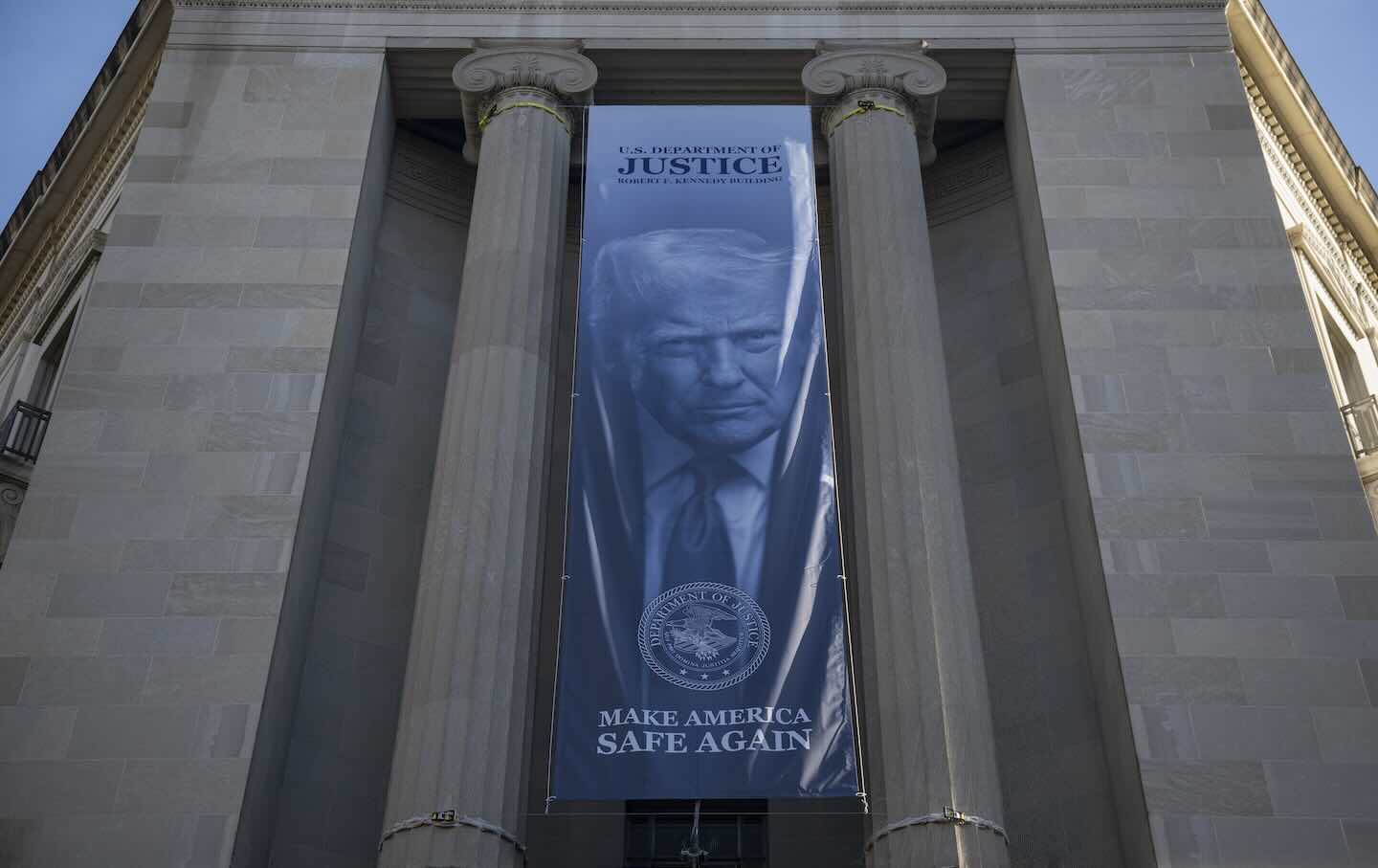
The Department of Justice is in a crisis, at a level that hasn’t been seen in decades, if perhaps ever. Not since 1975, when US Attorney General John Mitchell was prosecuted and convicted for conspiracy and obstruction of justice related to Watergate, has there been a more toxic and chaotic environment at the department. Today, under Pam Bondi, the DOJ shows a flagrant disregard for the rule of law and contempt for the Constitution. A once-exalted institution that was integral to the protection of civil rights now resembles an elite agency that serves the private interests of a president rather than vulnerable Americans.
Perhaps the most troubling aspect of this state of affairs is how we got here. In January, after Renée Good, a 37-year-old mother in Minneapolis, was shot and killed by an Immigration and Customs Enforcement agent, the head of the DOJ’s Civil Rights Division, Harmeet Dhillon, said that the department would not investigate whether the agent had violated any federal laws. US Deputy Attorney General Todd Blanche claimed there was “no basis for a criminal civil rights investigation,” despite clear video evidence showing otherwise. “We don’t just go out and investigate every time an officer is forced to defend himself against somebody,” Blanche added. “We investigate when it’s appropriate to investigate.”
At the same time, the DOJ began pressuring its prosecutors to investigate the victim and her wife. Six attorneys resigned from the department in protest, including Minnesota’s second-in-command at the US attorney’s office, Joseph Thompson.
Around two weeks later, the same day that Border Patrol agents in Minneapolis killed Alex Pretti, a 37-year-old intensive-care nurse, by shooting him 10 times at close range, Bondi sent a threatening letter to Minnesota Governor Tim Walz, offering a chilling quid pro quo framed as “common sense solutions.” Bondi demanded that Walz provide access to voter rolls, end the state’s sanctuary policies, and release sensitive records on Medicaid and Food and Nutrition Service programs, including data from the Supplemental Nutrition Assistance Program. In exchange, Bondi claimed that those “simple steps” would “help bring back law and order to Minnesota.”
These actions not only mark a radical shift at the DOJ but also expose how compromised and corrupt the department has become.
Yet it is not the DOJ’s response to ICE’s lawless conduct in Minnesota alone that raises serious alarm. The department has been severely tarnished by unlawful appointments and the politically motivated prosecutions of officials who have criticized Donald Trump. The failed criminal cases against New York Attorney General Letitia James and former FBI director James Comey come to mind. US District Court Judge Lorna Schofield disqualified the acting US attorney, John Sarcone III, ruling that he had not been lawfully appointed when he issued the subpoenas against James. Bondi had appointed Sarcone as a “special attorney” and given him an “indefinite term” inconsistent with lawful DOJ appointments, which are made by the president with “advice and consent from the Senate” and are four years in length.
Months earlier, US District Court Judge Cameron McGowan Currie had dismissed the cases against James and Comey, explaining that the prosecutor, Lindsey Halligan, had been unlawfully installed by the department. “All actions flowing from Ms. Halligan’s defective appointment…were unlawful exercises of executive power and are hereby set aside,” Currie ruled.
Not surprisingly, the DOJ’s shameful abuse of power has pushed career lawyers to leave. The Justice Connection, a network of former DOJ employees, estimates that roughly 6,400 workers across the department have been terminated or left their positions voluntarily. Dena Robinson, a former lawyer in the Civil Rights Division, said that under Bondi, the job has changed from fact-finding investigations to finding “facts that would fit the narrative.”
Hundreds of military officers from the Judge Advocate General’s Corps are now filling in, some temporarily serving as immigration judges and others as special assistant US attorneys—a role that “DOJ policy once barred…outside a military base,” Defense One reported, which raises serious ethics concerns.
Today, the DOJ no longer reflects the role that Congress intended it to play: that of securing America’s democracy during the Reconstruction era. Principally, that meant upholding the rule of law and enforcing the Constitution and federal laws in the aftermath of slavery and civil war. In the ensuing decades, that also included playing a vital role in investigating and prosecuting hate crimes. Now, however, the DOJ pursues a different mission: one that regards Americans as subjects rather than citizens.
The steady weaponizing of the DOJ to do Trump’s bidding has weakened its integrity, tarnished its trustworthiness, and dangerously undermined its credibility. For now, Congress should heed the demands of the civil-rights organizations calling for more oversight of the Department of Justice—before it’s too late.