
Trump Is Losing Ground in the States Where He Was Once Competitive
Trump still hasn’t figured out how to run against Kamala Harris, and that’s helping Harris to secure states where Biden was in trouble.
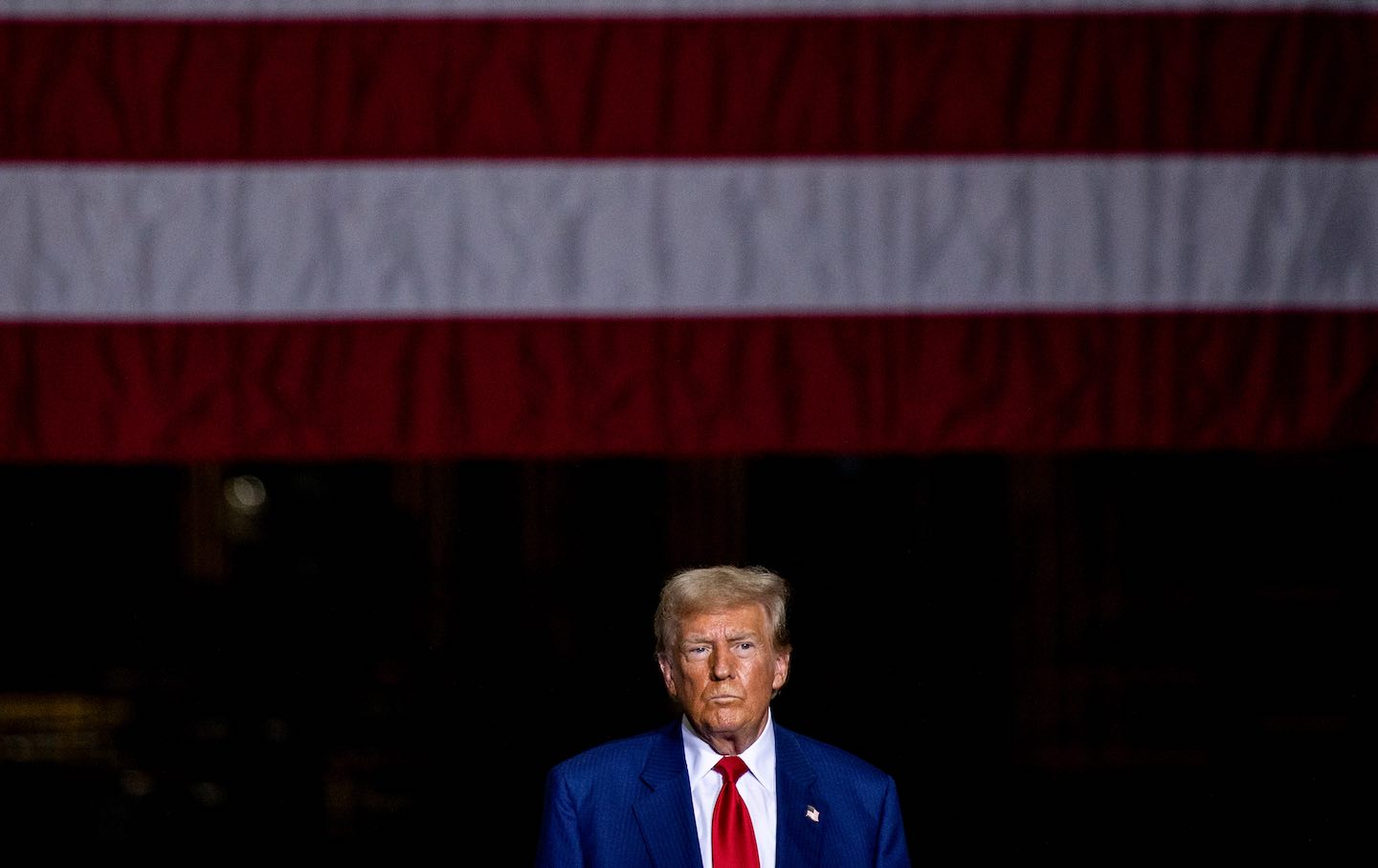
Former US president Donald Trump during a campaign event at Alro Steel in Potterville, Michigan, on August 29, 2024.
(Emily Elconin / Bloomberg)
Joe Biden’s decision to stand down as a 2024 presidential candidate was once expected to disrupt his own Democratic Party. But that didn’t happen. What happened instead was an unprecedented show of unity for the Democratic presidential nominee, Vice President Kamala Harris, that culminated in a strikingly successful Democratic National Convention and Labor Day campaign rollout.
Instead of derailing the Democrats, Biden’s decision turned out to be a much bigger problem for Donald Trump and his reconstructed Republican Party. Trump had turned the GOP into a cult of personality, rigidly enforced by his staffing of leadership positions with family members and fierce loyalists, his punishing of dissenters by endorsing primary challengers, and his social media assaults on anyone who questions his authority. The former president simply assumed that Biden saw the Democratic Party in the same way as the Trump team sees the GOP—a personal fiefdom. Trump never really entertained the prospect that he would be running against anyone other than a weak incumbent who most Americans thought was too old to serve a second term. After Biden’s disastrous appearance in the June 27 presidential debate, the Republican strategy seemed to be working. Surveys found that Trump was opening leads in battleground states and, even more notably, showing signs of being competitive in states that had once been thought to be in the Democratic column.
States that had backed Democrat Hillary Clinton in 2016 and Biden in 2020 were suddenly trending toward Trump in the summer of 2024. “Democrats Fear Safe Blue States Turning Purple as Biden Stays the Course,” announced The New York Times on July 12, as it suggested that Minnesota and Virginia could be in play. A July 4 Newsweek article headlined “Donald Trump’s Chances of Winning New Jersey Are Growing,” observed, “Two recent polls have put Donald Trump ahead of Joe Biden for the presidential election in New Jersey, a state no Republican has won since 1988, amidst an ongoing Democratic Party debate over whether the incumbent president should be their candidate again in 2024.” Politico ran down a list of traditionally Democratic states that suddenly looked to be competitive on July 11 and declared that “perhaps nowhere are these bluer-state blues on such stark display as in New Hampshire, which Trump came within half a percentage point of winning in 2016—and where a post-debate poll now shows him erasing the double-digit lead Biden held heading into 2024.”
New Hampshire became the symbol of Biden’s decline and Trump’s surge.
“We’ve all been watching the six or seven key battleground states, and they’ve now pretty much gone for Trump,” Neil Levesque, the director of the New Hampshire Institute of Politics, told Politico. “Now if we’re into the second tier, in which New Hampshire definitely lies, that’s a very alarming situation for the White House.”
That was then. This is now.
Harris is surging nationally: She now leads Trump by almost two points in the Real Clear Politics survey of recent polls. Surveys suggest she’s moving into the lead in a number of battleground states, such as Wisconsin and Michigan. And it looks she’s closing the deal in New Hampshire, knocking Trump out of the running in a state that once seemed to be in his reach.
A University of New Hampshire poll from just before the Democratic National Convention had Harris leading 50-43. A Saint Anselm College Survey Center puts her up 51-44.
Pollsters say Democrats are unifying in support of the Harris-Walz ticket. At the same time, Republicans are in disarray.
The Boston Globe reported on Labor Day that Tom Mountain, a prominent Trump supporter in New England, had written to Trump volunteers that “the campaign has determined that New Hampshire is no longer a battleground state.” In an e-mail obtained by the Globe, Mountain cited “campaign data/research” and wrote that Trump was “sure to lose (New Hampshire) by an even higher margin” than in 2016 and 2020. Resources should be shifted to the battleground state of Pennsylvania, he argued.
Trump aides denied that the campaign had given up on New Hampshire. That’s par for the course. Campaigns rarely if ever admit that they are surrendering any state. But Trump’s declining poll numbers in New Hampshire suggest that it won’t be a regular stop on his fall travel schedule. That’s good news for Harris, but also for the Democratic Congressional Campaign Committee, which now looks to be better positioned to hold the state’s two US House seats.
The same goes for New Mexico, where Harris is leading by 10 points in the polls, and where US Senator Martin Heinrich, who was once thought to be facing a credible challenge, is up by 12 points. The latest analysis of polling and patterns by The Economist finds that Harris is “almost certain to win New Jersey.”
More significantly, it is now Harris who appears to be on the march in states that were until recently seen as trending in the other party’s direction. Polling has her essentially tied in North Carolina and Georgia and rising rapidly in Florida (with one poll showing Harris within three points of the former president). In Maine, where Trump won an electoral vote in 2020 (under the state’s system for assigning Electoral College votes based on congressional district results), Harris is now ahead in both of the state’s congressional districts and has opened up a remarkable 17-point lead statewide.
While her numbers in state and national surveys are encouraging, and while she’s definitely showing strength in states that may allow Democrats to “expand the map,” Harris cannot rest easy. Democrats have enjoyed late-summer leads in the past, only to see them dissipate by November. So Harris and Walz have been racing across the country, with each of them making multiple appearances on Labor Day weekend.
What of Trump? He took Labor Day off, except for a social post in which he somehow forgot to even mention the contributions made by America’s unions. Trump’s post attacked Harris in predictably incoherent fashion, referring to the former prosecutor, state attorney general, and US senator, and current vice president, as “Comrade Kamala.”
Popular
“swipe left below to view more authors”Swipe →“But,” the Los Angeles Times noted on Monday, “his wild punches aren’t landing.” That’s because, after more than a month, Donald Trump still has not figured out how to run against Kamala Harris.
More from The Nation

Abolish ICE Abolish ICE
Demonstrators take to the streets in protest against an ICE shooting in New York City. Foley Square, October 2026.

Mamdani Is Facing Heat Over the NYPD. Here’s What He Should Do. Mamdani Is Facing Heat Over the NYPD. Here’s What He Should Do.
The mayor is being given a series of false choices over his public-safety agenda. But there is another way forward.

Why Calling Anti-Trans Hate a “Distraction” Is So Troubling Why Calling Anti-Trans Hate a “Distraction” Is So Troubling
It’s a familiar line in the midterms: Anti-trans attacks are a “distraction” from “kitchen-table” issues. That sends a chilling message about whose rights are worth fighting for.
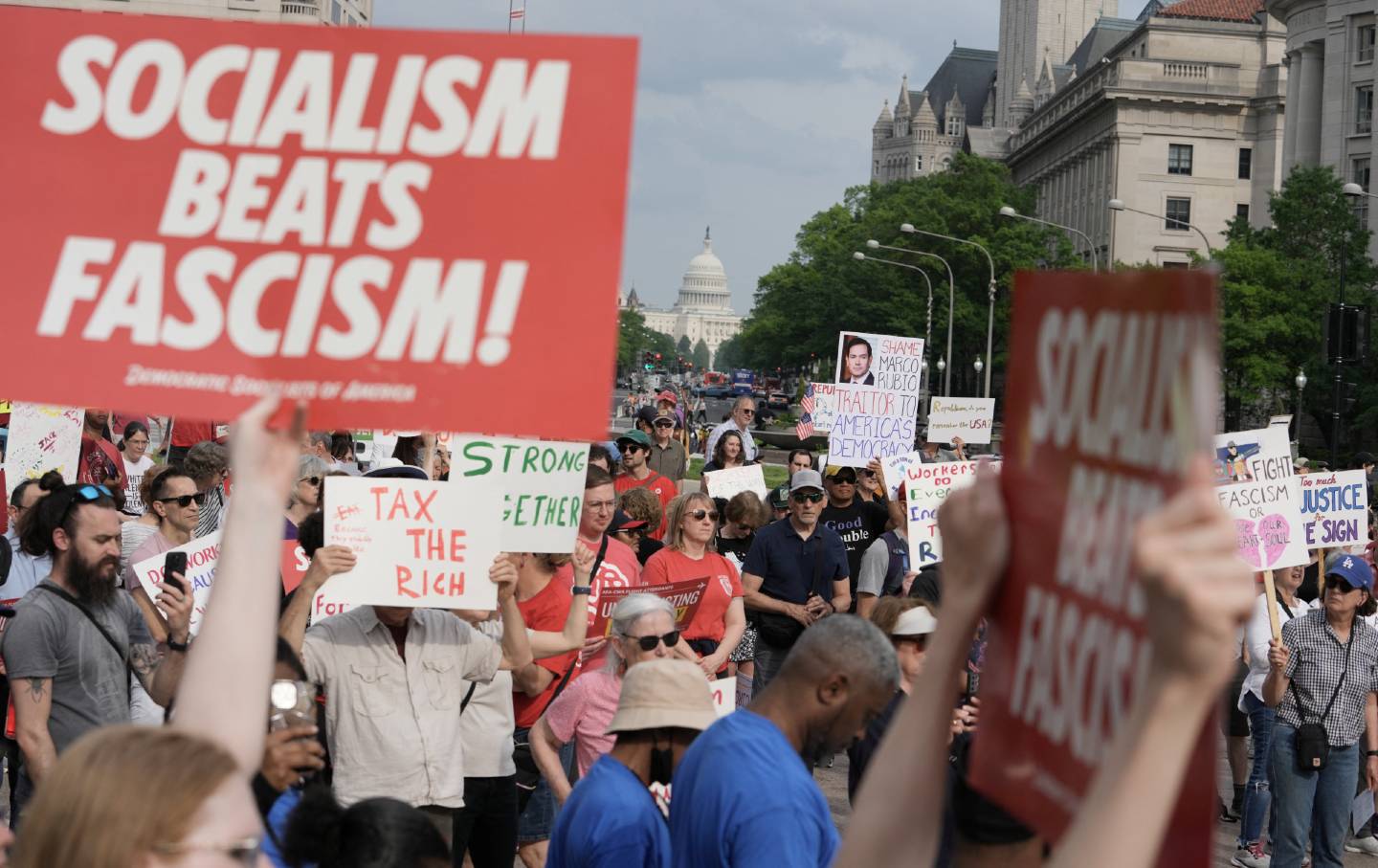
So What Is Socialism, Anyway? So What Is Socialism, Anyway?
In a world dominated by neoliberal market fundamentalism, “socialism” is what will make a more moderate, regulated form of capitalism work for most people.
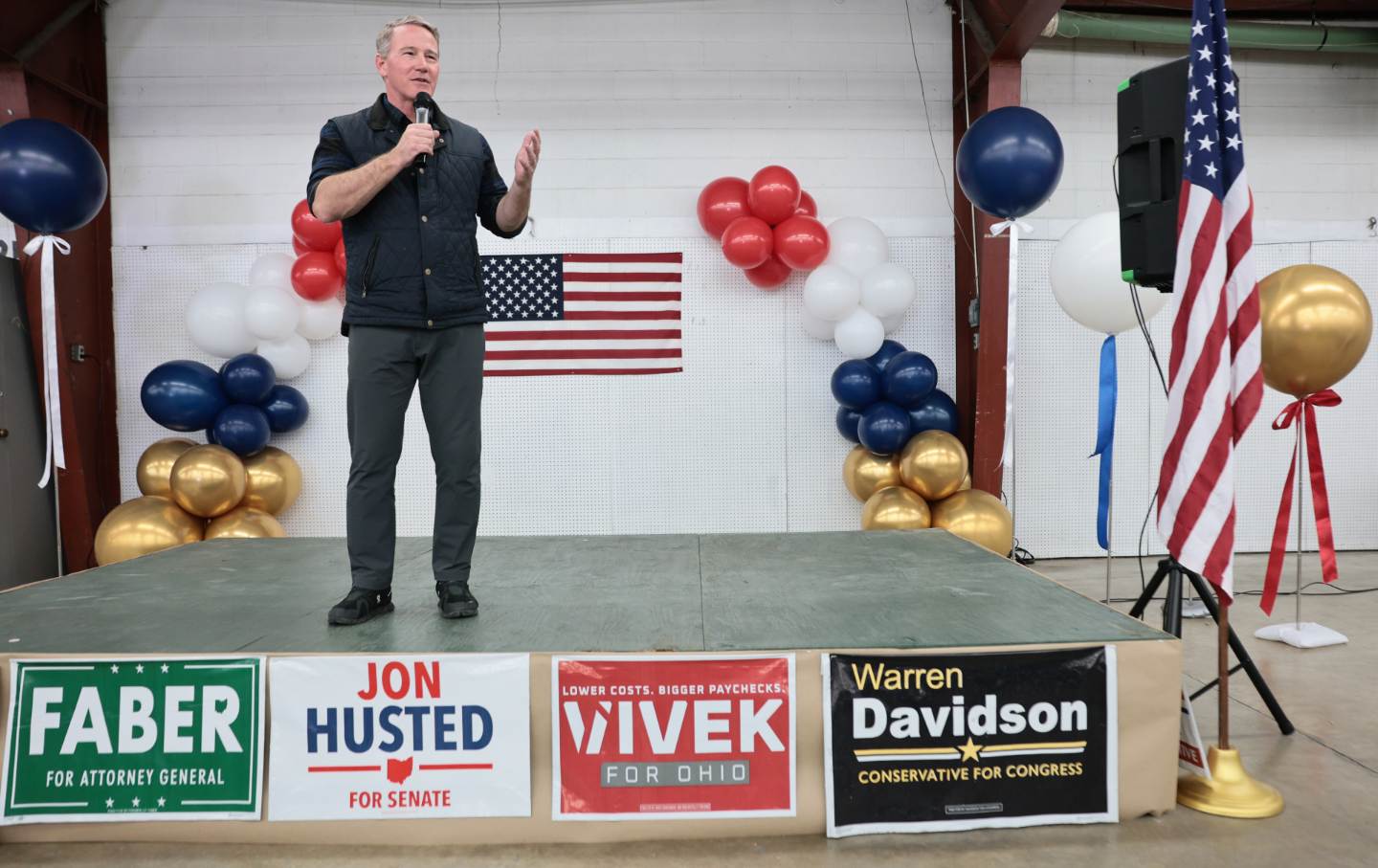
Will the GOP’s Big Money Save Jon Husted in Ohio? Will the GOP’s Big Money Save Jon Husted in Ohio?
Former senator Sherrod Brown is leading in most polls, but a tidal wave of spending may prop up the struggling incumbent.
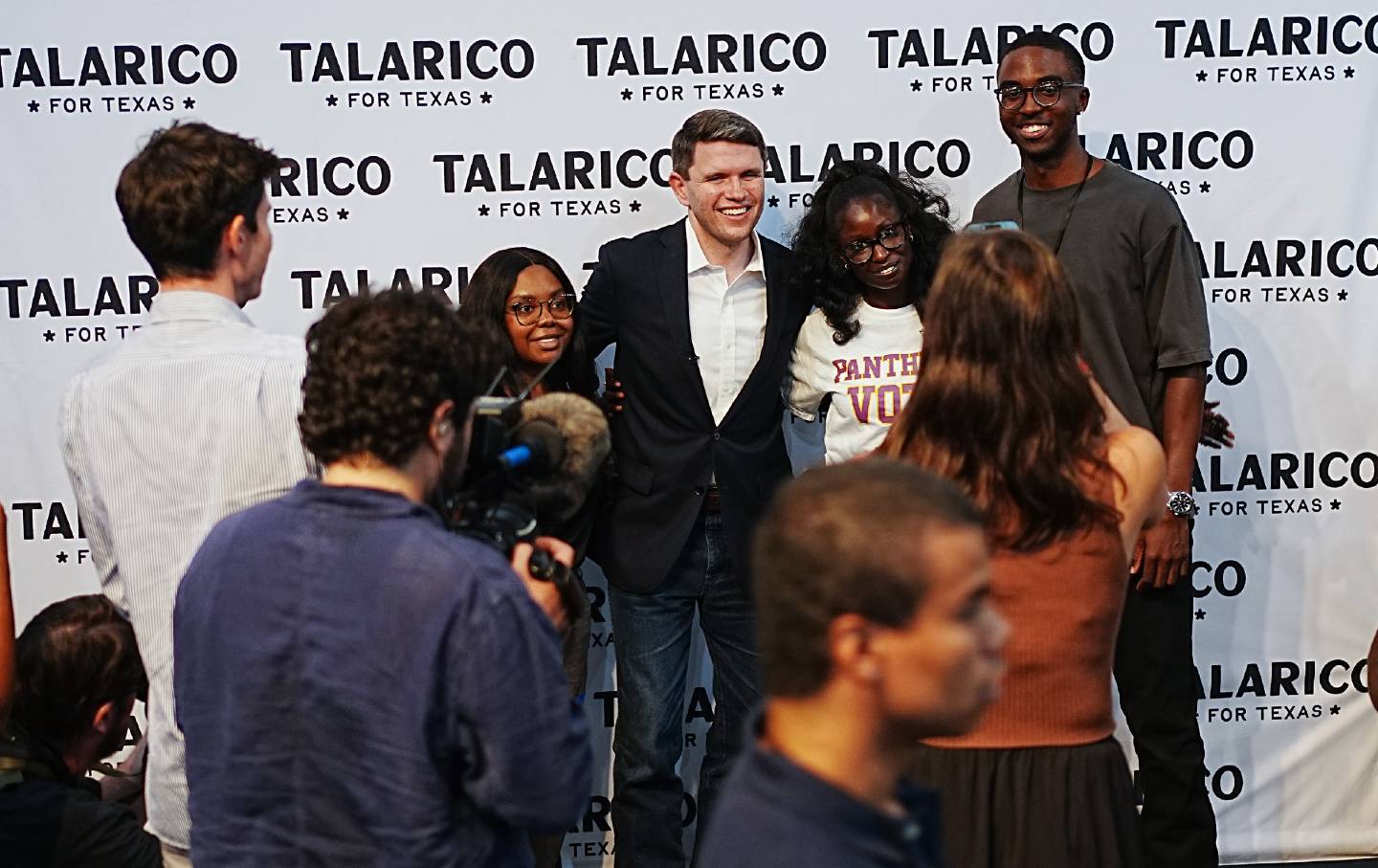
James Talarico Is Preaching a Gospel of Pluralism James Talarico Is Preaching a Gospel of Pluralism
He’s not the only progressive doing it.

