
Thomas Massie’s Defeat Could Come Back to Haunt Trump
The president’s successful campaign to remove the rebel congressman has a real chance of backfiring.
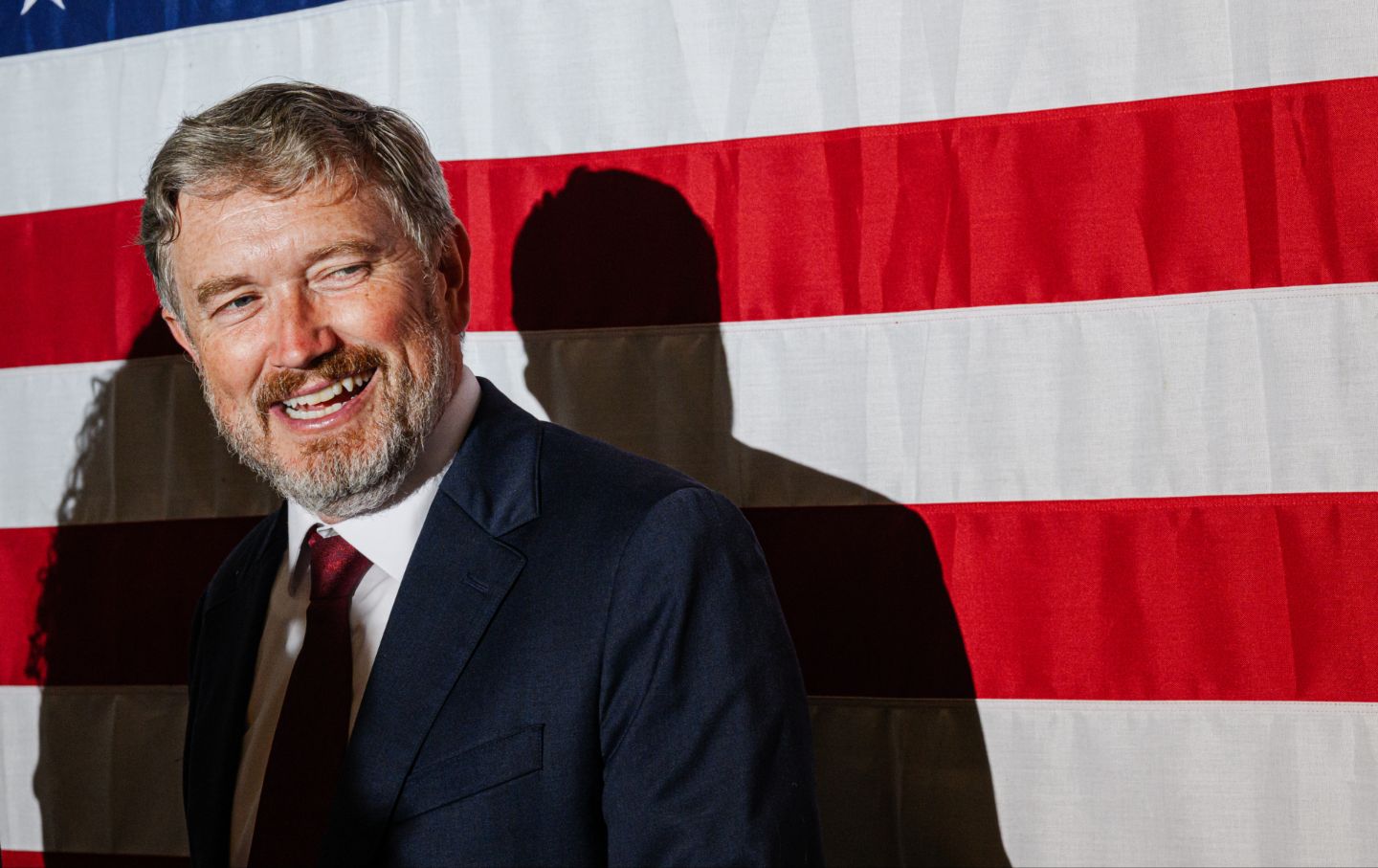
Thomas Massie speaks with supporters after his concession speech on May 19, 2026, in Hebron, Kentucky.
(Jon Cherry / Getty Images)Ever since he joined Congress in 2012, I’ve probably disagreed with Representative Thomas Massie at least 90 percent of the time. But I can’t help but feel that his defeat in the GOP primary for his Kentucky congressional district on Tuesday night was both a tragedy and a travesty.
Massie has always had an insurgent streak. He joined national politics as a Tea Party Republican, strongly affiliated with the Rand-and-Ron-Paul libertarian wing that so unnerved the GOP establishment. Ever since, he’s shown a consistent willingness to buck his party.
Often, this defiance has been in service of bad ideas, such as trying to push Republicans to be even more opposed to the welfare state. But in Trump’s second term in office, Massie has put his rebelliousness to good use. He has emerged as a major thorn in the president’s side, playing a key role in pushing for the release of the Epstein files and being one of the few Republicans who is an outspoken critic of the Iran War.
Unfortunately for Massie, open opponents of Donald Trump rarely survive long in today’s GOP, which has made fealty to the president its overriding principle. Trump made removing Massie from Congress a key priority in this year’s midterms. So did AIPAC, the pro-Israel lobby group opposed to his anti-war politics. Trump and AIPAC threw their support behind Ed Gallrein, a Navy SEAL who promised to toe the party line.
The combined forces of Trump and AIPAC proved insurmountable, even though Massie was well-liked by Republican voters. Because of the involvement of AIPAC and other pro-Israel donors, this primary was the most expensive in American history, with at least $32 million spent. Massie ultimately lost in a landslide; while votes are still being tabulated, early results suggest Gallrein won by 55 percent to Massie’s 45 percent.
Massie joins the long list of GOP politicians who have had their political careers cut short because they stood up to Trump, often for conflicting reasons. This roll call of vanquished Republicans includes Mark Stanford, Liz Cheney, Adam Kinzinger, and Jeff Flake.
As Mother Jones notes:
This year, Trump helped oust five Republican Indiana state legislators who had rejected pressure from the president to redraw the state’s congressional maps to create two new Republican seats in mid-decade redistricting. And this month, Louisiana GOP Sen. Bill Cassidy lost his primary after Trump targeted him over Cassidy’s vote to convict him in his 2021 impeachment trial.
Massie, an astute observer of the internal politics of the GOP, was unlikely to be surprised by this development. In an interview with the Washington Examiner in 2017, he had some prescient thoughts on how voters who had previously supported libertarian leaning candidates were gravitating toward Trump. Massie told the interviewer: “All this time, I thought they were voting for libertarian Republicans. But after some soul searching I realized when they voted for Rand and Ron and me in these primaries, they weren’t voting for libertarian ideas—they were voting for the craziest son of a bitch in the race. And Donald Trump won best in class, as we had up until he came along.”
Yet, while Trump and AIPAC are currently triumphant, theirs may still turn out to be a Pyrrhic victory.
AIPAC’s campaign against Massie calls to mind its 2024 success in two supporting candidates in Democratic primaries who ousted outspoken congressional critics of Israel, Cori Bush and Jamaal Bowman. Those were the two most expensive primaries in American history prior to Massie/Gallrein. Yet, since that victory, AIPAC has found its brand becoming toxic among Democratic Party voters, appalled at the Gaza genocide and the close alliance pro-Israel groups have forged with Trump. This year, it’s become common for Democratic politicians such as Vermont Senator Peter Welch to insist that they will not take money from AIPAC.
Massie’s defeat suggests AIPAC is still entrenched in Republican politics, but that too could change. According to a recent Pew poll, “57 % of Republicans ages 18 to 49 have an unfavorable opinion of Israel, up from 50% last year.” Gallrein’s support skewed towards older Republicans, the one significant demographic cohort that remains pro-Israel. According to a poll by Quantus Insight, Gallrein had strong majority support among voters over the age of 55, while Massie had an equally strong majority support among voters under 55. This suggests that AIPAC’s ability to shape Republican elections might rapidly diminish in the coming decade.
Trump’s grip on the GOP might itself turn out to be an anchor dragging his party down. Trump’s approval among voters, including independents, is at an all-time low in his second term, standing at 37 percent in a recent New York Times/Siena poll. If the GOP were even a little bit more ideologically diverse, Republicans facing the voters in the midterms could argue that they should be judged on their merits rather than on their approval for Trump. But the current GOP is nothing more or less than a Trump personality cult. It will sink or swim based on how voters feel about Trump. And right now, voters generally don’t like Trump at all.
For his part, Massie has been admirably jaunty and upbeat in defeat. In his concession speech, he indicated he is not backing down from opposing Trump. He told the assembled crowd, “Today is the six-month anniversary of the Epstein Files Transparency Act. We’ve taken out two dozen CEOs, an ambassador, a prince, a prime minister, a minister of culture—and that was just six months. I’ve got seven months left in Congress.”
Popular
“swipe left below to view more authors”Swipe →Massie also said, “While gas is almost $5 a gallon and diesel is almost $6, they’re talking about this big ballroom…. It looks like the Roman Empire. I see a few analogies there…”
These are fighting words. Massie might have lost in the primary, but he lost with his honor intact. Trump won’t be around forever, and if there is a future for the Republican Party, Massie is in a better position to shape it than his colleagues who have disgraced themselves in replacing principles with a personality cult.
Become a Sustaining Donor This September
Between the reemergence of right-wing red-baiting and Donald Trump’s use of the chilling National Security Presidential Memorandum–7 to criminalize left political organizing, we’re seeing McCarthyism reborn before our eyes.
This assault on democracy cannot be ignored or wished away. Resisting it requires bravery in the face of threats and repression, a steadfast commitment to the truth, and the unwavering belief that we can—and will—overcome this darkness.
We must have an independent media that sets the record straight, unearths corruption and abuses of power, and advances a politics of justice and dignity for all if we’re to win this fight.
That’s why I’m writing to you today. This September, The Nation needs to add 100 monthly donors to sustain our progressive journalism. Your contribution makes the next investigative report, the next truth-speaking column, and the next pathbreaking essay all possible.
I hope you’ll support our work with a recurring donation today. If you donate $10 or more a month, we’ll send you a brand new “Hands Off the Free Press!” sticker to recognise your commitment to our cause. Please, donate today.
Onward,
Katrina vanden Heuvel
Editor and Publisher, The Nation
More from The Nation

Clavicular’s Charges Are One Thing. Rape Culture Is Another. Clavicular’s Charges Are One Thing. Rape Culture Is Another.
Braden Peters consistently acts as though the autonomy of women is a maladaptive trait, and dogmatically dismisses any claim to female equality as an outlying aberration.
Kimberly Guilfoyle Is a Master of Mafia Diplomacy Kimberly Guilfoyle Is a Master of Mafia Diplomacy
The US Ambassador to Greece is making suspicious deals for her buddies.
Missing Guardrails for AI Missing Guardrails for AI
Trump ignores the threat of extinction.

The First Amendment Lives for Another News Cycle—Maybe The First Amendment Lives for Another News Cycle—Maybe
In this week’s Elie v. U.S., our justice correspondent parses Trump’s attacks on CNN, MS NOW, and Politico. Plus: it’s time to impeach the judges!

