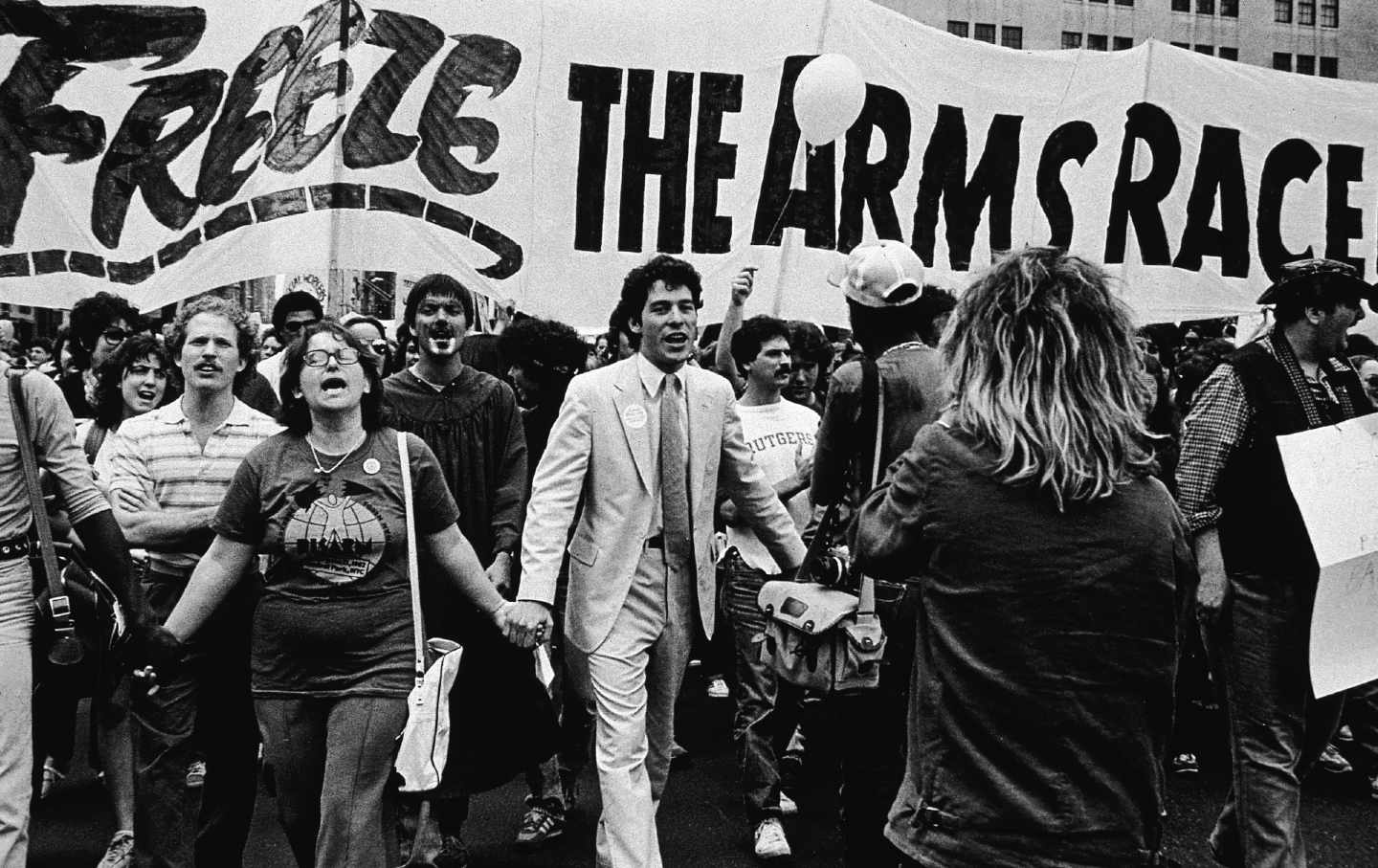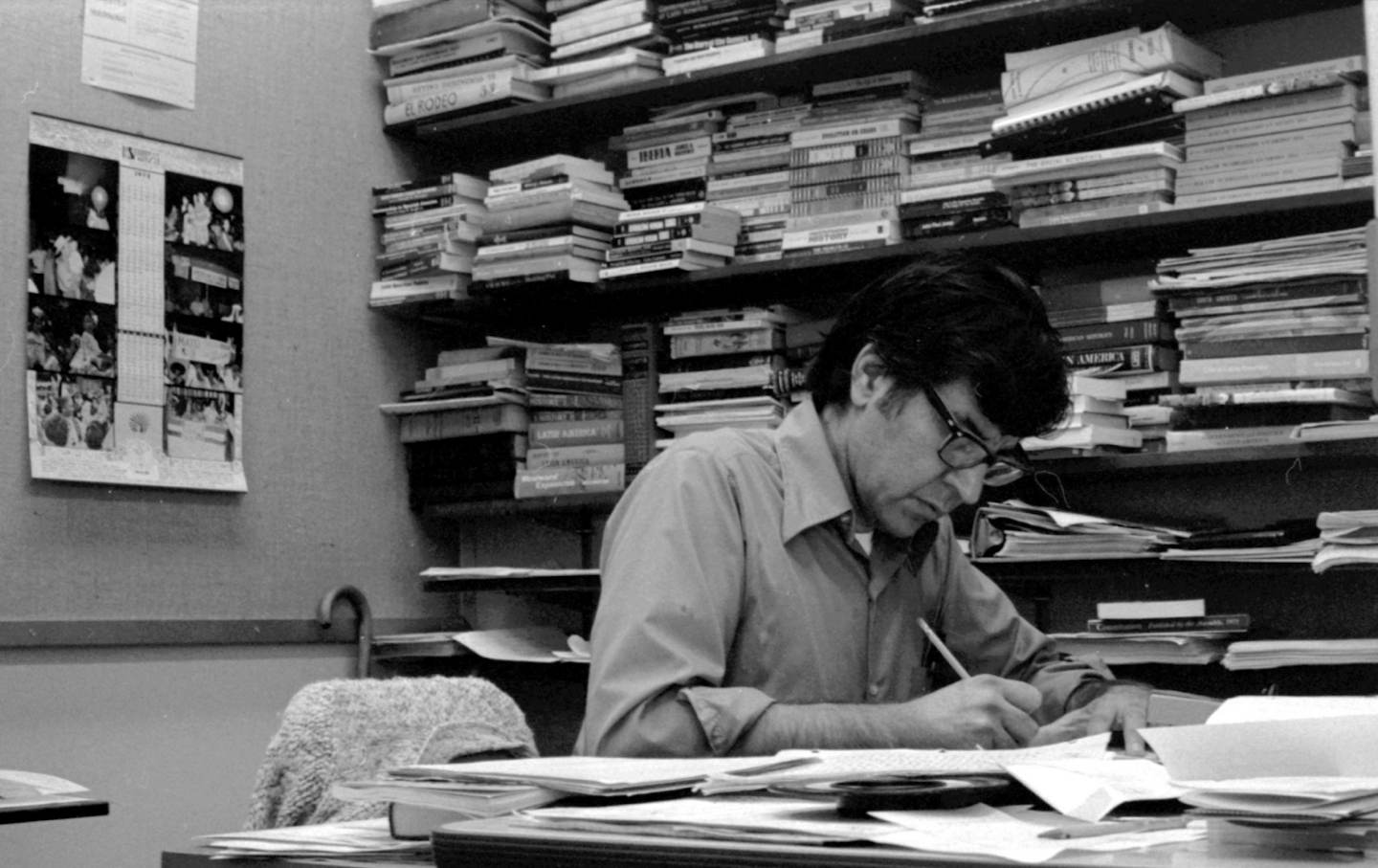
Dr. Rodolfo “Rudy” Acuña, circa 1969.
(Courtesy of CSUN’s Unrest Collection, directed by Miguel Durán)They told us this was history. From elementary school through college, it arrived printed in textbooks, laced with authority, taught as truth:
European settlers came escaping hardships, Native people welcomed them, and the nation expanded. “Progress” followed. The Mexican-American War became a “shifted border.” Conquest became destiny; settlement fact.
And we were left to learn their story, not our own.
That narrative held until Dr. Rodolfo “Rudy” Acuña intervened in 1972, reshaping the writing of history and a generation’s historical awareness. In Occupied America: The Chicanos’ Struggle Toward Liberation, he wrote, “Incomplete or biased analyses by historians have perpetuated factual errors and created myths.… The tragedy is that the myths have degraded the Mexican people—not only in the eyes of those who feel superior, but also in their own eyes.”
Born in 1932 in a racist Los Angeles, Acuña, who died in March at 93, learned how educational institutions excluded his community. He experienced these structures firsthand as a student, janitor, public school teacher, and community college instructor.
By 1969, despite fierce resistance—including campus repression, police surveillance, and arrests during student-led struggles to establish Ethnic Studies— he became the founding chair of Chicano Studies at California State University, Northridge (CSUN), establishing the nation’s largest department of its kind, authoring over 44 courses in a span of two weeks, and laying the institutional foundation for Chicano Studies and the broader field of Ethnic Studies. What exists today—CSUN’s two graduate programs, four undergraduate degrees, and a curriculum offering more than 150 courses—stands as part of Rudy’s legacy.
Many Chicana/o Studies faculty, students, and activists first encountered Rudy by reading his texts, attending his lectures, or standing alongside him at marches or MEChA meetings. He consistently reminded us that the institutions we entered misrepresented our history, disrespected our language, and confined our community to the lower rungs of the economic ladder. For those of us in Chicana/o Studies, Rudy was more than a colleague. He was our conscience. He insisted that scholarship was linked to the people’s struggle. If knowledge did not serve the people, it was complicit in their erasure. Chicana/o Studies was not simply an academic project or a teaching position—it is inextricably tied to our liberation.
Occupied America: The Chicanos’ Struggle Toward Liberation, published in 1972, confronted a field dominated by triumphalist, white-centered narratives that celebrated expansion while rendering Indigenous peoples, Mexicans, Chicanos, and people of color invisible. For those excluded, there was no archive of self, no intellectual home—only distortions and silence. Occupied America changed that, giving Chicanos a language to name dispossession, a framework to confront power, and a ground from which to claim presence. The book became a foundational text for Chicana/o Studies. In it, Rudy wrote:
History can either oppress or liberate a people.… Mexicans—Chicanos—in the United States today are an oppressed people… and, sadly, many believe that the only way to get along in Anglo-America is to become “Americanized” themselves. Awareness of their history—of their contributions and struggles, of the fact that they were not the “treacherous enemy” that Anglo-American histories have said they were—can restore pride and a sense of heritage to a people who have been oppressed for so long. In short, awareness can help them to liberate themselves.
In the decades that followed, Acuña’s interventions extended across issues of labor, land, and migration, producing a body of work unmatched in scope and urgency. In 22 books, including America Ocupada (1976), Community Under Siege (1984), Anything But Mexican (1996), and Corridors of Migration (2007), he integrated scholarship and activism, consistently revising Occupied while producing hundreds of essays, articles, chapters, and public writings. The quintessential activist-scholar, Acuña’s work was always a call to confront power and defend truth.
At CSUN, he was also instrumental in creating Central American Studies, the first academic program of its kind in US higher education, supporting a generation of students shaped by US-backed wars, displacement, and under-resourced LA schools. Working with student organizers from the Central American United Student Association, Acuña helped secure institutional space without exerting control over the process. Building on that foundation, the nation’s first experimental courses on Central America were developed, helping to establish the field nationally and internationally.
Throughout, Rudy insisted that Chicana/o and Ethnic Studies were instruments of struggle, formations born of insurgency that must remain accountable to the communities that made them possible. That insistence remains under attack. Today, right-wing political organizations, state-level policy makers, and local school boards are attempting to restrict Ethnic Studies curricula, challenge its place in education, impose penalties on how it is taught and discussed, and suppress its perspectives, creating a context reminiscent of earlier challenges. Across school boards, campuses, and in public discourse, educators who speak of settler colonialism, decoloniality, and liberation face increasing hostility—an extension of the same struggles that shaped the emergence of Chicana/o Studies and that form part of Rudy’s lineage.
Acuña never let us forget the student activists who founded Ethnic Studies programs, who were surveilled, beaten, and incarcerated:
These students fought for Chicano Studies and the recruitment of Mexican Americans to colleges and universities. Their sacrifices and accomplishments must be placed in context. The government and the establishment did not give them Chicano Studies; they took it.
Rudy’s trajectory exemplifies the depth of his legacy. He transformed the writing of history, rendered previous narratives untenable, and continues to shape those who study, teach, and live its truths. To honor him is to move beyond remembrance.
He endures in students who refuse erasure, in classrooms where Occupied America remains a call to action, in the courses he built, the courage he instilled, and the scholarship fund he created to support future generations.
Popular
“swipe left below to view more authors”Swipe →Professor-artist Harry Gamboa once asked Rudy about his work, and Rudy responded:
“Your work is your understanding of life.… I am a materialist. I don’t think that we’re going to have an afterlife or be judged. And so consequently you want to leave something to this world. Now, if you consume and that’s all that you do, you’re not going to leave something for this world. But if you produce, if you write, if you build organizations, you are going to leave a footprint. I don’t want to be like other people who destroy, nor do they leave anything behind. I think that having the advantage of an education gives you a responsibility to produce something. To do something.”
Acuña did more than leave a footprint; he altered the terrain. And if history remains a site of struggle where we are all on the inside, as he said, the question is not what he leaves but how we carry it forward.
Hasta siempre, Rudy.
Become a Sustaining Donor This September
Between the reemergence of right-wing red-baiting and Donald Trump’s use of the chilling National Security Presidential Memorandum–7 to criminalize left political organizing, we’re seeing McCarthyism reborn before our eyes.
This assault on democracy cannot be ignored or wished away. Resisting it requires bravery in the face of threats and repression, a steadfast commitment to the truth, and the unwavering belief that we can—and will—overcome this darkness.
We must have an independent media that sets the record straight, unearths corruption and abuses of power, and advances a politics of justice and dignity for all if we’re to win this fight.
That’s why I’m writing to you today. This September, The Nation needs to add 100 monthly donors to sustain our progressive journalism. Your contribution makes the next investigative report, the next truth-speaking column, and the next pathbreaking essay all possible.
I hope you’ll support our work with a recurring donation today. If you donate $10 or more a month, we’ll send you a brand new “Hands Off the Free Press!” sticker to recognise your commitment to our cause. Please, donate today.
Onward,
Katrina vanden Heuvel
Editor and Publisher, The Nation
More from The Nation
Journalist Meaghan Beatley on Latin America’s Feminist Resistance Journalist Meaghan Beatley on Latin America’s Feminist Resistance
A conversation with the author of Sex and Dissent about what American feminists can learn from the Green Wave movement.
As Cornell’s Rape Case Draws National Attention, Students Want Accountability. As Cornell’s Rape Case Draws National Attention, Students Want Accountability.
A new lawsuit alleging that a former student was drugged and gang-raped by Chi Phi fraternity members is sparking outrage in the Cornell community.

Irish Goalkeeper Gavin Bazunu’s Refusal to Play Against Israel Puts Him on the Right Side of History Irish Goalkeeper Gavin Bazunu’s Refusal to Play Against Israel Puts Him on the Right Side of History
Bazunu’s decision raises the perennial question: Why is a country that is currently committing a genocide allowed to compete in the first place?
The Promises and Compromises of the University of California The Promises and Compromises of the University of California
I grew up in a neighborhood manufactured by the University of California, Irvine. It felt like a utopia for academics—until the university forsook its mission of serving the publi...
Is Platonic Co-Parenting the Future of the Family? Is Platonic Co-Parenting the Future of the Family?
Disillusioned with the nuclear family and apprehensive of tethering their reproductive futures to the bleak hellscape of modern love, young people are seeking a different way.