
Why Marriage Equality Is Back on the Ballot
A second Trump presidency could bring same-sex marriage bans back into effect. In November, California, Colorado, and Hawaii will ask voters to secure marriage equality into state law.
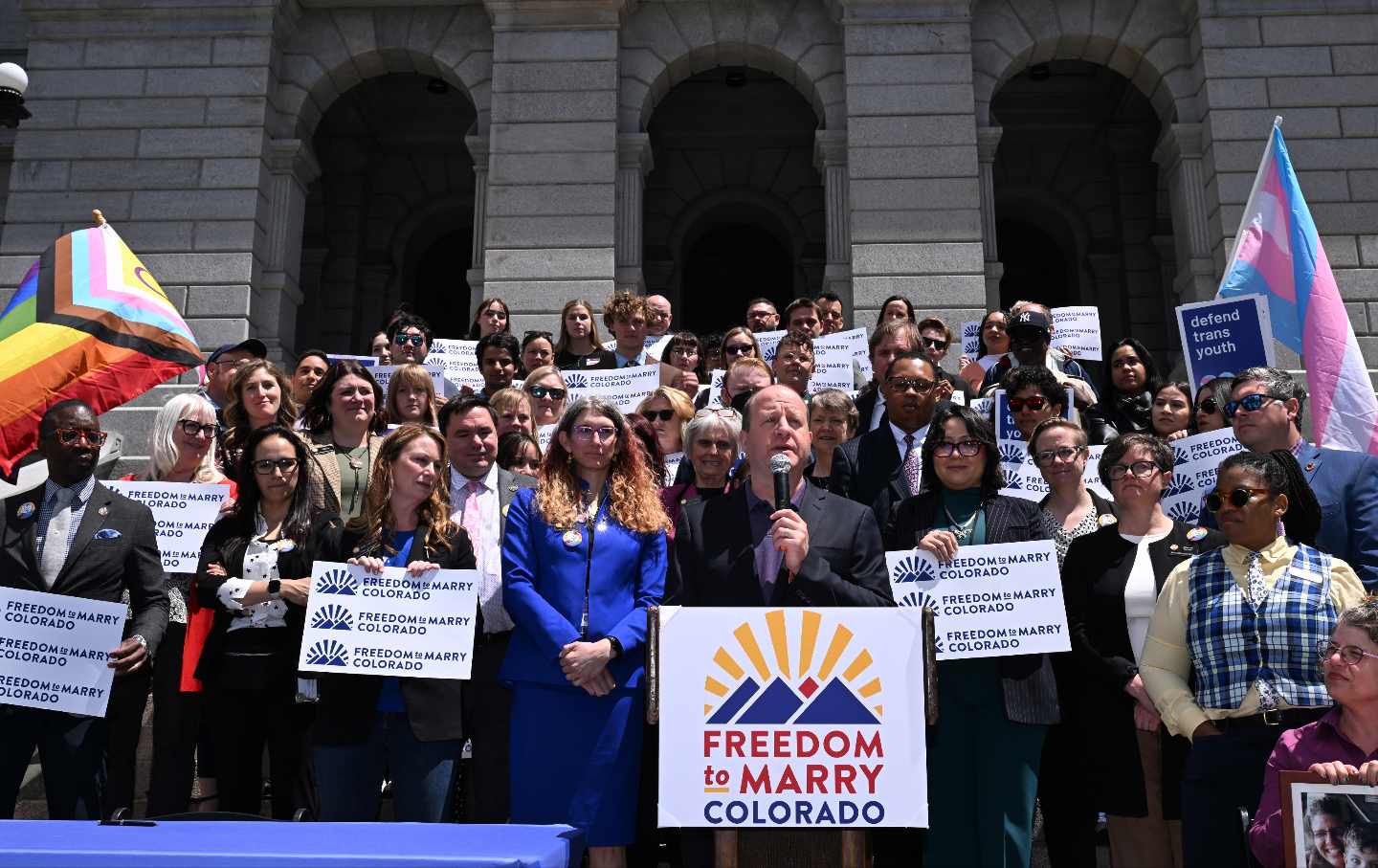
Governor Jared Polis speaking after the Colorado legislature passed a measure to repeal the ban on same-sex marriage currently in the state Constitution.
(Helen H. Richardson / Getty)
This November, facing a potential second Trump presidency, three states—California, Colorado, and Hawaii—will ask voters to secure same-sex marriage into state law.
In 2015, a 5–4 Supreme Court majority in Obergefell v. Hodges found that state bans on same-sex marriage were unconstitutional. But 30 states still have unenforceable amendments on the books that prohibit marriage equality, according to the LGBTQ+ advocacy group Movement Advancement Project.
That leaves same-sex couples vulnerable if the Supreme Court were to overturn Obergefell, as hard-line conservative Justice Clarence Thomas signaled he would look to do in his June 2022 concurrence in Dobbs v. Jackson Women’s Health Organization: “We should reconsider all of this Court’s substantive due process precedents, including Griswold, Lawrence, and Obergefell,” Thomas wrote at the time. Broad consensus among Republican senators, according to NBC News, indicates that Trump would fill at least one Supreme Court vacancy during his four-year term if he wins in November.
There is limited federal protection already in place for Obergefell’s potential overturning. In 2022, Congress passed the Respect for Marriage Act, which requires the federal government to recognize same-sex and interracial marriages and states to recognize same-sex marriages performed in states where such marriages are legal. Still, if the Supreme Court overturned Obergefell, states would not be required to issue marriage licenses contrary to state law. The Respect for Marriage Act, too, could always be overturned with a rightward shift in congressional power.
As such, California’s Proposition 3 would amend the state’s Constitution to include a “fundamental right to marry, regardless of sex or race” and remove language in the state’s Constitution, created in 2008 under Proposition 8, which states that marriage is only between a man and woman. Colorado’s Amendment J would remove the Colorado Constitution’s current language, which, after voters passed a 2006 amendment, only recognizes a marriage between one man and one woman. Hawaii has no current same-sex marriage ban on the books—its state legislature overturned a same-sex marriage ban in 2013—but its amendment would remove a constitutional provision that states that the legislature “shall have the power to reserve marriage to opposite-sex couples.”
Shay Franco-Clausen, political director of nonprofit LGBTQ+ civil rights organization Equality California and vice chair of the California Democratic Party’s LGBTQ+ Caucus, told The Nation that though she’s not organizing in Colorado or Hawaii, she suspects the simultaneous suite of amendments comes due to “that fear of a possible Trump administration.” Franco-Clausen is among the lead Democratic organizers working to support the passage of California’s same-sex marriage amendment.
“Before [Trump] was elected, and when he got elected, people were upset, but they hadn’t lived through it,” Franco-Clausen said. “Now that we’ve lived through it and the division that he continues to create, his naming that our marriages and our relationships aren’t real—that we’re not normal—that protection for people during another potential Trump administration is necessary. All states that don’t have same-sex marriages’ legal protection should have it.”
It’s a markedly different political landscape for same-sex marriage than it was when California’s and Colorado’s constitutional amendments were passed. In 2006 and 2008, only 42 percent and 40 percent of Americans thought same-sex marriage should be legalized, according to Gallup polling. But a majority of Americans (69 percent) in 2024 support legal same-sex marriage, even if that number has declined in recent years among all political identifications, most prominently Republicans.
Broad support for same-sex marriage is apparent in the amount of money raised in support of the amendments. Financial contributions toward each of the amendments have only come from their supporters: According to campaign finance reports, California’s, Colorado’s and Hawaii’s amendments have a total of almost $3 million, $440,000, and $55,000 in contributions respectively, with opposing parties raising $0 in funds.
Franco-Clausen said polling, with around 72 percent approving, looks strong for Proposition 3’s passage. Despite those comfortable numbers, a multimillion-dollar advertising campaign urging the amendment’s passage will air to voters in the final lead-up to the election. The advertising campaign is also part of an effort, first reported by Politico, to address a lack of diversity in how LGBTQ+ advocacy groups messaged about same-sex couples—largely depicting white, cisgender same-sex couples that strategists thought would appeal to conservative voters—during the 2008 campaign against Proposition 8. Franco-Clausen says both leadership and marketing for Proposition 3 better reflect the LGBTQ+ community’s diversity.
“The photos that are [now] being used are very intentional. The LGBT movement has really been centered in white gay men, white lesbians. [But] that’s our community too,” Franco-Clausen, who is Black and Puerto Rican, said. “A lot of organizations are changing their messaging and the images they use to reflect what the community actually looks like. We’re doing the same thing.”
Notably, the amendments expose an ideological shift among Republicans and conservative groups, many of whom, fearful of alienating an American electorate broadly supportive of same-sex marriage, have made no formal opposition to the amendments. California’s Republican Party, for example, is neutral on Proposition 3. The Hawaii Republican Party has not made an endorsement or rejection of the state’s amendment. And Colorado’s Republican Party even flip-flopped on support for its state’s amendment. For around eight hours, the Colorado Republican Party briefly supported Amendment J’s passage in a voting guide, according to reporting from the Colorado Times Recorder, before updating it to remain neutral on the amendment. Colorado Republican Party chairman Dave Williams did not respond to a request for comment from The Nation.
“Importantly, the focus of any LGBTQ-related efforts should be on the trans agenda and children harmed within this state,” read the now-deleted text. “Focus in LGBTQ issues by the GOP must turn to children and education.”
Colorado’s Amendment J has little organized opposition, though one religious group, the Colorado Catholic Conference, which represents the state’s Catholic bishops, opposes the amendment. Even so, executive director Brittany Vessely told The Nation that the organization is primarily focused on defeating an amendment that would create a constitutional right to abortion in the state and permit the use of public funds for abortion services, more so than the state’s same-sex marriage amendment.
Popular
“swipe left below to view more authors”Swipe →Though polling data for Hawaii and Colorado’s amendments is limited, California’s amendment seems all but guaranteed to pass. It’s an exciting prospect for LGBTQ+ advocacy groups and activists, who say removing the state’s inert language against same-sex marriage sends a message that all are welcome in the Golden State.
“Our state Constitution still lists marriage as a union between a man and a woman,” Rae Seneff, a University of California San Diego student and president of the school’s College Democrats chapter, said in a video shared by the organization. “Marriage is defined by mutual love, not by one’s gender. This is why we must pass Prop 3, which would cut out this outdated language and make it clear that marriage is a fundamental right. Because it is.”
More from The Nation
How the Theatrics of Mamdani’s Trump Meeting Backfired How the Theatrics of Mamdani’s Trump Meeting Backfired
By pandering to the president’s vanity, the New York mayor reinforced Trump’s image as a strongman commanding deference—an especially bad look on the eve of Trump’s war with Iran

Students in New York Are Going Hungry. How Can Mamdani Help? Students in New York Are Going Hungry. How Can Mamdani Help?
With plans for city-owned grocery stores and a focus on affordability, the new mayoral administration offers fresh hopes of successfully confronting the food crisis among students...

We Are the Fire That Melts the ICE We Are the Fire That Melts the ICE
Oaxaca, Mexico, street art.

Trump’s Reason for War in Iran? Trump’s Reason for War in Iran?
Obliterating the Epstein files at any cost.
Why Can’t Top Democrats Just Say “No War With Iran”? Why Can’t Top Democrats Just Say “No War With Iran”?
The response to what could be the biggest geopolitical disaster of the 21st century is foot-dragging, silence, and sleepy, feigned opposition long after the deed is done.
This Is an Unnecessary, Unauthorized, and Unconstitutional War This Is an Unnecessary, Unauthorized, and Unconstitutional War
Congress has a duty to take up War Powers resolutions and assert its primacy over matters of war and peace.

