Santa Marta May Be a Game-Changing Moment for the Climate
At a crucial climate conference, a critical mass of countries begins mapping a fossil fuel phaseout.
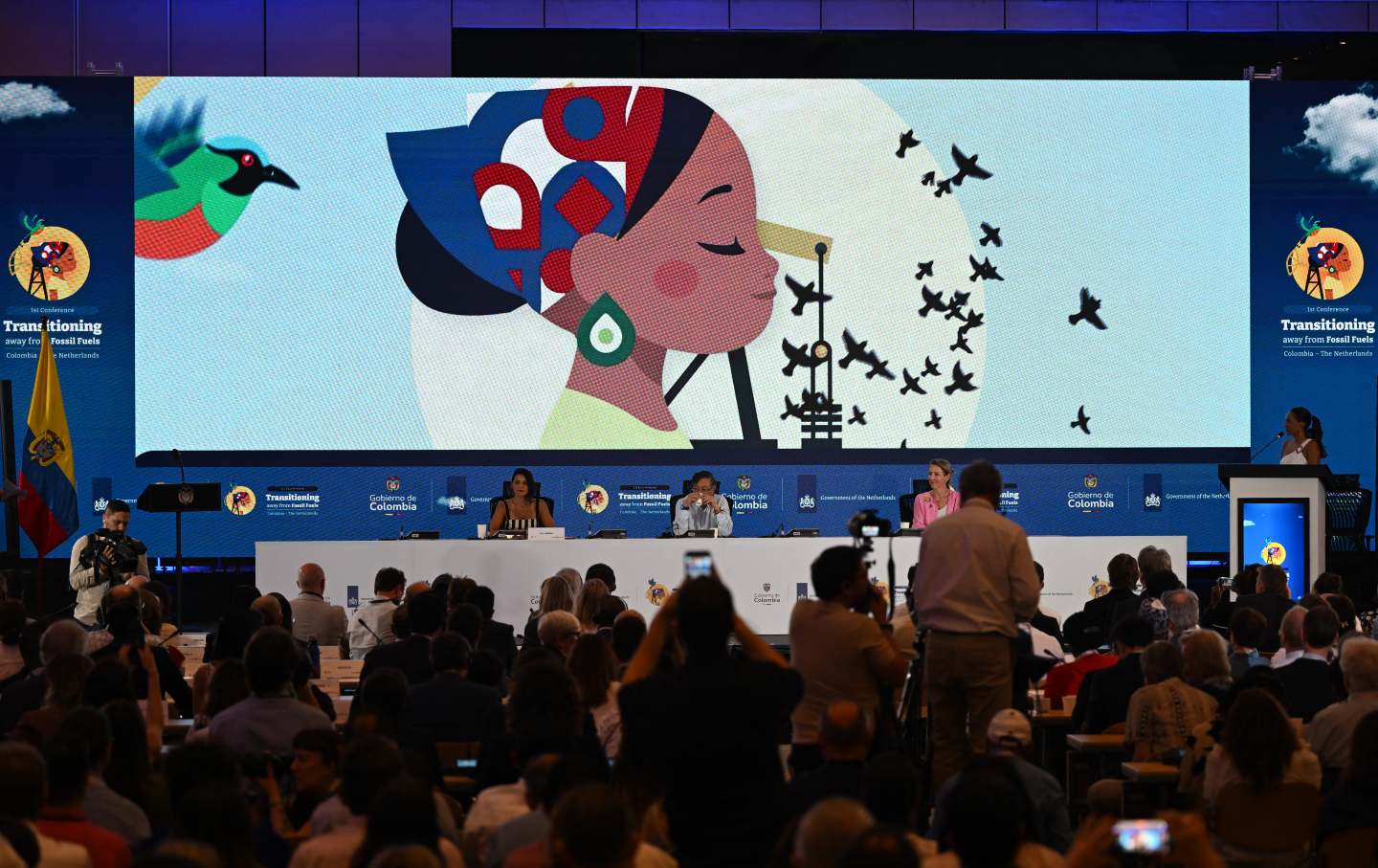
Colombia’s President Gustavo Petro (C), Colombia’s Environment Minister Irene Velez (L) and Dutch Minister of Climate and Green Growth Stientje van Veldhoven attend the International Conference on the Just Transition Away from Fossil Fuels in Santa Marta, Colombia, on April 28, 2026.
(Raul ARBOLEDA / Getty Images)
Santa Marta, Colombia—“You are the light in a tunnel of darkness,” climate scientist Johan Rockstrom told delegates at the First Conference On Transitioning Away From Fossil Fuels this week in Santa Marta, Colombia. After years of UN climate summits rarely even mentioning the words “fossil fuels,” 57 countries representing one-third of the world’s economy came to Santa Marta to discuss not whether but how to leave behind the primary driver of climate change. This potentially historic development drew strong media interest: 146 journalists from 61 news outlets and 28 countries attended in person, countless more followed the livestream, and abundant news coverage appeared around the world, according to the governments of Colombia and the Netherlands, the conference’s cosponsors.
The gathering got an unexpected boost when the head of the International Energy Agency said in an interview with The Guardian that the war in Iran has broken fossil fuel markets beyond repair. The interruptions to oil and gas supplies and the resulting price spikes, said Turkish economist Fatih Birol, will forever turn countries away from fossil fuels and toward more secure renewable energy sources. “The damage is done,” added Birol, whose agency The New York Times has described as “enormously influential” on the long-term plans of energy companies and investors around the world.
Irene Vélez Torres, the environment minister of Colombia, welcomed Birol’s comments. “It seems that many of us are seeing at the same time that fossil fuels cannot provide energy security, because fossil fuels are subject to scarcity, and scarcity can be manipulated,” she said in an interview with Covering Climate Now.
The conference is separate from the UN process, so the goal was not to negotiate a legal agreement but to learn from everyone—including businesses, Indigenous peoples, and other parts of civil society—about the best ways to disentangle economies and societies from fossil fuels. Each country’s road map will be voluntary and specific to its own circumstances. “This conference is not about documents,” said Rachel Kyte, the UK special representative for climate. “It’s about finding fellow travelers and learning from them—what’s working, what isn’t?”
For example, France released what it called “the first national roadmap” by a developed country to phase out fossil fuels. The plan foresees removing coal from the national electricity grid by 2027, ending oil consumption by 2045 and gas by 2050. The Chinese electric car giant BYD and the Australian mining company Fortescue hosted a private sector roundtable aboard what Fortescue said was the world’s first cargo ship powered completely without fossil fuels. The company urged businesses and governments to pursue “real zero” emissions, rather than the “net zero” goal that employs carbon offsets and allows continued emissions. Asked about the 80–89 percent of people around the world who want stronger climate action, Ana Toni, the Brazilian diplomat who served as executive director of COP30 UN climate summit, urged citizens to act “at the national level. There are elections coming up, and what consumer choices people make also matter.”
The Santa Marta conference’s conclusions are aimed at accelerating progress at COP31 this coming November, but its larger impact may come from the economic heft of the conference’s “coalition of the willing.” Joined in Santa Marta by California, the world’s fifth-largest economy, these countries account for 30 percent of global fossil fuel consumption. Withdrawing that buying power from oil, gas, and coal over the coming years could accelerate the retreat from fossil fuels foreseen by Birol.
Santa Marta may be a game-changing moment in the climate story, and journalists have an abundance of story lines to explore in the months ahead. Will the stirring rhetoric that governments expressed in Santa Marta be matched by policies they implement back home? Will more countries and subnational governments join their ranks? How will the big emitters that did not attend—the United States, China, and other fossil fuel–producing states and companies react? A follow-up conference will take place in February 2027, hosted by the Pacific island nation of Tuvalu and cosponsored by Ireland. “This is not the end,” Velez declared in the conference’s closing moments. “It is the beginning of a new global climate democracy.”
Become a Sustaining Donor This September
Between the reemergence of right-wing red-baiting and Donald Trump’s use of the chilling National Security Presidential Memorandum–7 to criminalize left political organizing, we’re seeing McCarthyism reborn before our eyes.
This assault on democracy cannot be ignored or wished away. Resisting it requires bravery in the face of threats and repression, a steadfast commitment to the truth, and the unwavering belief that we can—and will—overcome this darkness.
We must have an independent media that sets the record straight, unearths corruption and abuses of power, and advances a politics of justice and dignity for all if we’re to win this fight.
That’s why I’m writing to you today. This September, The Nation needs to add 100 monthly donors to sustain our progressive journalism. Your contribution makes the next investigative report, the next truth-speaking column, and the next pathbreaking essay all possible.
I hope you’ll support our work with a recurring donation today. If you donate $10 or more a month, we’ll send you a brand new “Hands Off the Free Press!” sticker to recognise your commitment to our cause. Please, donate today.
Onward,
Katrina vanden Heuvel
Editor and Publisher, The Nation