The Hottest World Cup in History
The World Cup is not just a sports story. It’s a climate one, too.
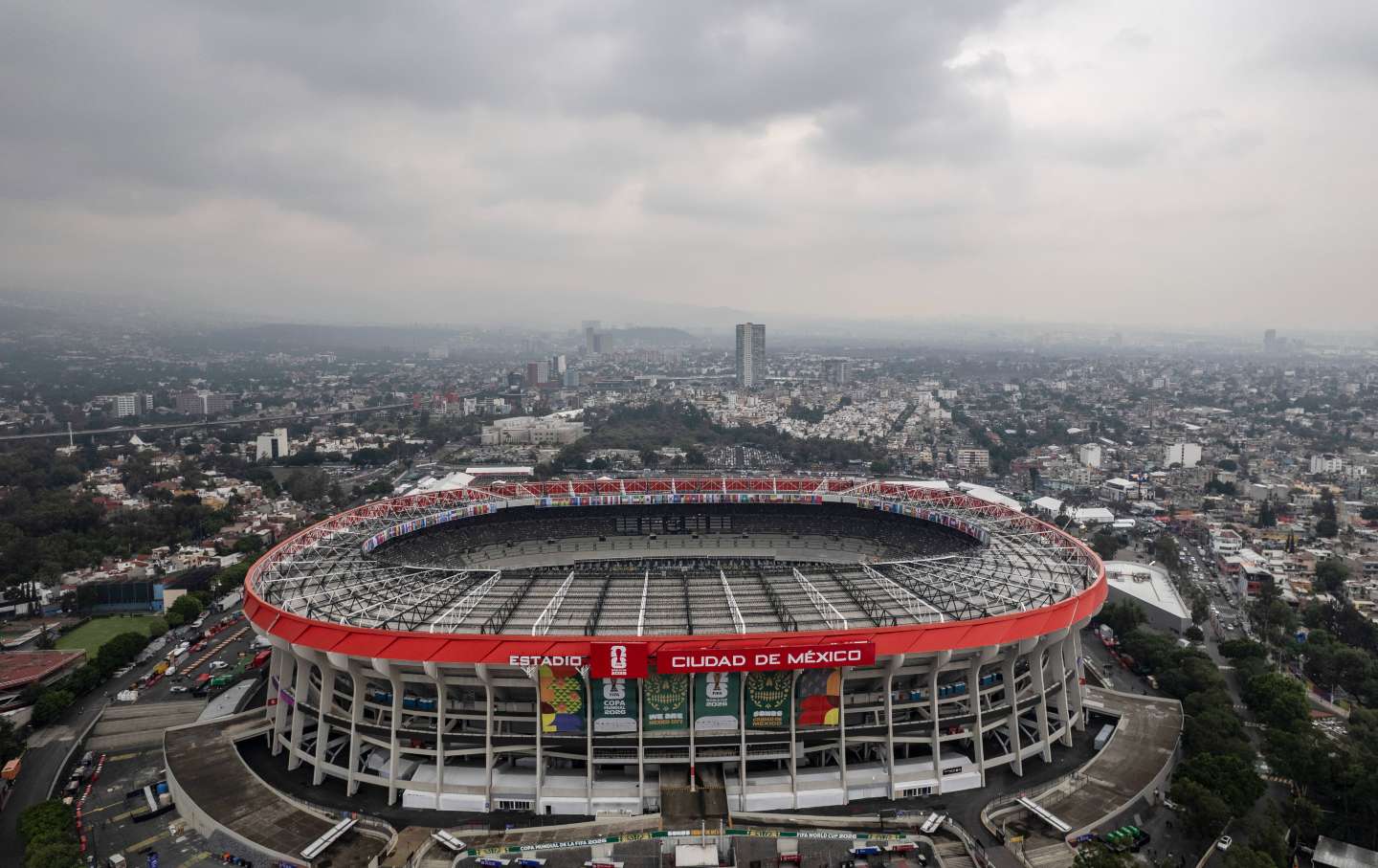
Aerial view of the Mexico City Stadium two days before the start of the 2026 World Cup on June 9, 2026, in Mexico City, Mexico.
(Cristopher Rogel Blanquet / Getty Images)This summer’s World Cup will be unlike any other in the 96-year history of the world’s most popular sporting event. Never before have players on the field and spectators in the stands faced the intensity of heat expected to confront them at the matches taking place over the next 39 days, starting with today’s opener between Mexico and South Africa. The extra heat is due in no small part to rising global temperatures driven by burning fossil fuels, making the 2026 World Cup not just a sports story, but a climate one, too.
Game-time temperatures at many of the host venues in the United States and Mexico are projected to be higher than during any previous World Cup, according to new scientific studies. (The 2022 World Cup was hosted by Qatar, but its desert heat was offset by shifting the tournament from summer to winter and holding matches in air-conditioned stadiums.) Climate change has increased the number of extremely hot summer days in 14 of the 16 cities hosting matches during the 2026 Cup, the scientific nonprofit Climate Central found. Perhaps most at risk is Miami, which “now experiences roughly two additional weeks of extreme June and July heat compared to the 1970’s,” Climate Central’s Ben Tracy reports.
In anticipation of the exceptional heat, FIFA, the international governing body of soccer, has taken the extraordinary step of ordering referees to enforce a three-minute break halfway through each half so players can rest and hydrate. Nevertheless, the heat could be so intense, especially in Miami, Dallas, Houston, Kansas City, Guadalajara, and Mexico City, that players’ performance—how fast they can run, how many minutes they can play—is projected to suffer at 97 of the 104 total matches. “It has such a huge impact on the way you play,” former pro footballer Marissa Abegg told Tracy. That, in turn, has implications for the flow of play and the outcomes of matches: Teams that rely more on speed or endurance, for example, will potentially be disadvantaged.
Spectators, too, will suffer. Eleven of the 16 venues are open-air stadiums where spectators will endure the full wrath of the prevailing heat and humidity. Health experts warn of increased risks of heat stroke, dehydration, and kidney failure. In response, some stadiums are adding cooling stations, misting tents, and additional medical staffing.
So a friendly request for our fellow journalists on newsrooms’ sports desks: Acquaint yourselves with the abundant science behind these warnings, via the links in this article. And mention that science occasionally in your reporting and commentary. To ignore climate change would omit crucial context that fans will find useful for understanding why their favorite teams and players excelled or languished during this World Cup.
There will be plenty of opportunities to make the climate connection. Commercials will occupy two minutes and 10 seconds of each hydration break, but for our TV and radio colleagues it will be easy enough during the remaining 50 seconds of airtime to note that these breaks are taking place because, thanks largely to global warming, players are enduring some of the highest temperatures in World Cup history.
A full account of the climate connection would include not only what climate change is doing to the Cup, but also what the Cup is doing to climate change. A Guardian article described how this year’s tournament is “on track to be the “most polluting” World Cup ever, with total greenhouse gas emissions hitting nearly two times the historical average.” The Guardian notes various “FIFA own goals,” including the association’s decision to increase the number of competing teams from 32 to 48. Most impactful, however, was FIFA’s decision to name three different host nations, rather than the usual one. And since Mexico, the United States, and Canada are large land masses, teams and spectators traveling to and from venues must travel long distances by air, a notoriously carbon-intensive means of transport. Finally, in what The Guardian calls a sponsorship deal “that looks like it was concocted in a greenwashing laboratory,” FIFA in 2024 “signed a four-year partnership deal with Aramco, the state-owned Saudi energy behemoth that is the largest corporate greenhouse gas emitter on Earth.”
In short, there are plenty of climate angles for journalists to explore while covering the 2026 World Cup. The same was true of the Winter Olympics earlier this year, and in 2022, and of the 2024 Summer Olympics. In each case, most coverage was disappointingly silent on the climate connection to these globally beloved sporting events. The next 39 days will reveal whether the 2026 World Cup will be any different.