The Hantavirus Is Also a Climate Warning
Higher temperatures, like this coming summer’s, bring more infectious diseases.
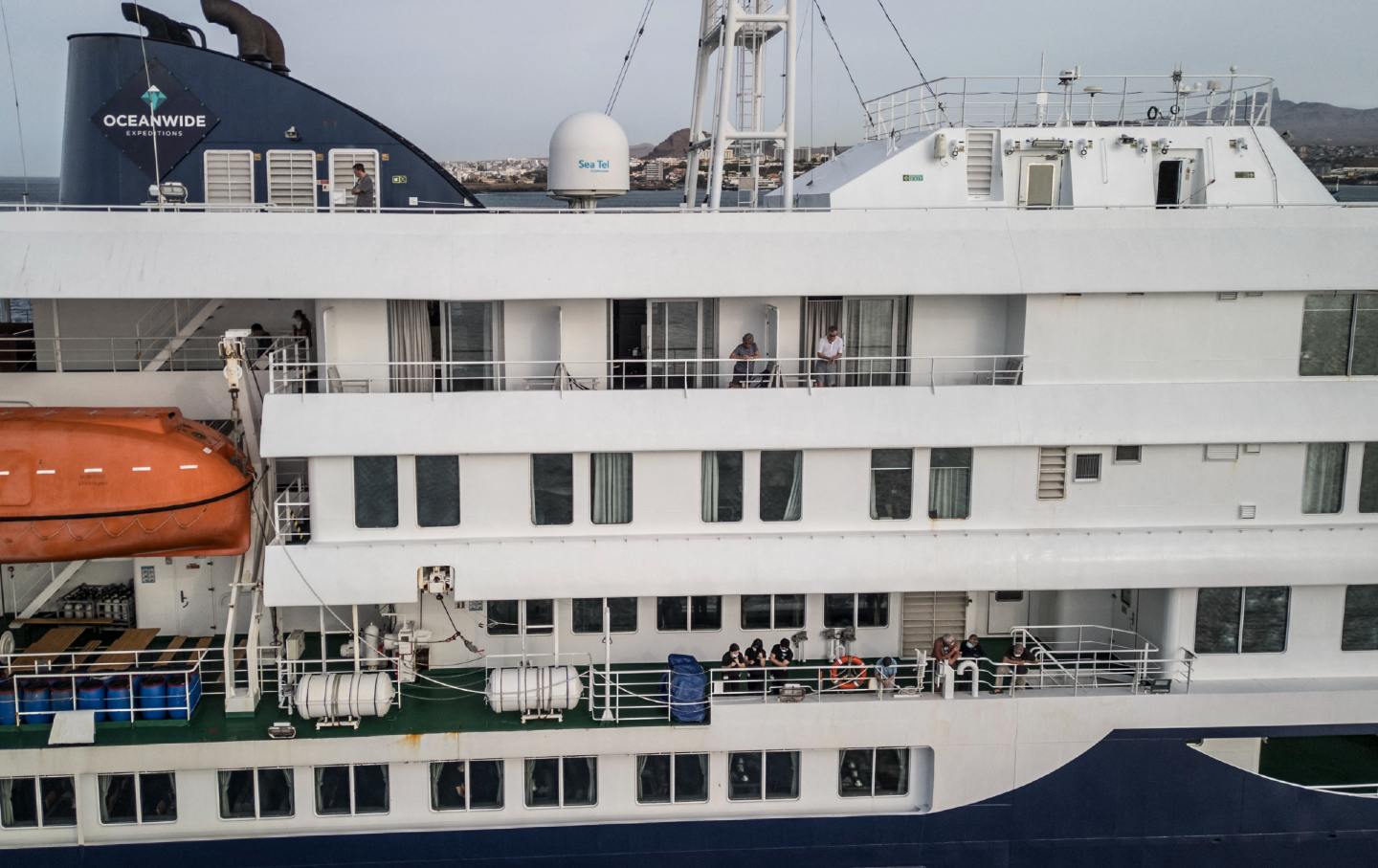
Passengers watch as unseen health personnel assists patients onto a boat from the cruise ship MV Hondius, while stationary off the port of Praia, the capital of Cape Verde, on May 6, 2026. Evacuations were taking place because of a deadly outbreak of hantavirus.
(AFP via Getty Images)The signs now are that the hantavirus is not the next pandemic. But with 2026 predicted to be the hottest year on record, the hantavirus outbreak is a warning of what public health experts have long said: A hotter planet is a deadlier planet.
Rising global temperatures and the impacts they trigger—harsher heat waves, stronger storms, and wider spread of infectious diseases—endanger human health in myriad ways. The world’s top medical societies have been sounding the alarm since 2009, when the journal The Lancet called climate change “the biggest global health threat of the 21st century.” The Lancet’s 2025 report found that climate change is responsible for “millions of unnecessary deaths a year,” with excess heat alone killing 546,000 people.
The Associated Press and CNN appear to be the first major news organizations to make the climate connection to the hantavirus outbreak on a cruise ship that departed Argentina on April 1. CNN reported that hantavirus has long been present in the far south of South America, but its frequency has increased recently in Argentina, where cases “have almost doubled in the past year, with the country recording 32 deaths alongside its highest number of infections since 2018,” according to the Argentine health ministry. Citing local public health researchers, the AP reported that “higher temperatures expand the virus’ range because…rodents that carry the hantavirus can thrive in more places.” A historic drought that drove animals beyond their normal habitats in search of food was followed by intense rainfall. “When precipitation increases, food availability increases, rodent populations grow, and…the chance of transmission between rodents—and eventually to humans—also increases,” Raul González Ittig, a researcher at state science body CONICET, told the AP.
Three passengers on the cruise ship have died from hantavirus, and nine have contracted the virus. The World Health Organization has emphasized that the risk to the general public is very low, and there is no danger of a pandemic akin to the Covid-19 contagion that convulsed the world in 2020.
The link between hantavirus and climate change remains far from definitive; more research is needed to determine how large a role climate change played in this particular outbreak. Journalists can help by reporting on this research as it unfolds and asking public officials what steps they are taking to keep communities informed and safe.
Journalists can also alert our audience to a broader warning that scientists have long issued.As recently explained in the Journal of the American Medical Association, higher temperatures allow mosquitoes, ticks, and rodents that carry infectious diseases to spread to previously inhospitable areas, increasing the threat to humans from malaria, cholera, Lyme disease, and other maladies.
Higher temperatures are exactly what the months ahead will bring across much of the Northern Hemisphere. This year is expected to be the hottest in recorded history, thanks to an El Niño super-charging global temperatures that are already amplified by climate change. Besides threatening human health directly, this heat will also make drought and wildfires more likely.
Too often, news coverage of extreme weather disasters has been silent about climate change’s role; for example, most reporting on the mega-fires that scorched Los Angeles in 2025 focused on the roaring flames but ignored what helped spark them in the first place. CCNow’s recent white paper on the state of climate journalism applauded AP and CNN for their sustained commitment to climate coverage at a time when “climate hushing” has afflicted many other news organizations, especially in the United States. That commitment is what enables the AP and CNN to see the climate connection to breaking news like the hantavirus and inform their audiences accordingly. As hotter and more extreme weather confronts much of the world in the months ahead, these AP and CNN stories offer an exemplary model for how all of journalism can do better.
Become a Sustaining Donor This September
Between the reemergence of right-wing red-baiting and Donald Trump’s use of the chilling National Security Presidential Memorandum–7 to criminalize left political organizing, we’re seeing McCarthyism reborn before our eyes.
This assault on democracy cannot be ignored or wished away. Resisting it requires bravery in the face of threats and repression, a steadfast commitment to the truth, and the unwavering belief that we can—and will—overcome this darkness.
We must have an independent media that sets the record straight, unearths corruption and abuses of power, and advances a politics of justice and dignity for all if we’re to win this fight.
That’s why I’m writing to you today. This September, The Nation needs to add 100 monthly donors to sustain our progressive journalism. Your contribution makes the next investigative report, the next truth-speaking column, and the next pathbreaking essay all possible.
I hope you’ll support our work with a recurring donation today. If you donate $10 or more a month, we’ll send you a brand new “Hands Off the Free Press!” sticker to recognise your commitment to our cause. Please, donate today.
Onward,
Katrina vanden Heuvel
Editor and Publisher, The Nation