
Fossil Fuel Companies Are Silencing Us All
The verdict of Energy Transfer v. Greenpeace has disturbing implications for freedom of speech.
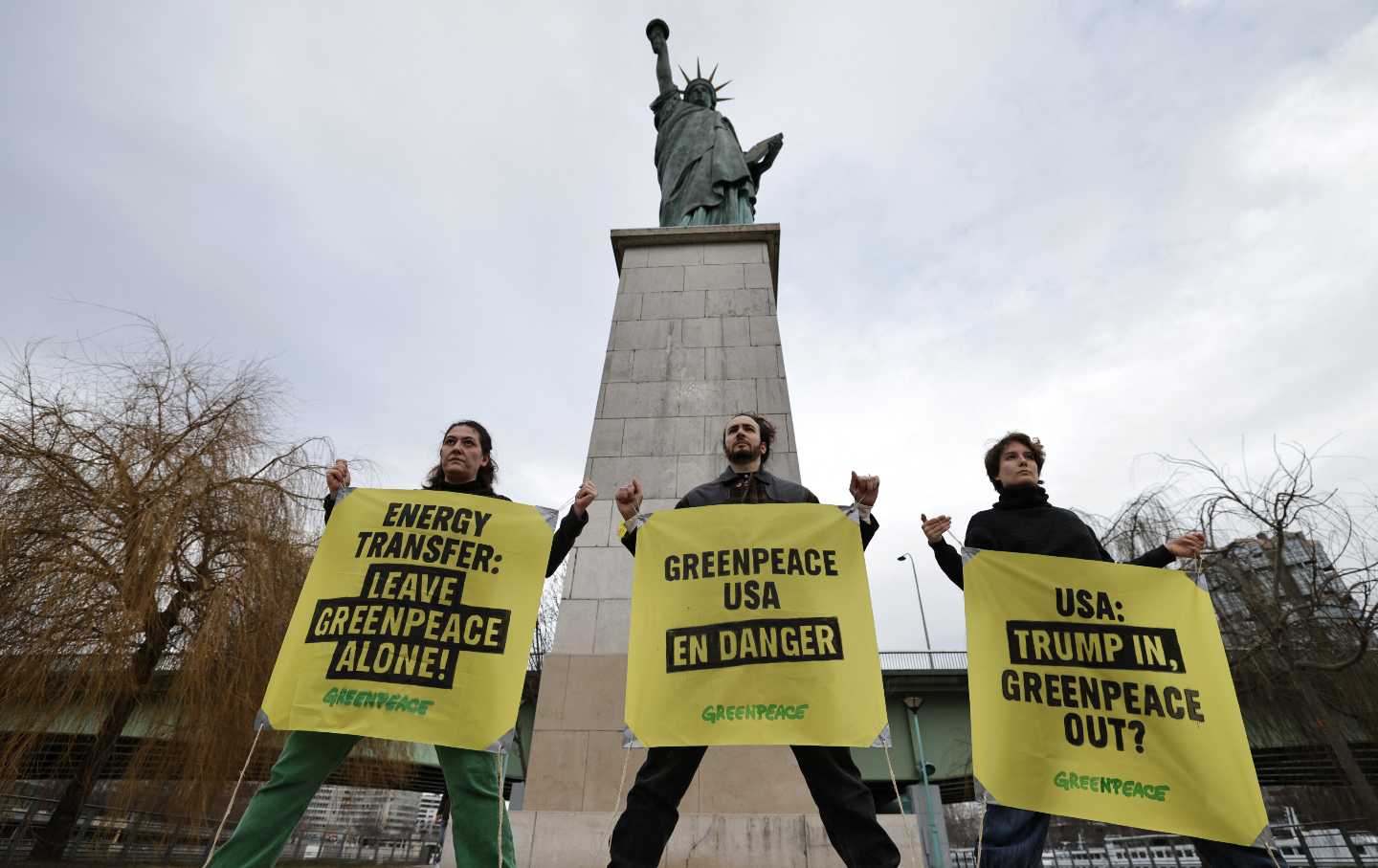
But activists aren’t letting corporates shut them up.
(Thibaud Moritz / AFP via Getty Images)
If you didn’t follow the proceedings of Energy Transfer v. Greenpeace in Mandan, North Dakota last week, you don’t realize how much your free speech has just been compromised.
On March 19, three entities from the global environmental nonprofit Greenpeace were found liable for $667 million in damages in a lawsuit filed by Energy Transfer, a Dallas-based oil and gas company worth nearly $70 billion. The suit originated from Greenpeace’s limited role in supporting indigenous-led protests against the Dakota Access Pipeline.
Energy Transfer insists that their claims were about the illegal conduct of protestors and their supporters, but the truth is more disturbing.
Free speech and civil liberty organizations have been sounding the alarm for months about how this decision could chill speech in the United States for everyone. The jury’s verdict, which awarded damages far beyond what Energy Transfer sought, sends an unequivocal message: Public protest can result in crushing financial consequences.
The implications for peaceful civil disobedience are profound.
The decision also prompts the question: Who can a corporation silence? Virtually everyone, apparently. In the 21st century, censorship is not just a governmental threat—it’s a corporate threat. And it’s not a left-wing or right-wing crisis—it’s a planetary crisis.
So how did we get here?
At the turn of the 20th century, fossil fuel companies ignored how their industry damaged the environment, behaving as though our rivers could be bought and the land was theirs to pollute. In the 1960s, people finally woke up: Activists, lawyers, union members, grandparents, and young people protested, organized, and sued to stop these harmful activities and pass laws so nature could speak just a little more. They worked to give nature a voice, only to have it silenced time and again.
Since the 1990s, many of those same fossil fuel companies—now even more powerful—began to silence citizens too. Every year, land and environmental defenders around the world are murdered for daring to resist environmental exploitation. Since Global Witness started collecting records in 2012, over 2,000 people, many from Indigenous communities, have been killed after exercising their right to protect their lands and the environment from harm. These lethal attacks—perpetrated by organized crime, governments, or other unknown actors—are the most dramatic, but by no means the only, form of threat that defenders face.
The corporations building and operating the pipelines, terminals, and plants started to realize the most efficient way to shut these climate defenders up: They would just sue them into oblivion.
Last year, for example, a fisherwoman in the Philippines posted on Facebook about the liquid natural gas terminals being built near her home that threatened her fishing livelihood. The company in charge of the terminals sued her. Thankfully, those charges were recently dropped, but these kinds of tactics are gaining steam. A human rights lawyer in Brazil worked with her community to stop offshore gas-fired power plants that harmed endangered sea life, and she posted about those dangers on social media. The company operating the plants sued her.
The subjects of these lawsuits—the climate defenders—all faced harsh penalties and outlandish legal costs that threatened their freedom, their livelihoods, and their sanity. The goal was simple: to make them disappear by suing them into silence.
Now, companies have realized that they have to think bigger. It wasn’t enough to extinguish individual critics; they had to shut up entire organizations, even movements. Nonprofit organizations like Greenpeace and the Environmental Defense Office (EDO) in Australia, which had seemed safe from these kinds of reprisals, became legal targets. In a decision that sent shockwaves through climate movements last November, a court ordered EDO to pay $9 million AUD in legal fees to a company after its legal challenge to an offshore gas project failed. Silence can be obtained in different ways, and one of those is through financial death.
With these victories, corporations saw the possibilities in targeting new actors who impeded their goals and moved on to suing public officials. In California, where large swaths of Los Angeles burned to the ground from the effects of climate change earlier this year, a company sued the state’s attorney general for monetary damages and retractions. The attorney general’s offense? Accusing the fossil fuel industry of misleading the public about the virtues of plastic recycling. And just to cover all bases, the company is also suing several nonprofit organizations that brought their own complimentary suit on the heels of the California AG’s complaint.
It is neither surprising nor new for corporations to use the law to fulfill their own mandates—to generate maximum profits for their shareholders. What seems to be different, now, are the targets of their lawfare. It’s one thing to try to silence an indigenous activist, who, one imagines, may have limited access to lawyers and funds to pay them. It’s quite another to tell a state attorney general (of a really big state) to shut up.
Popular
“swipe left below to view more authors”Swipe →As California is burning and small island states like the Maldives are sinking, lawsuits against climate defenders are proliferating across the globe. So many cases are being filed to shut them up and shut them down that we don’t know the accurate number. Corporations are piling on, and they are doing so for a reason: The more climate defenders are sued, the scarier it becomes to be a climate defender. No matter how sound the science, how true the facts, or how strong the community support, being the subject of a defamation lawsuit is intimidating and expensive.
The suits are calculated not only to stop the speech that the company is complaining about, but also to prevent more of this kind of speech. This creates a chilling effect, causing people to self-censor for fear of what backlash their legitimate, legally protected speech might incur.
As the world is heating up, the environment for free speech is chilling. This is the terrible dichotomy that climate defenders are battling. It is exhausting, frightening, and inspiring work. Without it, the corporations seeking to convince us that their projects are really good, or really not that bad, for the climate, will meet absolutely no resistance.
As a climate and human rights lawyer who works with climate defenders worldwide, I’m often asked, “What can I personally do to stop climate change?” I tell them: Protect climate defenders. They are everywhere—ranchers in Nebraska, scientists at NASA, the attorney general of California, maybe your neighbor, maybe yourself—and they are in the legal crosshairs. They, and we, need to be able to speak up and speak out.
If our ability to do this is imperiled by companies using the law to silence us, we’d better get our own lawyers to fight to protect our own rights.
Become a Sustaining Donor This September
Between the reemergence of right-wing red-baiting and Donald Trump’s use of the chilling National Security Presidential Memorandum–7 to criminalize left political organizing, we’re seeing McCarthyism reborn before our eyes.
This assault on democracy cannot be ignored or wished away. Resisting it requires bravery in the face of threats and repression, a steadfast commitment to the truth, and the unwavering belief that we can—and will—overcome this darkness.
We must have an independent media that sets the record straight, unearths corruption and abuses of power, and advances a politics of justice and dignity for all if we’re to win this fight.
That’s why I’m writing to you today. This September, The Nation needs to add 100 monthly donors to sustain our progressive journalism. Your contribution makes the next investigative report, the next truth-speaking column, and the next pathbreaking essay all possible.
I hope you’ll support our work with a recurring donation today. If you donate $10 or more a month, we’ll send you a brand new “Hands Off the Free Press!” sticker to recognise your commitment to our cause. Please, donate today.
Onward,
Katrina vanden Heuvel
Editor and Publisher, The Nation
More from The Nation
Gavin Newsom Comments on Climate Gavin Newsom Comments on Climate
On the sidelines of the UN General Assembly meeting and New York Climate Week, the California governor called AOC “the real damn deal.”

Cities as Climate Labs: Inside the U20 Summit Cities as Climate Labs: Inside the U20 Summit
Mayors at the Urban 20 Summit worked across borders to confront the climate crisis at the local level.
Big Oil’s Origin Story Big Oil’s Origin Story
Amy Westervelt’s new book, Brought to You By, exposes the deep history of today’s “information pollution.”
Two Years After Helene, North Carolina’s Unsettled Recovery Two Years After Helene, North Carolina’s Unsettled Recovery
The state has become a testing ground under an eviscerated FEMA and a missing-in-action “recovery czar,” Michael Whatley, with big political ambitions.
A Reckoning Comes for Nepal A Reckoning Comes for Nepal
A year after its Gen Z uprising, Nepal faces a struggle not only for democracy and human rights but for climate survival.

How a Creative Mind Lives in Nature How a Creative Mind Lives in Nature
Working in the wilderness could not satiate my intellectual impulses. But for the protagonist of Hothouse Bloom, the binary between mental and physical labor is what calls her.

