Earth Day Was Born in Protest
Now protest may have put Greenpeace USA on the brink of extinction.
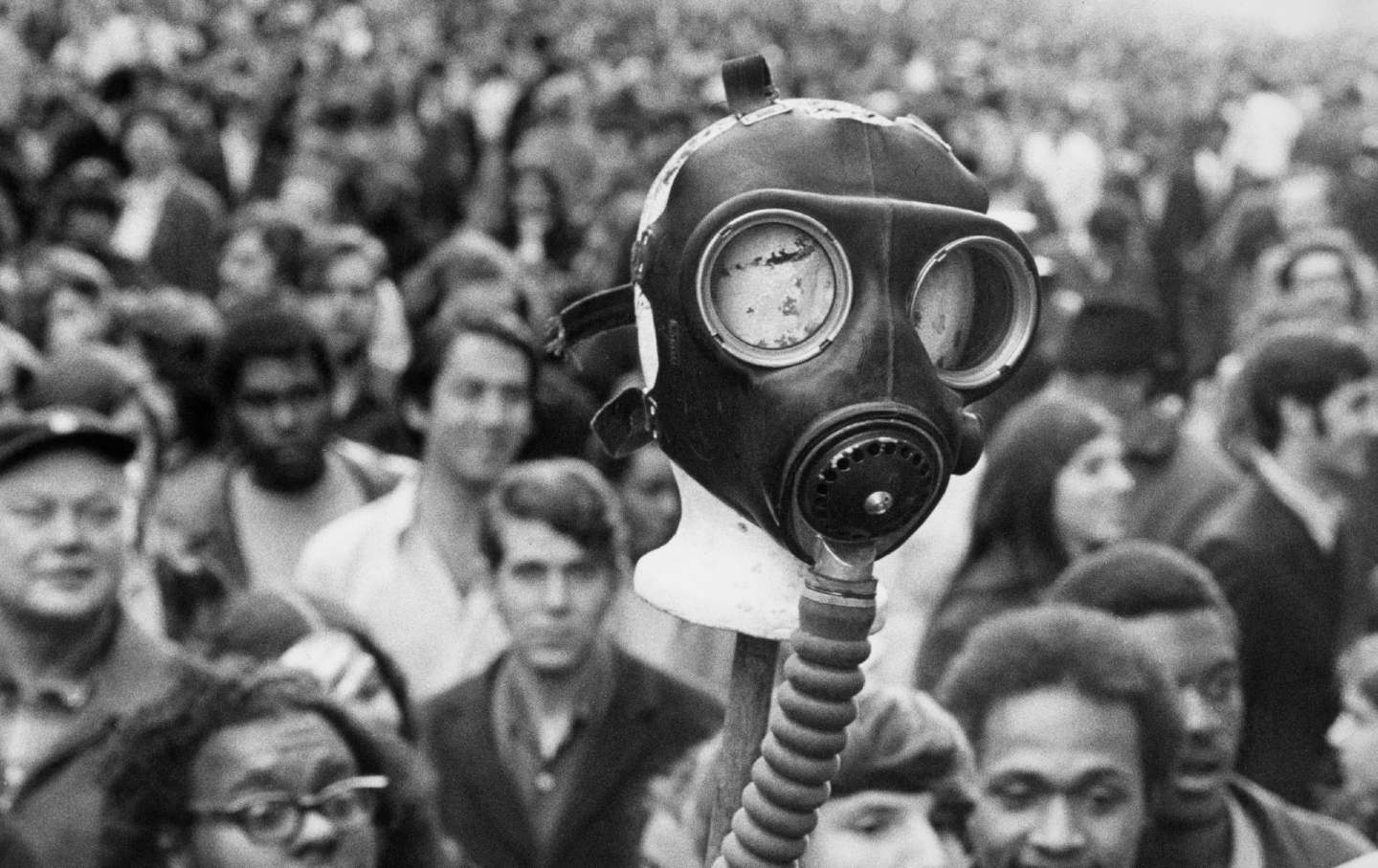
A gas mask is held aloft at the inaugural Earth Day protest in New York City, New York, on April 22, 1970.
(Cyril H. Baker / FPG / Archive Photos / Getty Images)This week, people at hundreds of locations in scores of countries celebrated Earth Day, with activities ranging from tree plantings and trash pickups to conferences and art exhibits. Not many of those people, however, seem to have attended protests, though that is how Earth Day came into being. In 1970, huge, nonviolent protests across the United States drew an estimated 20 million people, an eruption of mass sentiment that President Richard Nixon felt threatened his reelection chances so acutely that he created the Environmental Protection Agency and signed far-reaching environmental laws.
It’s important for journalists to understand the role of protest, partly because our coverage shapes what society as a whole knows about the controversies in question. Of course, we should not become the mouthpieces of protesters, but rigorous reporting does not equate to being a mouthpiece. Our civic role is to ascertain and share the facts as best we can so the public and policymakers can make informed judgments.
Probably no environmental organization in the world is more associated with the tactic of protest than Greenpeace. Nonviolent protest has been part of Greenpeace’s DNA since the group’s founding in 1971, when activists sailed a boat into a prohibited area off the Alaskan coast to obstruct US nuclear bomb testing. Since then, Greenpeace has grown into a global operation, with branches in 55 countries that employ direct action, research, and public advocacy against fossil fuels, species extinction, nuclear power, overfishing, and other environmental scourges.
Now the US branch of Greenpeace may itself be on the brink of extinction, due to a lawsuit arising from the Standing Rock pipeline protests in 2016 and 2017. Energy Transfer, the company building the Dakota Access oil pipeline, sued Greenpeace, charging that it incited the protests through a misinformation campaign. A jury in the oil-and-gas-producing state North Dakota found Greenpeace guilty after a trial studded with irregularities: Seven of the 11 jurors had ties to the fossil fuel industry; the judge refused news organizations access to a livestream of the proceedings; and Greenpeace’s core defense—that it played only a supporting role in a protest that actually was led by Indigenous peoples—was dismissed. Martin Garbus, a human rights lawyer who previously defended such global icons as Nelson Mandela and Vaclav Havel, called it “the most unfair trial” he had ever witnessed.
In March 2025, the jury ordered Greenpeace to pay nearly $667 million in damages. Although later reduced to $345 million, that amount remains exponentially larger than the group’s annual budget and would likely bankrupt it. Greenpeace is appealing. Journalists interested in covering the next phase of the story can find the contending parties’ perspectives here and here.
Timed to Earth Day, the former executive director of Greenpeace USA, Annie Leonard, has co-authored a book making the case for nonviolent protest as an essential tool for bringing about social change. Protest: Respect It Defend It Use It is a global compendium of instances when protesters shifted the course of history, often by telling stories that captured media attention. “Protest interrupts business as usual,” Leonard writes, “shines a spotlight on a wrong or a demand, elevates an issue on the public agenda,” and in so doing has helped deliver “rights and progress we value and may even take for granted today: weekends, women’s right to vote, desegregation, same-sex marriage, cleaner air and water.”
Protest is not for the fainthearted. At least 2,253 defenders of land, forests, or rivers were killed globally between 2012 and 2024, according to the NGO Global Witness. Today, as authoritarian governments and corporations increasingly seek to silence free speech and criminalize activism, our role as journalists remains essential: to inform the public and hold power accountable. Which means treating activists the same way we treat politicians and CEOs: as newsmakers.
Become a Sustaining Donor This September
Between the reemergence of right-wing red-baiting and Donald Trump’s use of the chilling National Security Presidential Memorandum–7 to criminalize left political organizing, we’re seeing McCarthyism reborn before our eyes.
This assault on democracy cannot be ignored or wished away. Resisting it requires bravery in the face of threats and repression, a steadfast commitment to the truth, and the unwavering belief that we can—and will—overcome this darkness.
We must have an independent media that sets the record straight, unearths corruption and abuses of power, and advances a politics of justice and dignity for all if we’re to win this fight.
That’s why I’m writing to you today. This September, The Nation needs to add 100 monthly donors to sustain our progressive journalism. Your contribution makes the next investigative report, the next truth-speaking column, and the next pathbreaking essay all possible.
I hope you’ll support our work with a recurring donation today. If you donate $10 or more a month, we’ll send you a brand new “Hands Off the Free Press!” sticker to recognise your commitment to our cause. Please, donate today.
Onward,
Katrina vanden Heuvel
Editor and Publisher, The Nation