
How California’s Kids Are Taking On Big Oil
After last year’s devastating wildfires, young Californians are spearheading a growing movement to force polluters—not taxpayers—to pay for the damage.
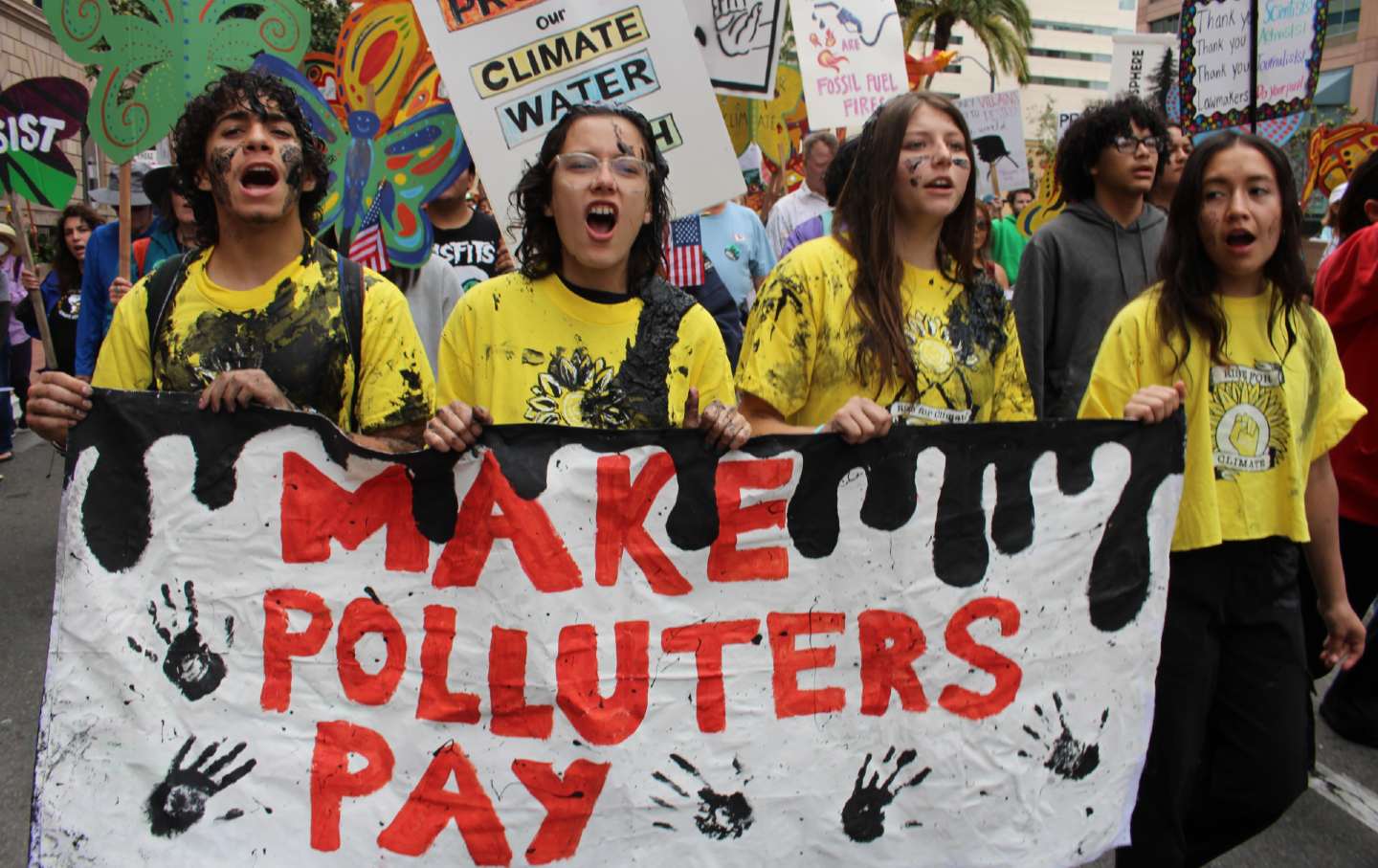
California students campaign for the Polluters Pay Climate Superfund Act.
(McGarrah Wilson)At his home in Pasadena, high schooler Atticus Jackson frantically shoved his belongings into his car as the sky turned a deep orange. A few hundred feet away, the fire climbed up the mountain and a cloud of red and gray smoke obscured the view. He drove out of his city, ash raining down on the sidewalks below, in complete shock. “It felt like my world had been thrown off its center,” he said.
The catastrophic Palisades fire, along with the Eaton fire, razed more than 50,000 acres in southern California. Experts say they were fueled by climate change. Galvanized by the disaster, Jackson founded a Sunrise Movement chapter in Foothills, the area that includes Pasadena and Altadena, to advocate for environmental justice in his community. And, exactly a year after the blaze narrowly missed his house, Jackson met with contingents from the national Sunrise Movement in Altadena for a rally to demand accountability and transparency from local leadership.
As he marched through Altadena twelve months later, Jackson said the streets looked eerily similar to how they did in the immediate aftermath of the fires: “The debris might have been cleaned up, but there were still dozens and dozens of empty lots reduced to the foundation.”
Estimates have ballooned to more than $250 billion in damage, making the fire one of the costliest in US history. “Recovery is happening very slowly, and for a lot of residents, it’s really expensive,” said Jackson. But to him, and the other young people touched by the fires, the solution is clear: make fossil fuel companies pay.
California’s youth have pushed for a state bill that would do just that. The Polluters Pay Climate Superfund Act is modeled after federal legislation that requires companies to clean up toxic spills and hazardous waste sites. The proposal, which has analogous statutes in Vermont and New York, aims to hold fossil fuel companies, not taxpayers, financially responsible for climate change damages like the LA fires.
To youth advocates, the bill is common sense. “If you make a mess, you should be the one to clean it up,” said Sofia Carrasco, a high school activist with San Diego 350’s Youth v. Oil Campaign.
The act has become the flagship policy goal for environmental advocacy organizations like Sunrise Movement and 350.org, who are touting it as a mechanism to address the growing costs of climate change. Amid California’s projected $3 billion budget deficit, it offers a new source of funding for the state. Around 40 percent of the funds would also be specifically earmarked for disadvantaged communities most burdened by environmental impacts, like air pollution.
“The biggest thing we hear when we try to implement some sort of solution is that we don’t have the money,” said Mani Bekele, a San Jose high schooler and climate activist. “This bill provides an answer to that question, ‘where’s the money going to come from?’”
Unsurprisingly, the superfund bill is not nearly as popular among legislators. In April 2025, Senator Caroline Menjivar and Assemblywoman Dawn Addis, who authored twin bills in both legislative chambers, canceled scheduled committee hearings for the legislation in hopes of receiving more support later in the year. But the bill continued to stall afterwards until it passed its January 2026 deadline and officially died.
“It’s not unusual for meaningful legislation to take time,” said Christina Scaringe, California policy director for the Center for Biological Diversity, a sponsor of the bill. In New York, a similar climate superfund law died in assembly after its first introduction, but later passed into law in 2024. “While the 2025 bill vehicles may now be dead, the campaign is growing and the work continues.”
Scaringe attributes the bill’s failure to fossil fuel lobbyists who, along with building trade unions, say the act will drive up gas and electricity prices.
“Higher costs lead to increased energy prices, adding financial strain on working class families who are already struggling to survive in our nation’s most expensive state,” said Keith Dunn, a representative for the California’s State Building and Construction Trades Council—a union notorious for allying with fossil fuel interests and staunchly opposing environmental bills.
Economists in a 2022 NYU’s Institute for Policy Integrity study found that, contrary to what industry voices have argued, the climate superfund bill in New York likely wouldn’t drive up costs at the pump, since oil companies would still have incentives to keep their prices at competitive market levels.
But, that positive prediction has not tempered the concerns of California’s biggest fossil fuel players. “Oil companies have an incentive to overestimate the impact [the bill] would have on consumers,” said Ethan Elkind, Climate Program Director at UC Berkeley Law.
In the first quarter of the year, superfund opponents spent 10 times the amount environmental groups did to lobby against the bill. “These fossil fuel giants…are working overtime to kill superfund bills,” said Scaringe. “The policy is effective and well-grounded in law and science, but these industries recognize the threat of potential accountability.”
Their capacity for big spending paired with their hostility towards green legislation makes challenging fossil fuel interests daunting. According to Elkind, even California climate policy, reviled by the right for its supposed extremist quality, has predominately focused on promoting fossil fuel alternatives, like electric vehicles and carbon capture, rather than on confronting the fossil fuel corporations directly.
Jackson says he’s disappointed in his legislators for letting the bill stall. “In an overwhelmingly Democratic state like California, I would think that environmental legislation like this would be an easy yes, especially in the aftermath of the LA fires,” he said. “I’m about to graduate high school and inherit an environment that is not as resilient as it was decades ago…The solutions are here, but we choose not to use them.”
Popular
“swipe left below to view more authors”Swipe →According to the office of Senator Caroline Menjivar, who authored one of the bills, Menjivar will not be reintroducing the legislation this year. “It does not have the votes to move forward so we passed it,” said Teodora Reyes, communications director for Sen. Menjivar’s office. Additionally, there was no consensus on what version could move forward as an alternative.
Jackson and other students across California are hoping the bill can be reintroduced in 2027. In the meantime, they’re doubling down on their advocacy in hopes of showing legislators how much public support is behind the bill.
Across the state, students have lobbied their city councils to pass resolutions endorsing the climate superfunds, a symbolic gesture of support that they hope will sway state legislators. So far, 28 cities, counties, and school boards have passed a resolution supporting the bill.
Jackson, who is working with the Sunrise Movement to pass his own resolution in Pasadena, says that these kinds of actions keep the moment alive. “We don’t want to see the bill as dying or dead,” said Jackson. “Instead, it is an opportunity to tell lawmakers that we are not going to go down quietly and a reminder to big oil that this is not a win for them.”
Elkind says the bill’s future will “boil down to coalition politics” and whether supporters can gather enough public support. “Ultimately, the politicians have to answer to the voters. So, if there’s something that the public is paying attention to, [politicians] are going to do what’s popular, not what interest groups want,” said Elkind.
Encouragingly, despite their best efforts, fossil fuel companies have not managed to curb overwhelming public support for this kind of legislation. According to nationwide polling conducted by Data for Progress, 77 percent of Americans support a climate superfund bill. “The fossil fuel lobby [has] a lot of money to influence and lobby the state legislature,” said Bekele. “They have that resource. But our coalition has the resource of public opinion.”
Become a Sustaining Donor This September
Between the reemergence of right-wing red-baiting and Donald Trump’s use of the chilling National Security Presidential Memorandum–7 to criminalize left political organizing, we’re seeing McCarthyism reborn before our eyes.
This assault on democracy cannot be ignored or wished away. Resisting it requires bravery in the face of threats and repression, a steadfast commitment to the truth, and the unwavering belief that we can—and will—overcome this darkness.
We must have an independent media that sets the record straight, unearths corruption and abuses of power, and advances a politics of justice and dignity for all if we’re to win this fight.
That’s why I’m writing to you today. This September, The Nation needs to add 100 monthly donors to sustain our progressive journalism. Your contribution makes the next investigative report, the next truth-speaking column, and the next pathbreaking essay all possible.
I hope you’ll support our work with a recurring donation today. If you donate $10 or more a month, we’ll send you a brand new “Hands Off the Free Press!” sticker to recognise your commitment to our cause. Please, donate today.
Onward,
Katrina vanden Heuvel
Editor and Publisher, The Nation
More from The Nation

Gavin Newsom Comments on Climate Gavin Newsom Comments on Climate
On the sidelines of the UN General Assembly meeting and New York Climate Week, the California governor called AOC “the real damn deal.”

Cities as Climate Labs: Inside the U20 Summit Cities as Climate Labs: Inside the U20 Summit
Mayors at the Urban 20 Summit worked across borders to confront the climate crisis at the local level.

Big Oil’s Origin Story Big Oil’s Origin Story
Amy Westervelt’s new book, Brought to You By, exposes the deep history of today’s “information pollution.”
Two Years After Helene, North Carolina’s Unsettled Recovery Two Years After Helene, North Carolina’s Unsettled Recovery
The state has become a testing ground under an eviscerated FEMA and a missing-in-action “recovery czar,” Michael Whatley, with big political ambitions.

A Reckoning Comes for Nepal A Reckoning Comes for Nepal
A year after its Gen Z uprising, Nepal faces a struggle not only for democracy and human rights but for climate survival.

How a Creative Mind Lives in Nature How a Creative Mind Lives in Nature
Working in the wilderness could not satiate my intellectual impulses. But for the protagonist of Hothouse Bloom, the binary between mental and physical labor is what calls her.

