
The TikTok Case Could Open the Floodgates to More Corporate Influence on the Media
Whether or not we agree with the Biden administration’s arguments, progressives shouldn’t root for the court to rule in favor of Tik Tok.
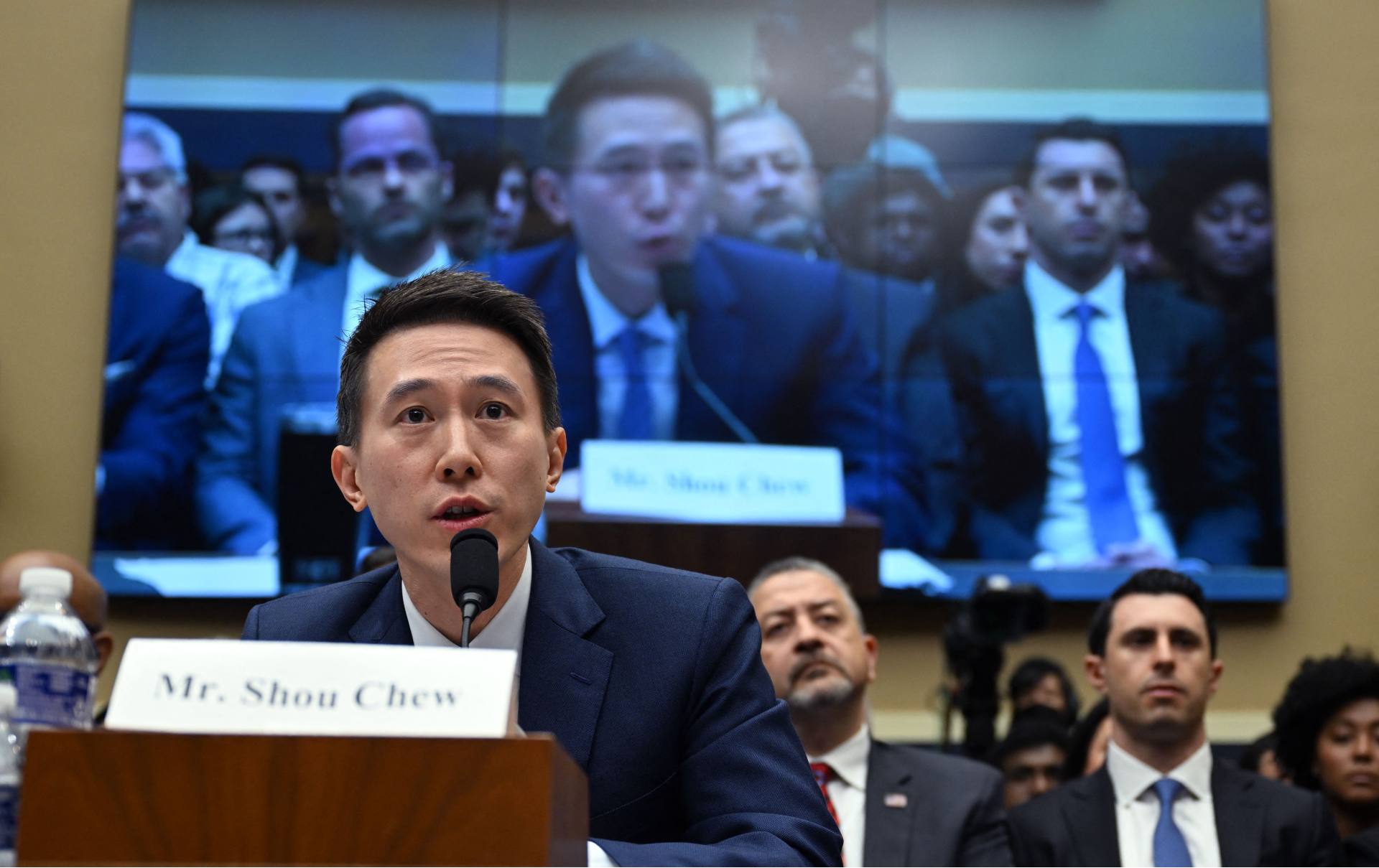
On Thursday [January 10], the Supreme Court is holding a special, extended, two-hour oral argument on an emergency petition. The question before them is whether the looming forced divestiture of TikTok in the United States is constitutional.
But this case is about far more than whether the United States should allow a Chinese-controlled TikTok to operate in the US. It’s about corporate speech rights, and the nature of national sovereignty. Even if you don’t agree with Biden’s argument about TikTok, you shouldn’t be rooting for the court to strike down the law. You should be rooting for this court—which can get a little trigger happy with corporate speech rights—to say nothing at all.
That’s because there’s a real possibility that the court could reject TikTok’s specific plea but nonetheless give Big Tech companies a road map for insulating themselves from regulation by describing social media rights in sweeping First Amendment terms.
The emergency petition was brought by TikTok, asking the court to temporarily block enforcement of the Protecting Americans from Foreign Adversary Controlled Applications Act (PAFACA). Signed into law last April, PAFACA uses an existing framework that identifies China, Russia, Iran, and North Korea as “foreign adversaries” and bans the use in the US of apps controlled by any such country. Without court intervention, the Chinese government-controlled ByteDance will be required to sell TikTok by January 19.
TikTok’s constitutional argument is grounded in corporate speech rights cases. They and their supporters argue that (a) TikTok has its own First Amendment rights, (b) Americans use TikTok to share information and express themselves, and (c) since the law restricting who can own it might lead to the Chinese government withdrawing it from those Americans altogether, the law violates the First Amendment rights of American users. Unsurprisingly, it cites Citizens United in support of all of these claims.
Before the 1970s, such an argument would have been plainly invalid. Restrictions targeting foreign government involvement in domestic politics are taken for granted as a feature of sovereignty across the globe. While TikTok emphasizes that it is a communications platform to bolster its arguments, sovereign limits on foreign ownership have been particularly concentrated in communications industries. Argentina, Canada, the United States, and many other countries have limits on foreign ownership of television and radio networks. TikTok is prohibited on official devices in the European Union, the United Kingdom, and Austria, and wholly banned because of Chinese ownership in India. In November, the Canadian government required TikTok to dissolve its Canadian business.
The founding fathers embedded restrictions on foreign governmental interference in our constitutional structure. At the Constitutional Convention, Alexander Hamilton cautioned that “foreign powers also will not be idle spectators. They will interpose, the confusion will increase.” The Foreign Emoluments Clause, which we know too well—if only because of Trump’s repeated violations of it—bars federal officeholders from accepting payments from foreign governments. The high bar for treaty ratification grew out of James Madison’s fear of “the power of foreign nations” to interfere in treaty negotiations.
American statutes have consistently applied foreign ownership restrictions to the communications sector. Driven by fears that foreign adversaries might use radio to influence policy, Congress passed the Federal Radio Act, which authorized the precursor to the FCC to license radio companies, and added a 20 percent limit on foreign stockholding to the restrictions from the 1912 Act. The Communications Act of 1934 includes a section prohibiting a foreign government or its representative from holding any radio license. The constitutionality of these rules was taken for granted.
A series of cases in the 1970s that had nothing to do with foreign ownership—but everything to do with a novel understanding of the First Amendment—set the stage for the questions the court is facing this week.
Two big 1970s cases, Virginia State Pharmacy Board and Bellotti, reframed the First Amendment as not solely the right to speak but also a right to hear—including corporate speech. The first case, brought by Ralph Nader and Public Citizen, established that corporations cannot be limited in pharmaceutical advertising because consumers have a right to hear ads. The second, in an opinion by Justice Powell—with a fierce dissent by that well-known radical William Rehnquist—concluded that members of the public had the right to hear political persuasion by banking corporations, and so states couldn’t ban corporate speech around referendums.
It was a neat trick, one that sounded reasonable, but in practice led to the explosion of corporations using the First Amendment to strike down any laws that limited their reach. The most famous of these cases was Citizens United v. FEC, which relied on Bellotti to conclude that individuals had a right to hear corporate ads about candidates for office.
One question that haunted all these cases was the one now at issue in the TikTok case: If corporate speech rights are grounded in a right of Americans to hear, wouldn’t foreign governments gain the same kind of protection-by-reflection? How can there be a “right to hear” ExxonMobil ads without a “right to hear” Russian ads?
Popular
“swipe left below to view more authors”Swipe →My own view is that the entire “right to hear” enterprise was a misinterpretation of the First Amendment, and that while courts should strike down viewpoint-based restrictions, they should allow states and the federal government to impose content-neutral corporate speech rules. But I don’t think a hasty New Year’s oral argument is the time to work through all these questions.
The other big potential issue here is how the court characterizes the “speech rights” of social media platforms themselves. In a series of cases, including Netchoice v. Moody, the court has repeatedly punted on questions of how to think about algorithmic feeds. The ACLU, which has been leading the charge on expanding corporate speech rights since Buckley v. Valeo, filed a brief seeking an expansive vision. But that could mean states wouldn’t be able to limit social media’s targetting of teenagers, or regulate potentially dangerous algorithms (like those that deluge anorexic teenagers with weight loss videos).
The politics of the case are all over the place; Donald Trump attempted to require a TikTok sale in his first administration, but changed his mind after billionaire TikTok investor Jeffrey Yass became one of his biggest donors. Biden supports the law, as do most Democratic lawmakers, but public support has bounced around, and it is now mostly unpopular. Even if the Supreme Court upholds the law, Trump has several ways in which he could effectively reverse the divestiture requirement—after he becomes president.
I’ve read several of the amicus briefs filed in this case, and found them a little scatterbrained. SCOTUS gave interested parties less than two weeks over a holiday break to file, so there’s a degree of sloppiness by the amici that is unusual for Supreme Court arguments. I’d include the brief I filed in this category—while I stand by the arguments, cites were only checked once, and the structure was thrown together. So why file at all?
For me, the urgent need to file flowed from the long echo of Buckley v. Valeo, the first case in which the Supreme Court discovered that money is speech. That was another hastily decided case, where the justices put speed over thoughtfulness so that they could rule before the 1976 elections. They ended up splitting the baby: upholding contribution limits while striking down spending limits, and turning four generations of politicians into professional fundraisers instead of representatives. It effectively institutionalized corruption in America. We don’t need any more such Solomonic wisdom right now.
Become a Sustaining Donor This September
Between the reemergence of right-wing red-baiting and Donald Trump’s use of the chilling National Security Presidential Memorandum–7 to criminalize left political organizing, we’re seeing McCarthyism reborn before our eyes.
This assault on democracy cannot be ignored or wished away. Resisting it requires bravery in the face of threats and repression, a steadfast commitment to the truth, and the unwavering belief that we can—and will—overcome this darkness.
We must have an independent media that sets the record straight, unearths corruption and abuses of power, and advances a politics of justice and dignity for all if we’re to win this fight.
That’s why I’m writing to you today. This September, The Nation needs to add 100 monthly donors to sustain our progressive journalism. Your contribution makes the next investigative report, the next truth-speaking column, and the next pathbreaking essay all possible.
I hope you’ll support our work with a recurring donation today. If you donate $10 or more a month, we’ll send you a brand new “Hands Off the Free Press!” sticker to recognise your commitment to our cause. Please, donate today.
Onward,
Katrina vanden Heuvel
Editor and Publisher, The Nation
More from The Nation

The Promises and Compromises of the University of California The Promises and Compromises of the University of California
I grew up in a neighborhood manufactured by the University of California, Irvine. It felt like a utopia for academics—until the university forsook its mission of serving the publi...

Is Platonic Co-Parenting the Future of the Family? Is Platonic Co-Parenting the Future of the Family?
Disillusioned with the nuclear family and apprehensive of tethering their reproductive futures to the bleak hellscape of modern love, young people are seeking a different way.

How Trump’s Crackdown on Speech Has Damaged the Student Press How Trump’s Crackdown on Speech Has Damaged the Student Press
I serve as editor in chief and president of The Stanford Daily. Our newsroom has keenly felt the effects of Trump’s campus crackdown, which is why we sued the federal government.
Treat Spotify Like a Public Utility Treat Spotify Like a Public Utility
Music streaming platforms have way too much control over musicians and music lovers. It’s time to rein them in.
What’s the Matter With Effective Altruism? What’s the Matter With Effective Altruism?
President Trump has decried the techbro creed for indulging in AI doomerism, but its excesses are far worse than that.

