The Ugly History of the Law Used to Target Mahmoud Khalil
From the moment the McCarran-Walter Act was passed in 1952, The Nation has sounded the alarm about the danger it posed to politically active immigrants.
Donald Trump and his advisers have cited the Immigration and Nationality Act of 1952, also known as the McCarran-Walter Act, to justify the arrest and deportation of Palestine solidarity activists like Mahmoud Khalil. Without supplying evidence that Khalil has ties to Hamas, the administration argues that an obscure provision in the law allows “any aliens or class of aliens” to be deported if their presence is deemed to have “potentially serious adverse foreign policy consequences.”
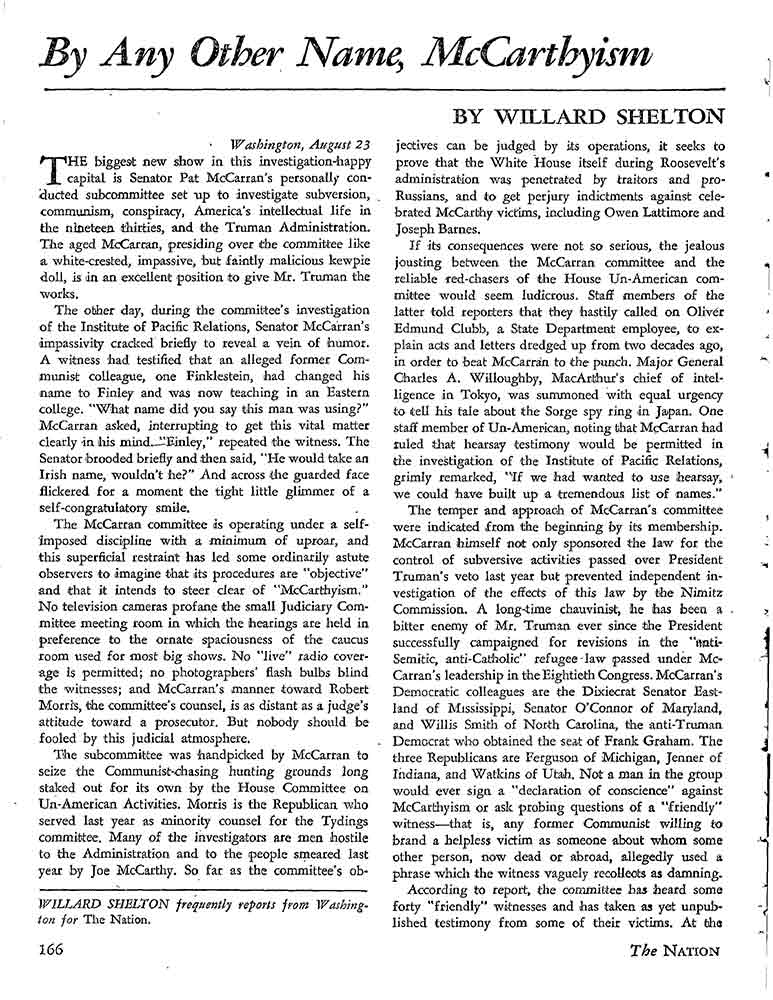
Pat McCarran, one of the act’s coauthors, was a conservative Democratic senator from Nevada and a known racist and antisemite whose disregard for civil liberties was consistently condemned by this magazine. His Internal Security Act of 1950 required communists to register with the federal government and established a board to investigate those accused of subversive activities. “This was the year of the McCarran act,” The Nation observed, “a year in which fear spread poison on all levels of American life.” Reporting on McCarran’s work ferreting out subversives, The Nation’s Willard Shelton commented in 1951, “Inquisitors have come and gone, but the witch hunt continues, snaring more victims, manufacturing new heresies, mounting steadily in virulence.” The Supreme Court later struck down most of the law as a violation of the First Amendment.
In 1952, in an effort to bar entry to communist sympathizers and deport those already here, McCarran helped draft the immigration law that Trump is now invoking. In The Nation, civil rights lawyer Alex Brooks tried to warn readers about the bill as it made its way through Congress: “Exclusion or deportation is not based on whether an alien has actually done something wrong but on whether an immigration official is ‘satisfied’ or ‘has reason to believe’ he has. The Attorney General is even empowered to sanction deportation or deprive a resident of his precious citizenship when certain facts appear in his ‘opinion’ to warrant such drastic action.”
In 1984, the Reagan administration began an effort to deport the feminist author (and onetime Nation contributor) Margaret Randall because her writings went “against the good order and happiness of the United States.” Randall had been born in the US, but she inadvertently lost her citizenship when she became a Mexican citizen in 1967. David Cole, then one of Randall’s attorneys and now The Nation’s legal affairs correspondent, explained the stakes of her case. To enforce the 1952 law against those who posed no real threat to this country, he wrote, would be “to adopt the very totalitarian precepts from which the McCarran-Walter Act was purportedly designed to save us.”
Become a Sustaining Donor This September
Between the reemergence of right-wing red-baiting and Donald Trump’s use of the chilling National Security Presidential Memorandum–7 to criminalize left political organizing, we’re seeing McCarthyism reborn before our eyes.
This assault on democracy cannot be ignored or wished away. Resisting it requires bravery in the face of threats and repression, a steadfast commitment to the truth, and the unwavering belief that we can—and will—overcome this darkness.
We must have an independent media that sets the record straight, unearths corruption and abuses of power, and advances a politics of justice and dignity for all if we’re to win this fight.
That’s why I’m writing to you today. This September, The Nation needs to add 100 monthly donors to sustain our progressive journalism. Your contribution makes the next investigative report, the next truth-speaking column, and the next pathbreaking essay all possible.
I hope you’ll support our work with a recurring donation today. If you donate $10 or more a month, we’ll send you a brand new “Hands Off the Free Press!” sticker to recognise your commitment to our cause. Please, donate today.
Onward,
Katrina vanden Heuvel
Editor and Publisher, The Nation