
How Mona Chalabi Explains Income Inequality
An interview with the data journalist about how she uses numbers and design to illustrate how class weighs on the lives of Americans.
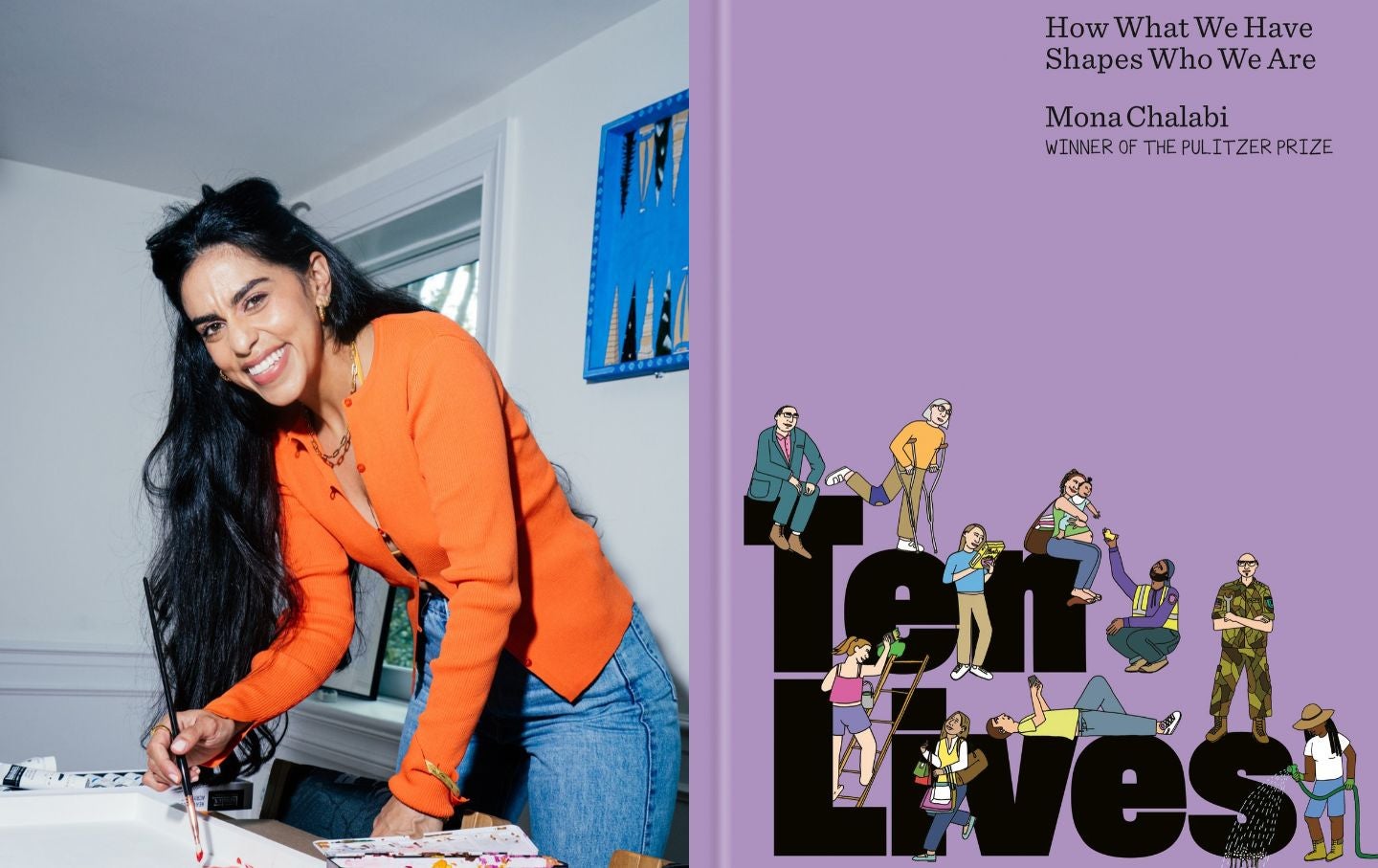
Mona Chalabi and her new book.
(Mona Chalabi)Iraqi British journalist Mona Chalabi is trying to convince the world that data visualization is cool—and it’s working. She has amassed a significant social following with her whimsically hand-drawn and boldly color-blocked figures that foreground what she calls data’s “human aspect” and make it more legible and engaging. Chalabi—who was formerly a data editor at The Guardian and is presently a lecturer of graphic design at Al-Quds Bard in Palestine—has come to be known for using these tools to make social issues the center of her work. The data journalist was awarded the 2023 Pulitzer Prize in Illustrated Reporting and Commentary for her New York Times series depicting the staggering wealth gap between Jeff Bezos and average Americans.
In her first book, Ten Lives: How What We Have Shapes Who We Are, she again turns her pen to the problem of money in America by mapping the country’s “economic universe”—i.e., the financial lives of 10 representative Americans of different income deciles. These include a woman working as a birth surrogate for supplementary income, a recent divorcée, a Gen Z rideshare driver recovering from gambling addiction, and a veteran conflicted about his need for disability assistance. She explores how much people have and don’t have, where it comes from, its relationship to their health and sense of identity, all with her trademark visual flair. (One figure from the book depicting mortgage denial rates by the race or ethnicity of applicants replaces the usual bars in a bar graph with upturned middle fingers that get progressively larger). She also weaves her own financial portrait with theirs, showing remarkable transparency about her career earnings and family history in recognition of how we’re all implicated in each others’ universes. The book reflects Chalabi’s personal commitment to not participating in the harmful but normalized practice of looking away from social inequities. Below, she talks to The Nation about the journalistic rules she’s happy to break, and how data can help reveal, and potentially overthrow, unfair systems.
—Naomi Elias
Naomi Elias: Why did you land on money as the subject for your first book?
Mona Chalabi: At the start of Covid, when I was worrying about money, and I was thinking about the forces that had shaped my life. I mentioned in the book how on the one hand I felt precarious, but also I was not precarious at all, which is kind of a theme throughout the whole book, people feeling precarious even despite not necessarily being. I lived on the third floor of a Brooklyn brownstone at that point, and I remember seeing some of my neighbors, the people who owned their full brownstones, descending and climbing into their Range Rovers and just disappearing upstate. The streets literally emptied. And those of us that were left behind had a different kind of exposure to the pandemic because of class. And at the same time, we were also far less exposed than the people working in Amazon, for example, who were delivering our goods, the people who were stocking the shelves in the supermarket while we wandered around with our masks on. It was really clear to me that class really, really mattered.
NE: Why the focus on income and not wealth?
MC: Partly pragmatism. It would be really hard to extract that data from the people that I was interviewing, because sometimes their wealth actually isn’t even known to them. There are instances where people don’t exactly understand how much money their partner might have. And, for reasons I talk about in the book, I really focus on the household rather than the individual.
It also requires a different kind of honesty. I already found it so remarkable that people would just sit down for hours and hours detailing their finances to me. If I would have started to get into how much they were going to inherit from their parents, I don’t know if I could have relied on the same kind of honesty from them. And more importantly, the fact-checking would have been harder. It’s one thing to gain consent from them to tell me the story, but it’s another thing to then contact their parents and be like, “So, how much wealth exactly do you have?”
NE: When you narrowed down the responses to your questionnaire, in order to find “ten representative Americans,” what sort of demographics were on your mind?
MC: There were groups that I wanted to see represented, that I didn’t hear from. For example, I think it’s a failing of the book that I don’t have anybody who’s Native American in there. It’s not perfectly representative. I did know that I didn’t want these 10 people to be white; I didn’t want them to live on the two coasts. I did find that just because of the nature of my Instagram following—and by the way, obviously I didn’t find everyone through Instagram—but a lot of the people who responded were between 20 and let’s say early 40s, and I wanted a bigger age range than that. I did want to have some gender representation. I definitely wanted to include some disability representation. There were so many different boxes that I wanted to check, and what happened was that certain themes that I knew that I wanted to explore—like gambling addiction, like surrogacy—meant that I just set aside whoever was responding to me, and I went out looking for those people by going through nonprofits or through chat forums or whatever it might be to find someone who was navigating that particular world.
NE: Over the course of the years you worked on this book, subjects’ financial circumstances changed sometimes dramatically, which created really interesting storylines, as in the case of you meeting Chris Smalls before he became president of the Amazon Labor Union. How did that evolving data affect the story you were telling?
MC: That definitely wasn’t the plan. When I first sold the book, I was like, “Yeah, I’m going to have this written for you in 18 months.” Completely delusional and arrogant. And in a way that was actually a blessing, because if I just did three interviews with each person, a snapshot of their lives, I wouldn’t have seen that evolution. It’s because I struggled so much to find those 10 people, and each interview just led to so many more questions for me to understand them. Their lives did change. I mean, Chris’s a really dramatic one, but all of them. It’s depressing to me that when I met Tiffany [a 46-year-old Black goat farmer in Ohio representing the book’s poorest decile], one of the first times we spoke, she was like, “God, I would hate to be working in Burger King.” And then on one of our calls she’s like, “Yeah, I had to start working at McDonald’s.” So, yeah, their lives did change quite dramatically, as did mine. I think the book is stronger for it, and it changed the nature of our conversations. If I had done that snapshot approach, I don’t think there would have been that same kind of emotional investigation. There’s a vulnerability in disclosing numbers, and there’s also a vulnerability in admitting to working in Burger King when it’s the very thing that you said you never ever wanted to do.
NE: I’m interested in how you view hand drawing as a way of visualizing imprecision and why you think that’s important in data visualization.
MC: It’s fundamentally more honest. Many of the data sets that I’m looking at, the underlying information actually does have quite a big margin of error. So to present in these really clean charts is fundamentally a bit misleading. I was working with data that did have that degree of precision, but even then I want people to be able to see the respective scale of these bars as opposed to things with decimal places. Including these wobbly lines, the idea is that you see that the underlying data is imprecise, and it reminds me of this human aspect of the data, like, a human was responsible for choosing which variables to gather, what time period. It’s also about what is in vogue in terms of data collection. There’s so much bias that is involved. I hope that by presenting information in this way, I’m not hiding from that. It’s a bit more explicit: Here’s my hand and my pen and where my bias lies as I’m presenting this to you.
NE: All journalistic mediums (editorial, broadcast) are dealing with the attention span issue in their audiences. How does that influence your artistic choices?
MC: I’m much more familiar with how to navigate that on social media. I will often present an extremely simplified version of the statistics and then kind of gradually complicate it. And that’s obviously a really difficult line. You never want someone to have walked away with a version that is so simplified and abstract that it’s wrong, basically. And so, it’ll be a case of when I’m saying breaking it down into pieces, it might be that the title gives you the most simple takeaway, and then there’ll be one asterisk in the graphic and then another one. I’m trying to kind of guide where your eye goes in terms of how you’re consuming that information. I call that iterative storytelling. If you imagine on Instagram, it’s like each swipe is a different part of the story and I guess in a way, each chapter here is like another swipe and another complication.
NE: You break with some journalistic practices in this book by paying your interviewees and including yourself and your financial history in the story. What was behind that choice?
MC: I actually did more than that. Another practice that I broke with was I sent them the chapters prior to publication, which you don’t normally do. That felt really important to me, and I said that I would do that right from the start, even though nobody asked. And obviously the consequence of that was that not everyone was super happy with their chapter. Some of that actually did result in a little bit of a negotiation, which is why I did it. I’m willing to make a little sacrifice so that you don’t feel bad about this project.
Popular
“swipe left below to view more authors”Swipe →Then to speak a little bit to the other principles that you mentioned that I parted with, disclosing my personal circumstances was really unpleasant, and it’s the reason why I’m very, very anxious about talking to you right now, why I’m anxious about the book coming out. I’ve done work in the past that has been a bit revealing, but this feels really different. I felt like there was no way I could make this argument that many of us are navigating shame about our finances and a lot of us are dishonest, and that actually we need to have much more frank conversation about class.… How could I do all of that without actually walking the walk? And because so much of the book is actually claiming a very important way to address inequality is redistribution, hoarding up all of the assets that I got from the book felt wrong. Look, I know it’s really complicated if we just change the journalistic norm and everyone can be paid for participating in journalism, but to write a book about class and to interview people who literally, in some cases, were really struggling, and to just take those stories and make money from writing those stories without paying them money, I kind of think it’s indefensible.
NE: You express a desire for this book to encourage people to make “collective economic demands on government that are more specific and more powerful than ‘tax the rich,’” which I found interesting because you once said data journalism is not suited to a radical agenda “because all it can do is show you the consequences of the system and not how it operates.” Do you still believe that and how does your work address that issue?
MC: I do think in a way the book is still showing you a lot of the consequences of how the system is operating. At least the charts are doing that. A lot more of the back and forth, the actual transcripts, are revealing more of the how. I still do think that there’s a lot of truth in that. I hope that this book is not solely a work of data journalism, because if it were just that, I don’t think it would be a radical book. I don’t even know if it’s radical. It’s funny, I was approached about writing a book for a few years before I undertook this and a lot of them were conversations about basically publishing a collection of my graphics, and that was so uninteresting to me. I have no desire to do a coffee-table book of my illustrations. I was really clear about this when we were really figuring out the design, but the illustrations and the charts are in service of the text. I still believe that data journalism alone is never going to assure a radical agenda, because when it’s done badly it can have this silencing effect on individual voices.
NE: And when done correctly?
MC: I just did a silly little chart yesterday about intergenerational mobility. It was about the percentage of people that earn less than their parents. And a few people said, “This makes me feel better.” I think really good data journalism actually galvanizes people to become more radical because it lets you know that there’s this tendency to internalize many things and assume that it’s our individual shortcomings.
I spoke to one of my closest friends this morning, she was my French professor, and one of the things that we have spoken about in the past is the fact that in France it’s illegal to collect data on religion. That’s because of the French concept of secularism, which they’re obsessed with, which I understand in theory, but what it means is that it’s virtually impossible to prove, on a systematic basis, Islamophobia in France. Now, Muslims in France aren’t like, “Oh, I don’t know if Islamophobia exists. I haven’t seen the data or I haven’t seen the chart.” They are well aware of the fact that Islamophobia exists, that anti-Arab racism exists. And I understand the arguments that some French people will make to me, that what does it do to let’s say a 17-year-old boy who is the child of North African immigrants, to see what his chances are of going to college? Is that massively demoralizing? Or does it contextualize their struggle and let them know that it’s not them? I think really good data journalism does reveal some of these systems.
I wrote an article for The Guardian ages and ages ago, and they never ended up publishing it. As soon as Trump took office, I went around and interviewed a bunch of people who worked at the Census Bureau, including the former Census Bureau director. And I was like, “Things are about to get bad, aren’t they?” And everyone was very clear on like, “Yeah, they’re about to get bad.” I think the fact that Trump, as is the playbook of authoritarian regimes, is interested in dismantling the data sets that reveal discrimination on a systematic basis means that it’s not for me to be sitting there pondering about the efficacy of these things. If he believes that those numbers matter, then I fucking believe they matter.
Like, this might feel like a stretch, but it’s something I’ve been thinking about. I wanted to create a chart on suicide rates in the Israeli military, and they stopped publishing those statistics a few years ago. And I’m like, OK, if you believe that those statistics are harmful, then I want them even more. I really, really want to understand what’s going on. I hope I’m communicating both that, yes, I believe that these data sets matter, that it matters to see.… One of the data sets that [Trump’s] stopping is the one that shows employment discrimination. I want that data set to continue to be able to see racial patterns in employment discrimination. And I don’t believe that relentlessly collecting that data, documenting that data, publishing the data is sufficient to overturn the systems that we have. So it’s both things. It’s not blind faith and adoration of numbers at all.
More from The Nation
How Did New York Become So Unequal? How Did New York Become So Unequal?
A new history of New York examines how it went from a center of social-democratic experiment to one of neoliberal devastation.
The EEOC Is Failing Workers While Hunting for Discrimination Claims From White Men The EEOC Is Failing Workers While Hunting for Discrimination Claims From White Men
Investigators are rapidly closing out claims of workplace discrimination so that they can search for the kinds of cases chair Andrea Lucas most wants to find.
The Country Repudiated Bigotry in This Election. Will the Sports World Follow? The Country Repudiated Bigotry in This Election. Will the Sports World Follow?
If we follow the lead of billionaire team owners, toxic cable news channels, and misguided athletes, it’s a resounding no. That just means we need to forge our own path.
Rethinking the Early History of North America Rethinking the Early History of North America
Peter Mancall’s new book reframes the history of the American continent as a zone of encounters between Native peoples, European empires, and African societies.
Do Socialists Even Believe in Socialism Anymore? Do Socialists Even Believe in Socialism Anymore?
The American left has a growing list of victories—and an unfinished argument about the society it wants to build.
Feature / Mike Beggs, Ben Burgis, and Bhaskar Sunkara
A Rogue DA in No-Man’s Land A Rogue DA in No-Man’s Land
A strange case of prosecutorial misconduct during a murder investigation in the Oklahoma panhandle.

