Lady of the Moors
Who was Emily Brontë?
Who Was Emily Brontë?
A new biography tries to reconstruct her everyday life.
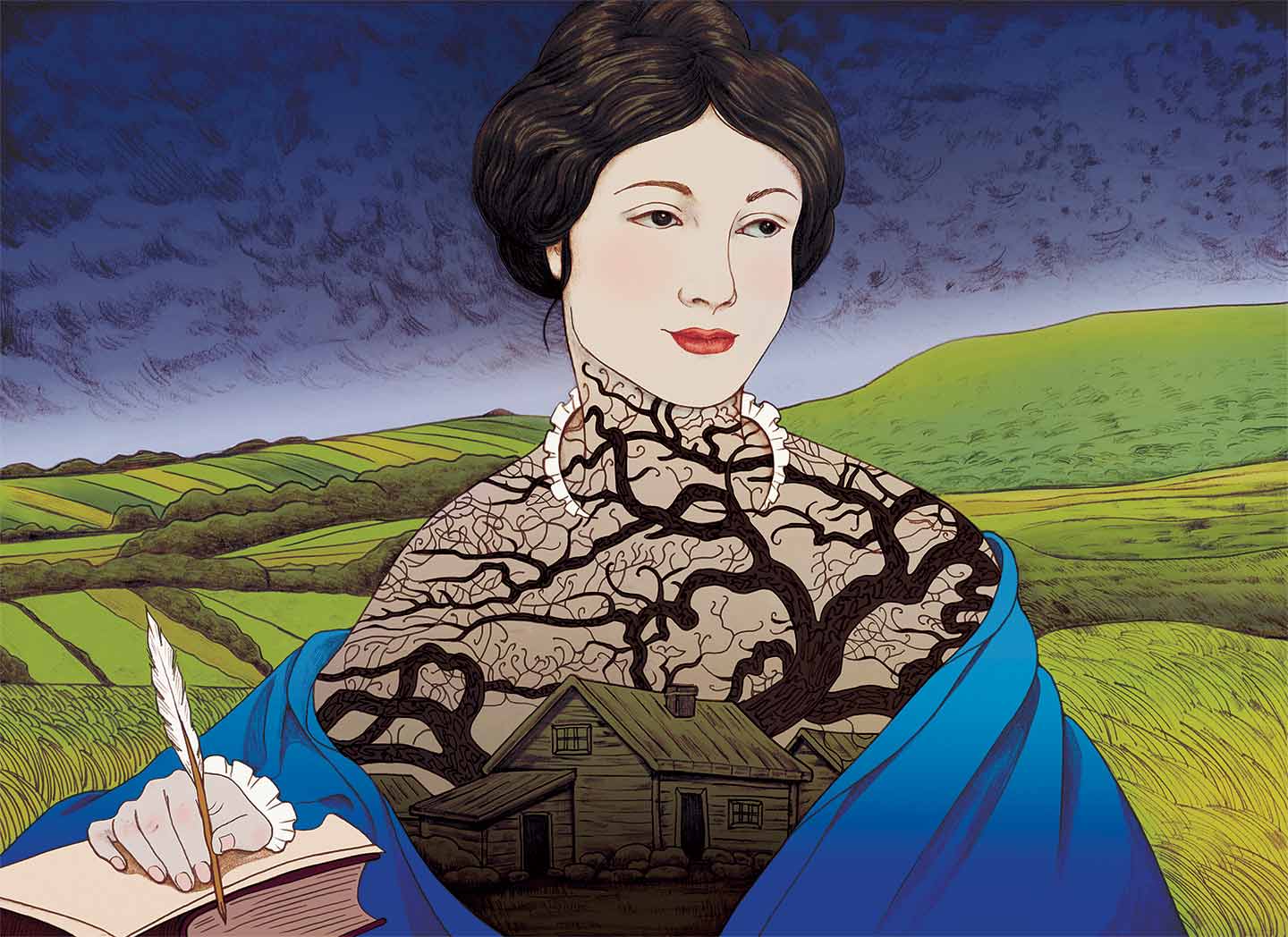
At first, I felt resistant to the idea of reading an Emily Brontë biography. After all, Brontë did not make herself the most approachable author—or person, for that matter. If you take Elizabeth Gaskell’s word for it, she was “never happy nor well but on the sweeping moors that gathered round her home—that hater of strangers, doomed to live amongst them.” Nobody knows what endowed her with such fierceness and strangeness or made her do what she did or write what she wrote. As someone who has read nearly everything she wrote that survives, I must confess that I didn’t really want to know. Brontë herself, after all, seems to have wanted her readers to know nothing about her, not even her real name.
Books in review
This Dark Night: Emily Brontë, A Life
Buy this bookIn her new biography of the unknowable Emily, This Dark Night, Deborah Lutz doesn’t commit the prime biographical sin of trying to make Brontë too easy to understand or relate to. Instead, she asks more questions than she answers.
For this reason, while some readers may be frustrated by the paucity of new facts or explanations for why Emily was the way she was, for others (including this reader) this vagueness is the very reason for the book’s success. Weighing in at a mere 264 pages (before notes), This Dark Night is not the door-stopper that habitual readers of biography might be used to. The fact of the matter is that Brontë didn’t live very long (she died of tuberculosis at age 30), and very few traces of her short life remain. Much of what we “learn” here is speculation, gleaned from the poetry, prose, and fragments of writing—sometimes literal scraps as well as minuscule productions that Lutz calls “paper crafts”—that she left behind.
From these pieces, as well as those by her siblings Anne, Charlotte, and the good-for-nothing Branwell, Lutz imagines what Emily’s days would have been like. Born in 1818 to an Irish clergyman father and a mother who came from a wealthy Cornish merchant family, Emily had to grow up fast. While she was still a young child, she lost her mother and two older sisters, and over the next two decades her beloved remaining siblings moved away: Charlotte continued her schooling and became a disgruntled teacher, Branwell tried and failed at a variety of professions, and Anne found some success as a governess.
As a result, Emily became the de facto head of the Brontë household at the Haworth parsonage in Yorkshire. While her father, Patrick, was busy with his spiritual and intellectual pursuits as the parson of Haworth, Emily took on some of the domestic tasks of cooking and cleaning. Even after her siblings returned from their positions elsewhere, Emily remained the main caretaker of the family’s home.
Hedging language (such as would and may) predominates here, as Lutz tells us what life in the parsonage was like and describes Emily’s day-to-day tasks, which included “turning” clothes (reversing and restitching them so the less-worn sides faced outward), peeling potatoes, and feeding the dogs, as well as her role in the famous imaginative worlds of the Brontë siblings.
Lutz also has to rely on this hedging language when exploring Emily’s intellectual formation in these years. She makes the assumption that the Brontës’ mother, Maria, had “bluestocking ways” and likely read Mary Wollstonecraft based on her membership in various lending libraries, including the Penzance Ladies Book Club, which seems a little too easy, but otherwise sticks to what we can reasonably know or assume. She tells us about Emily’s attendance at church; her time spent in Keighley, where she borrowed books; and her famous wanderings on the moors with her siblings and her mastiff mix, Keeper.
To that end, Lutz wisely keeps out of the debate surrounding what Emily may or may not have done to get sent away to school at age 17. Emily and the other Brontës, Lutz reminds us, had a social existence in Haworth and in Yorkshire more generally. They weren’t, as is often depicted, merely hermits living alone on the heath.
The mythology of Emily as a free-range “moor nymph” was partly started by Charlotte in her editor’s preface to the posthumous second edition of Wuthering Heights. In her grief, and perhaps also because of an inability to communicate what Emily was really like, Charlotte depicted her genius sister as a kind of feral savant—a “native and nursling of the moors,” as she put it—who was somehow otherworldly.
Lutz seeks to remind us that this was not the case by returning Emily to the domestic sphere as well as the “wild workshop” of West Yorkshire that she loved so much. Her Emily is not some weird sprite haunting the landscape, but something even stranger: a real woman.
Emily was also a writer. With Charlotte and Anne, she wrote a series of poems that were published under their male pseudonyms: Ellis, Currer, and Acton Bell. Although there had been plans for Emily and Anne to publish their novels first (Wuthering Heights and Agnes Grey, respectively, which were published together in 1847), they did not appear until Charlotte’s hugely successful Jane Eyre came out separately, also in 1847.
Unlike Jane Eyre and Agnes Grey, Wuthering Heights does not tell the story of a poor governess making her way in the world. Instead it draws on the twisted tales of violence and drama that Emily had heard in her Yorkshire youth, as well as the stories of the bog bodies and other mysteries that pervaded the local landscape. There is nothing nice or educative about the novel; all of its characters, from the pain-wracked lovers, Cathy and Heathcliff, to the miserable servants who inhabit the Heights alongside them, are at best tortured, and at worst torturers themselves.
Ever since Wuthering Heights first appeared (also under the nom de plume Ellis Bell), it has brought out strong feelings, both good and bad, in its readers. According to Lutz, critics at the time largely agreed that the novel was “coarse, strange, disagreeable.” But as the years have gone on, many others have been drawn to it precisely for its strangeness.
Popular
“swipe left below to view more authors”Swipe →One such reader, who found in Brontë an unsettlingly kindred spirit, was another unrelatable Emily, Emily Dickinson, who called her “gigantic” and wanted one of Brontë’s poems read at her funeral. One can only speculate about what drew one Emily to the other, but I fancy that at least part of it was their shared sense of estrangement. Both insisted on a certain distance between themselves and the world; they asked readers not to get closer to them but to remain at a remove.
This challenge—to be drawn into another’s writing but also to stand at some distance from them—persists today. In a post-theory world still laboring in the shadow of the New Critics, most graduate students in literature are taught that identification is the cardinal sin—that to identify with a character, or to identify the speaker of a poem as the author, is naïve. Yet as a teacher, I’ve noticed my undergraduate students using the word relate as though it were a prerequisite to being drawn toward a text rather than a pitfall to avoid. I think that sidestepping this shift—from seeing identification as an intellectual mistake to embracing it as a feelings-based relation—is at the core of how I approach Brontë’s life. I don’t want to view her simply as a cold and intellectual figure. But I also don’t want to relate to her; to the extent that I do, it shows me monstrous capabilities in myself.
The point is not to bring Emily Brontë down to earth by claiming (as the 2019 show Dickinson did to that later Emily) that she was just like us, all anachronistic feelings and hidden Sapphic longings, but to bring her down to an earth that was uniquely hers. Lutz’s book does just that. Her Emily is a thrillingly earthbound creature, as individual and ultimately as inaccessible as we all are. To think we know her or understand her would be reductive. But to realize that we don’t fully know or understand her is to realize that she is just like us.
After reading This Dark Night, I don’t feel like I really know Emily Brontë any better, but I do think I understand her world a bit better—her terroir, the environment she was steeped in and that infuses her verse and prose. Lutz does not try to explain Emily—rather, she leaves her where she wanted to be, on her own. Lutz doesn’t make her do anything; instead, she wonders often about how Emily might have found her eventual role as the keeper of the Haworth parsonage, but she is careful not to put words in her subject’s mouth.
We don’t learn much that’s new about Emily herself, but we do learn what it would have been like to be in her world. Anyone looking for easy answers to Wuthering Heights, a brutal and confusing book, or its strange author will be disappointed—but those readers for whom the mystery is the point will certainly be pleased.
More from The Nation

The Genius of Charli XCX The Genius of Charli XCX
On her new album, Music, Fashion, Film, the musician embraces rock.

The Architectural Follies of Trump’s Washington, DC The Architectural Follies of Trump’s Washington, DC
The president plans to remake the capital in his own image, but is all he is doing destroying what’s already there?

The Carnival of Venice Biennale The Carnival of Venice Biennale
That so much of the art of “In Minor Keys” is muted in effect is ironic, because so much of it is overproduced, aspirationally eye-catching, and so big.

America Without the NFL America Without the NFL
Chuck Klosterman’s Football is a eulogy for the sport on the eve of its decline.

