
America Without the NFL
Chuck Klosterman’s Football is a eulogy for the sport on the eve of its decline.
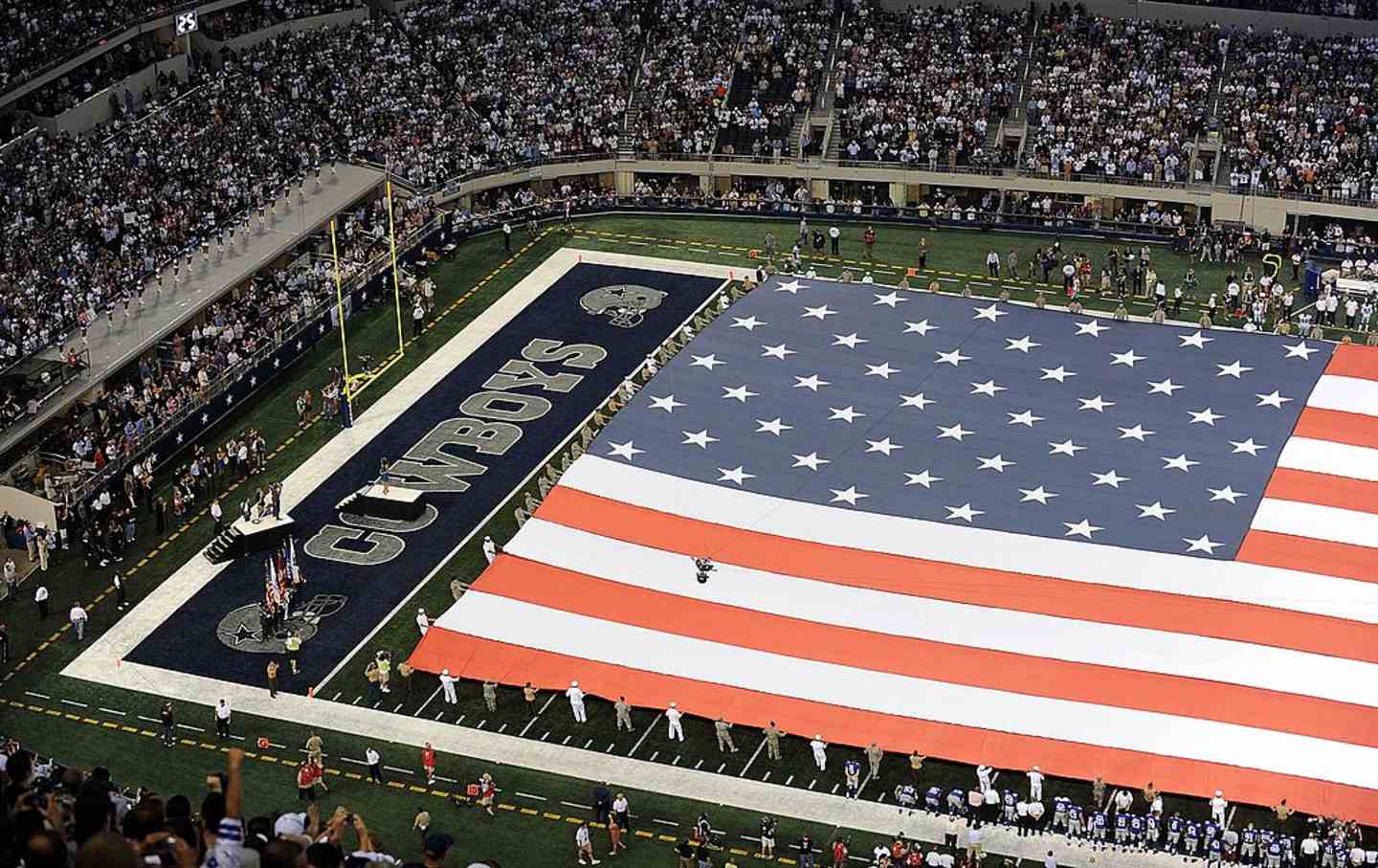
Performing the national anthem before a game between the New York Giants and the Dallas Cowboys at Cowboys Stadium in Arlington, Texas, on September 20, 2009.
(Ronald Martinez / Getty Images)
Chuck Klosterman begins Football, his personal history of the game, by admitting that his ideal reader has not yet been born. “My target market is the unborn,” he tells us, “closely followed by the recently born, closely followed by a handful of present-day adults who likely have no interest in what I’m writing about.”
This is a strange strategy, and Klosterman acknowledges it as such. To further ground expectations, he immediately declares all the things that his book will not be about: the pleasures of escapism, or fandom, tribalism, and community, or a love letter to the game.
Then, after more disclaimers about his own personal relationship to football, in which he acknowledges that his ideas may be dismissed because he is merely a fan rather than an ex-player, Klosterman declares his mission statement: “This is an expository obituary, published before the subject has died, delivered by someone who wants to explain why the victim mattered so much to so many, despite so much evidence to the contrary.”
Klosterman truly believes that the most popular and profitable sport in America is actually very fragile and will eventually collapse. This may come as a surprise to those of us in the present, but football’s demise, he explains, won’t happen for generations. Klosterman’s future reader, then, belongs to an imagined audience, the historians of a game that has long ceased to be.
The collapse, Klosterman thinks, will begin with college football. Recent changes, like the transfer portal and college players monetizing their name, image, and likeness (NIL), will push the college sport further into professionalization. This will lead to teams separating from college institutions altogether, and the strongest teams divorcing themselves from the NCAA, which would only hinder their profits at that point. College football without the veneer of amateurism will become just another league, a less interesting version of the NFL. Combined with the dwindling participation in youth football, the landscape will adopt a radical asymmetry by 2040 in Klosterman’s vision of the future: The NFL will still be immensely popular, but the sport’s foundations will look shakier and shakier.
Then, by the middle of the century, there will come a fatal realization that TV advertising has ceased to function as a profit generator, Klosterman argues. The NFL, like many other sports leagues, depends on the money from advertising. But “at some point between 2040 and 2060, the money required for the production and distribution of televised advertising [will become] too expensive to justify the continuance of a never-proven strategy.” Once the TV deals have to be renegotiated and the lucre they bring in shrinks, the league’s overall value will take a hit. The NFL, which has never had to downsize, will struggle to do so and face labor strife as the owners attempt to cut costs.
As this happens, the Americans of the future, who will not be as attached to the game as we are, will be fine with football going away. It’s hard to imagine what would cause such a shift—will football die or just get less popular?—but Klosterman thinks that football will unravel at the institutional level because it will first have unraveled at the cultural level:
I see football doomed by its own unreasonable success. It’s a sport so commercial and expansive that it can no longer function any other way, trapped by its own necessity for autocatalytic growth. That success was built off its ability to reflect twentieth-century America, an accidental synchronicity that became profound. But because that synchronicity was unintentional, it can’t resynchronize on command. As generations change, football fundamentally stays the same, turning it into a $25 billion simulacrum—a disconnected metaphor for a society that no longer exists, rocketing on autopilot, oblivious to the growing distance between itself and the future.
As one of his contemporary readers, someone who has watched his fair share of football and manages his fall schedule around NFL Sunday, I can only say that Klosterman’s vision of the end of football is hard to believe. Maybe that difficulty in imagining the sport’s death, like imagining the end of capitalism, comes from living in the present. In his introduction, Klosterman anticipates that struggle. But one wonders if he actually believes his own thesis, given that so much of the book is a defense of the sport.
What is strange about Klosterman’s book, ultimately, isn’t his prediction of football’s death but the form his fandom takes: He spends most of the book writing from the position that football is a perfect game and then tries to disprove that conceit, despite professing an ardent belief in football’s virtues. “If one concedes that football has evolved into the best TV product available,” he writes, “its dominance of the television medium is justified and positive. It suggests that mass entertainment is occasionally a meritocracy. The popularity of football on television doesn’t prove that football is objectively good, but it does present an objective reflection of what Americans desire (and that achievement alone has virtue).” Everything from its structure and rules to the way that Americans see it as a simulation of war makes it superior to its challengers, and that popularity explains its place at the top of the American sports food chain.
He positions the violence of the game, which can be off-putting for nonfans, as enough to thrill viewers without making them truly feel bad about the desire to see other humans get hurt, because the violence is not critical to the enjoyment of the sport:
I don’t think the relationship between football and violence is a fraction as straightforward as the relationship between violence and boxing. A correlation exists, but it’s more theoretical. Football is never watched as a blood sport; fans want a spectacle where the possibility of injury is omnipresent, but without anyone getting seriously hurt. What they love about football is the strategy and the skill.
He admits that the game is built around control and domination, in which the players are continuously stripped of autonomy and creativity, becoming pawns for the coordinators and head coaches. Rather than this aspect of the game being a negative, though, Klosterman writes that it shows that “control is what we crave—perhaps not for ourselves, but certainly for other people.”
Even the fact that it has less actual action than many other sports—the TV product is marred by stops, starts, and numerous commercial breaks—is framed as a positive. The average 11 minutes of action in a three-hour broadcast are good, Klosterman argues, because the excitement and complexity that do unfold in those minutes are so over the top “that it feels like watching something that’s too fast-twitch to comprehend.” And the stoppages and breaks allow fans a chance to pause and think about what just happened, in a way that other sports don’t.
Popular
“swipe left below to view more authors”Swipe →Reading Klosterman’s thoughts on football felt broadly familiar, but his theory of football is clouded by abstractions and contradictions. And it’s not because he contends that the violence of the sport is not something that people enjoy, even though the NFL used to make compilations of the game’s biggest hits every week; it’s because he presents so many aspects of football as the idea of football, and not the reality that anyone who is a fan experiences every week. It’s a vision of the sport that dwells in Plato’s cave.
One of the clumsiest parts of Klosterman’s book is his attempts at political punditry. His first provocation is arguing that “all thirty-two NFL teams share their TV revenue equally, the most visibly successful example of American socialism.” What he refers to as “socialism” is the billionaire owners’ profiting from a closed system, and private companies that often force cities to pay for their stadiums and renovations while the owners keep the profits. And that’s without going into the power imbalance between the owners and the labor class of the NFL. Klosterman’s idea of socialism and its ethic of redistribution just doesn’t make sense, unless it’s simply the class solidarity of billionaires.
Another point of contention is the Rooney Rule, which Klosterman writes is evidence of how forward-thinking the league is, without mentioning the constant criticism that the NFL receives because teams go through the motions of interviewing minority candidates for top positions without seriously considering them for hire. The league right now has three Black head coaches, and of the 10 head-coach vacancies this past cycle, none were filled by minorities. There are no majority-Black owners in the NFL, either.
What’s clear is that much of Klosterman’s book endorses tired myths about football: that it’s the greatest sport by virtue of its design and popularity, and that football’s popularity is a sign of its goodness. He often proposes counterarguments—the idea that the sport is structurally racist or that the NFL’s TV-viewing experience is subpar—but he dismisses these pretty quickly. Instead, he works backward from the conclusion that football is the greatest sport, and so these arguments are never meant to be engaged with seriously.
In the chapter “My Own Prison,” for example, he addresses the designation of the Dallas Cowboys as “America’s Team.” That title was bestowed by NFL Films producer Bob Ryan in 1979, because the Cowboys were very successful at the time and were constantly on national television. There was nothing more to it: “America’s Team” was an honorific that reflected advertising more than it did the Cowboys’ ability to substantially represent anything about the country. But Klosterman sets out to prove that the title was more than just marketing, writing at length about the culture of football in Texas: on the cultural impact of Friday Night Lights, his own childhood fantasies of playing high-school football in Texas, his hero Roger Staubach, and how football is truly a religion in the Lone Star State, as opposed to elsewhere.
Indeed, so much of the book’s style—what makes it appealing, and what makes it appalling—is evident in Klosterman’s defense of the Cowboys. When he writes about Staubach, it is thrilling. Klosterman is vulnerable and effusive in a way that captures how fandom feels, a vulnerability and sincerity that often do not exist in sportswriting or in intellectual writing about sports. But the logic of his arguments falls apart because it stays firmly within that emotional framework and refuses to truly entertain anything that jeopardizes his beliefs about the sport.
One of the indisputably great insights Klosterman provides is that “football is a way to experience war without the inconvenience of death and destruction. The relationship between football and war,” he adds, “is so enduring that it’s become cliché.” The long-standing theory about the birth of college football is that it was invented as a surrogate for military conflict after the end of the Civil War because there was a fear that, otherwise, men would grow soft and weak. The military ethos is now an unquestioned feature of football discourse: When Miami Dolphins tight end Kellen Winslow Jr. injured a Tennessee Titans player in 2003 with a crushing block, he defended the play by saying, “He’d do the same thing to me. This is war.” He was made to apologize for the statement, but what he said was no different from how many players describe the game and themselves. (Winslow’s actions off the field, which included criminal convictions for battery and rape, are briefly mentioned by Klosterman, but he is invoked mainly as an example of football’s martial logic.)
Over and over, Klosterman draws a straight line from football to war, the same way that players and coaches do, but for some reason he doesn’t connect that to the history of when and why the game became so popular and so tied to the American identity. He doesn’t mention, for example, how the NFL embraced the American military in its branding and marketing after the 9/11 attacks in 2001. Since then, games have included flyovers by the Blue Angels, and coaches and players regularly don camouflage inspired by the military on the field.
To this day, the NFL continues to use the image and story of former NFL player and soldier Pat Tillman to bolster that connection. Tillman joined the Army in June of 2002, turning down a three-year, $3.6 million contract extension from the Arizona Cardinals. He was killed in Afghanistan in April of 2004 by friendly fire, though the US government, including President George W. Bush, presented his story as one of heroic sacrifice, burying the details of the initial investigation into his accidental death. Almost two decades later, when the Philadelphia Eagles played the Kansas City Chiefs in the 2023 Super Bowl, the NFL aired a short video before kickoff narrated by Kevin Costner honoring Tillman, in which he was said to have died “in the line of duty.”
The Super Bowl between the New England Patriots and the juggernaut St. Louis Rams on February 3, 2002, was a full-on celebration of the military, showcasing commandos, battle maps, crosshairs in the graphics, and the commentators reciting military quotes every chance they got. The theme for Sunday Night Football was created by John Williams to mimic the kind of military themes that he had used for Saving Private Ryan and War of the Worlds. The NFL still trots out veterans every chance it gets, has pregame flyovers for the stadiums, and drapes the fields in huge American flags. Twenty years later, while playing for the Tampa Bay Buccaneers, former Patriots QB Tom Brady said, “I almost look at, like, a football season like you’re going away on deployment in the military, and it’s like, ‘Man, here I go again.’”
Klosterman is right that football’s popularity in the United States means that the game is aligned with American culture and society in a way that other sports are not, though it’s not clear if he understands why that sentiment is true. Football isn’t war, but it profits off the country’s ability to wage war around the globe. If the players and coaches reach for military references all the time, it’s because of how intertwined the military is with the story of the sport.
If we’re honest about that link, then we have to be honest about the fact that football’s popularity is tied to the thrill, or at least the pride, that people find in the violence of the country writ large—and how the sport has chosen to position itself, through design and narrative, as a secondary experience for that pleasure. If football and violence go hand in hand, then it’s harder to argue that it is good and superior by the nature of its design and that its popularity is a normal consequence of that superiority.
The thing with obituaries, especially public ones, is that more often than not, they sanitize their subjects. People don’t like to speak ill of the dead. Klosterman’s book is no different: In this public performance of future mourning, he reduces the sport to its clichés.
Become a Sustaining Donor This September
Between the reemergence of right-wing red-baiting and Donald Trump’s use of the chilling National Security Presidential Memorandum–7 to criminalize left political organizing, we’re seeing McCarthyism reborn before our eyes.
This assault on democracy cannot be ignored or wished away. Resisting it requires bravery in the face of threats and repression, a steadfast commitment to the truth, and the unwavering belief that we can—and will—overcome this darkness.
We must have an independent media that sets the record straight, unearths corruption and abuses of power, and advances a politics of justice and dignity for all if we’re to win this fight.
That’s why I’m writing to you today. This September, The Nation needs to add 100 monthly donors to sustain our progressive journalism. Your contribution makes the next investigative report, the next truth-speaking column, and the next pathbreaking essay all possible.
I hope you’ll support our work with a recurring donation today. If you donate $10 or more a month, we’ll send you a brand new “Hands Off the Free Press!” sticker to recognise your commitment to our cause. Please, donate today.
Onward,
Katrina vanden Heuvel
Editor and Publisher, The Nation
More from The Nation

Edward Said: Between Worlds Edward Said: Between Worlds
A new film biography depicts the Palestinian writer as still out of place—and ahead of his time.

Imani Thompson’s Grad-School Thriller Imani Thompson’s Grad-School Thriller
In Honey, the novelist offers a different take on the campus satire.
Love and Literature in Leslie Fiedler’s America Love and Literature in Leslie Fiedler’s America
When will the American novel grow up?

What’s Behind the Dubai-ification of America’s Yemeni Cafés? What’s Behind the Dubai-ification of America’s Yemeni Cafés?
Over the years, Yemeni cafés have become beloved establishments for students and coffee lovers alike. But recently they have undergone a conspicuous aesthetic makeover.

