
Trump Has Lost Interest in the Iran War, but It’s Still Quite Interested in Him
The United States is losing the conflict, stoking chaos in the region, and inviting economic calamity—all with no end in sight.
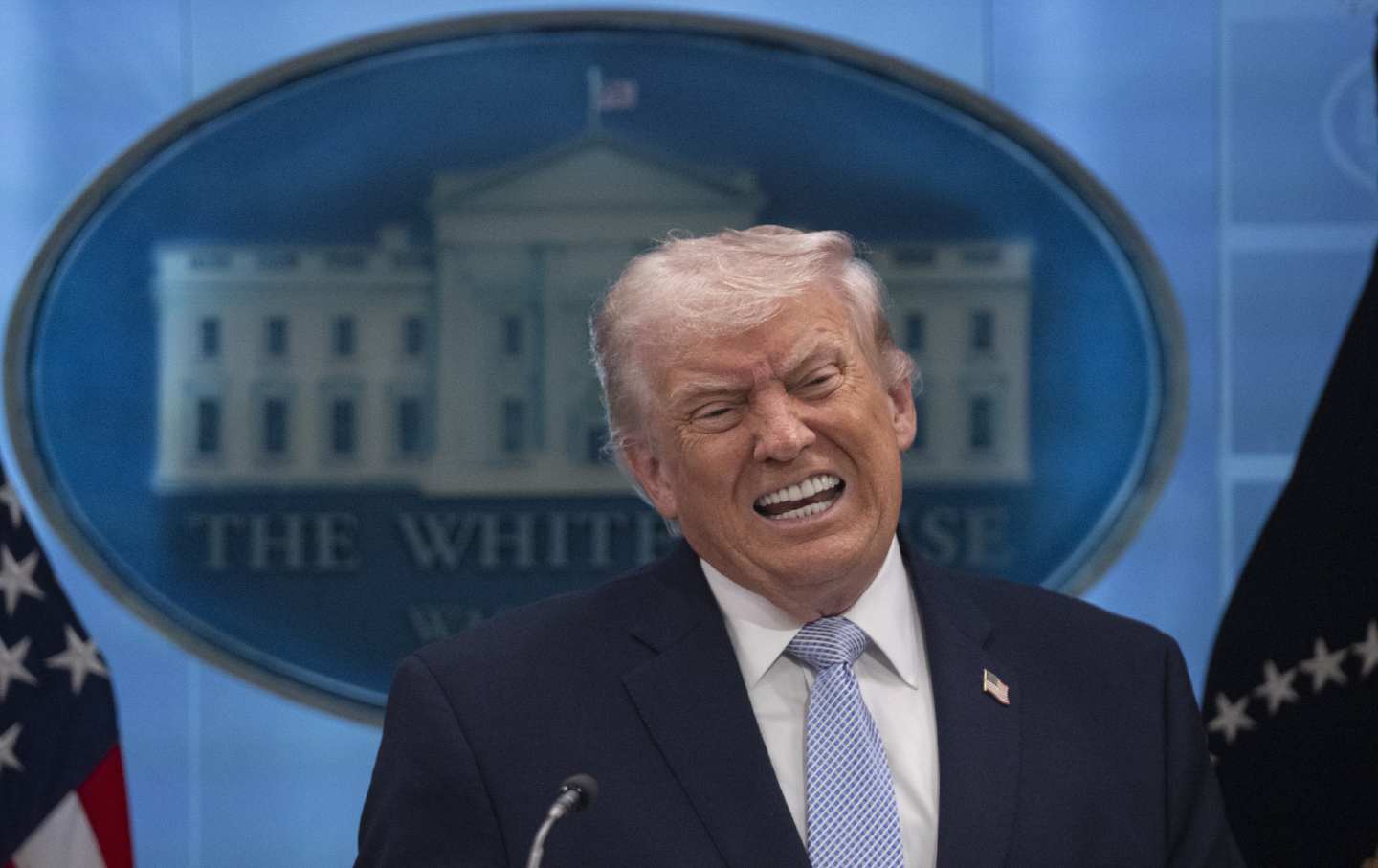
President Donald Trump at an April press conference on the Iran War.
(Celal Gunes / Anadolu via Getty Images)As the interminable war with—sorry, “excursion” to—Iran stumbles along toward its eighth month, President Donald Trump seems too busy bribing voters, causing diplomatic uproars at his golf tournaments, and posting slop-filled AI images of himself glumly attacking the planet from space to bother trying to bring it to an end. In some ways, it’s a welcome development to be relieved of Trump’s weekly, market-manipulating pronouncements about how Iran is “begging” to make an incredible deal because its military is so completely and utterly destroyed. But the Trump White House’s seeming indifference to how the conflict is actually going also leaves us zooming blindly toward the precipice of disaster without any plan to apply the brakes.
Trump has openly abandoned the pretense that Tehran’s new leaders will come crawling back to the negotiating table anytime soon. As Trump was en route to the GOP’s desperate, cobbled-together “midterm convention” in Dallas, he made the puzzling claim to reporters that the war “will end immediately after our election.” He then claimed in his bombastic speech in Dallas that “they’re hanging out for dear life, hoping that we lose, so they can deal with dumb, weak Democrats and they can have their nuclear bomb.”
Here in consensual reality, of course, these hypothetical Democratic majorities in one or both chambers of Congress would not take over until January 2027 and would still not be in charge of negotiations with Iran. But these are the kind of troublesome little details that the president militantly ignores in his bizarre, self-serving reveries. As long as the inevitable American capitulation remains just over the horizon, the president won’t have to own up to the many calamities his war has unleashed.
He certainly doesn’t want anyone taking a close look at what’s actually transpiring day after day in the Persian Gulf. To put it bluntly, the war is going far worse for the United States than anyone could possibly have imagined eight, or even three, months ago. The Strait of Hormuz remains largely closed, with shipping traffic still at a tiny fraction of what it was on the eve of the conflict. As the United States and Iran continued to trade blows, daily tanker crossings of the waterway have mostly been in the single digits this month (as opposed to around 100 a day before Trump’s blunder). Prices for Brent crude oil were once again trading well above $100 a barrel this week—the invisible threshold that forces headline writers to use bigger font sizes and investors to stop pretending that things are going to be just fine.
Many countries have so far cushioned the economic blow of the dramatic reduction of oil exports out of the Persian Gulf by drawing down their strategic reserves or cutting consumption. Still, prices are creeping up, especially for diesel, which is critical for trucking and farming in the United States and just reached an all-time high of more than $6 a gallon.
Iran’s Houthi allies in Yemen have also emerged this month as a significantly more serious threat than they seemed to be at the conflict’s outset, attacking and seriously damaging the vital East-West Saudi pipeline that has kept oil prices from getting out of control. That pipeline will now be closed for weeks. The vulnerability of long, virtually defenseless pipelines to these kinds of attacks is a challenge that seems not to have occurred to the Trumpworld hacks who convinced themselves that there was an easy and permanent workaround for the Strait of Hormuz problem.
Houthi forces also seized the Red Sea port of Mokham and the island of Perim at the mouth of the strategic Bab el-Mandab channel between Yemen and Somalia. That maneuver raises the possibility of still more disruptions to shipping and further territorial advances against the country’s Saudi-backed official government. The Houthis have surely noted that Iran has not had to successfully sink a single tanker to halt traffic through the Strait of Hormuz; they’ve also calculated, quite reasonably, that normal shipping operations will not resume until an agreement to stop the fighting for good is in place. The Trump administration has so far ignored Saudi pleas for help, because the United States can ill afford to get drawn into yet another front in what has become a nightmarish regional war. Trump’s reckless treatment of the balance of power in the region has even managed to revitalize piracy along the Somali coast.
Things aren’t going much better in the effort to use a blockade of Iranian shipping to bring the Islamic Republic to heel. It’s true that Iran lacks the firepower to directly drive the United States from the region. Yet the regime’s military forces remain unbowed and aggressive. Even without disabling any American warships, Iran has the United States looking and acting like a country on the run—especially since the naval blockade’s logistics are being maintained from thousands of miles away.
Having destroyed the US Navy’s Fifth Fleet headquarters in Bahrain early in the war, Iran has now reportedly reconstituted some of its prewar capcity for producing ballistic missiles. Iran’s military leaders have apparently erected new facilities located further underground to put them beyond the reach of America’s bunker-busting bombs. It also looks like construction at the underground Pickaxe Mountain complex south of Tehran is meant to protect potential new nuclear enrichment facilities, or perhaps even existing ones. These moves are all strong signals that Iran will indeed be racing toward a nuclear weapon—something analysts warned for many years would be the inevitable outcome of an ill-considered and unsuccessful effort to decpitate the regime.
Eight months ago, the idea that Iran could not only endure a prolonged US attack but emerge from such a conflict in a significantly better strategic position would have seemed farcical. But the United States has failed to eliminate the regime’s supply of drones and ballistic missiles and still hasn’t sufficiently degraded the capacity of Iran’s air defense to control the country’s airspace. Despite all the premature celebrations about the destruction of Iran’s defense industrial base from Beltway hawks, Tehran seems to have plenty of firepower left, with more on the way. This has left an increasingly isolated American president with few precious tools to end the war. So instead he keeps running his filthy mouth as he further depletes America’s supply of missiles in the desperate hope that his ineffectual blockade brings the regime to its knees before American voters deliver Congress to the Democrats.
Today, it is the United States, not Iran, that looks like it is on the verge of being brought to its knees. And for what? Thanks to the inflation spiked by this inane imperial misadventure, the Fed is raising interest rates, putting homeownership and new auto purchases beyond the reach of more Americans. The yields on US bonds are at their highest level since 2008, sparking a quiet panic among investors and economic analysts who sense that the worst is very much yet to come. America’s military posture has been revealed as, at best, deeply vulnerable to recent developments that seemingly no one in the Pentagon saw coming.
A straightforward recitation of this war’s regional outcomes is incredibly bleak. Iran’s theocratic regime, whether under the control of Supreme Leader Khamenei or a junta from the Iran Revolutionary Guard Corps, is more dug in, more radical and more willing to take risks than ever. Iran has demonstrated the ability to hit US assets all over the region and to cause a global economic crisis with a few well-timed missile attacks on tankers. The regime’s leaders also now have fresh data on how far down they need to dig to protect missile and drone factories as well as nuclear enrichment sites. The Iranians retain possession of their enriched uranium, and their allies in Yemen are on the march—seemingly on the verge of emerging as the victors from the country’s long-stalemated civil war. I almost pity the MAGA stooges who are still getting frog-marched out to write op-eds claiming that this all represents a huge victory, actually.
Popular
“swipe left below to view more authors”Swipe →It does not. The Iran War has been an unqualified policy fiasco that has left American diplomatic and military credibility in tatters and greatly fortified the position of our chief regional adversary. In the stalemated struggle for control of the Gulf of Hormuz, the conflict has handed Iran an economic weapon that can be used any time Tehran’s new autocrats want to extract policy concessions from the United States and its allies. It may yet bring an end to the long economic expansion that followed the Covid-19 crisis, while continuing to immiserate millions of Americans already struggling to make ends meet. In that sense, it is the perfect MAGA stunt—an impulsive and morally bankrupt disaster authored by Trump and his odious quislings, with more suffering to come and still no end in sight.
Become a Sustaining Donor This September
Between the reemergence of right-wing red-baiting and Donald Trump’s use of the chilling National Security Presidential Memorandum–7 to criminalize left political organizing, we’re seeing McCarthyism reborn before our eyes.
This assault on democracy cannot be ignored or wished away. Resisting it requires bravery in the face of threats and repression, a steadfast commitment to the truth, and the unwavering belief that we can—and will—overcome this darkness.
We must have an independent media that sets the record straight, unearths corruption and abuses of power, and advances a politics of justice and dignity for all if we’re to win this fight.
That’s why I’m writing to you today. This September, The Nation needs to add 100 monthly donors to sustain our progressive journalism. Your contribution makes the next investigative report, the next truth-speaking column, and the next pathbreaking essay all possible.
I hope you’ll support our work with a recurring donation today. If you donate $10 or more a month, we’ll send you a brand new “Hands Off the Free Press!” sticker to recognise your commitment to our cause. Please, donate today.
Onward,
Katrina vanden Heuvel
Editor and Publisher, The Nation
More from The Nation
The Reality Today Is That Foreign Policy Hawks Are a Minority in the Democratic Party The Reality Today Is That Foreign Policy Hawks Are a Minority in the Democratic Party
It is damn time we all started acting like it.

Gloria Steinem: A View From 1990s Moscow Gloria Steinem: A View From 1990s Moscow
“Keep women’s solidarity in mind: Don’t forget how we empower each other through mutual support,” she reminded us.

Accountability for the Gaza Genocide Can’t Focus on Netanyahu Alone Accountability for the Gaza Genocide Can’t Focus on Netanyahu Alone
Getting rid of one bad leader won’t bring justice.

How the AfD Benefits Politically From the Ukraine War’s Backlash How the AfD Benefits Politically From the Ukraine War’s Backlash
No election result is monocausal, and there are clearly many factors that have converged to make the AfD Germany’s most popular party.

Cuba: The “Pandora’s Box” of US Humanitarian Assistance Cuba: The “Pandora’s Box” of US Humanitarian Assistance
As the US strangles Cuba economically, Marco Rubio is running a $100 million “hearts and minds” program on the island.
The Palestine of Soraya Antonius and Annemarie Jacir The Palestine of Soraya Antonius and Annemarie Jacir
In The Lord and in Palestine ’36, the story of Mandatory Palestine comes into focus.

