
The Punk-Rock Appeal of the Women’s Pro Baseball League
The new competitive circuit captures the energy and DIY spirit of punk, while promoting a surprisingly sturdy vision of civic belonging.
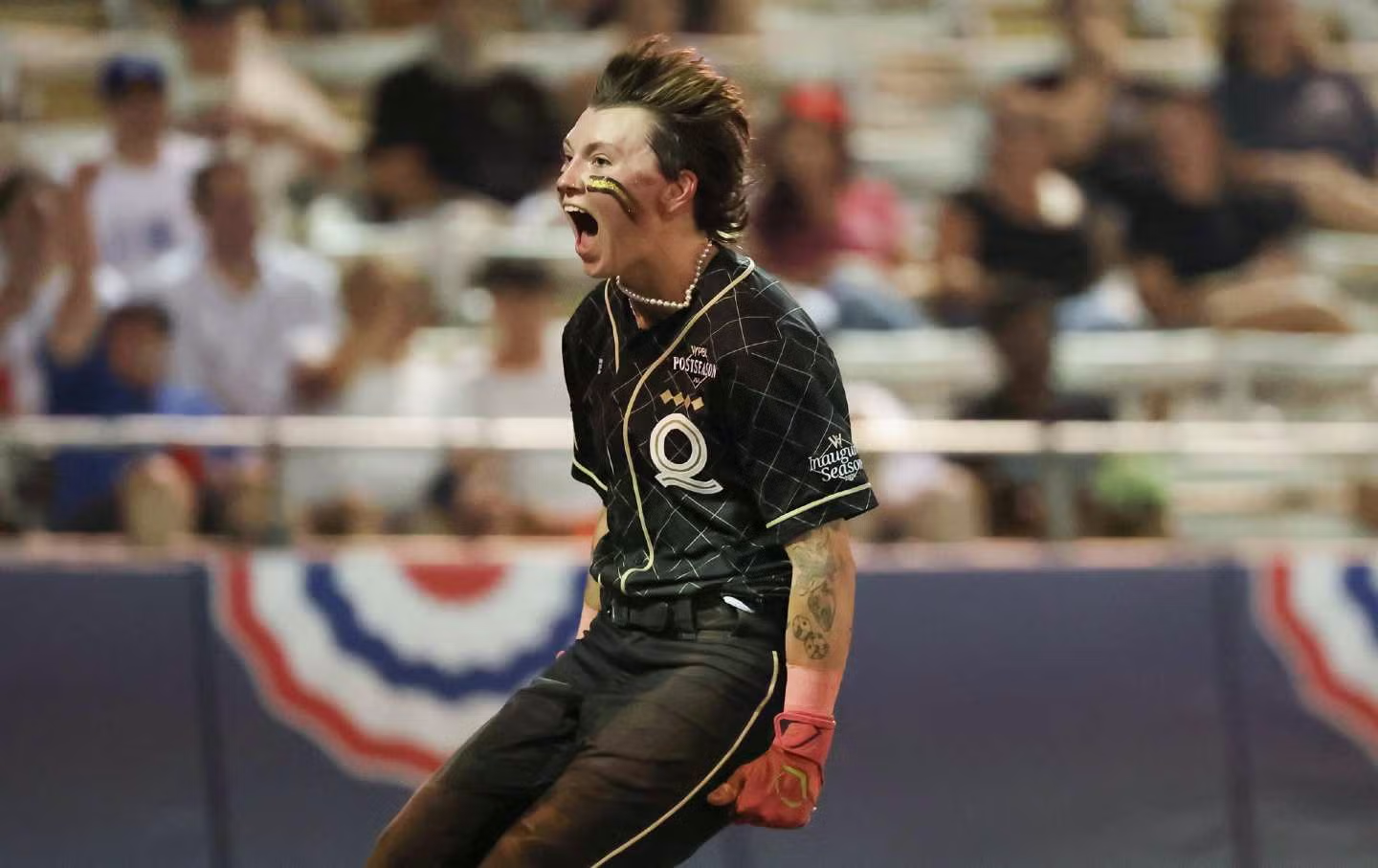
Ashton Lansdell of the Los Angeles Queens celebrates after scoring against the San Francisco Firebells in game two of the Women’s Pro Baseball League Championship.
(Jayden Mack / Getty Images)Cultic ecstasy seizes my body. I leap to my feet from a sitting position and thrust my hands skyward like someone who got the Holy Ghost in church. Like a contagion, the same behavior ripples across the aisle I’m sitting in. About a quarter of the way across the crowded baseball stadium, the vector peters out. Either the people roughly 10 rows away don’t notice our spirited efforts to sustain a wave across the entire crowd, or they just don’t feel like participating.
“Those guys suck, dude,” our wave leader groans. “They need to get with the program!”
It’s no less than the sixth time that this person has hectored our section to start an ill-fated wave. To the chagrin of the visibly exasperated spectators around him, he has not lost hope.
I’m in the stands for game three of the Women’s Professional Baseball League’s best-of-five inaugural championship series. The Los Angeles Queens are up two games to none on the San Francisco Firebelles, and another Queens win will secure the championship. The WPBL website boasts that “for the first time in 70 years, the best women baseball players in the world are competing on a professional stage.” Players hail from across the United States and 11 other countries. The league’s first-ever regular season began a few weeks earlier on August 1, 2026. Each squad in the league played all the other teams five times, for a total of 15 regular season games in a triple round-robin format. For now, there are four teams in the WPBL, two of whom have already been eliminated: the Boston Hunters and the New York Heights. All the games are played in impartial Springfield, Illinois. Watching teams named aspirationally after major markets compete in the neutral territory of flyover country feels like a provisional unity of these States, in a way it’d be hard to approximate by other means.
I’ve taken a road trip from St. Louis, Missouri, where I live, to Springfield, which I’m not sure I’ve heard of before now. Despite the city’s claim to fame as the adult home of Abraham Lincoln, it wouldn’t have surprised me to find the Klan posted up in the stadium parking lot. Along with my intrepid companions Jesse and Doc, I bought tickets online the night before the game, but pickings were slim. Three successive seats in the same row weren’t available. We bought a pair that were right next to each other and a third ticket a few rows behind those two. Our plan was to barnstorm the end of one row and dare anyone to challenge our claim. A group of white fans to our left look like they want to. They gawk over their shoulders at us like schoolyard extras in a Ruby Bridges movie. I almost hear my antebellum-era ancestors assembling into a bluesy chorus of telltale woe and foreboding.
When we pulled into Springfield half an hour ago, my eyes settled on a chain restaurant I’d never seen before.
“Taco Gringo?” I blurted. “Sounds a little too White Power for my taste. Is it really a selling point that gringos are back there making the tacos?”
“I don’t think the gringos are making the tacos,” Doc had joked. “They’re probably just cracking the whip.”
Though most of my teenage years and young adulthood took place on the East Coast, I’m a native St. Louisan. The MLB’s St. Louis Cardinals are our dominant sports franchise, so naturally my earliest baseball memories were formed at Busch Stadium. I’ve had difficulty rooting for the home team since the police killing of Ferguson teenager Mike Brown in 2014. That year, social media was awash in clips of mobs clad in Cards regalia spitting and cursing at Black Lives Matter protesters. It’s likely that there’s some overlap between the folks at the ballpark with me now and those justice-averse Cardinals fans. But here, as supporters of a new league, it feels like we have a clean slate.
Well, sort of. I can’t help but suspect that some percentage of the enthusiasm that radiates throughout Robin Roberts Stadium today is traceable to the 2023 NCAA women’s college basketball final, in which Caitlin Clark’s Iowa Hawkeyes fell to Angel Reese’s LSU Tigers. The widely watched showdown between two highly marketable and racially polarizing players sparked a surge in public interest in women’s sports. There is no competitive storyline Americans relish more than a clash between a Great White Hope and what they perceive as an uppity Black antagonist, and apparently the fervor is gender neutral. That revelation doesn’t exactly brighten the forecast for our crumbling empire, but it does boost the overall flashbulb wattage of women’s sports.
Here at game three of the WPBL’s inaugural championship series, fans carry signs with slogans like “I drove 300 miles to be a part of HERSTORY.” There is a palpable shared sense that the one thing better than being on the right side of history is cheering history on while you’re sitting by its third base line.
A strict, masc-of-center auntie in her 50s or 60s seated to my right foretells the outcome of each at-bat.
“That’s an out!” she yells sometimes, leaning back in her seat with her arms crossed as a fly ball lingers over second base.
“That’s a hit,” she claims other times, as soon as she hears the crack of the bat.
Growing up a baseball fan in the 1990s Midwest, I tracked the traditional box score stats in the paper every morning before school. Before the Moneyball movement, baseball diehards assessed player performance via straightforward statistical categories like batting average, fielding percentage, and runs batted in. These were the numbers you would see on the back of a baseball card. Starting in the early 2000s, those traditional statistics were phased out in favor of advanced analytics. Where sportscasters once narrated home runs by bellowing things like, “Busting out the whooping stick!,” they instead began to pepper the broadcast with references to math nerd esoterica like launch angle, spin rate, and exit velocity.
Look, I love Neil deGrasse Tyson. Physics has its place. But I doubt I’m speaking only for myself when I say I tune into baseball games to watch swaggering leviathans swing clubs at projectiles and hammer them to the moon. The shift in how baseball is discussed and understood is a microcosm for how the digital age has muddied the distinction between information and meaning. I appreciate that the experts can contextualize the game with such an impressive volume of information. This stern auntie’s play-by-play—which more than compensates with passion for what it lacks in data—strikes me as far more meaningful. The subtext of her commentary is that she’s been waiting for a league like this one for most of her life, and she’s not going to take one iota of action for granted.
Typically, yearning for baseball’s salad days would mark me as retrograde. In this case, I’m quite sure appreciating WPBL for its contrasts with MLB makes me a part of the vanguard. That said, I hesitate to position the WPBL as somehow morally superior to other professional sports leagues. Women’s sports are more often instrumentalized as battlegrounds in the culture wars than treated as legitimate ends in themselves. Moralizing is boring, and watching some of Earth’s most talented and tenacious people push their bodies to their limits in the name of autumnal glory is a good time. At least as much as we need an endless hermeneutics of ball, we need an erotics of ball.
Being taken out to this ballgame and taken out to the crowd also feels more poignant at a cultural moment defined by atomization. When things like, say, the venerable practice of wearing headphones when listening to media in public have fallen out of favor, any symbiosis between strangers feels like a sign of great respect in our culture. That’s what makes me realize why being absorbed into a fandom that’s both salutary and scintillating is so comforting, so familiar. The WPBL is the new punk rock.
As a millennial pushing 40, I’ve been a punk rocker much longer than I wasn’t one. I’m in two actively recording and gigging bands right now; I threw my first house show in my parents’ basement to celebrate my 15th birthday. Punk is about building the reconciled world in miniature and making its qualities infectious. Organizing a scene in your town is a small insurrectionary act—lining up a single domino that might, and sometimes does, kick-start a massive cascade.
A lot of the viral content about being an aging punk or emo kid focuses on nostalgia, as if the upshot of belonging to a forward-thinking subculture is to perseverate on the past. But the skills and instincts that we honed in VFW halls, garages, and church basements are just as easily applicable to the pursuit of gender equity in professional sports. Why settle into being a mark for the contrived cash grabs of your local Emo Nite when you could sublimate your ennui and residual angst into supporting a likeminded subculture like the WPBL instead?
Everyone who spent their teens and 20s working for street teams, orchestrating circle pits and Walls of Death, and tucking show flyers under windshield wipers can channel their punk-rock past in helping to secure the WPBL’s future. In 2018, Vice published a satirical article asking, “What Kind of Punk Dude Over 30 Are You?” The article joked that thirtysomething punks have a limited menu of acceptable hobbies and interests that they can cultivate to stave off the creep of cultural irrelevance. As I ponder the high jinks I might get up to as an over-40 punk, WPBL zealotry presents a compelling case.
Punks are better known for throwing bricks than laying them, but jury-rigging alternative structures is a big part of what we do. Whether we’re debuting a zine, a new band, or a DIY show space, we’ve always taken a distinct pride in supporting something precisely because it’s fledgling yet fertile, burgeoning and brimming with promise. The slightly grating wave whisperer here at the game reminds me of the dutiful mosh mentors I grew up with in the punk scene. They trained members of the audience to pick up anyone who fell down while slam dancing, reminded us to choose opportune and safe moments for our stage dives, and urged us to pass the hat for touring acts even when there wasn’t much money to go around. A movement isn’t only held together by the headliners—it’s also sustained by the energized, anonymous folks who dole out unsolicited marching orders, and those who roll with them even as we roll our eyes.
As the innings accumulate, I’m brought back to the beer-soaked stages and sweat-streaked floors where I cut my teeth. The early days of a punk band’s ascent are traditionally viewed as innocent, less cynical, driven by a genuine love of the game. Likewise, since legal gambling is now largely coextensive with professional sports, watching professional baseball for its own sake is a return to a simpler time. Cheering and jeering abound, but no one here is screaming about their parlay, or frantically refreshing the FanDuel app.
Much like navigating the street parking outside a makeshift venue or house show, figuring out where to leave the whip near the stadium was a riddle. My friend Jesse ended up pulling her SUV onto a muddy strip of grass next to some train tracks nearby. The demand for women’s professional baseball for the moment outpaces the real estate set aside for its patrons. We figured Springfield was still adjusting to the influx of fans from other cities, and strict parking enforcement would be unlikely. On his way to the ticket line, a man in a Chambray shirt and jeans looked back at our car and grinned impishly.
“Looks like a parking spot to me!” he declared, flashing us a thumbs-up. A nascent iteration of the American pastime foments the same constructive lawlessness as Warped Tour or the Fest.
A newfangled women’s baseball league and a punk scene both recall the architectural principle of flex space—a term that describes any versatile, adaptable, lightly zoned area in a commercial building. Some rooms or settings are designed for specific purposes. The construction of the room circumscribes how the room can be used. By contrast, flex space is meant to be pliable enough that occupants can customize it to suit the fluctuating needs and aims of their business. The punk scene and the WPBL are both flex spaces where norms can shift in real time. They’re both underground pockets that can slip the generally totalizing yoke of unfettered capitalism. In these flex spaces, the conditions of possibility are developed and implemented on the fly.
This includes a temporary suspension of the “customer is always right” ethos that otherwise guides American commerce. Jesse ventures into the bowels of the stadium to brave the concession line in the third inning. By the top of the fifth, she still hasn’t returned. I hop out of my seat and pace the stadium corridors until I find her in line, where an interminable trail of sweaty, hungry WPBL supporters are being surprisingly civil about the slow, disorganized food service. Jesse herself mentions being on the verge of becoming hangry, but exercises some commendable and not totally characteristic restraint. It’s as if the entire concession line is down for the cause. They know the WPBL is an embryonic but well-intended enterprise that calls for a level of patience and indulgence that the more established sports institutions may not require.
The phrase “social construct” penetrated the mainstream during the height of what is now derisively described as Woke 1, those pathbreaking days from early 2014 to 2021 when American culture seemed more mutable and benevolent than it has felt since. Whenever I heard gender, sexuality, or race described as social constructs, I always wondered why we couldn’t consciously build some new, more humane structures from scratch. Where was the social construct factory? Who among us might put on their hard hat and start hammering out frameworks meant to shelter rather than subjugate? In the stands at a WPBL championship game, I feel that construction effort commence.
It turns out the crowd of murmuring, staring white folks in the section next to us were actually marveling at Doc’s service animal, a preternaturally adorable toy Australian shepherd. Dogs are the ultimate social lubricant. When paired with baseball, they form a diversion powerful enough to neutralize racial reticence.
“His name is Dodger,” Doc tells a middle-aged white couple behind us. “The energy here almost reminds me of Dodger Stadium.”
Popular
“swipe left below to view more authors”Swipe →“You’ve been to Dodger Stadium?” the husband breathes, as if Doc had seen the gates of Valhalla. I don’t directly observe this conversation, since I was wary that eye contact with the couple behind us would prolong the engagement. So I imagine Doc adjusting her sunglasses and tossing her fabulous Afro as she says, “Yeah, I’m originally from LA. The Dodgers are my favorite team. Where are you guys from?”
“Here,” the couple says in unison.
“We’ve seen Bush Stadium and Wrigley Field,” goes the husband.
“They’re both incredible,” adds the wife.
It’s not quite an Obama-era beer summit, but it is a quiet coalescence of coastal elites and heartland dwellers, a glimmer of baseball’s potential to patch up tattered social fabric. The moment recalls the words of legendary folk-punk troubadour Frank Turner. Addressing the crowd at an Amityville Music Hall solo show in 2025, he explained how and why a punk performance—like a WPBL game—is always more than meets the eye.
“If we all do our parts, we will achieve two things. The first of which is, we’ll make a cool noise. And arguably, that’s what this is all about. But the other thing we’ll do is demonstrate a point which is important to me. Which is that live music, rock ’n’ roll, folk music, punk rock—whatever name you wind up calling this—is not about raised pieces of flooring and backstage passes and tour buses and egos and all that stuff. It’s about bringing people together. It’s about a room full of strangers who leave as friends, a room full of strangers who achieve something together that’s more than the sum of their parts, thereby demonstrating to themselves and to the rest of the world that we can be a community if we choose to be one.”
Doc, Jesse, and I rocked up to the ballpark expecting the Los Angeles Queens to close out the series with a 3–0 sweep. San Francisco had other plans. They overpowered the Queens from the jump, racing out to a commanding seven-to-nothing lead in the second inning and not letting up. Attendance at the decisive victory of a best-of-five series would certainly be more historic, but San Francisco’s fighting spirit won the crowd over. We all needed reminding that no deficit is too daunting if you come out swinging. A few weeks later, a sitting president will casually fantasize aloud about sacrificing two major Californian cities to the war against Iran. For now, we’re galvanized by the collective exercise of manifesting a future where the San Francisco Firebelles’ smoking baseball bats are as American as smoking gun barrels.
During a seventh-inning stretch, the wave’s most vocal advocate finally sees his wish fulfilled. The wave breaks out on the side of the stadium opposite ours. Our section exults and keeps it going when it reaches us. As fireworks shimmer across the late-summer sky, the glass ceiling feels like a piñata visibly starting to give way, sprinkling rewards that will only multiply if we all keep swinging on target. I’m filled with enough goodwill and forbearance to consider stopping at Taco Gringo on the way home.
More from The Nation
The Eviction Kings Are Being Sued The Eviction Kings Are Being Sued
Corporate landlord American Landmark admitted that its business model priced tenants out. Now, former tenants have filed a class-action lawsuit against the company.
How the End of “Roe” Is Reshaping Medical Care: A Q&A With Alice Miranda Ollstein How the End of “Roe” Is Reshaping Medical Care: A Q&A With Alice Miranda Ollstein
In her new book “Side Effects,” the “Politico” reporter shows that the impact of abortion bans goes far beyond reproductive health care.
William Gass’s Brilliant and Maddening Magnum Opus William Gass’s Brilliant and Maddening Magnum Opus
Long out of print, The Tunnel returns with a timely exploration of the fascism of the heart.
What Trump’s Cruel Policies Against Immigrants Say About Who’s Next What Trump’s Cruel Policies Against Immigrants Say About Who’s Next
The plight of immigrants under this administration provides a lesson and a warning.
The Culture of Experts and the Rise of MAHA The Culture of Experts and the Rise of MAHA
The left won’t win over rural Americans by condescending to them.
What’s It Like Inside a Data Center? What’s It Like Inside a Data Center?
Northern Virginia is laden with structures that house data for Fortune 500 companies. I went inside just one of those monstrosities that bothers its neighbors.

