Homelands
John Edgar Wideman’s American vernacular.
John Edgar Wideman’s American Vernacular
The master novelist offers a view of a United States defined by its cultures of improvisation.
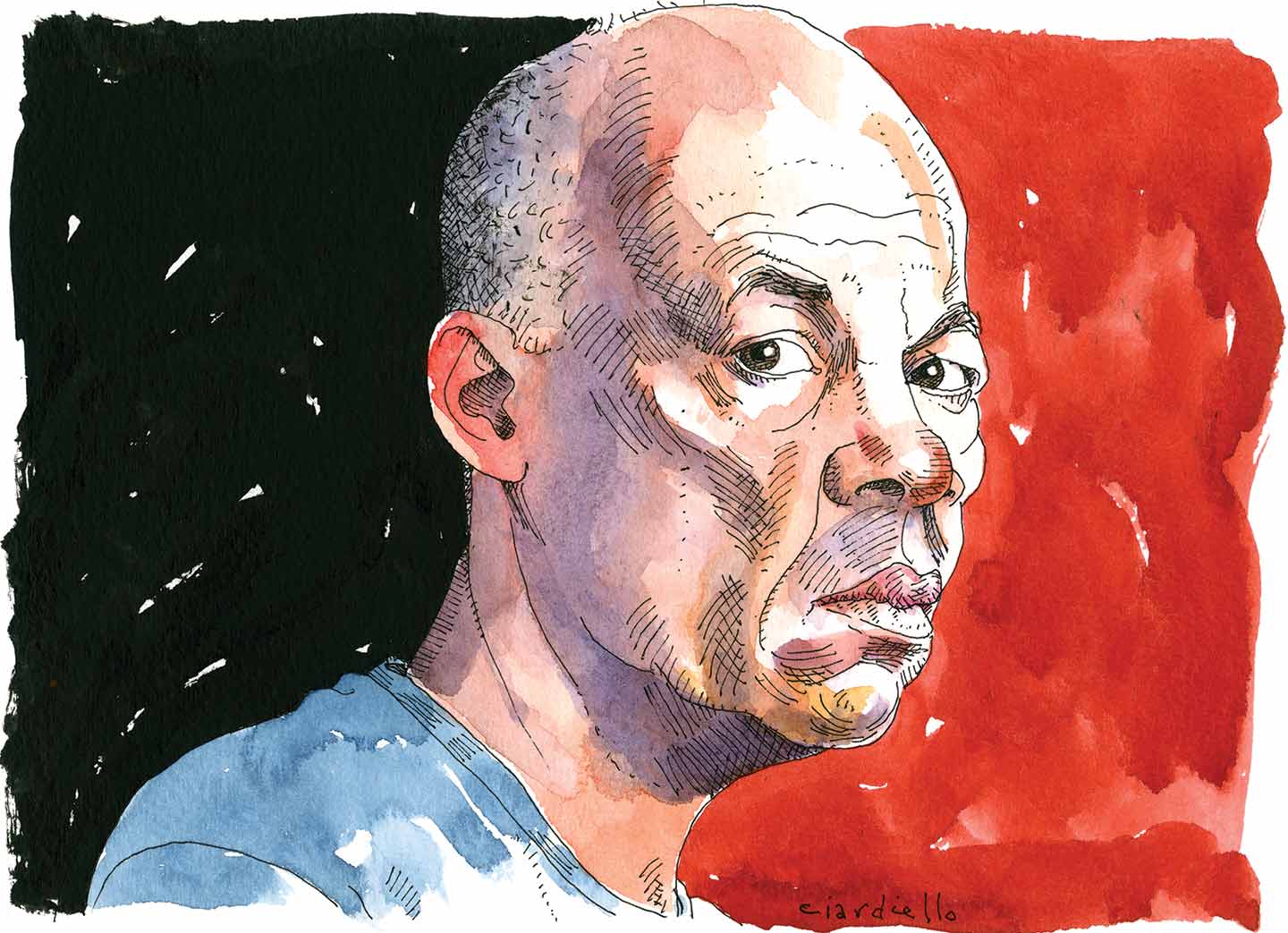
Languages of Home is John Edgar Wideman’s first collection of essays, profiles, and creative nonfiction. Although it is a welcome addition to his oeuvre, its emergence might be surprising to Wideman’s closest readers. While a master novelist and memoirist, he tends not to be nostalgic or precious about his past work. He doesn’t like looking back, especially at his own literary record.
Books in review
Languages of Home: Essays on Writing, Hoop, and American Lives, 1975–2025
Buy this bookWideman may even greet Languages with some ambivalence. He seems to suggest as much in “Joe Wood,” a gorgeous piece from his mesmeric, elegiac 2024 book of fiction and nonfiction, Slaveroad, in which the voice narrating “Joe Wood” worries that collecting his nonfiction would only lead to “inevitable disappointment.” That voice belongs to a writer—simultaneously Wideman-like and not Wideman at all—who, upon scanning his editor’s proposal for a book that sounds a lot like Languages, ponders the futility of such projects:
My initial reaction was who needs it—the who including in the first place, as usual, myself: Why task myself to stir up memories and revisit thoughts and ideas that I probably would just as soon forget, if I’d not already forgotten. Old words nobody else needs either. Writing largely ignored by the reading public when it originally appeared in print—commissioned essays, bits of memoir, lit crit, social and political commentary, woe-is-me victim statements protesting the outrageous, murderous discrimination still visited daily upon people who supposedly enjoy the equality promised by democracy, guaranteed by America’s Constitution and Bill of Rights.
Glancing again at the proposed book, the narrator notices two pieces—“the preface to an anthology of Gulf Coast folktales Zora Neale Hurston had col-lected; an essay I’d contributed to a book about Malcolm X”—missing from the table of contents. He explains that those two essays need to be included, because he continues to draw “substance and reassurance” from their subjects. With “their renewed presence” and his “remembrance of their giant gifts,” the narrator might mitigate the “long-distance loneliness, the sense of wasted time and failure” that comes from revisiting his writing.
Both Wideman’s foreword to the Hurston collection, Every Tongue Got to Confess, and his essay “Malcolm X: The Art of Autobiography,” first published in Joe Wood’s Malcolm X: In Our Own Image, appear in Languages of Home, making this new book a hub of crosstalk among the works in Wideman’s catalog, stretching from these 32 anthology introductions, book prefaces, magazine articles, and literary reviews to Slaveroad and his 1967 novel A Glance Away. In these pieces, you’ll find Wideman thinking through Black history and ethics, interrogating the legacies of violence in American life, and imagining how strong art can lead us to those elsewheres of dreams and possibility. In this way, Languages is an archival distillation of Wideman’s six-decade writing career, specifically in terms of his essays. But this compendium is also something more: It is a craft book about the African American literary tradition and Black vernacular practices, the aesthetic resources that both bestow, and the art of improvising in and on the essay form.
In his prefatory notes on Hurston, Wideman shares an anecdote from his early years as a professor of African American literature. In 1968, a group of Black undergraduates at the University of Pennsylvania approached him with a request: Please offer and lead a course on Black American literature. Wideman, who was then teaching in Penn’s Department of English, demurred, arguing that his “education, social conditioning, and status as the only tenure-track assistant professor of color in the entire College of Arts and Sciences” precluded him from teaching such a class. Watching the students’ response to his “brisk, precise dismissal,” he saw
the cloud, the almost instantaneous dulling and turning away and shrinking inward of the students’ eyes speaking a painful truth: I had not simply said no to a course, I’d said no to them, to who they were, who I was in my little cubicle in Bennett Hall, to the beleaguered island of us, our collective endeavor to make sense of the treacherous currents that had brought us to an Ivy League university and also threatened daily to wipe out the small footholds and handholds we fashioned to survive there.
Wideman reversed his decision later that day. Designing a syllabus for that class initiated his training in and teaching of Black aesthetics. In 1971, he established and chaired the Afro-American Studies Program, and as he explains in his 1988 essay “The Black Writer and the Magic of the Word,” his commitment to Black writing and culture transformed his own literary art.
Arranged chronologically, Languages of Home records how the author’s immersive studies reformed his writing. While the personal essays and criticism from the 1970s and ’80s are a public record of Wideman’s education in African American literature and cultural practices, the creative nonfiction of the ’90s and aughts displays his growing authority on matters of justice and the weight of witnessing, the technical properties of autobiographical writing, the stories of Emmett and Louis Till, the liminality of Dennis Rodman, the “hedge against oblivion” that siblings can offer us, the intonations and silences of Thelonious Monk’s music, and the powerful frequencies of time and harmony that one can hear in doo-wop singing.
In pieces like “Defining the Black Voice in Fiction,” Wideman riffs on Gayl Jones, Richard Wright, and Charles Chesnutt to identify what he calls the “unity in diversity” of Black writing. He also goes on to name several of the traits that these Black authors share and how each writer in this larger tradition is compelled to improvise their own singular, personal, aesthetic theories that advance the tradition and, simultaneously, literary art writ large. Reviewing Albert Murray’s Stomping the Blues, Wideman remarks that “the fundamental ritual” of Black speech is one’s instruction in and experimental extension of its “evocative…transforming” practices. Precisely analyzing how Murray has assembled his book, Wideman then concludes:
The way Stomping the Blues is put together—the rhythmic counterpoint between words and images; its rhetorical strategies, the stylized intimacy of the narrative voice, the voice’s wide range of speech and literary styles, its incantatory use of exhortation and magic formula; the embodiment of black speech rituals (i.e., signifying, dozens): the constant metaphorical links between language and music, dance movement and speech—point to structural continuities in the various media of Afro-American expressive culture. Murray’s book literally evokes the Good Time atmosphere of the Saturday Nite Function. How we learn about the blues is part of what we learn.
Much like Murray, Chesnutt’s formal and rhetorical innovations influence and guide Wideman the essayist. In a 1972 essay for The American Scholar, and then later in his 1985 preface to Charles W. Chesnutt and the WPA Slave Narratives, he details how Chesnutt rigorously re-envisioned the rules of world building in fiction. Altering “the traditional frame which emasculated black speech,” Chesnutt helped the writers who followed him to recognize “the rich possibilities” found in Black oral narrative practice “when it is transmitted into written word.”
Since then, Black American writers have been transmitting their individual improvisations on Chesnutt’s innovations. Richard Wright, Wideman tells us, “viewed racial conflict in American society as a struggle over the nature of reality.” Black artists writing realist fiction had to challenge and defy that style’s guidelines to represent their realities in print. Chesnutt, according to Wideman, was the first writer to design a defiant Black-realist mode: juxtaposing “the dialect voice with standard literary discourse (a code for the real), dramatizing the inadequacy of the assumptions (encoded in literary discourse as part of the real) that locked the black voice and black character into conventionalized, formulaic molds.” If the old literary molds could not imagine or encapsulate Black humanity, then Chesnutt’s works modeled how African American writers could devise new formal and grammatical rules for representing Black speech and reality in novels and short stories.
Drawing from Roland Barthes’s S/Z, Wideman argues that through this oral mode, now put down in written form, Black writers have revealed that “the code of novelistic realism refers to a pictorial code which is itself not ‘reality’ but a set of conventions for depicting reality within the frame of a classical painting.” Artists such as Wright, Hurston, and Jones, Wideman argues, pushed the tradition in a range of new directions, attacked “the authority” of older practices of literary expression, and therefore bridged not only the gaps between Black speech and literature but also between the written word and experience. In this way, they not only formed “one of the unities in diversity which substantiate a Black Tradition in American Literature,” but they also remade the national literature, inventing aesthetic and intellectual possibilities otherwise not available in it.
The proximity between life and art borne out in the Black American literary tradition, however, created its own burdens, as Wideman also notes. Weak readings arise, he observes, as a result of critics who interpret Black writers “by examining the circumstances of their lives rather than by examining what they wrote.” For Wideman, this can be clearly seen in “the tendency among critics to divide Wright’s life into segments. Based on a broad outline of his life and treatment of each segment separately, the major phases of Wright’s career…are used as proof of a disintegrating rather than an evolving art and personality.” Though biography and history can be useful in literary interpretation, they can also obscure the artist and overwhelm the art. When critics reckon with African American writing on its own terms, Wideman suggests, they can face its power and genius most immediately.
Wideman’s reluctance to look backward seems to be motivated by his desire to keep his past labors from inhibiting his consistent creative output. Interviewed by Elias Rodriques for The Nation in 2021, Wideman explained: “I don’t want to look back. What’s in it for me? One of the scariest things is picking up a story and reading a line and thinking, ‘Why did I spend my time doing that?’ or ‘I wish I had a red pencil to get this boy in better shape.’” Yet what is striking is that although Wideman has long been ambivalent about history and biography playing a role in the critical appraisal of Black literature and art, both have also long haunted his literary works. After the completion and release of his third novel, The Lynchers, in 1973, Wideman entered a seven-year period of “‘woodshedding,’ as [jazz] musicians would say,” a complex, experimental conversion of his own biographical circumstances and family history into the basic material of literary art.
Playing one-on-one with the Black tradition, Wideman recapitulated the lessons he’d learned from his criticism, recalibrated his approach to writing, rejuvenated his prose musically, and crystallized a new style that simultaneously embodied the tradition, renewed it, and moved it into the future. These adjustments served his art and production enormously. Among the innovations of these books is Wideman’s transposing a very real place, the Homewood section of Pittsburgh—what we might call, after Albert Murray, his “briar patch”—into a very special setting in American literature.
Wideman accomplished this first in his 1981 short-story collection Damballah, in which a history of Homewood is established through interrelated stories tracing the French family’s lineage from slavery to the city, and in his novel from the same year, Hiding Place, which tells the story of how Tommy French hides in his reclusive great-grand-aunt Bess’s Hill District house after a botched robbery turns murderous. Wideman then rounded out his now-classic trio of fictional works with the 1983 award-winning novel Sent for You Yesterday, about a novelist and intellectual, Doot—another French family member—who experiences an artistic revival when he learns how to interpolate Homewood’s vernacular speech and blues-idiom music into his stories.
One year later, in his canonical Homewood-focused memoir Brothers and Keepers, Wideman explored his relationship with Robby, his then-incarcerated youngest brother. Robby’s imprisonment led Wideman to put his burgeoning command of African American literary aesthetics to use in narrating the intertwined histories of Homewood and his own family’s lived experience. When he taught Black Fire—the foundational anthology of Black Arts Movement writing and criticism edited by Amiri Baraka and Larry Neal—to his UPenn undergraduate students, he began to see how the young, rebellious Black men in his native Homewood walked “the streets with, as one of the Black Fire writers put it, dynamite growing out of their skulls.” In Homewood, as in his studies of Black writing, Wideman found the aesthetic resources for remaking his own art: The neighborhood became “a repository of black insight, survival techniques, and expressive strategies [for] performing emancipatory rites.” As Wideman writes in the collection’s eponymous essay from 1985, some of Homewood’s powers are preserved in its “bilingual, Creole, maroon, bastardized, miscegenated, cross-cultural acceptance of itself in the mirror only it can manufacture.”
Homewood’s vernacular modes were, Wideman discovered, an expansive, enlivening archive of rhetorical and narrative practices. In the 2008 novel Fanon, Wideman parallels his mother’s style of flattening and fattening “perspective” in her stories with the images in the collages of the Homewood-reared painter Romare Bearden. Both, he notes, find ways to cram “everything, everyone, everywhere into the present,” into spoken and visual narratives that “flow, intimate and immediate.” Their stories are “truly democratic—each detail counts equally, every part matters as much as any grand design. Size and placement don’t highlight forever some items at the expense of others.”
As readers progress through Languages, Wideman turns away from explication—teaching us how Black writers, including himself, make art—and toward the making of that art. In this way, Languages is a guidebook about writing but also an illustration of it. In his guise as artisan, Wideman, like Bearden, is a turntablist, sampling and collaging both fiction and nonfiction. He takes his readers to Cairo and Chicago, Los Angeles and New York City. He details his movements through these cities in a first-person voice that sometimes breaks and pivots into a formal interview or shifts into and out of a personal essayist/memoirist stance. Using typographical markers and rhetorical and scenic changes, Wideman encourages his readers to do their own cutting and connecting beyond any essay’s boundaries. As he suggests in an addendum to “Looking at Emmett Till,” his profound essay about the “unhealed because untended” wound of Till’s murder, readers and writers alike must embrace the imperatives of “imaginative truth-telling”—a form of “communication that gives the lie to language as fact.” “All information,” he continues, “includes a point of view, intention, and author. Facts pretend this isn’t so. Good writing reminds us everyone’s responsible for dreaming a world, and the dream, the point of view embodied by it, within it, is as close to fact, to reality, as we ever get.”
In his 1990s magazine writing, especially his efforts in Esquire, one finds Wideman mixing and matching brilliantly, urging his readers to accept their responsibilities in understanding the worlds around them and dreaming up new ones. Often, basketball serves as a performance model for such imagining. Basketball, especially playground pickup hoop, he argues, is infused with “the spirit of our American place, not the marketplace, mind you, but the vernacular, always-up-for-grabs agency of cultural change, creativity, and possibility.” In “Michael Jordan Leaps the Great Divide,” he evacuates the air from glossy-magazine celebrity-athlete puffery and sculpts from its constituent elements—travel writing, interviews, sports reporting, and personal writing—an avant-garde essayistic statuary. Here, Jordan becomes a Black-vernacular performer whose hang-time artistry, Wideman dreams, might release Americans from their racial strictures.
In a profile of Denzel Washington that was written in anticipation of the actor’s star turn in Spike Lee’s 1998 basketball movie He Got Game, Wideman further explores how basketball can free America from its racial strictures but also how it can sometimes imprison us. Breaking out of a close focus on Washington, he asks his readers why the film’s hero, Jesus Shuttlesworth (played by Ray Allen), must leave Coney Island to fulfill his promising basketball future:
Why does this sharp, affecting, skywalking film low-bridge itself with a tired trope? Why is one more African-American protagonist’s quest for integrity, for actualization, identity, and fulfillment, predictably enacted within the framework of escaping home?
Illustrating Wideman’s particular intellectual debts to W.E.B. Du Bois and Malcolm X, “Dead Black Men” observes the gulf between known and experienced reality while offering readers a trenchant, sophisticated, and melancholic study of Los Angeles in the aftermath of the 1992 uprising: There is the LA we know, or think we know, and then there is the LA that is full of a “whole lot of people, black, white, all colors in this country and in other countries,” forced to perform “the function of a captive, exploited, expendable source of labor and resources, colonized, sweatshopped, indentured, commandeered, apprenticed, the labor that built our country into a world power.”
Wideman’s writing on Los Angeles also anticipates his 2002 treatise “Whose War: The Color of Terror.” In the 21st century’s political discourse, he reminds us, not only does “terror” incarcerate all of us and return us to the old divides and perimeters of colonialism: “To label an enemy a terrorist confers the same invisibility a colonist’s gaze confers upon the native.” Worse yet, it also enables the state to proclaim that it is “besieged by terrorists” and therefore cannot be held accountable for its own actions.
The nation-state’s cries of terror have driven it to terrorize racialized and marginalized American communities. “We’ve accumulated centuries of experience dealing with problems of marginality,” Wideman writes, “problems that are suddenly on center stage for the whole society: inadequacy of language, failure of institutions, a disintegrating metropolitan vision that denies us or swallows us, that attracts and repels, that promises salvation and extinction. We’ve always been outsiders, orphans, bastard children, hard-pressed to make our claims heard.” While language and narrative can initiate new forms of freedom, they can also alienate, isolate, instigate, and harden marginalization.
Wideman recognizes these risks; his criticism has helped him source practices for mitigating them. Discussing Hurston’s penchant for positioning “herself firmly, insistently within the language of her Africanized culture,” he explains that “her goal is self-knowledge, self-gratification as she recalls, reconstitutes, the pleasures of speaking and acting within the culture, [she] accomplishes crossover with minimal damage to integrity. Her crossings are expressed through language and customs she shares with the people she interviews and invents.” Rather than commodifying Black people or their cultures, Hurston displays otherness to a perceptive reader “by remembering who she was, who she is, by listening, respecting, by staring clear-eyed at her self, her many selves past, future and present in the primal language, the language of feeling they speak.”
Completing Languages of Home, readers might discern that Wideman’s description of Hurston’s accomplishment could also serve as an elucidation of his own achievement—in the essay and throughout his catalog. In “What Is Afro, What Is American?,” his 1986 review of Ralph Ellison’s essay collection Going to the Territory, Wideman notes that great writers are “always teaching us how to read them. One measure of greatness is how much we need the lessons, how much we appreciate them and then take them for granted. In a master’s fiction there are implicit instructions and when he or she writes about writing, the messages become insistent.” These lines apply to Wideman’s Languages of Home as well.
Popular
“swipe left below to view more authors”Swipe →Yet despite the sweep and capaciousness of the collection, there is something unfinished about the book. The closing piece, “Doo-Wop,” written in 2025, just after Wideman’s 84th birthday, is a response to Mitchell Jackson’s introduction to the collection. Beginning with some riffs reminiscing about his days singing with his Homewood homeboys in a group called the Commodores, Wideman’s essay builds up into a song that ends in ellipsis, an echo that calls for more response, not a final note. Perhaps this volume’s incomplete nature is fitting. Wideman, after all, is still thinking, writing, and participating in the great call-and-response of the playground court. One might argue that his impulse to improvise, to emulate the energy of a pickup game, informs the antiphonic nature of both the essays in Languages of Home and his frequent on-court sparring with the Black literary tradition. He may not need these essays, but we do. These pages communicate ideas for and questions about pursuing freedom. The process of reading them can feel like going one-on-one with the author, or better, rolling to an outdoor court with Wideman and calling out, “Who got next?”
Watching Jesus’s flight from Brooklyn, Wideman likely saw some reminder of his own late-’50s leap from Homewood to the University of Pennsylvania, where he became an All-Ivy League basketball player and Rhodes Scholar. He also saw the film repeating some of the constraints and limitations on Black American life that he charted in his 1992 essay “Dead Black Men and Other Fallout From the American Dream.”
The trick of Languages of Home is that the book may be what Wideman wanted all along. Because I’ve spent some time nosing around his archives at Harvard University, I know that he’s been thinking about some version of Languages of Home since the 1990s. In a file folder in one box among many others, there’s a copy of a letter that Wideman once sent to his agent, Andrew Wylie. Dated June 19, 1996, the note describes a table of contents that mirrors both the one described in “Joe Wood” and the one organizing the book in my hands now. “We do work in progress, Mitch,” Wideman doo-wops in reply to Jackson. These pieces are both a life’s work and the resonant call of Wideman’s next new song.
More from The Nation

The Carnival of Venice Biennale The Carnival of Venice Biennale
That so much of the art of “In Minor Keys” is muted in effect is ironic, because so much of it is overproduced, aspirationally eye-catching, and so big.
America Without the NFL America Without the NFL
Chuck Klosterman’s Football is a eulogy for the sport on the eve of its decline.
Edward Said: Between Worlds Edward Said: Between Worlds
A new film biography depicts the Palestinian writer as still out of place—and ahead of his time.

Imani Thompson’s Grad-School Thriller Imani Thompson’s Grad-School Thriller
In Honey, the novelist offers a different take on the campus satire.