
Campus Catharsis
Imani Thompson’s grad-school thriller.
Imani Thompson’s Grad-School Thriller
In Honey, the novelist offers a different take on the campus satire.
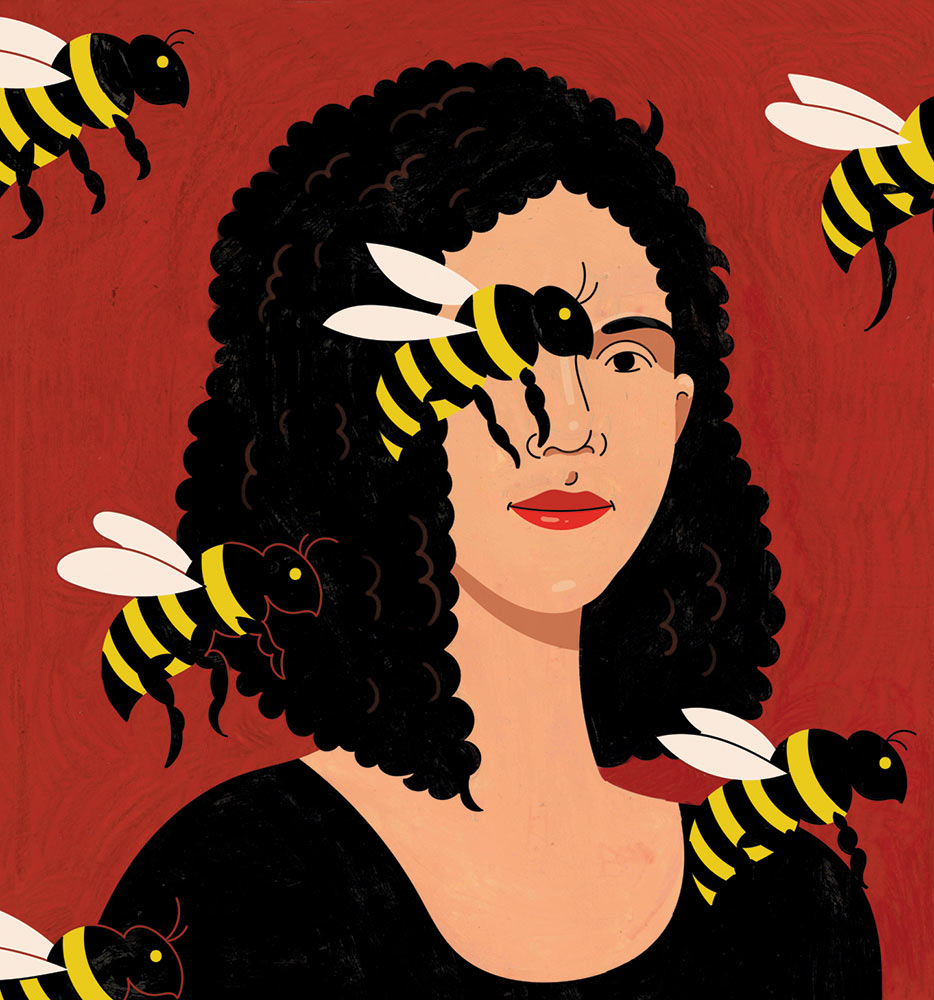
Fictional serial killers are deranged and twisted, but most of all, they are vain. Their desperate attempts to justify their perceived superiority over their victims are evident even in how they see themselves—seductive demigods that everyone else desires. Before Patrick Bateman, the investment banker turned serial killer in Bret Easton Ellis’s American Psycho, decides to go on a murder spree, he spends a lot of time looking at himself in the mirror. “I want Helga to check my body out,” he says, “notice my chest, see how fucking buff my abdominals have gotten since the last time I was here.” Bateman isn’t attracted to Helga; he doesn’t want to be intimate with her. He wants Helga to see his body as taut and Herculean. He wonders whether his attractiveness might also cloud her judgment and eventually lead to her entrapment. Bateman isn’t just a serial killer; his superficial qualities reflect American hyper-consumerism and corporate culture: Everyone wants to look good, not only for its own sake but also so they can make a killing. Even if we revile him, Bateman’s pathology is also ours.
Books in review
Honey: A Novel
Buy this bookThe serial killer in Honey, Imani Thompson’s debut novel, is not all that different. Well before she embarks on her own murderous rounds, Yrsa—a Black British doctoral student at Cambridge University—already indulges in the crass aesthetics of death. After failing to help a professor retrieve an EpiPen during what eventually becomes a fatal allergic reaction to a bee sting, Yrsa is overcome with glee: “Arteries, veins, capillaries. Popping! An orchestra of justice. He’d lunged at her—that had been shocking. Exciting. The theatrics of the wheezing man. The red-hot raspberry of his face.” Yrsa’s exultation has more to do with what the victim represents than with any direct relationship she has to him. Professor Richardson is married and has been having an affair with his doctoral-student advisee, Nina, Yrsa’s friend. He has also attempted to use Nina’s original research as his own without crediting her. Adultery and academic dishonesty are the reasons that Yrsa finds him deplorable. After witnessing his death, the exhilaration she feels leads to a succession of murders that she commits at Cambridge and in the London area.
Honey is frantically twisted and sardonically dark. Yrsa is a serial killer who fashions herself as a virtuous Black feminist, both in theory and in practice, and she unequivocally and vociferously censures racism and sexism. Because of her self-declared moral high ground, she feels vindicated in terminating the lives of men she deems to be behaving badly—scholarly philanderers, finance bros, American jocks. Not only does she indict these men for society’s problems, but she also thinks she has a right to kill off the manosphere, one by one, all under the banner of critical race studies. Her revenge isn’t just visceral—it is academically grounded.
Yrsa’s attempts to provide commentary can at times seem overly prosaic to anyone who has read a social-media thread in the age of cancel culture. But that is part of Thompson’s point: The complaints may be all too familiar, but they are also acutely felt by people who feel slighted by being misunderstood or underpaid. Public shaming, which in the context of the novel makes it difficult to like Yrsa, is often the only means of addressing such complaints in a society where the authorities remain sovereign and entrenched.
With Yrsa, however, as her story unfolds and the body count mounts, one realizes that she is motivated by other reasons too—her frustration with the bad men is merely a rationalization for her actions. In this way, Yrsa is not unlike many of her fictional counterparts. They might invoke real-world politics to justify their behavior, but we all know they are pursuing far less humane ends.
As it stands, Yrsa is ultimately a monster set up to display both her obscenity and her banality. Often her hubris devolves into humor. Her comic disposition is especially evident post-coitus: “Why can’t she just shag in peace? Why do men have to speak?” she thinks after one liaison. Sometimes, we realize, she kills for revenge, other times out of boredom. After one of her love interests, Hugh, confesses that some of the men at Cambridge have a point-scoring system for the women they’ve slept with—three points for a woman with a double-barreled name (a marker of the English upper class), 18 points for a woman already in a relationship, and 20 points for someone with “Black-girl magic”—Yrsa eventually murders him. “There wasn’t much blood,” she later reflects after pushing him off a roof. “But there was a broken limb—his hand, outstretched—in the creeping buttercups.” The murders are one thing, and her motivation for them is another.
In this way, Honey isn’t just a serial-killer novel; it is a revenge story, but also a satire of a society obsessed with rectitude. All of these elements work in tandem and to great effect. What makes the revenge plot so seductive is the buildup more than the act itself. We follow intensely as Hamlet ponders how best to avenge the murder of his father. The stakes are found in the uncertainty of his efforts—that vengeance might be the only solution, but it is also one that may never be realized. When Medea feels spurned after her husband Jason’s death, her reprisal becomes our success, because we are living vicariously through her bereavement.
Honey uses this uncertainty to help drive the story forward. But, at times, Yrsa’s psychological core gets lost amid the story’s momentum. After all, revenge as a motivating force to take down men is not all that distinctive or innovative, particularly because it echoes recent television portrayals of Black women contemplating or enacting retribution, such as Michaela Coel’s I May Destroy You and Donald Glover’s Swarm. We get that we are being offered a satire, but Yrsa’s constant self-absolution doesn’t allow the reader to see her—or, for that matter, any other character—from within. “She does what comes easily,” Thompson writes. “People think she’s ambitious because often she’s the best, but it’s not drive.” And yet we don’t often witness Yrsa at her best, either.
After she delivers a eulogy, several of the characters applaud her. Yrsa’s childhood friend Kitty Denver says, “Your speech was absolutely beautiful. God, it had me bawling.” But was it really? Without a direct quote from the panegyric, it’s impossible to say; the reader is told these things instead of shown them.
Though Yrsa’s brilliance is often left undemonstrated, one thing is clear: that she is a bully, an irritable and unpleasant person. Sitting in the history library, Yrsa confronts a person whom she deems to be a demonic typer:
“Your typing, it’s pretty distracting and some of us are trying to work.”
The girl looks fraught, confused, on the edge of tears. It’s a typical undergraduate look.
“But I’m just…just typing.”
“Yes, too loudly.” Yrsa spells the word out for her before returning to her laptop screen and lollipop.
The girl with the typing problem gets up and moves tables. Yrsa hears a sniffle.
What does Yrsa want? For everyone to bend to her will, even if it makes them cry.
Popular
“swipe left below to view more authors”Swipe →Does anyone have the right to take matters of injustice into their own hands? Honey ultimately poses this question to the reader but then holds back on answering it. In the end, nothing Yrsa says or experiences can serve as a defense for her actions. She is insufferable, not just because of her killing spree but because she is arrogant, impulsive, mean, reckless, and judgmental, which makes me think there is little to no room for compassion for a character who shows little to no vulnerability. Hamlet’s or Medea’s revenge at least appears to be somewhat relatable; they are grieving. Patrick Bateman’s and Hannibal Lecter’s serial murders are at least entertaining, given their genius. Yrsa can be wry and shrewdly observant, but she can also be jaded and insipid.
Honey is the profile of an erudite antihero who speaks in a language of redress but has little interest in it; it is a portrait of a character’s alienation from the society on whose behalf she claims to be acting. The material inequities that result from anti-Blackness, housing discrimination, or financial insecurity are conveniently absent; Yrsa is a creature absorbed by her own grievances and frustrations. Her murder binge doesn’t feel ethically complex; her homicidal ventures are just nefarious. Honey is a literary case study in which conflict is not abuse. At times, we are even left wondering: Was Yrsa actually injured, or does she only imagine herself to be?
If one seeks a political critique of racism, literature can provide it. Yet fiction often excels at examining what is too opaque for political criticism, too ambiguous for righteous judgment, or too self-important to fully escape satire. When a novel’s protagonist kills someone, it can lead us to ask whether the act was really justified. Yet it can also invite us to ask how we arrived at this moment that is so consumed by the idea of vengeance, and that is what Honey does. As Yrsa plunges deeper into her murder spree, she also spirals into a grim cycle of queasiness, irrevocably tied to a rage that she finds all around her. Her deeds do not provide a remedy; nor do they summon any self-reflection. They often end up being as boring as Yrsa is bored.
More from The Nation

The Genius of Charli XCX The Genius of Charli XCX
On her new album, Music, Fashion, Film, the musician embraces rock.

The Architectural Follies of Trump’s Washington, DC The Architectural Follies of Trump’s Washington, DC
The president plans to remake the capital in his own image, but is all he is doing destroying what’s already there?

The Carnival of Venice Biennale The Carnival of Venice Biennale
That so much of the art of “In Minor Keys” is muted in effect is ironic, because so much of it is overproduced, aspirationally eye-catching, and so big.

