The Right Way to Handle the Death Penalty
Even before her state botched another execution, gubernatorial candidate Jerri Green was telling Tennesseans that “the death penalty has always been inhumane, expensive, and biased.”
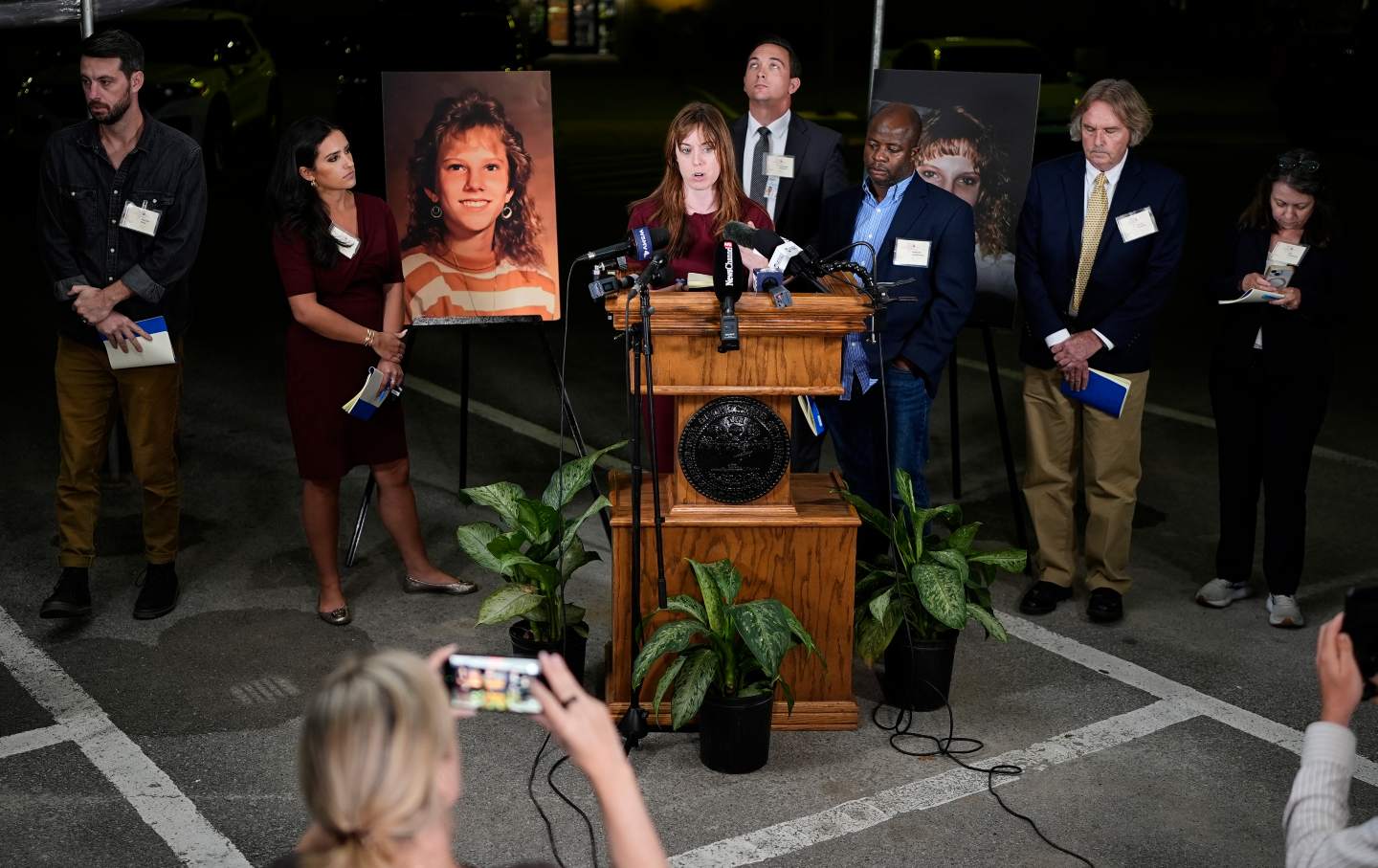
Media witnesses recount the moments before the execution of Christa Pike was halted Wednesday, September 30, 2026, in Nashville, Tennessee.
(George Walker IV / AP Photo)The botched execution of Tennessee death row inmate Christa Pike has added another compelling argument to the case for banning the death penalty. Following a pair of horrific attempts by the state to take the life of the 50-year-old women on Wednesday, The New York Times reported that a lawyer for Pike “said she was alive and receiving life-saving medical care on Thursday…. Ms. Pike survived an injection of two doses of the lethal drug pentobarbital in what was the state’s second bungled execution this year.”
The torturous debacle was described by Robin Maher, the executive director of the Death Penalty Information Center, as “the worst we’ve seen” in a long history of botched executions in American states. It was so awful, so “deeply disturbing,” in fact, that Tennessee Governor Bill Lee ordered a review of the hours-long attempt to kill Pike, halted executions in Tennessee, and called the nightmarish incident “a tragedy.”
Yet Lee, a longtime backer of capital punishment, defended state-sanctioned killing. “The people of Tennessee have determined that capital punishment is the appropriate sentence for the most heinous of crimes,” he said. “The people of Tennessee expect that those sentences will be carried out in a manner that is not only legal, and constitutional, but effective and that didn’t happen and I’m highly disappointed along with Tennesseans about what happened last night.”
Lee is not seeking reelection this fall. But the Republican front-runner to replace him, Tennessee Senator Marsha Blackburn, appeared to be most interested in finding another method for euthanasia. “While there should be a thorough review of what happened and why the process failed, the answer is simple: bring back the electric chair and deliver justice for these victims swiftly,” said Blackburn. “As your governor, I will do just that.”
In stark contrast, Blackburn’s Democratic rival, Memphis City Council member Jerri Green, spoke from practical experience while occupying the moral high ground.
“The state botched this execution because the Attorney General rushed this process, even after the execution of (another Tennessee death row inmate) Tony Carruthers failed just four months ago,” said Green. “There is a lack of transparency around drug testing, as well as qualified and ethical personnel—but the fact of the matter is: the death penalty has always been inhumane, expensive, and biased. And Marsha Blackburn wants to bring back one of the most cruel forms of capital punishment, the electric chair.”
Green is right. The death penalty has always been inhumane, expensive, and biased. Academic studies, legal reviews and honest political debates in states that have banned executions—under Republican and Democratic governors—have confirmed that state-sanctioned killings fail to make communities safer and invariably promote injustice. As the American Civil Liberties Union, explains,
The death penalty in America is a broken process from start to finish. Death sentences are predicted not by the heinousness of the crime but by the poor quality of the defense lawyers, the race of the accused or the victim, and the county and state in which the crime occurred. From 1976 to 2015, 1,392 executions occurred in the United States, and 995 of them took place in the South. Time and time again, we have proven that the criminal justice system fails to protect the innocent and persons with serious mental disabilities and illnesses from execution. Even the administration of executions is utterly flawed: Every method of execution comes with an intolerably high risk of extreme pain and torture.
While that’s true, overturning the death penalty has been a tough sell in Southern and border states such as Tennessee. But Green has not hesitated to make the case for change—based on her values and her legal background. A graduate of the Georgetown University Law Center, who began her legal career as a juvenile public defender in Nashville, she has served as executive director of the Community Legal Center in Memphis and as Shelby County’s chief public defender.
“As a public defender, I’ve met a few too many people who were wrongfully convicted on death row who were later exonerated,” Green said Thursday. “As governor, I would put a moratorium on all future executions. If we say we are pro-life, that means we must be anti-death penalty.” That’s a position Green was advocating for even before Tennessee’s botched executions started making national headlines.
Asked by the Nashville Banner earlier this year whether she would continue state executions if elected, the Democrat bluntly replied, “No.” “My decades in the legal system have shown me that state-sanctioned executions are unjust, inhumane, and prone to irreversible error,” she explained. “The death penalty does not deter crime, costs taxpayers millions more than life without parole, and is plagued by administrative failures. As Governor, I will halt state executions and focus our taxpayer dollars on real, effective public safety measures.”
This combination of moral clarity and experience-based understanding of what’s at stake in the death penalty debate is not unheard-of. But it is still too rare in red-state politics. And it distinguishes Jerri Green as a gubernatorial candidate worth watching.