
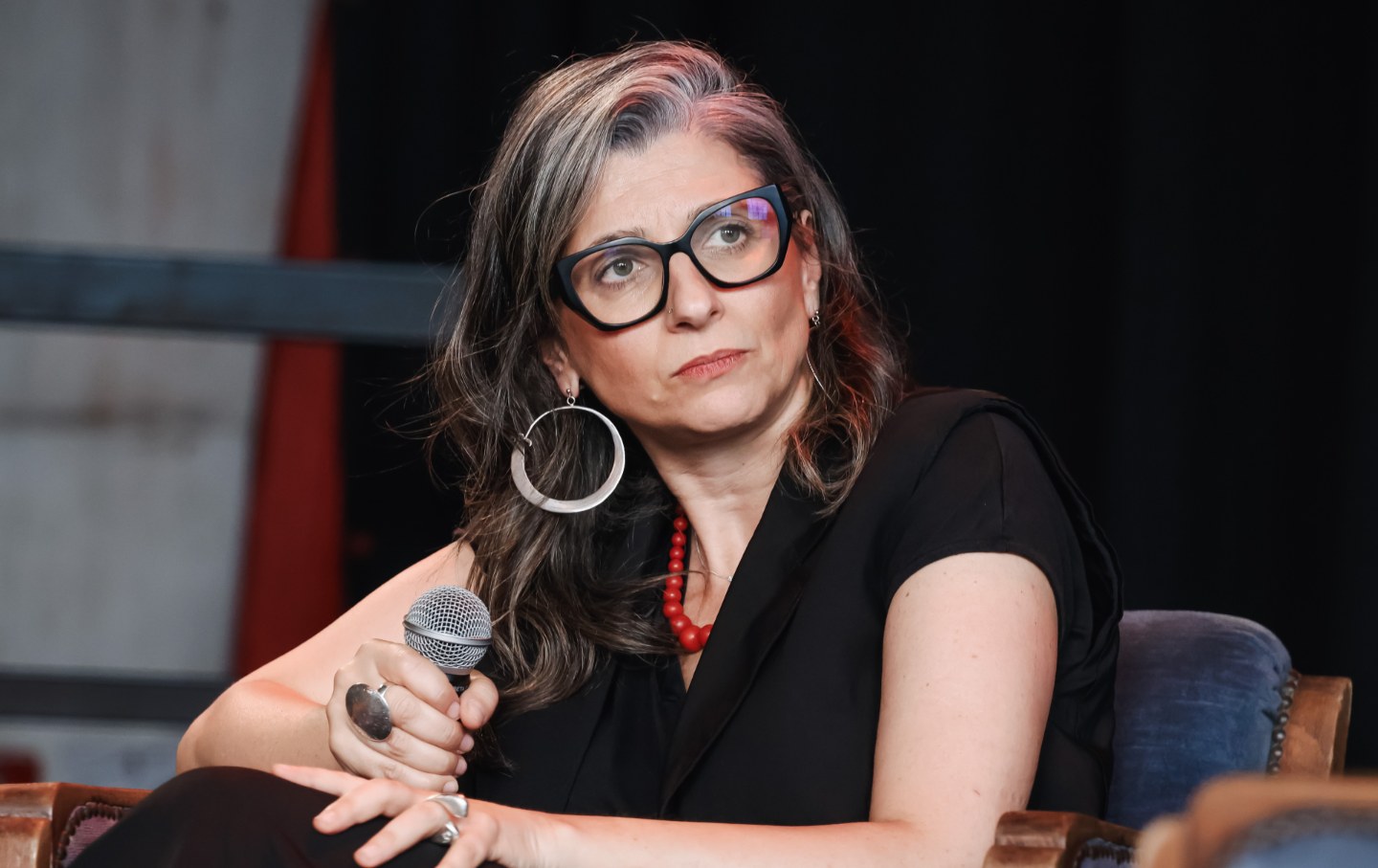
Francesca Albanese, United Nations special rapporteur on the occupied Palestinian territories, attends the presentation of the book The Light of Awakening. From Palestine to the Entire World, a Manifesto of Resistance and Freedom at Spirit de Milan in Milan, Italy, on May 27, 2026.
(Alessandro Bremec / NurPhoto via AP)Francesca Albanese has served as the UN special rapporteur on the occupied Palestinian Territories since May 2022; she was confirmed for another three years in April 2025. Albanese is the first woman to hold the office. (The Nation’s editorial board member Richard Falk held the same position between 2008 and 2014.)
As special rapporteur, Albanese has been a courageous figure battling numerous efforts to discredit and delegitimize her. In March 2024, she reported to the UN Human Rights Council that Israel’s actions in Gaza amounted to genocide. And in June 2025, the UN published a report by Albanese stating that many corporate entities, including Microsoft, Amazon and Alphabet Inc., were enabling and profiting from the occupation of the Palestinian territories and the Gaza genocide. In response, the Trump administration imposed sanctions on Albanese, naming her a “specially designated national,” forbidding all US persons and companies from doing business with her. Albanese called the sanctions “obscene” and said she was being punished for her “pursuit of justice.” Amnesty International called the move “a disgraceful affront to international justice.”
We met with Albanese via Zoom in May on the very day that a US district judge blocked the sanctions against her, ruling that they violated Albanese’s First Amendment rights. Our conversation was wide-ranging, defined by what Albanese has called her “intolerance for injustice.” It has been edited for space and clarity.
John Nichols: Early on, you did a couple of reports in which you very specifically sought to assert the word “genocide,” essentially to say to people, “Look, it is time to use this word [about what is happening in Gaza].” You faced a tremendous amount of resistance initially. Now, there’s been much broader acceptance, but I’m interested in why you made that choice at that point.
Francesca Albanese: I think that many Europeans of my generation, at least Italians of my generation, have had as part of their bread and butter an education about ‘never again.’ We have been exposed to the memory of the Holocaust. And so there is something already planted there that something as horrible as what happened during the Holocaust starts unseen, starts because the crimes against a specific group are normalized. So this was in the background; I had colleagues at the beginning of October [2023], telling me, “Oh my God, this is genocide.’ I had Israeli scholars saying, ‘This is genocide,” and I was totally reluctant. I didn’t want to use that word.
But then in the following weeks, I started studying. I started talking to academics and survivors. And I started documenting the facts and raising the risks for months [that] there could be [a genocide unfolding], because the language was genocidal. There were acts of killings, conditions calculated to destroy, endless cases of mental and physical suffering caused intentionally. And this is where I said, ‘Look, this is what Israel has done over the first five months, killing 30,000 people, an average of 150 people per day.’ Then it was statistics: 85 percent steadily were women and children. How it’s possible that this is just a miscalculation of where to throw a missile? I understood: It was a genocide, and like other genocides, it was unseen. Denial of the genocide is part and parcel of the genocide itself.
[International Court of Justice] member states have an obligation to act to prevent genocide the moment they have noticed [it]. So, in January 2024, the International Court of Justice recognized the plausible irreparable harm under the Genocide Convention to the Palestinians in Gaza. Member states had to stop all trading with Israel immediately, especially weapons. They continued.
Katrina vanden Heuvel: How far along is your work on the anatomy of genocide and complicity?
Francesca Albanese: I’ve mapped out the complicity of 66 states which are in violation of their obligation to prevent and punish acts of genocide. Clearly the United States is the state that spends the most, both militarily and in terms of financial support, but also it’s the headquarters of the biggest centers of wealth, the Big Tech, the military industry, the financial system. There is extractivism, and then weapons, and then banks and pension funds, and then the big tech—people call it technofederalism, or I call it necrocapitalism.
Palantir, for example, has developed technology based on the despair and the misery [inflicted] on the people of Gaza. And they say that. They claim it, say, “Look, this data all [worked together] while people were agitating under the bombing.” They have used [it] to be better prepared in times of emergency, so they concocted a program that they then sold to the NHS in the UK, as Yanis Varoufakis has reported. So this is why I say it’s necrocapitalism: because profits come first in capitalism. I’m not questioning this, but profit in terms of slaughtering children—it’s something extremely disturbing.
John Nichols: As a rapporteur, you have taken this struggle deeper, right? It is not merely to report on what governments are doing, or going after what the corporations are doing—you’re naming names in a way that does bring you scrutiny. Were you conscious that that was very likely to take this whole discussion to a new place?
Francesca Albanese: Absolutely. I knew, and I was scared, and I’ve had a couple of discussions. There was a former senior US official who warned me, “Look, they will go after you.” I’ve investigated a plethora of entities, including charities, sitting on neuralgic points of the system of displacement and replacement of the Palestinians, which is typical of settler colonialism. Today, there are businesses and corporations who amass a quantity of wealth that is absolutely able to annihilate the decision-making power of states, and this alters the democratic processes.
[But even with the risk,] I didn’t think for a second to get rid of my apartment in the US, because that apartment belongs to my daughter.
Katrina vanden Heuvel: How important has your truth-telling been in shaping the public debate and the media debate about Palestine and Israel?
Francesca Albanese: Someone recently told me: You speak about something that is highly technical in a way that is accessible. This has always been my ambition. Human rights are for the people—not for academics to write expensive books about. Human rights are swords and shields, and this is what many people across the globe are seeing now. This is why I agreed with my family suing President Trump. People need to know that justice works. For me, it’s not just about having my bank account back or my property back. It’s about reinstating a principle that international justice is in the public interest.
John Nichols: Your voice has resonated quite strongly with young people in the US. It has been less resonant with power in the US—with presidents and leaders of the Senate. I’m wondering how you assess that.
Francesca Albanese: What has happened with the younger generation, particularly in the US—I don’t think that they’ve listened to me. I’ve listened to them. I’ve learned from them. They are the ones who started calling out their universities for complicity with genocide. This has been an eye-opener.
[In terms of being listened to by the powerful,] maybe I’ve been less listened to than Michael Lynk or Richard Falk, in the sense that they managed to sit with the power. They don’t even sit with me, because it would be an embarrassment for them. It’s better to infantilize me and call me a witch. This is what they do, and this is why I’m saying that of all the things that Palestine has exposed, there is also this link between patriarchy and settler colonialism. I’ve encountered a lot of mansplaining, and I’ve enjoyed driving them mad.
Katrina vanden Heuvel: The UN, I’ve always believed, is a flawed but indispensable organization—but would you advise someone to apply or accept the role you have been occupying for the last years in terms of your overall experience?
Francesca Albanese: Of course, go for a ride—but be ready for the consequences. You need to be able to speak truth to power. I was not this person three years ago. I’ve changed because I’ve seen the genocide and the denial of genocide and the complicity making businesses flourish at the expense of the victims of the genocide. I was reporting the testimonies of people who had their anuses broken by rape. What else do you need? When will Israel have done enough? And this is not Netanyahu. This is not just Ben-Gvir. Withdraw the occupation, withdraw the settlements, stop exploiting Palestinian resources, and abolish all forms of apartheid. Then this is the beginning for what comes next.
John Nichols: I’ve been fascinated since the start of this by Ireland’s response to what has happened in Gaza. And I’ve wondered if you’ve noted that, and if you think that some countries, because of their experience, recognize a genocide or recognize a threat that other countries may not.
Katrina vanden Heuvel: Rashid Khalidi [has spoken] about Ireland in the context of oppression and resistance.
Francesca Albanese: Ninety-five [percent] of the Irish population has been thinking that this was a genocide since 2024. It’s been very different from the rest of Europe, because they’ve experienced colonization, British colonization before anyone else. There was a genocide, even if it’s not acknowledged. Almost 1 million people were killed by the famine caused intentionally by the Brits. I also say, “Look, we need to acknowledge that trauma generates trauma,” because then, what happened to the Irish people who moved to the United States? They have been part of a colonial project. This is why I’m saying we cannot judge Israel in 1948 and those who are really escaping brutal discrimination in Europe—those who escaped that really had nowhere to go. We need to acknowledge what has been done, and what was right and unavoidable years ago is clearly not right, and surely it must be avoided today.
John Nichols: And yet you are accused of being an antisemite. You’re accused of all sorts of terrible things when you’re stating something as you just did: factually, and also in a relatively sensitive way.
Francesca Albanese: “What doesn’t kill you,” we say in Italian, “makes you stronger,” and I will be forever indebted to a very negative experience that I went through at the beginning of my mandate. I was supposed to travel to the occupied Palestinian territory. The Israeli government even gave me a sense that they would let me in. And then a few days before I go, there is this bombshell that [starts], “Oh, Francesca Albanese is an antisemite because she has said ‘Jewish lobby’ in 2014.” Which is true; I said it. But they didn’t say the context; they didn’t say what was happening in 2014. I was there, and Israel had just killed 2,000 people, and the US was not even able to speak out against the killing of 500 children, and everyone said, “It’s because of AIPAC; it’s because of the Jewish lobby.” I was talking to people in Jewish Voices for Peace [sic], so this was the language. And I understand it’s offensive. It’s like saying the Muslim lobby or the Christian lobby. I’ve learned about all the conspiracy theories, so I acknowledge that.
Popular
“swipe left below to view more authors”Swipe →So, when this happened, I was blessed with the support of a number of Jewish scholars who came to my side and said, “Don’t shake, don’t bend, don’t crumble, don’t crash. Welcome to the club. From now on, you will be accused of all sorts of things, but you need to understand that this is a way to distract you, to silence you—but also to distract from what you are trying to do and say.”
And this lesson has stayed with me ever since, because today I know much more about the Holocaust. And again, the Holocaust didn’t happen in the concentration camps only. These were the ultimate means used, but it started with the dehumanization of the Jews. In my country, the fascist government passed a law in 1938 that prohibited Jewish people from joining the majority of professions. Today, antisemitism is no longer in the minds of many, what it is—meaning hatred against Semites, including Jewish people; violence against Jewish people because they are Jews. Today, everything you say about Israel can be antisemitic if it is too critical—too [inaudible]—and so this is why I keep calling the bluff.
Katrina vanden Heuvel: We’ve been talking about institutions, the UN, the judiciary. Someone whose voice has been heard in new ways is the pope. I wonder how you assess the new Pope’s language about peace, about other topics that are often not discussed in the public sphere.
Francesca Albanese: Personally, I was more naturally attuned with Pope Francis, whose clarity was immense. I like the fact that the pope has challenged the dominant vision that the power would like to pass as a civilizing mission. So this hope embodies another idea of the church. What I would like to see more, though, is that this is the perfect time to talk about Christ. Christ was someone who was able to speak truth to power. He was looking for what is just. He was always on the side of the most vulnerable, and this is something that should cross all the religions. There are many Jewish people, not just in Italy, around the world, they say, “Zionism—political Zionism and Zionist ideology—is corrupting the beauty of Judaism, which is the religion of the victims, the religion of the most vulnerable, and we have always been next to the marginalized. We cannot forget who we are.”
John Nichols: It is clear that the United States and several other countries have a great disregard for the ICC, and that international law is under assault by some of the most powerful countries in the world. How do you confront that? What should our response be?
Francesca Albanese: International law is a tool to regulate conduct. This is what has allowed the West to preserve peace and stability, mostly for us. The people in other parts of the world have not seen much of it. But today we have reached a level of lawlessness that is unprecedented. I think that this is the beginning of the end for us, because if the laws that have protected us until now get eroded to the point of not having safeguards anymore, we will return to the law of might. We don’t need to see more violence. We have already seen enough violence in Palestine, in Israel, in the rest of West Asia—in the US! It’s been a very painful period for US citizens. I’m talking about ICE. Police violence is not new. But now, having vigilantes shooting at people just for protesting—and then the vigilantes going and just apprehending people in the street because of the color of their skin—this is outright racism. I mean, we have had this in Europe 100 years ago, and this is why I tell my US fellows, ‘Keep on waking up.’ This is why I gave the book I wrote this title, When the World Sleeps. So for me, international law is a tool, a peaceful tool to justice. And today we are seeing this fight between lawlessness, which is the way to barbarism, or respect for the rule of law, which is the way to maintain peace and stability.
Katrina vanden Heuvel: The assault on civilians is something we’ve never seen. And the Geneva Conventions—all of these important, though flawed, post–World War II designs have been under stress. So I’m wondering if you see the need to reconstruct these institutions at some point, and is that part of your work going forward?
Francesca Albanese: The majority of the European population, in fact, has expressed discontent for how European governments deal with Israel. They would like the end of trade and military transfers to Israel. And then there are workers who have been striking. There are people, even people who do not care about Palestine, but you know, they say, “How it’s possible that there is such a high military expenditure in our country, and then we don’t have the money to invest in schools, in preventative health, and even in curative health?” There is a convergence of power in the hands of those we have already named. We need to be smarter—as Martin Luther King used to say, “If those who hate wars had the same ability to organize than those who love wars, there will be no wars.” And this is the thing: Now we need to organize. And how do we organize? Doing the right thing: ethical consumption, ethical investments, moving savings out of banks who invest in the arms industry. If everyone did the right thing—everyone as they can, everyone as they know—we will be done with it. We will be done with the plutocrats strangling our lives.
More from The Nation
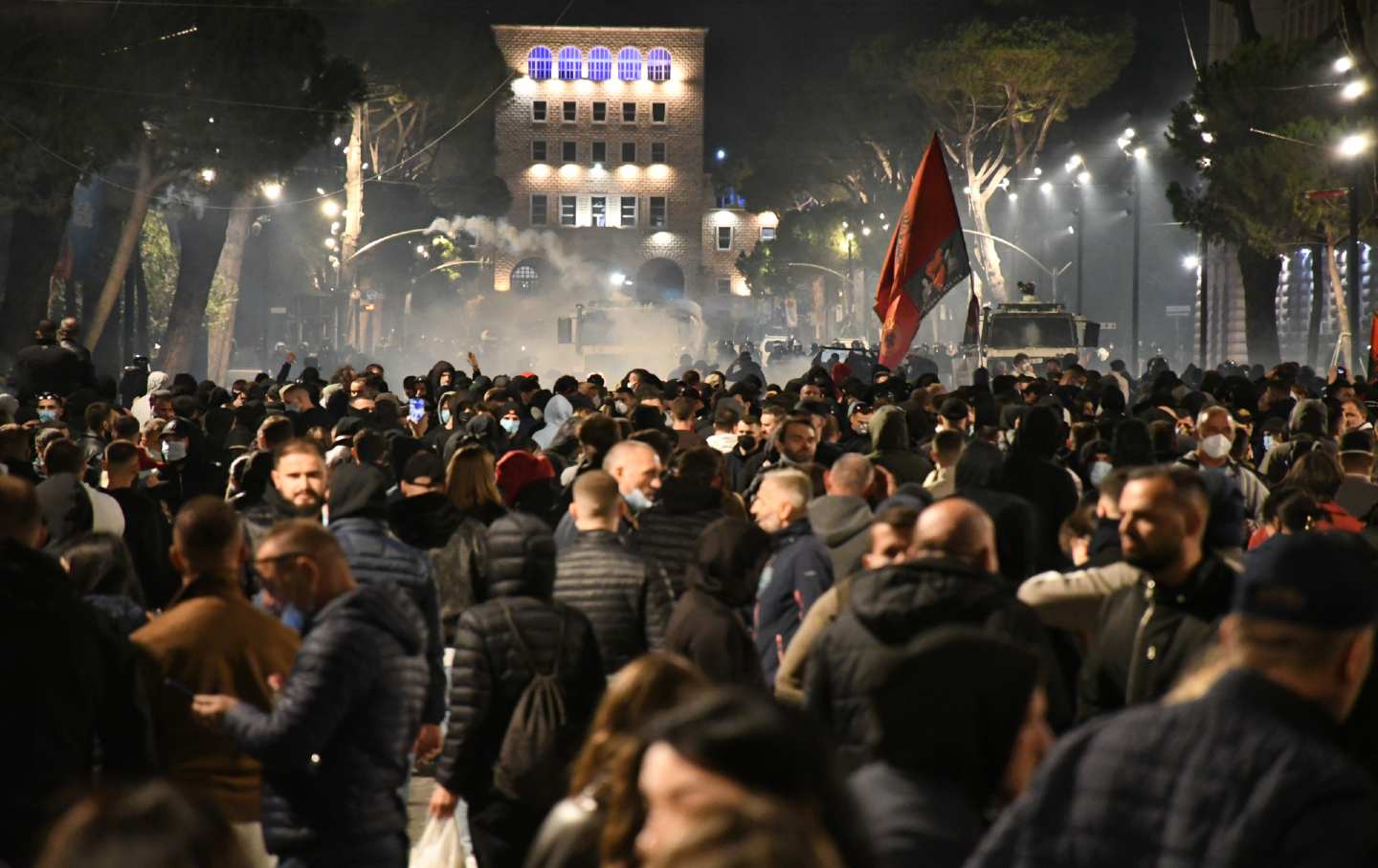
Albanian Student Strikes Spur a Political Crisis Albanian Student Strikes Spur a Political Crisis
A new round of protests against the ruling party's corruption has Prime Minister Edi Rama giving cops bonuses to crack down on dissent.
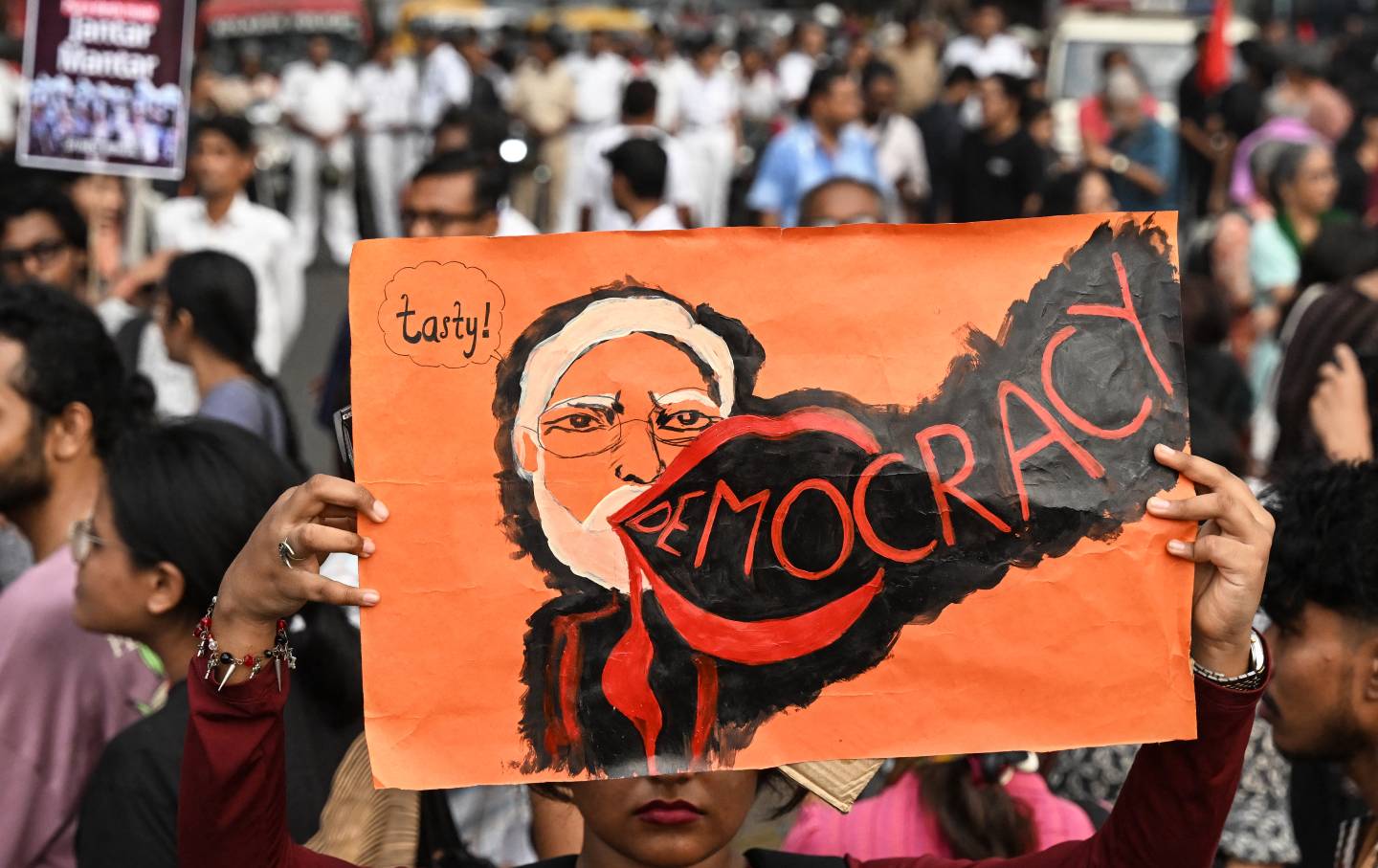
Inside India’s Gen Z Cockroach Janta Movement Inside India’s Gen Z Cockroach Janta Movement
Young Indians are challenging the purge of voter rolls by Modi’s right-wing government. Shrishti Khanna, who was detained by Delhi police while covering the protests, explains.
The Clarion Call of “NAZA” The Clarion Call of “NAZA”
Yuval Abraham and Rachel Szor’s new film not only documents the horrors of the present but give us a glimpse of a possible future too.
The Specter of Lepenism Looms Over France’s Social Crisis The Specter of Lepenism Looms Over France’s Social Crisis
Joining forces with the “yellow vests,” youth demonstrators are raising the alarm in a country falling to the far right.
Progressives Are Backing Puerto Rican Independence. It’s About Time. Progressives Are Backing Puerto Rican Independence. It’s About Time.
More and more leftists are concluding that statehood for the island is not enough.
The Saudi Phase of the Iran War Signals More Chaos to Come The Saudi Phase of the Iran War Signals More Chaos to Come
The conflict that Donald Trump has repeatedly proclaimed an unequivocal American victory keeps spiraling out of control.

