A System of Destruction
Yuval Abraham and Rachel Szor’s NAZA.
The Clarion Call of “NAZA”
Yuval Abraham and Rachel Szor’s new film not only documents the horrors of the present but gives us a glimpse of a possible future too.
A still from NAZA.
(Courtesy of NAZA)More than 74,000 Palestinians have been killed by Israeli troops in Gaza over the past three years. There are more than 20,000 children among the dead—an unfathomable number. We may never know exactly how many people were killed and how many died of secondary causes, such as sepsis or cancer. The environment, with packs of ranging dogs and the atomizing effects of kilotons of explosives, has done its part to efface those facts.
NAZA, a new documentary by Yuval Abraham and Rachel Szor, works in a somewhat different direction. It seeks to document the particulars of what did take place, to preserve the truth through a series of interviews with two dozen perpetrators—primarily Israeli intelligence officers—on a rooftop in Tel Aviv. By focusing their interviews on these intelligence officers and data scientists, the men who built the air force’s targeting algorithms, Abraham and Szor anticipate and undermine any arguments that the atrocities committed in Gaza occurred on the ground and were strictly the result of targeting Hamas fighters. Instead, we learn that the massive death toll occurred through calculated and dispassionate appraisals of when it would be easiest to kill a particular Palestinian—usually when that person was at home with his family—and that all of the “collateral” deaths (tens or even hundreds of them, depending on the target) resulted from these deliberate policy decisions.
Early in NAZA, we see a view of the Israeli occupation of Gaza in the 1970s. We are treated to propaganda from another era, quaint depictions of a smiling, benevolent mid-career Israeli army officer describing his good works to the attentive and smiling Arabs, somehow in their fellahi garb—not an ahistorical detail, but an unrepresentative one. What we are watching is the installation of some of the first telephone infrastructure in Gaza, built by the Israelis and designed from the outset with surveillance in mind.
A voiceover in Hebrew explains that the system will, in the years to come, serve as one of the best ways for Israel to monitor Palestinians and control them. What we are seeing is the modern surveillance state, the one we all now inhabit, at an early stage in Gaza.
A half-century after those images were first recorded, we are taken to 2023—into a world whose currency is destruction on a massive, historical scale. One in which Microsoft’s cloud infrastructure is used to capture millions of hours of private phone conversations between Palestinians in Gaza every day.
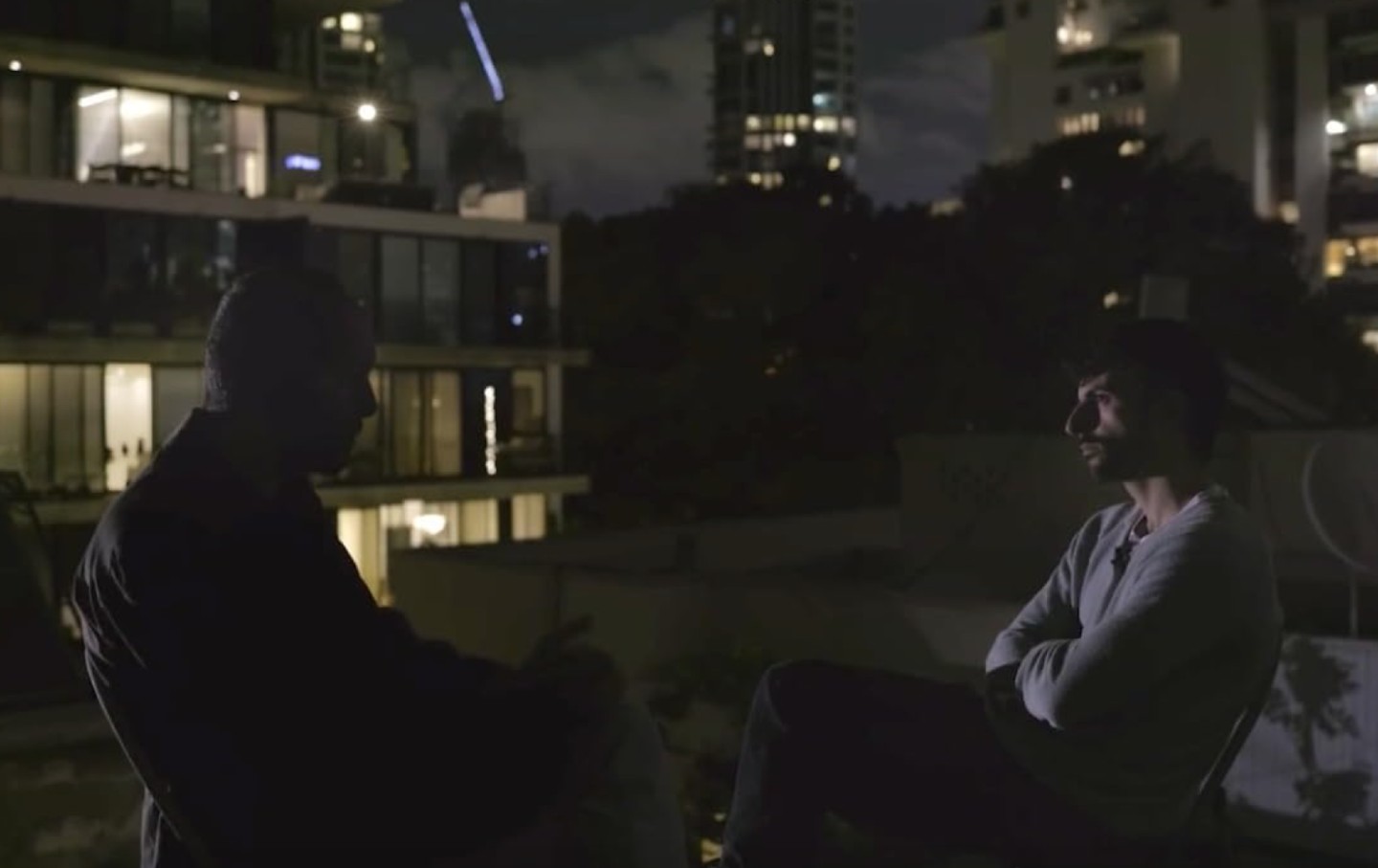
Most of the shots in the film are constructed elegantly, with Abraham and his interlocutor facing each other in shadow. The backdrop consists of the lights and glass towers of a modern city—the city of Tel Aviv. Close-up shots punctuate these conversations, capturing intimate moments across various high-rises—a hand brushing crumbs from a table; someone watching the evening news in an apartment. Here, Israelis enjoy their privacy and experience life just as many people in Europe and the United States do. But not so for the Palestinians living in Gaza, a mere 37 miles or so to the south.
Each of the film’s two dozen interviews explores different contours of the mass murder. There is Lavender, the software program that “identifies” Palestinian targets for execution, often permitting the murder of 20 or even 500 people in order to assassinate a single man, and Where’s Daddy?, another software program used to track Palestinians on a kill list; and then there is the unit tasked with targeting diplomatic threats on behalf of Prime Minister Benjamin Netanyahu’s office. There are men who describe themselves as “cogs” in a far more elaborate machine, and others who acknowledge their instrumentality in the destruction.
One of the men that Abraham interviews, perhaps mindful of the setting, describes how Al Rimal, a neighborhood he helped destroy in Gaza City, resembled Tel Aviv—tall glass modern towers, now gone forever. The viewer is thus invited to imagine NAZA: Tel Aviv; 2,000-pound bombs are indifferent to where they land and whom they maim or kill, after all.
There is little new information in NAZA (the title is an acronym taken from the phrase nezek agavi, or “collateral damage” in Hebrew). Abraham has reported most of his findings about the operations of the Israeli army in Gaza in Local Call and +972 Magazine over the course of the past three years. For example, a portion of the film is devoted to the workings of Lavender, a story that Abraham had already reported in April 2024, when only 34,000 lives had been taken.
But herein lies the challenge for the film. American and Israeli Zionists have attached themselves to the term NAZA to illustrate Israel’s righteousness. They ask, reasonably enough, why any damage would be described as “collateral” if the goal were to inflict wholesale destruction—one of the conditions of the genocide charge. The very use of the term indicates that not all damage is desirable; some of it is simply unavoidable. Abraham, for all his deftness as an interviewer, fails to directly tackle the sleight of hand involved in the NAZA descriptor. The rejoinder here is maybe too obvious: that the existence of programs like Lavender are little more an exercise in implausible deniability. A low or high error rate is beside the point when mass murder is the goal. We know—based on the statements of Israeli leaders themselves, and through the behavior of the perpetrators—that mass murder was the intention all along. The extermination of civilian life was the goal; the software merely put some distance between the operators and their works.
Yet there is still plenty to learn from NAZA, not least about the perpetrators themselves. One man describes the experience of watching through a drone camera as other Israeli soldiers execute starving Palestinians at an aid-distribution site. He and the others, at various points, speak as a proprietor would: These Palestinian lives belong to them. But they are not valuable or prized possessions, or even ones that could be usefully employed at a job site building settlements. The Israelis in the film relate to the Palestinians as disobedient and tiresome animals.
This attitude conveys the internalization of the phrase “human animals,” articulated by the war criminal and former minister of defense Yoav Gallant. It also explains the plaintive statement made by one of the perpetrators in the film: that neither he nor any of the others in his unit were “Arab haters.” They were just people doing a dirty job because, to paraphrase another of the interviewees, “If I don’t do it, someone else will.”
The enormous effort made by the Israelis in NAZA to describe their country’s trauma after the Hamas attack on October 7 can thus be summarized less as “How could you?” and more as “How dare you?” For them, the Palestinian offense is real, and so too is the injury to Israeli pride, and so they must correct the nature of the power relationship between the two groups, the balance between subject and object, and the value of a Jewish Israeli life as compared with those of the subalterns next door.
There is a genre of Jewish Israeli cultural production—films in particular, but also novels and TV shows—that is described as “shoot-and-cry.” Typically, an Israeli man (it’s almost always a man) behaves badly and then sheds tears about it. Those tears, and the inevitable self-reflective soliloquy or dialogue that follows, are meant to contrast his and his society’s high ideals with his and his society’s base behavior.
Popular
“swipe left below to view more authors”Swipe →We learn that there is high ground to be staked in the regret, the rueful contemplation of one’s own actions. Whatever the individual does, whatever his society requires that he do, his humanity is recoverable through his tears. The genre is designed to demonstrate to Israeli or Western audiences that the perpetrator’s humanity can be restored, despite everything. Or that he never relinquished it in the first place. He is an object of pity, a by-product of a savage reality.
NAZA avoids this trap. The perpetrators are given no real opportunity for self-indulgence. Abraham and Szor seem to understand that lamentations cannot erase what these Israelis have done in Gaza, what they continue to do.
Abraham’s critical distance as an interviewer is appropriate to the subject matter and the crime. He doesn’t cozy up to the perpetrators; he doesn’t try to sympathize or empathize with them. He doesn’t indulge their apparent desire to self-abnegate for the greater good, or whatever they think they’re doing. He asks questions; they answer. And when they evade or obscure things in their response, he asks follow-up questions.
Abraham and Szor have been criticized for veiling the identities of the people they interviewed, but I think this criticism misses the mark. With hundreds of thousands of perpetrators in Israel, there is no shortage of targets for prosecution, which is a project of the Hind Rajab Foundation. The perpetrators’ identities are anonymized in NAZA so that the filmmakers can collect the evidence, the testimonies, and the confessions that document what Israel is doing in Gaza.
Abraham and Szor’s effort is consistent with the goals of the Archive Genocide project. Palestinians will obtain justice, but it may come more slowly than many of us would like, and it may require a different set of tactics and methods in different settings.
One of the criticisms of NAZA made by Palestinians has been that it’s Oscar bait—a movie that instrumentalizes their pain and serves mainly as a monument to the filmmakers’ egos. I disagree with this assessment.
Still, there are frissons. At several points in the movie, the perpetrators are invited to draw the UX interface of their computer panels, where they sat and decided who (and how many other people) to kill. The scene is shot from above to capture what’s being drawn. The pens are high-quality felt pens with black ink—not the kind of pen I have on my desk, or the pen I’d grab from my kitchen as I rush out the door in the morning. The paper, too, is canvas-like, thick—not a standard item on the shelf.
What is one to make of the fact that a cinematographer planned these shots, knowing what they would contain? That care and artful attention were given to something that could have been depicted with a Bic and ordinary notepad? I understand: All art forms require art, and all artists must make art. If, in depicting a devastating fact, an artist or filmmaker suffuses the scene with quality—a sensibility that may be appreciated by the discerning viewer or member of the grand-prize jury—well, who can blame them? And yet…
I mentioned the surveillance state earlier. We learn through NAZA about some of the capabilities that modern states possess. The Israelis on camera reveal that they record Palestinians on their phones. They track movements and peruse digital photographs. They feed geolocation data into a computer model to map social interactions and surmise behaviors. And then they target people on that basis.
The tools of totalitarianism exist, and they are here to stay. What the Israelis have developed and utilized to eliminate life in the overwhelming majority of Gaza, every other government either possesses or will possess in the future. We are charged, as citizens of a constitutional democracy, with legislating protections for our civil liberties. I only hope that NAZA acts as a clarion call for people around the world. The film shows us one version of the future, which may be, in the end, one of its most meaningful achievements. But it also reveals how far along the path we’ve traveled. The threat has arrived—no quaint benevolence here—and it must be stopped.
More from The Nation
The Specter of Lepenism Looms Over France’s Social Crisis The Specter of Lepenism Looms Over France’s Social Crisis
Joining forces with the “yellow vests,” youth demonstrators are raising the alarm in a country falling to the far right.
Progressives Are Backing Puerto Rican Independence. It’s About Time. Progressives Are Backing Puerto Rican Independence. It’s About Time.
More and more leftists are concluding that statehood for the island is not enough.
The Saudi Phase of the Iran War Signals More Chaos to Come The Saudi Phase of the Iran War Signals More Chaos to Come
The conflict that Donald Trump has repeatedly proclaimed an unequivocal American victory keeps spiraling out of control.

Andy Burnham’s Speech to the Labour Party Conference Could Be the Start of a Positive Social-Democratic Politics Andy Burnham’s Speech to the Labour Party Conference Could Be the Start of a Positive Social-Democratic Politics
But the autumn budget to be released at the end of October will offer needed details.

Why Navi Pillay’s Receiving the Nobel Peace Prize Is So Important Why Navi Pillay’s Receiving the Nobel Peace Prize Is So Important
She believes that human rights and international law are universal principles that must be enforced regardless of violator’s ideology, ethnicity, or geostrategic alignment.