The World Cup Meets Casino Capitalism
FIFA’s new prediction market partners cast a shadow over the people’s game.
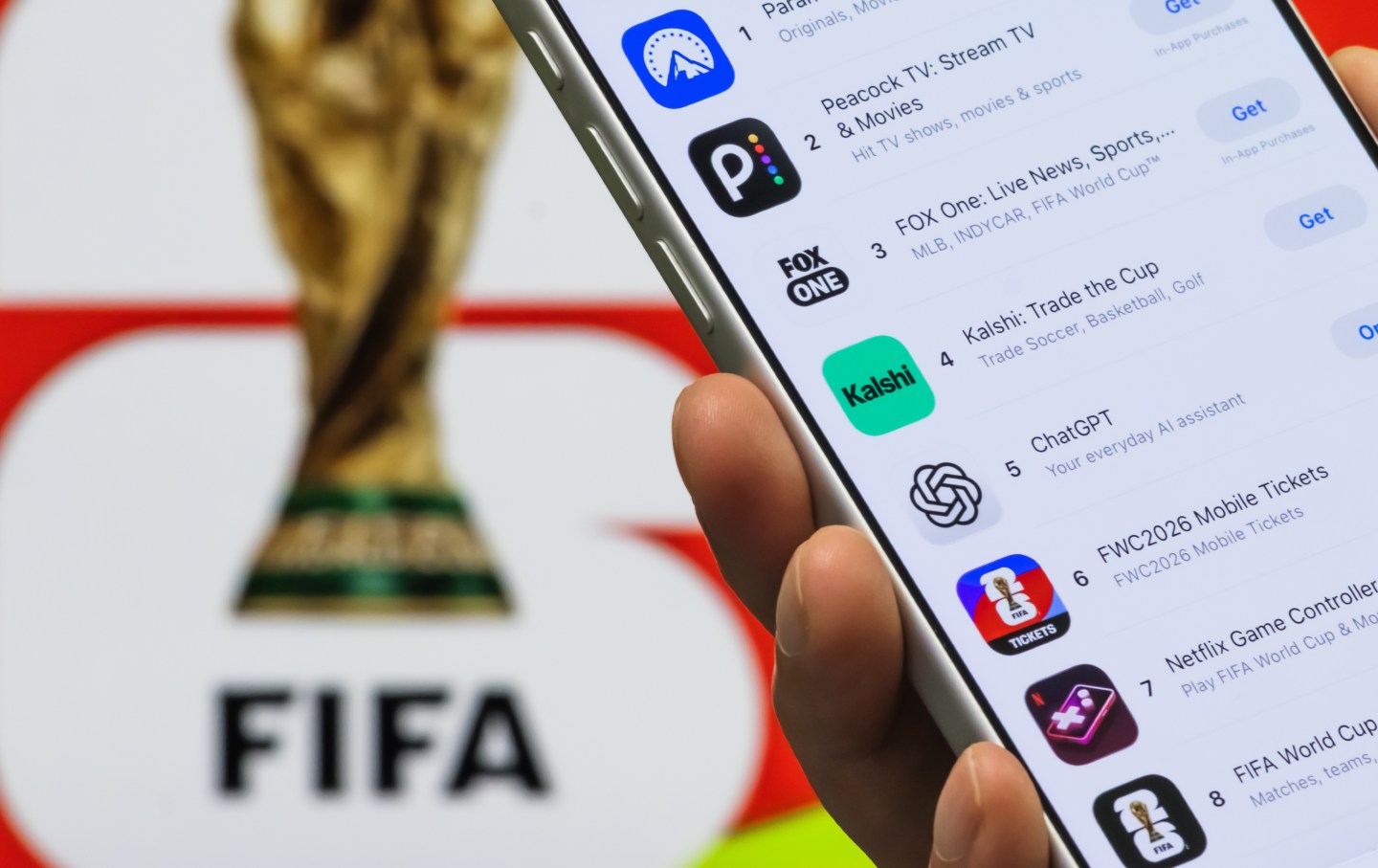
During the World Cup, Kalshi became the fourth-most-downloaded app at the Apple App Store.
(Cheng Xin / Getty Images)Just when one might think the FIFA greed machine couldn’t possibly whir at a higher, more grating pitch, the barons at the world’s governing body for soccer always seem to find a higher gear.
Weeks ahead of the World Cup, FIFA announced that it was partnering with ADI Predictstreet in “a landmark multi-year partnership” as “the first-ever Official Partner for the prediction market category.” The response from most FIFA watchers was, “What the hell is ADI Predictstreet?” After all, as investigative journalists at the soccer magazine Josimar revealed at the time, ADI Predictstreet had “no working product yet” and was “unlicensed in almost all jurisdictions.” Moreover, the shadowy entity was bankrolled by the Abu Dhabi royal family and run by Ajay Bhatia, an Emirati citizen of Indian descent who, after being accused of insider trading by India’s Security and Exchange Board, agreed to a £130,000 settlement and a voluntary six-month trading ban. The deal bore the standard corporate caveat: Bhatia neither had to admit nor deny wrongdoing.
Then, two weeks into the World Cup, the prediction market leviathan Kalshi signed an agreement with ADI Predictstreet, becoming a partner and making Kalshi an official FIFA sponsor. Its logo now flashes across the perimeter boards inside World Cup stadiums in Canada, Mexico, and the United States. Because Kalshi joined partway through the tournament, it scored the deal at bargain-basement rates: a reported $20 million, whereas FIFA had originally floated a $150 million partnership package to Kalshi, one the company refused. Typical FIFA partnerships, depending on the tier, range from $65 million to around $100 million per year.
With Donald Trump Jr. a “strategic partner” at Kalshi—as well as an investor through his venture capital firm 1789 Capital—the deal looks like yet another example of smash-and-grab casino capitalism.
The deal arrives at a time when sports betting has become a scourge on the sport of soccer. High-profile examples of corruption abound.
In 2023, the Italian football association banned Italy international and Newcastle United midfielder Sandro Tonali for 10 months for betting on matches in which he was playing. That same year, English striker Ivan Toney received an eight-month ban for illegal sports bets—many placed on his own team to lose. The penalty would have been longer had Toney not been diagnosed with a gambling addiction as part of the investigation. Toney is on the England roster at the 2026 World Cup. And when he looks up from the bench (he has yet to log a single minute on the pitch), he is confronted with ads for ADI Predictstreet and Kalshi that are plastered around the stadium.
Soccer’s gambling problem doesn’t end there. Only a few months before the 2026 World Cup kicked off, Major League Soccer handed lifetime bans to two players—Derrick Jones and Yaw Yeboah—for placing bets on soccer, including gambling that involved their own matches. And just two weeks before the tournament, Elye Wahi, the Ivory Coast player who featured in the 2026 World Cup, was arrested in France for sports betting–related offenses .
But such ethical complications do not seem to trouble FIFA. Under President Gianni Infantino, FIFA plans on raking in more than $11 billion in revenues from the 2026 men’s World Cup alone, a staggering sum that surpasses the gross domestic product of more than 60 countries, including tournament participants Cabo Verde and Curaçao.
Despite being an official FIFA partner, ADI Predictstreet was barely in the game. Betting through the company was moderate at best. Some matches reportedly attracted a measly $20 in bets. Enter Kalshi, which had racked up some $10 billion World Cup wagers during the first two weeks of the tournament alone.
To say that sports betting is a public-health concern is to make a massive understatement. In the United States, around 2.5 million adults—or 1 percent of the population—meet the National Council on Problem Gambling’s criteria for a “severe” gambling problem. As John Semley wrote last year in The Nation, “Another 5 to 8 million show signs of ‘mild or moderate’ gambling problems. As many as half of Americans who have sought help for problem gambling have considered suicide. And roughly 20 percent of the people with severe gambling problems have made attempts on their life.”
In the bigger picture, what Semley calls “gamblification” both takes advantage of and reproduces “two of the most lamentable tendencies of modern life: hyper-speculation on economic assets and widespread social atomization.” The World Cup is supposed to bring people together. But FIFA’s newest partners are pressing in the opposite direction, sacrificing public health on the altar of profit while setting a perilous precedent for other sports-governance bodies.
Aside from rescinding the harmful partnership, which is less likely than FIFA President Gianni Infantino’s successfully executing a corner kick, there are steps that everyday soccer fans can take to fight back against FIFA’s depredation and greed.
Popular
“swipe left below to view more authors”Swipe →The London-based nonprofit FairSquare has launched a “Reboot FIFA” campaign to address the desecration of the people’s game that this prediction market partnership represents. (Full disclosure: I serve on FairSquare’s advisory board.) Anyone can sign their name onto what FairSquare hopes to be the biggest-ever class-action complaint against FIFA, which the group is delivering to FIFA’s Ethics Committee (yes, it actually has one) and to the European Parliament.
The campaign is already netting attention. Halfway through the 2026 World Cup, the news broke that 50 members of the European Parliament are formally demanding that FIFA investigate FairSquare’s ethics complaint against Infantino over his move to hand-deliver Donald Trump the FIFA Peace Prize as well as allegations that Infantino has repeatedly breached FIFA’s own statutes that require “political neutrality.” (It’s hard to see how Infantino arriving at Trump’s Board of Peace meeting sporting a MAGA-style red cap emblazoned with “USA” and “45-47” is a politically neutral act.)
More and more people are coming to the realization that avarice is FIFA’s bailiwick and ethics are its bane. Trump’s recent intervention to overturn US men’s national team player Folarin Balogun’s red-card suspension—the US president called his FIFA BFF Gianni Infantino to ask him to reconsider the one-match suspension—has only rankled more people inside the FIFA orbit. Meanwhile, anti-FIFA activists have been organizing protests at numerous World Cup venues. The battle against FIFA greed is sure to continue. You can bet on it.