
We Can Still Realize FDR’s Vision
Roosevelt understood that freedom that extends from economic security.
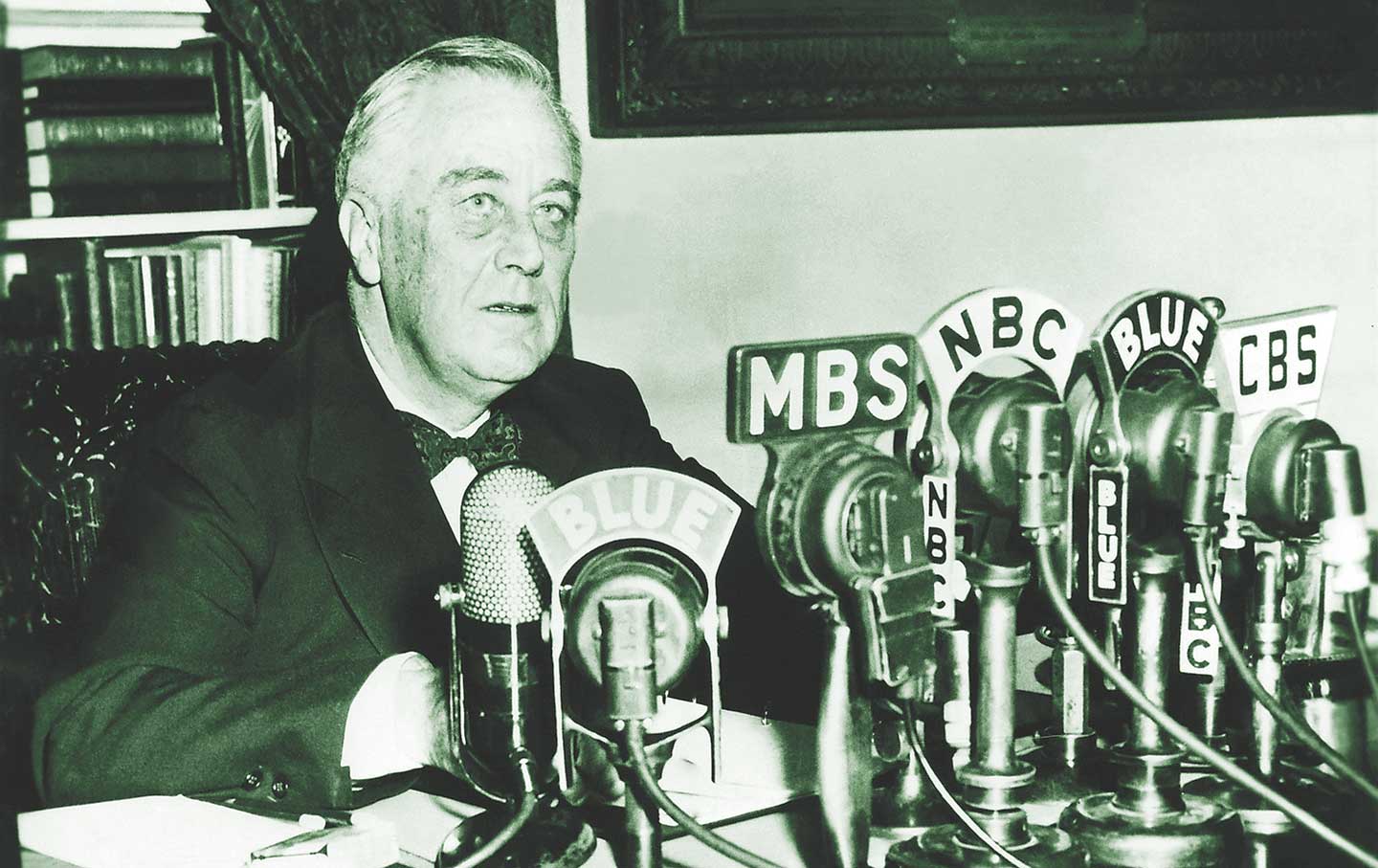
Nothing to fear: Franklin Delano Roosevelt knew that economic security was fundamental to democracy.
President Franklin Delano Roosevelt delivered the greatest, most radical, and most profoundly democratic State of the Union Address in American history on January 11, 1944. Rooting his message in the revolutionary promise of the Declaration of Independence, with its commitment to fundamental equality and the right to life, liberty, and the pursuit of happiness, FDR articulated the aspirations of generations—including our own—by projecting nothing less than the vision of a social-democratic United States.
While much great rhetoric and a good measure of history has been made in the time since what was once known as the President’s Annual Message to Congress evolved into the high-profile State of the Union extravaganzas of the current moment, no president has delivered a more compelling and lasting vision of transformational change than the one outlined by FDR in what was boldly described as a call for a “second Bill of Rights.”
250 Years of Searching for a More Perfect Union
Roosevelt did not go to Capitol Hill on that January day. Having contracted the flu, he sent the text of his address to Congress. And yet, to ensure that Americans would hear the message, he delivered it that evening via radio in a live “fireside chat” from the White House.
FDR began with an extended review of the war effort, with an emphasis on what still needed to be done to defeat Nazi Germany and Imperial Japan. Then, however, he looked ahead to the postwar moment. Well aware that most Americans remained anxious about the possible return of the Depression, he declared: “It is our duty now to begin to lay the plans and determine the strategy for the winning of a lasting peace and the establishment of an American standard of living higher than ever before known. We cannot be content, no matter how high that general standard of living may be, if some fraction of our people…is ill-fed, ill-clothed, ill-housed, and insecure.”
Evoking the spirit of the founders, he observed, “This Republic had its beginning, and grew to its present strength, under the protection of certain inalienable political rights…. They were our rights to life and liberty.” He continued: “As our nation has grown in size and stature, however—as our industrial economy expanded—these political rights proved inadequate to assure us equality in the pursuit of happiness.” As a consequence, “We have come to a clear realization of the fact that true individual freedom cannot exist without economic security and independence. ‘Necessitous men are not free men.’ People who are hungry and out of a job are the stuff of which dictatorships are made.”
Echoing Thomas Jefferson’s language in the opening of the Declaration of Independence, FDR continued: “In our day these economic truths have become accepted as self-evident. We have accepted, so to speak, a second Bill of Rights under which a new basis of security and prosperity can be established for all regardless of station, race, or creed.” The 32nd president then proceeded to call for an economic bill of rights that at its heart would guarantee to all Americans a useful job at a living wage, universal healthcare, a good education, food security, a decent home, and opportunities for recreation.
This was not a new agenda for Roosevelt: He had long been committed to realizing what he now proposed at the close of his third term. In his first presidential campaign, in 1932, he had outlined an Economic Declaration of Rights to challenge the persistent Gilded Age order. He pointed in the same direction with his 1941 State of the Union Address, in which he proclaimed the Four Freedoms that would become the nation’s declared war aims: freedom of speech and worship, and freedom from want and fear. However, he knew that he would not be able to advance the idea in Congress at that time. While Democrats nominally controlled both the House and the Senate, a coalition of conservative Republicans and reactionary Southern Democrats essentially managed congressional business and had already set themselves on the path of dismantling New Deal agencies in 1942. In fact, FDR was able to secure passage of the transformational GI Bill of Rights only because the conservative American Legion used its influence to push it through Congress.
Still, FDR had little doubt that the majority of Americans, especially working-class Americans, wanted the freedom that extends from economic security. At times inspired by Roosevelt, and at times pushing him to go farther than he may ever have intended, they had, over the 11-year period since his presidency began, battled reactionary forces at home during the Great Depression and then battled fascism abroad during World War II. In so doing, the people had radically transformed the nation and themselves. For all their sins of omission and commission, they had subjected big business to public accountability and regulation, empowered the federal government to address the needs of industrial workers and small farmers, mobilized labor unions and civil-rights groups, fought for their rights, and broadened and leveled the “We” in “We the People.” They had established the Social Security system, vastly expanded the nation’s public infrastructure, begun serious efforts to protect the environment, enthusiastically refashioned popular culture (just think swing music), and imbued themselves with the fresh democratic convictions, hopes, and aspirations that they carried into the war effort.
Given all that they had achieved and were continuing to achieve, working people might well have imagined that something like an economic bill of rights was within reach. National polling revealed that the vast majority of Americans had no intention of going back to the circumstances they had experienced before the arrival of the New Deal. They wanted to build on the advances that had been made during FDR’s unprecedented presidency. While it is true that they might not have used the term social democracy (neither did FDR), they certainly hoped for more of it: 94 percent supported expanding Social Security; 84 percent, unemployment insurance; 83 percent, healthcare for all; 79 percent, aid for students; 73 percent, new public-works projects; and 73 percent, a federal “job guarantee.” Moreover, polling also showed that three of every four workers wanted to expand and deepen industrial democracy in the workplace.
In the wake of the 1944 State of the Union broadcast, the AFL and the CIO, as well as the National Farmers Union and leading progressive groups and celebrities, began campaigning not merely to reelect FDR in the fall of that year, but also to promote his proposed economic bill of rights.
In calling for such a bill, Roosevelt not only sought to project a vision of the decidedly more democratic America that Americans themselves yearned to secure, but also to bolster those democratic ambitions and prepare the people for fresh political battles. While working-class Americans didn’t want to go back to the dispossession and vulnerability of the past, there were others who clearly did. The same forces that had fought the New Deal and FDR every step of the way retained influence over the economy and the politics of the country. Speaking for his class, Alfred Sloan, the chairman of General Motors, would say at war’s end: “It took fourteen years to rid this country of prohibition. It is going to take a good while to rid the country of the New Deal, but sooner or later the ax falls, and we get a change.”
With conservative Republicans, reactionary Southern Democrats, and especially corporate bosses in mind, FDR not only warned of a fierce “rightist reaction” late in his State of the Union speech. He also announced, with a ferocity that should speak loudly to us today, that after 50 years of class war from above, “if such reaction should develop—if history were to repeat itself and we were to return to the so-called ‘normalcy’ of the 1920s—then it is certain that even though we shall have conquered our enemies on the battlefields abroad, we shall have yielded to the spirit of Fascism here at home.”
Popular
“swipe left below to view more authors”Swipe →FDR won reelection in November of 1944, but he passed away the following April—just months into his fourth term. Yet the vision he championed did not die. Progressives and the labor and civil-rights movements sustained it for years. FDR’s call was echoed in the Democratic Party platform of 1960, in the great labor and civil-rights leader A. Philip Randolph’s proposed Freedom Budget of 1965, and in the Rev. Martin Luther King Jr.’s pleas for economic justice in the final weeks of his life. Then, after too many years of bad trade deals, stagnant wages, and neoliberal governance, US Senator Bernie Sanders resurrected FDR’s language and vision as a touchstone for his 2016 and 2020 presidential campaigns. Yes, Sanders lost. But polling by Data for Progress in 2023 showed that, just like our parents and grandparents, the great majority of us want an economic bill of rights. And if you pay close attention, you can actually hear that call being raised by a new generation of congressional and statehouse candidates in blue and red states across the country.
In this 250th year of our American experiment, and as we begin to approach the 100th anniversary of Franklin Roosevelt’s transformative presidency, we have an opportunity to redeem the promise of the Declaration of Independence and the best of the “Spirit of ’76.” This is the time to fight for—and finally secure!—an economic bill of rights for all Americans.
More from The Nation

The Jewish Case Against AI The Jewish Case Against AI
Haredi rabbis and the secular left agree: This technology is a threat to the entire social fabric.
The Fight for Educational Equality Is Also a Fight for a Just Supreme Court The Fight for Educational Equality Is Also a Fight for a Just Supreme Court
The court has severely weakened our ability to make an education system that fulfills the promise of Brown.

The Fall of “Scientific American” The Fall of “Scientific American”
When the beloved science publication got too political, its corporate owners stepped in. Now its future is uncertain.
The Bookstore Revolution in Taiwan’s Conservative Heartlands The Bookstore Revolution in Taiwan’s Conservative Heartlands
After Taiwan legalized same-sex marriage, gender-themed bookstores are working to build the social acceptance that the law alone couldn’t deliver.
Jalen Hurts Deserved Better. We All Do. Jalen Hurts Deserved Better. We All Do.
In a country that treats workers as expendable parts, Hurts’s playing through a blood clot is just the highest-profile example of the price workers pay in an oligarchy.
The Terrifying Future of States’ Criminalizing Pregnant People Is Already Here The Terrifying Future of States’ Criminalizing Pregnant People Is Already Here
The idea of charging people who have abortions with murder is gaining traction on the right. But a report finds that people are already being prosecuted for their pregnancy outcom...

