
Brazil’s Workers’ Party Is Not Stopping
With just a few days remaining before the runoff election, supporters of Lula’s party are doing everything possible to rally support behind the president.
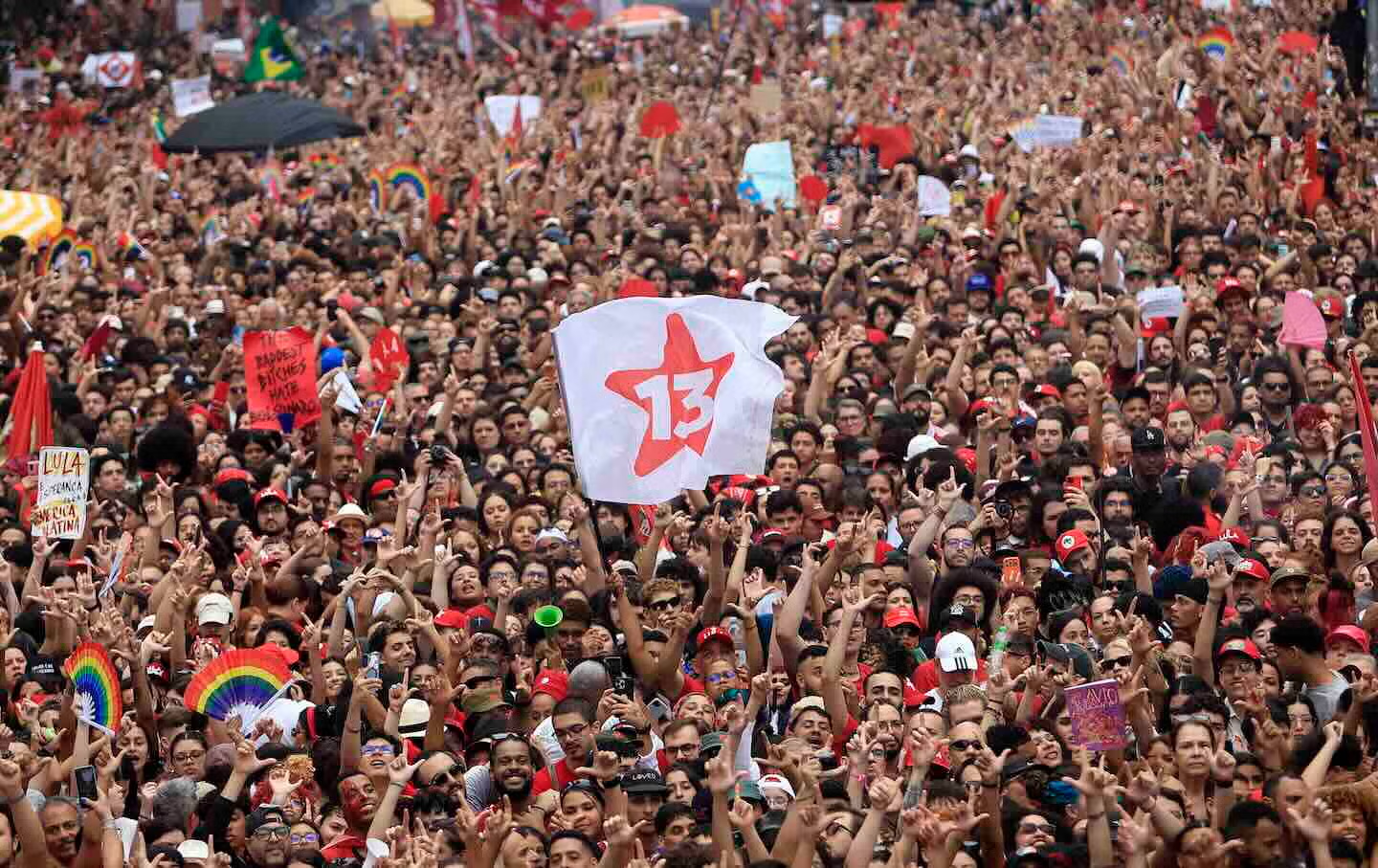
Supporters of Brazil’s President and presidential candidate Luiz Inacio Lula da Silva of the Workers’ Party (PT) attend a campaign event in Sao Paulo, Brazil, on October 11, 2026, ahead of the presidential runoff election.
(Miguel Schincariol / AFP)
Rio de Janeiro—On Tuesday, October 6, at roughly 5 pm, people wearing red shirts, hats, and stickers started filling the Rio de Janeiro Bankers’ Union office in the center of the city. Still shaken by the results of the first round of Brazil’s elections that previous Sunday, Workers’ Party voters had been called to a meeting by newly elected congressman Marcelo Freixo to strategize the next steps of a national campaign to turn the elections around.
That Sunday, October 4, millions of Brazilians voted to elect seats in the chamber of deputies and the senate, as well as state deputies, governors, and the presidential seat. Current democratic socialist president Luiz Inácio Lula da Silva, a member of the Workers’ Party, was facing far-right candidate Flávio Bolsonaro, the son of Jair Bolsonaro, who is currently in jail for an attempted coup d’état in 2022. Contrary to the polls leading up to election day, which predicted Lula had a lead over the far-right candidate, Bolsonaro captured 1.87 percent of valid votes over Lula, with 47 percent of total votes against Lula’s 45 percent. Since neither candidate reached over 50 percent of the vote, the race heads to a runoff on October 25. But even if Lula were to win this coming Sunday, Bolsonaro’s party, the Partido Liberal, swept the senate, winning 28 of 54 available seats, giving the far right a majority in the legislative chamber on top of its control of the House.
A Bolsonaro win in the runoff would give unprecedented power to the far right at two of the three top branches of Brazil’s government. And in the 48 hours following Bolsonaro’s advantage in the first round, he announced plans to modify the country’s 1988 constitution to “redemocratize the country,” proposing to abolish re-elections and reform the Supreme Court, the last independent branch of government. The Supreme Court has been key in maintaining Brazilian democracy. But experts warn that a far-right majority in the senate could be used to impeach and humiliate ministers who voted to convict Jair Bolsonaro. “It’s the end of the Lula era and we will be in power for decades,” Flávio said in a campaign event following the race.
The Lula era began in 2003, when he became president on a democratic socialist platform. He was elected again in 2006, with an approval rating of 52 percent. He won his third election in 2022, ousting far-right incumbent president Jair Bolsonaro. Lula’s governments were marked by a decline in poverty through welfare public policies, expansion of investments on higher education, increased access to water and basic sanitation, the delivery of hundreds of thousands of public housing units, and the expansion of workers’ rights in the country.
After the first round of voting, Lula and the Workers’ Party accused Meta of meddling with the 2026 elections through disinformation campaigns and the suppression of left-wing content across Meta’s social media platforms. Hundreds protested outside of Meta’s office in São Paulo on Monday, and the company announced on Tuesday that is complying with an order, triggered by the Lula campaign’s accusation, from the electoral court “to give equal treatment in its platforms” to both candidates ahead of the runoff, reported the Associated Press.
As Lula campaign supporters race to activate voters ahead of Sunday’s runoff, legal experts remain concerned about Flávio’s intentions to change the constitution. For Wallace Corbo, professor of constitutional law at the State University of Rio de Janeiro and the Getúlio Vargas Foundation, this proposal should be understood as a dog whistle confirming the likelihood of a return to far-right authoritarianism. “Substituting the 1988 Constitution in a context of the rise of authoritarian governments, with very low popular participation, is very problematic in terms of legitimacy, democracy, and rights for citizens and workers,” Corbo told The Nation, referencing the record number of people—33.4 million people, or 21 percent of the electorate—who did not vote in the October 4 elections. This low participation contrasts sharply with the 1988 Constitution, which involved an overwhelming number of participants from the different historically marginalized groups, including Indigenous people, Black people, and women, becoming “the most democratic and participatory constitution in our history,” after 21 years of a far-right military dictatorship supported by the United States, Corbo added. “There’s a danger of it being effectively abolished or significantly disfigured, with the rollback of certain rights for the population,” he said.
Additionally, a reform of the judiciary, as Bolsonaro has promised, might risk rolling back the limited abortion rights in the country. Abortion is largely banned in Brazil but is allowed in the cases of rape, life endangerment, or when the fetus has been diagnosed with anencephaly—exceptions that have been protected by Supreme Court rulings. In 2025, for example, Justice Alexandre de Moraes blocked a ban on fetal asystole, a technique used to stop the heartbeat of a fetus before it’s removed from the uterus, which would have ended all abortions beyond 20 weeks in Brazil. “The judiciary is still one of the institutions that most firmly upholds established rights and resists certain setbacks—this could be lost, and it could completely change this paradigm if, for example, there were an expansion of seats on the Supreme Court,” said Angela Boldrini, a São Paulo based journalist specializing in coverage of reproductive rights.
The next president will be able to name at least four new Supreme Court justices. If Bolsonaro wins, this would give him unprecedented power over the three branches of government. In the senate, the risk is a conservative majority passing even more draconian anti-abortion legislation. “If we have a chamber of deputies, a senate and a president that align with Bolsonarism, we lose all the checks and balances that could, for example, lead to a veto or the overturning of a presidential veto,” added Boldrini.
In the Rio de Janeiro Bankers’ Union office earlier this month, around 2,000 people showed up to strategize ahead of the election runoffs. The sense of urgency was palpable in the room as was the resolve to do everything possible to bolster Lula’s campaign. Lula is an original founder of the Workers’ Party and has dedicated his life to defending its principles, including the redistribution of wealth through welfare policies and taxing the rich.
“Each leftist militant here has to convince one person who didn’t vote to go vote,” said Alberes Lima, the Rio de Janeiro state president of the Workers’ Party. “We need to instill in people what a Bolsonaro government means. It means the end of workers’ rights, the end of a raise in the minimum salary; it means the end of many social programs that were built throughout many of your lives. Many things were built by people before us and we cannot make a mistake now.” With Brazil’s previous military dictatorship, which suppressed speech and violently persecuted leftists from 1964 to 1985, hanging in the air, Lima concluded, “We need to make a difference and we need to build something new so this bleak reality doesn’t fall upon Brazil again. 1964, never again.”
While many on Brazil’s left are sounding the alarm on a possible dictatorship that is similar to the 1964 coup d’état, which was backed by the United States, Corbo says this is a new, more subtle version of a shift to an authoritarian government. “[The Bolsonaro family and their allies] didn’t succeed in installing a violent coup d’etat [in January 2023], so they are trying to install it under a semblance of normality through the control of the three powers of Brazilian democracy,” he said. “With a president controlling all of these powers [the judicial, the legislative, and the presidency], there will be creations of new mechanisms to weaken the opposition, weaken regulatory channels, and establish an authoritarian regime through normal institutional channels.”
But much like 1964, this authoritarian regime would function in service of the interest of the United States, and consequently, could have catastrophic consequences for the whole world.
Flávio and Trump met months before the election and Flávio’s proposals contain 16 out of 21 demands Trump made of Brazil in October of last year, when the US imposed tariffs on the country. The demands include less regulation of American tech companies; no expansion of Brazil’s digital and free payment system, Pix; a “strategic and long term partnership” with regards to Brazil’s rare minerals; and an alignment on deforestation of the Amazon, 60 percent of which is located in Brazil.
A Flávio presidential term presents an existential threat not only to Brazil but to a world currently dealing with the accelerating effects of climate change. With the far right running the senate and Bolsonarista governors across Brazil acting in support of deforestation, the addition of a Flávio presidency would be devastating.
Popular
“swipe left below to view more authors”Swipe →“Flávio Bolsonaro has shown that he will be just as willing as his father to dismantle protections for climate and nature and allow illegal miners, loggers and land grabbers to invade Indigenous territories,” Jonathan Watts wrote for The Guardian on October 7. “As a lawmaker, he backed a 2019 bill to eliminate requirements for landowners in the Amazon to conserve a proportion of native vegetation. In his manifesto, he completely ignored the climate crisis. And he has courted support from some of the most predatory landowners in the rainforest.”
On the ground, left-wing organizers—both inside and outside of the Workers’ Party—are doing everything possible to mobilize support for Lula and Brazilian democracy, hosting rallies and making their presence known. “We need discipline in a moment like this,” congressman Freixo said at the October 6 meeting. “We cannot make mistakes.”
Given that a significant number of voters did not make their way to the polls in the first round—the highest number of abstentions since 1998—the Workers’ Party is focused on finding and captivating these eligible voters to overtake Bolsonaro. They have just three days left to turn out those voters, in what Freixo called “the most important election of our lives.”
More from The Nation
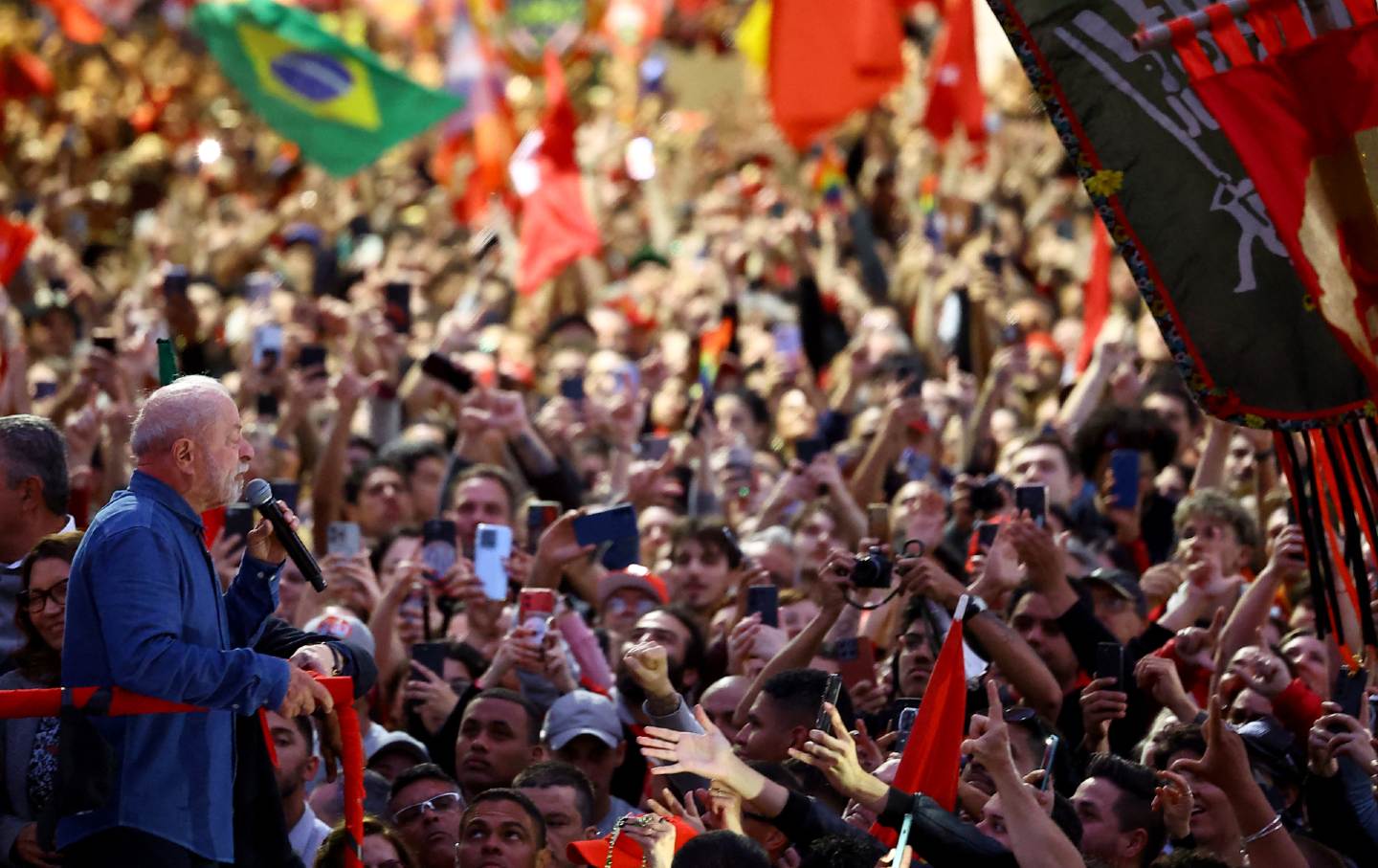
Brazil’s Decision Brazil’s Decision
The moral compass and basic humanity of political leaders really does matter.
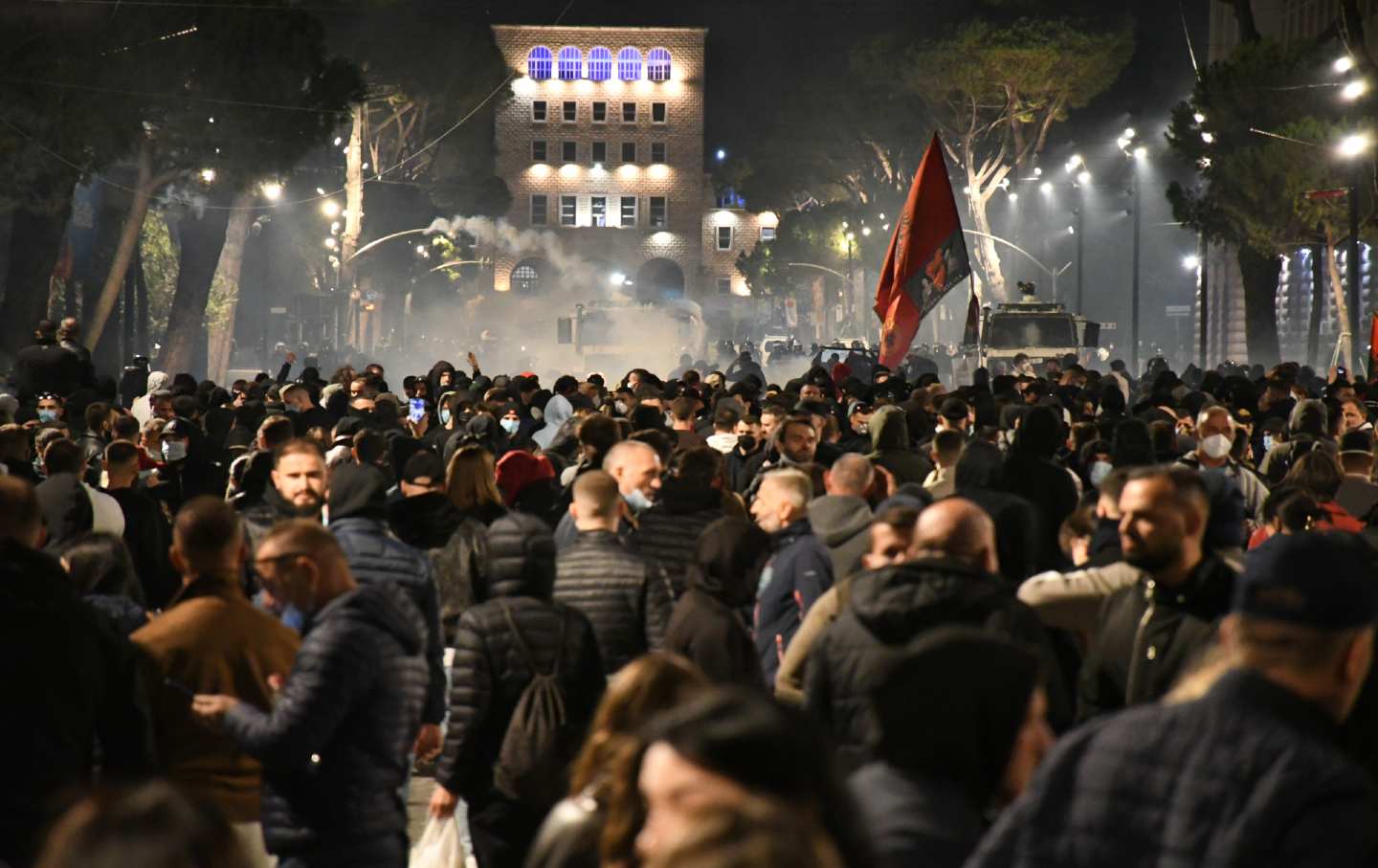
Albanian Student Strikes Spur a Political Crisis Albanian Student Strikes Spur a Political Crisis
A new round of protests against the ruling party’s corruption has Prime Minister Edi Rama giving cops bonuses to crack down on dissent.
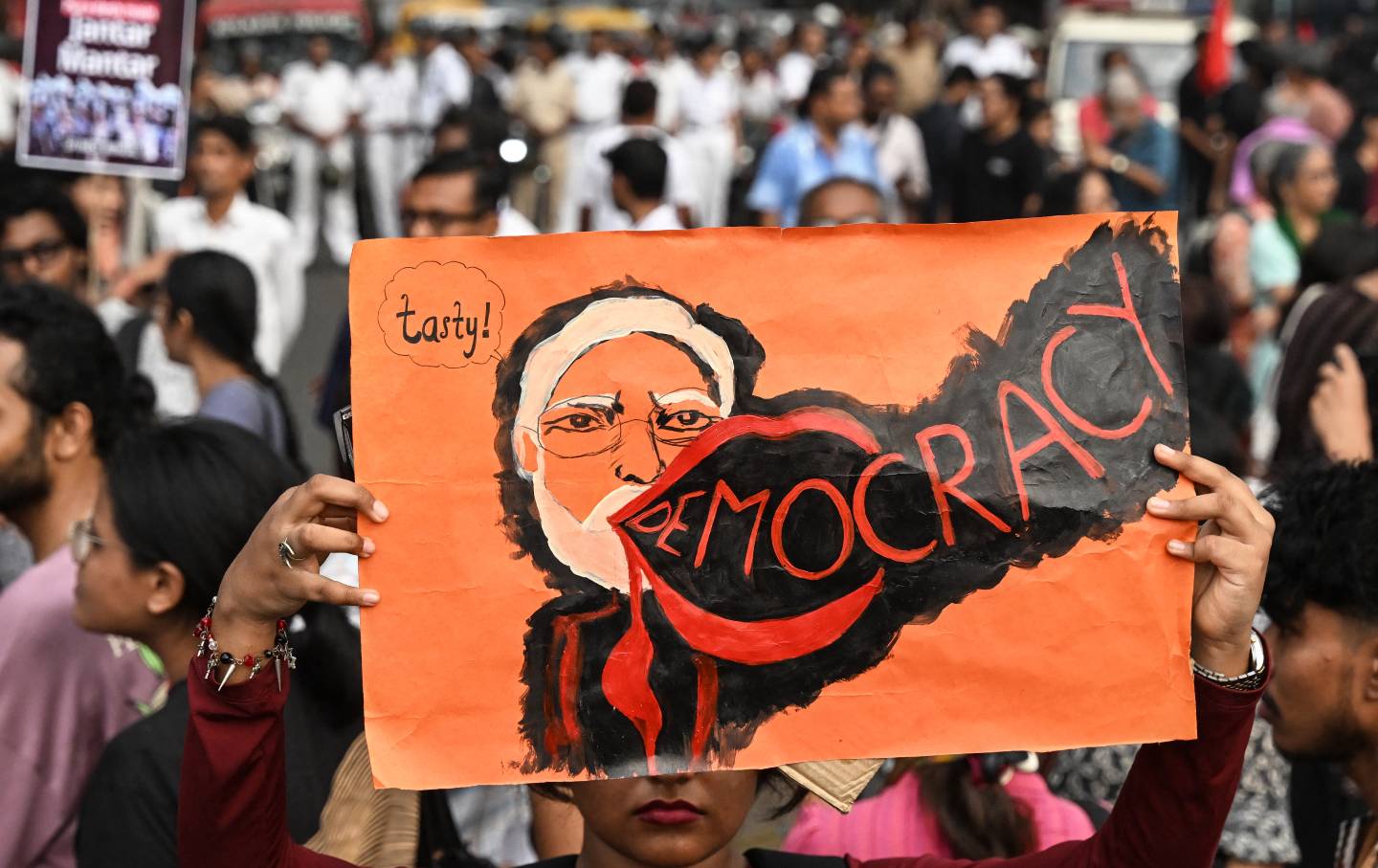
Inside India’s Gen Z Cockroach Janta Movement Inside India’s Gen Z Cockroach Janta Movement
Young Indians are challenging the purge of voter rolls by Modi’s right-wing government. Shrishti Khanna, who was detained by Delhi police while covering the protests, explains.
The Clarion Call of “NAZA” The Clarion Call of “NAZA”
Yuval Abraham and Rachel Szor’s new film not only documents the horrors of the present but gives us a glimpse of a possible future too.
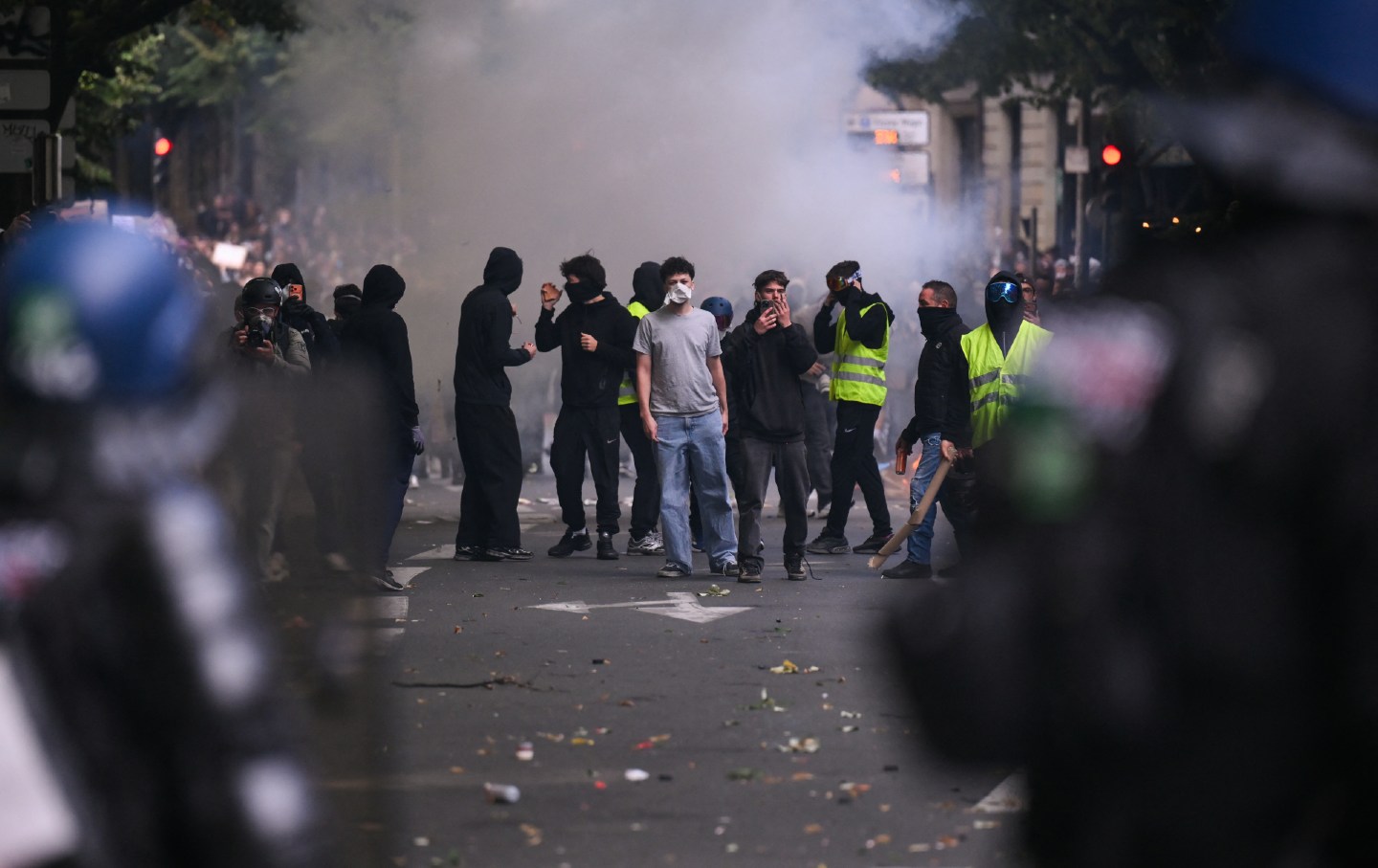
The Specter of Lepenism Looms Over France’s Social Crisis The Specter of Lepenism Looms Over France’s Social Crisis
Joining forces with the “yellow vests,” youth demonstrators are raising the alarm in a country falling to the far right.

