
The Trump Administration Is Refusing to Follow the Laws Protecting Domestic Violence Survivors
The administration has repeatedly failed to disburse funds for services for domestic violence survivors and blocked the enforcement of their rights.
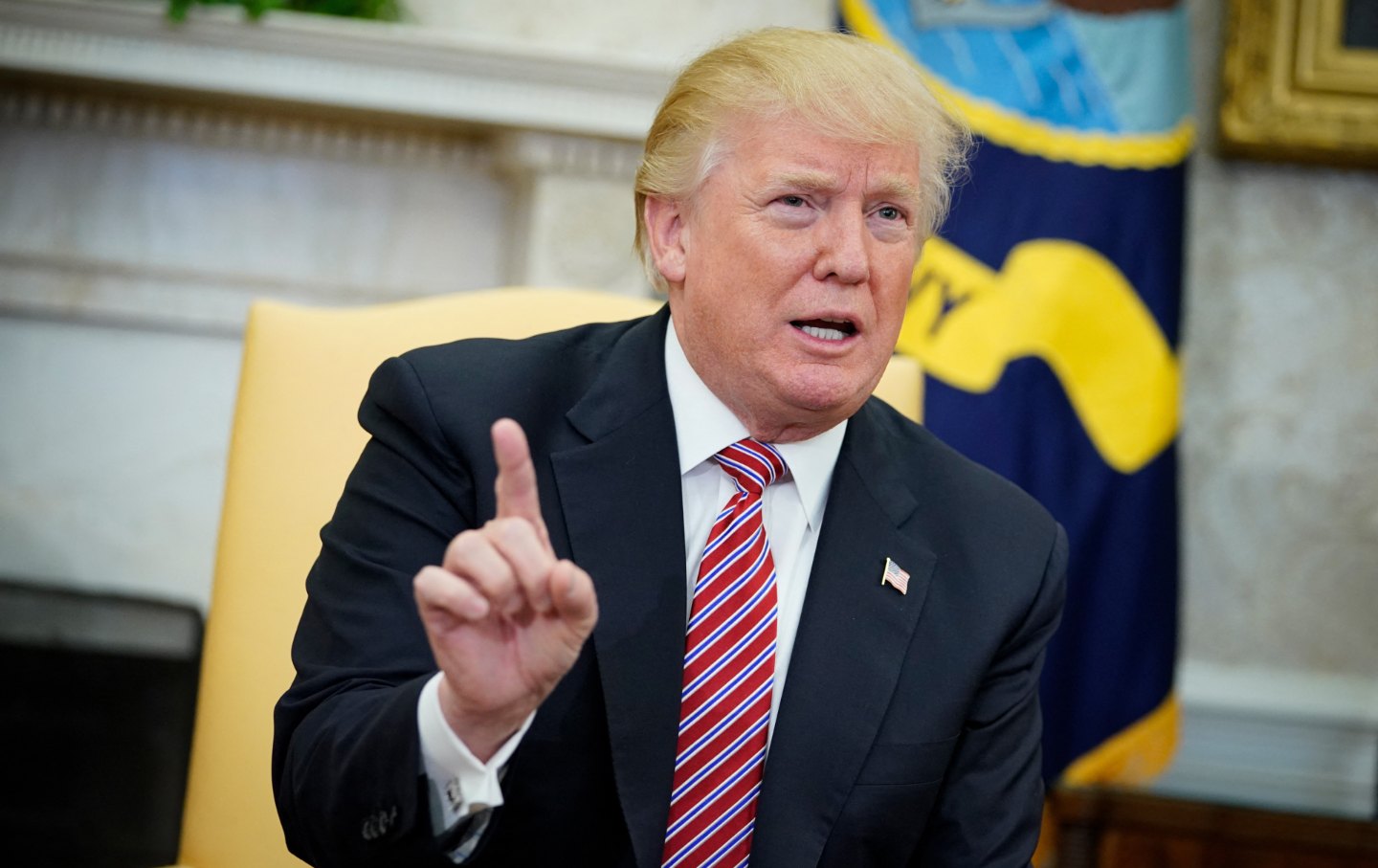
President Trump responds to a reporter’s question about domestic violence, in 2018.
(Mandel Ngan / AFP)In a typical year, the Miami Valley Fair Housing Center in Dayton, Ohio, receives approximately $550,000 in funding from the federal government to enforce fair housing rights and educate the public about them. But like many similar housing nonprofits, during the second Trump administration, the organization has struggled to access congressionally appropriated money. Last June, the organization went to court to sue the Trump administration for failing to disperse fair housing funding. After an extensive legal back and forth, it finally caught a break at the end of last September: The Department of Housing and Urban Development awarded it a $125,000 yearlong grant to conduct education and outreach on fair housing rights. But the money never arrived. Jim McCarthy, the organization’s president, heard from his assigned contact at HUD that higher-ups had questions about his organization’s activities, including an outreach event it was planning for victims of domestic violence. When the Violence Against Women Act was reauthorized in 2022 on a bipartisan basis, HUD was given new authority to pursue justice for victims of violence in federally supported housing whose landlords discriminated against them, and the Miami Valley Fair Housing Center wanted to make victims aware of their rights.
Finally, McCarthy received an e-mail from his contact at HUD headquarters. “VAWA is not a activity [sic] that aligns with the current administration’s priorities,” the e-mail, which was shared with The Nation, said.
Also by Bryce Covert
“This is the law. So it’s like, what do you mean?” McCarthy told The Nation. “What the hell?” Despite his confusion, he resubmitted the grant application with the outreach event for victims of domestic violence removed. After that, the grant was officially approved.
The e-mail that baffled McCarthy isn’t an outlier. It fits into a pattern in which the Trump administration has failed to disburse funds for services for domestic violence survivors that Congress appropriated and, through policy changes, has ignored or outright stymied the rights and needs of domestic violence victims. Some of the changes have been wrought by reduced funding and slashed staffing; some of them seem to stems from ideological crusades. All of the administration’s actions will almost certainly to lead to more violence and put victims’ lives at risk.
The Family Violence Prevention and Services Act, which was enacted in 1984, funds more than 2,000 domestic violence shelters and programs throughout the country. “It is the only federal funding source that is solely dedicated to domestic violence shelters and programs,” said Melina Milazzo, director of public policy at the National Network to End Domestic Violence, and it’s especially critical because many states don’t spend their own money on such services. But to access the money, states must apply for funds, and the Trump administration hasn’t even released the notice of funding opportunity yet, which is the first step in the process. It takes about six to nine months, Milazzo said, from when the notice of funding is posted for programs to receive funds. “This essentially means that domestic violence shelters and local programs across the country will face at least three months, likely more, without this core funding that essentially keeps their lights on and their doors open,” she said. Most operate with “very limited reserves and cash on hand, which essentially means any funding delays are effectively funding cuts,” she said. “Programs will be forced to reduce services, lay off staff, or even, in worst case scenarios, close altogether.”
The delay in FVPSA funding is compounded by other funding problems. About $200 million in discretionary grants from the Office of Violence Against Women from last fiscal year still hasn’t gone out, and so far there has been a “slight delay,” Milazzo said, in the notice of funding opportunity for that money for this fiscal year. “Cumulatively, this is all having a devastating impact,” she said. “Programs have been making cuts already and reducing services and are incredibly concerned about how long they’ll be able to sustain.”
NNEDV has already documented a gap in services; last year, local programs and shelters weren’t able to fulfill over 13,000 requests for help in a single day. That’s concerning, because victims of domestic violence are often in emergency situations that require immediate help. When NNEDV asked programs how long they could sustain their services if federal funding was cut by 50 percent or more, over half said they wouldn’t make it past six months; almost a quarter could only last one to three months.
If the delay in funding leads programs to cut back or close altogether, Milazzo expects more people who seek out services will get turned away. “It will mean more survivors and their children won’t have a shelter bed to go to, it will mean more survivors and their children won’t have legal assistance, safety planning, crisis counseling, the ability to get out of an unsafe situation and start to rebuild and heal,” she said. In worst case scenarios, she said, “you will see more fatalities, domestic violence homicides.” In other words, people will die. “The most dangerous time for a person in an abusive relationship is the time that they’re leaving,” she said. “If there’s no place for them to go, that means they have to return to an abusive relationship.”
There’s been little to no information from the administration about whether and when all of the funding will flow, Milazzo said. At least some of the holdup seems to be lengthy reviews to make sure funding is in line with Trump’s various executive orders, such as the one trying to eradicate diversity, equity, and inclusion and another denying the rights of trans and nonbinary people. “We can’t really get any answer from any of the agencies with respect to where things are, when things will come out,” she said.
Survivors of domestic violence are also getting caught up in the Trump administration’s crusade against immigrants. Immigrants living in the US who experience domestic violence—as well as trafficking, labor abuses, or other crimes—can petition for visas to stay legally, known as VAWA visas. Federal law says that these applicants generally shouldn’t be targeted for immigration enforcement. But Vanessa Alonso, CEO of law firm Alonso & Alonso, based in San Antonio, Texas, is representing clients who have pending VAWA cases who have received notices to appear before immigration judges—something completely outside of the VAWA visa process. “It’s really concerning,” she said. Some have even been picked up by immigration officials.
In addition, only US Citizenship and Immigration Services staff trained to deal with VAWA cases should be able to access details of such cases. But some of Alonso’s clients have had information from their visa petitions shared with other parts of the immigration system. One client, who had never been in an immigration database, filed a petition for a VAWA visa that included her address and immigration status; shortly afterward she received a notice at her home telling her to see an immigration judge. “It’s clear the application was used and that information as shared by USCIS improperly with ICE,” Alonso said.
“We’re seeing degradation of that protection and lines being blurred,” she added. “It’s almost as if the laws in place to protect this population are no longer being respected.” While she added that only a small percentage of cases are being affected by these problems, it’s concerning “because it’s never been done before.”
Meanwhile, in December USCIS announced that it would increase the standard of evidence domestic violence victims must meet for their petitions to be successful. According to the relevant statute, Alonso said, “credible evidence” is sufficient to win a VAWA case. Under that requirement, she was able to win cases based on clients’ own statements laying out the abuse they’d suffered. But “USCIS on their own are moving the goal posts,” she said. Now she’s advising clients to find text messages, photos, even witnesses to corroborate their stories. That’s not easy. “Often when someone’s experiencing this in a relationship, they’re not necessarily thinking about, ‘Let me collect this evidence so I can get my status on my own,’” she said. For the first time, immigration officers are interviewing her clients about their abuse. Clients are obligated to retell their stories, sometimes for hours, hoping that they’re able to relay it exactly as they did in their written declarations.
Some of Alonso’s clients are now hesitant to apply for VAWA visas at all. These cases take a long time, typically about four years, to resolve, which means that for some of Alonso’s clients, they submitted petitions that satisfied one set of rules and have now had the rules changed while they waited. Some have canceled their cases. Demand for these legal services is “extremely low compared to last year,” she said.
Alonso can no longer assure her clients that they’ll be protected from deportation while their applications are pending. “It’s just a different conversation when you’re speaking to a victim today. You have to say, ‘Look, the protections that the law has written are not being respected at the moment,’” she said. “A victim really has to weigh all of this and say, ‘Is it worth it to go forward?’ if potentially they are scared of their partner finding out, if it is going to take four years, if it’s not going to prevent deportation.”
“If the Trump administration’s intention is to get less people applying, I think it’s definitely working,” she added. And that, she said, will result in domestic violence going unchecked. “The less participation we have in those programs, the more perpetrators we will have potentially in our community who can continue doing what they’re doing.”
On paper, victims of domestic violence have been protected against discrimination in housing under VAWA for decades. But the housing protections lacked an enforcement mechanism. In its 2022 VAWA reauthorization, Congress directed HUD to enforce those rights the way it does with protections against racial, sex, disability, and other types of discrimination under the Fair Housing Act. Rights under VAWA include protection against eviction on the basis of gender-based violence and against discrimination in admission to housing programs, and they apply to people in housing complexes or programs administered by HUD, such as public housing or rental vouchers, as well as by Veterans Affairs and a few other federal agencies. That means domestic violence victims shouldn’t be evicted because their abuser damages the property or because the victim frequently calls the police to the unit.
During the Biden administration, the agency started accepting VAWA complaints and training its staff on how to process and remedy them. “We were standing that up and I thought it actually was starting to move pretty well,” said Sasha Samberg-Champion, special counsel for civil rights at the National Fair Housing Alliance who served as deputy general counsel for enforcement and fair housing and HUD under President Biden. The agency reached settlement agreements in “quite a number of cases,” he said, and was able to do it quickly. HUD not only helped victims quickly relocate to get away from their abusers, for example, but forced landlords to change their policies.
Popular
“swipe left below to view more authors”Swipe →“We had the ability to fully investigate cases, to send them forward for prosecution, to settle them freely,” said Paul Osadebe, former trial attorney in HUD’s Office of Fair Housing, speaking as a union steward at American Federation of Government Employees Local 476. “It was a full green light.”
But that changed in the second Trump term. “None of that is the case now,” Osadebe said. All of the people Samberg-Champion had worked with to set up the new capabilities at HUD are now gone, he said. Osadebe was on that team (he was fired in February after speaking out about the administration limiting HUD’s ability to enforce the Fair Housing Act), and he said that through firings and reassignments only one or two people are left working on VAWA enforcement at HUD. “That slows things to a crawl,” he said. VAWA complaints, as with all other fair housing complaints, are not being allowed to proceed. “It doesn’t matter whether someone is under threat of imminent violence,” Osadebe said. “It’s all treated as if it’s not urgent and is worthy of suspicion and needs to go through 20 layers of review and it’s presumed it shouldn’t go forward.” Like Alonso, he observed that victims were required to have hard proof of their abuse in order for HUD to move for a settlement. All other cases “just sit,” he said. Natalie Maxwell, chief legal officer at the National Housing Law Project, hasn’t heard of a single VAWA complaint getting resolved since Trump took office.
But enforcing VAWA protections in housing is not optional. “It’s completely illegal that HUD is not adjudicating complaints filed under VAWA,” Samberg-Champion said.
Only HUD has the jurisdiction to process VAWA complaints, and it can not only secure justice for a victim but also force systemic change to make sure others aren’t harmed. Victims can try to sue on their own, but “that is not an easy process and there are not enough attorneys to represent all the folks that need help,” Maxwell said. “It leaves survivors without an avenue for relief.”
Right before he was put on administrative leave, Osadebe had been working on a complaint that involved a victim of stalking who had to flee her home and was trying to get her housing back. “That person is homeless and will remain homeless and is probably homeless to this day,” he said. “I wasn’t allowed to help someone I could have helped.”
The administration’s actions paint a picture of an ideological opposition to the rights of domestic violence victims. And they come from one led by a number of people who have been accused of sexual misconduct, including Defense Secretary Pete Hegseth, who has been accused of abusing his second wife. Two members of Trump’s first administration resigned after being accused of domestic violence. President Trump himself was caught on a microphone saying he could grab women “by the pussy” and kissed women without their consent, was accused of rape by ex-wife Ivana Trump (who later disavowed the allegation), has been accused by at least 26 other women of sexual abuse, and was found liable for sexual abuse by a jury. Last September, he downplayed the severity of domestic violence, calling it a “lesser infraction” that shouldn’t be treated as a crime. “Things that take place in the home, they call crime,” Trump complained. “They’ll do anything they can to find something. If a man has a little fight with the wife, they say, ‘This was a crime scene.’”
Become a Sustaining Donor This September
Between the reemergence of right-wing red-baiting and Donald Trump’s use of the chilling National Security Presidential Memorandum–7 to criminalize left political organizing, we’re seeing McCarthyism reborn before our eyes.
This assault on democracy cannot be ignored or wished away. Resisting it requires bravery in the face of threats and repression, a steadfast commitment to the truth, and the unwavering belief that we can—and will—overcome this darkness.
We must have an independent media that sets the record straight, unearths corruption and abuses of power, and advances a politics of justice and dignity for all if we’re to win this fight.
That’s why I’m writing to you today. This September, The Nation needs to add 100 monthly donors to sustain our progressive journalism. Your contribution makes the next investigative report, the next truth-speaking column, and the next pathbreaking essay all possible.
I hope you’ll support our work with a recurring donation today. If you donate $10 or more a month, we’ll send you a brand new “Hands Off the Free Press!” sticker to recognise your commitment to our cause. Please, donate today.
Onward,
Katrina vanden Heuvel
Editor and Publisher, The Nation
More from The Nation

Trump Is Using Your Taxpayer Money to Pay for Illegal Election Propaganda Trump Is Using Your Taxpayer Money to Pay for Illegal Election Propaganda
But as brazen and authoritarian as these ad spots are, they seem likely to backfire.

Clavicular’s Charges Are One Thing. Rape Culture Is Another. Clavicular’s Charges Are One Thing. Rape Culture Is Another.
Braden Peters consistently acts as though the autonomy of women is a maladaptive trait, and dogmatically dismisses any claim to female equality as an outlying aberration.
Kimberly Guilfoyle Is a Master of Mafia Diplomacy Kimberly Guilfoyle Is a Master of Mafia Diplomacy
The US Ambassador to Greece is making suspicious deals for her buddies.
Missing Guardrails for AI Missing Guardrails for AI
Trump ignores the threat of extinction.

