A New Booklet Seeks to End Reproductive Injustices Behind Bars
The authors want to inform people in women’s prisons about their rights. “There’s no way to survive in there unless we know what our rights are.”
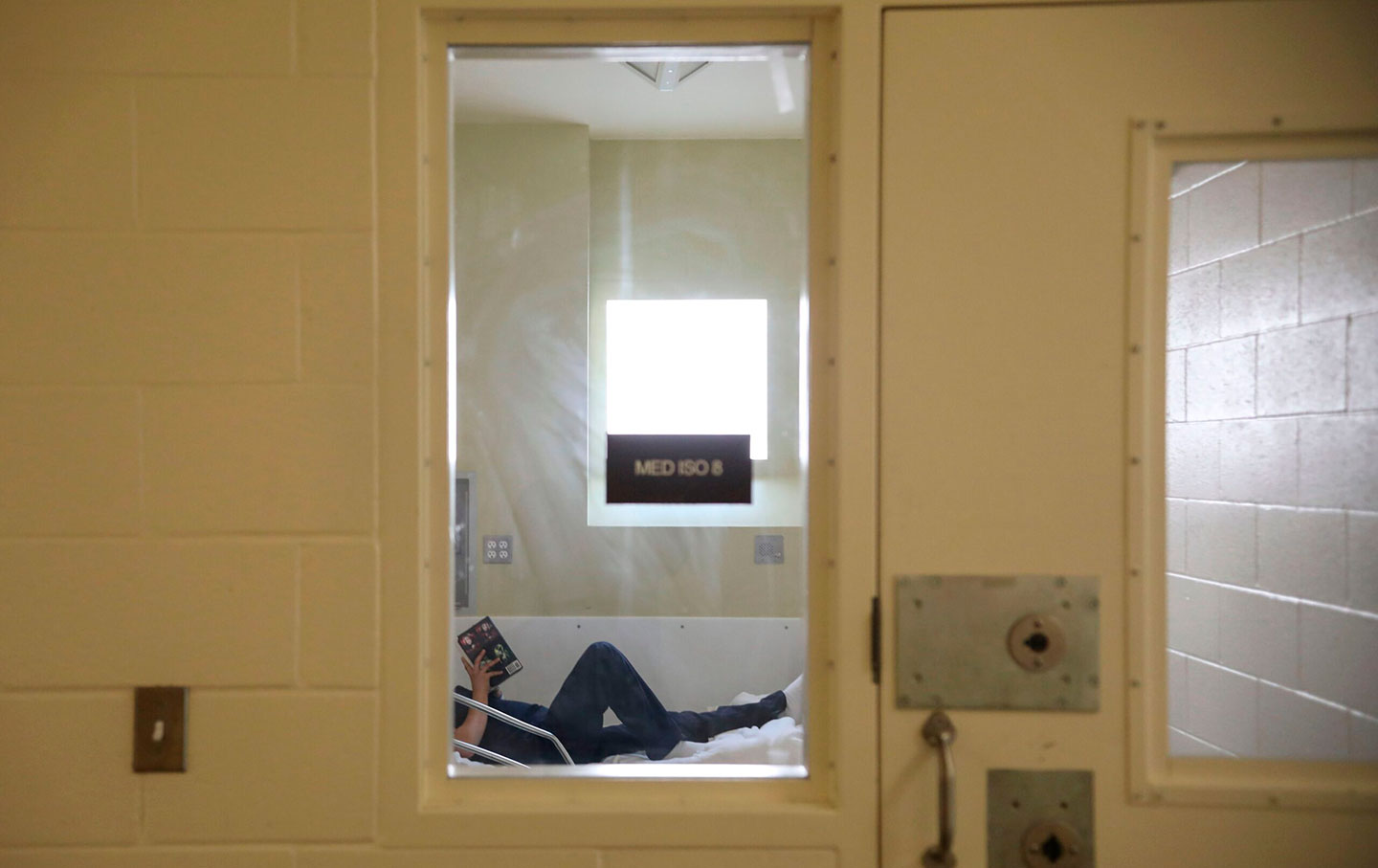
Aminah Elster recalls being told to avoid the gynecologist to protect her uterus. It wasn’t an idle warning. In different yards across California’s women’s prisons, people advised one another to avoid the gynecologist, warning that he wanted to “take their wombs.”
Between 2005 and 2013, over 850 people in California women’s prisons were sterilized. Many were not told beforehand that the procedure would leave them unable to have children.
This includes Ezekiel Teaque. While at Valley State Prison for Women, gynecologist James Heinrich told him that he had a cyst on his left ovary and recommended removing the entire organ. Seven years later, Heinrich told Teaque that he had a cyst on his remaining ovary. At the hospital, Teaque received some confusing news—the surgeon told him that his right ovary had already been removed. He never received documentation confirming whether he still had one ovary or if both had been removed. (Valley State converted to a men’s prison in 2013. Heinrich no longer works for the California Department of Corrections and Rehabilitation.)
Robbin Machuca was told by a different prison gynecologist that she had a cyst on her ovary and needed surgery to correct it. “I was young.… I didn’t know about insides and stuff like that,” she told The Nation. She consented to the procedure and later learned that she had been sterilized.
These sterilizations made headlines and sparked outrage. In 2021, after years of advocacy, the state agreed to pay $4.5 million to nearly 800 people in its women’s prisons who had undergone procedures that “could have resulted in sterilization.”
But people in women’s jails and prisons face routine reproductive injustices every day, most of which go unnoticed. And there are a series of factors that allow these injustices to continue.
Behind bars, accurate medical information is hard to come by. Providers may not explain conditions or procedures. Incarcerated patients often do not know that they can ask for more information, ask for more time before making a decision, or say no to a proposed procedure. That’s what happened to Teaque, a Black trans man who entered prison in his early 20s.
“Back then, I never thought a doctor would lie to me,” Teaque, now 54, told The Nation.
Machuca recalled thinking similarly at the time. “I trusted them because it was their field of duty,” she said.
Now both Machuca and Teaque are part of an inside-outside research team seeking to ensure that people in women’s prisons are better-informed and better-equipped to talk with medical providers about their health concerns and that appalling injustices, such as the mass sterilizations, don’t happen again.
The California Coalition for Women Prisoners (CCWP), Unapologetically HERS, and researchers with the University of California San Francisco, in collaboration with incarcerated researchers at the Central California Women’s Facility, have published Know Your Reproductive Rights in Prison. The 95-page booklet covers reproductive healthcare, such as cancer, menstruation, pregnancy, abortion, and procedures that can cause sterilization as well as informed consent, evaluating procedures, and accessing or refusing treatment. It also includes information about prison basics, such as grievances, retaliation, shackling, and strip searches.
“A gap that this booklet seeks to fill is to inform people about their rights, what they can say no to, how they can ask questions, and to give people the power to choose and make decisions on their own health care,” Aminah Elster, who spent 14 years behind bars, told The Nation, noting that many had never seen a gynecologist and had little to no experience around healthcare before their incarceration.
“People needed better tools and information because they weren’t getting it from their doctor,” said Jen James, a researcher with UC San Francisco and a member of the California Coalition for Women Prisoners. “They needed better information about how to talk to their doctor.”
Know Your Reproductive Rights in Prison is grounded in reproductive justice, a Black feminist framework advancing the right to maintain bodily autonomy, to have or not have children, and to parent children in safe and sustainable communities. “We see these rights as fundamentally incompatible with prisons,” the booklet’s authors declare. “We seek to build power among incarcerated and formerly incarcerated individuals, fostering collective advocacy and systemic change.”
“I was incarcerated for 30 years,” said Chyrl Lamar, a member of both CCWP and Unapologetically HERS. “I had no clue [tubal ligations were] happening to any of these people. It was really heartbreaking.” She learned about the sterilizations after coming home in December 2020. She joined efforts to garner reparations for sterilization survivors. The Forced or Involuntary Sterilization Compensation Program ended in 2025. “Even though they stopped giving out compensation, that shouldn’t be the end of the story,” she said.
Elster is now the cofounder and director of Unapologetically HERS, an organization led by formerly incarcerated people advancing racial and gender justice. They are among five formerly incarcerated contributors in the book.
But it’s not just their experiences that informed the book and the process. Unapologetically HERS has a program that trains people inside women’s prisons on participatory action research. Five people incarcerated at the Central California Women’s Facility, including Teaque and Machuca, learned data analysis and coding. They also identified the reproductive justice issues that were important to them, created a survey, and then surveyed their peers.
Initially denied compensation, Teaque appealed and was ultimately granted compensation. When he learned about the participatory research program, he applied, hoping to use his own experiences and hard-won knowledge to help others. Teaque chose to focus on sterilizations. From his 35 years in prison, he already knew who had been imprisoned when sterilizations were happening and began by interviewing them, asking if they had understood the forms they were signing and the procedures they were scheduled for. Again and again, the answer was no.
Machuca surveyed the people at her prison job and at groups. She gathered people together and asked them about their reproductive history—pregnancies, abortions, live births, menstruation. She had done some research methodology while enrolled in college classes through Fresno State, but this was the first time she was putting these skills to use.
Leesa Nomura, who is also formerly incarcerated and now an organizer with CCWP, recalled connecting with younger women who had been in the system since they were teenagers or even younger. She noted that many had been incarcerated from a young age—in group homes and juvenile detention and later, to county jails and state prison. In none of these institutional settings were they taught about their body or reproductive health, making them extremely vulnerable to being pressured into procedures such as sterilization. “There’s no way to survive in there unless we know what our rights are,” she told The Nation “I’d like to see this [book] be part of every person’s intake so that the things that happened in the past aren’t repeated.”
Popular
“swipe left below to view more authors”Swipe →To that end, the book includes advocacy tools as well as penal codes, laws, and rights pertaining to reproductive rights. “People inside definitely need the penal code [which governs how California’s state prisons operate] to assert their rights,” said Vrindavani Avila, a doula and CCWP member.
Lamar hopes that the book encourages more people to be proactive about their health rather than relying on medical authorities. “I learned that at an early age, and I think this booklet is going to be very helpful for them,” she said.
The process of creating the book has also had intangible effects.
Being part of this research, Teaque said, “has given me purpose, confidence, and the drive to educate myself on things that have to do with our rights. Knowledge is power, and I realize how many people are lacking the knowledge needed to change things.”
For Machuca, the book is a tool to combat reproductive injustice. “How can we stop this from happening and how can this never happen again?” she said. “We could work together to stop the harm.”
Proceeds from book sales pay for sending free copies to incarcerated people.
Become a Sustaining Donor This September
Between the reemergence of right-wing red-baiting and Donald Trump’s use of the chilling National Security Presidential Memorandum–7 to criminalize left political organizing, we’re seeing McCarthyism reborn before our eyes.
This assault on democracy cannot be ignored or wished away. Resisting it requires bravery in the face of threats and repression, a steadfast commitment to the truth, and the unwavering belief that we can—and will—overcome this darkness.
We must have an independent media that sets the record straight, unearths corruption and abuses of power, and advances a politics of justice and dignity for all if we’re to win this fight.
That’s why I’m writing to you today. This September, The Nation needs to add 100 monthly donors to sustain our progressive journalism. Your contribution makes the next investigative report, the next truth-speaking column, and the next pathbreaking essay all possible.
I hope you’ll support our work with a recurring donation today. If you donate $10 or more a month, we’ll send you a brand new “Hands Off the Free Press!” sticker to recognise your commitment to our cause. Please, donate today.
Onward,
Katrina vanden Heuvel
Editor and Publisher, The Nation