
Why Is Steph Curry Investing in Israeli Security Tech?
The greatest shooter ever is part of a financial ecosystem in which Silicon Valley capital pours into Israeli technology companies with ties to the IDF.
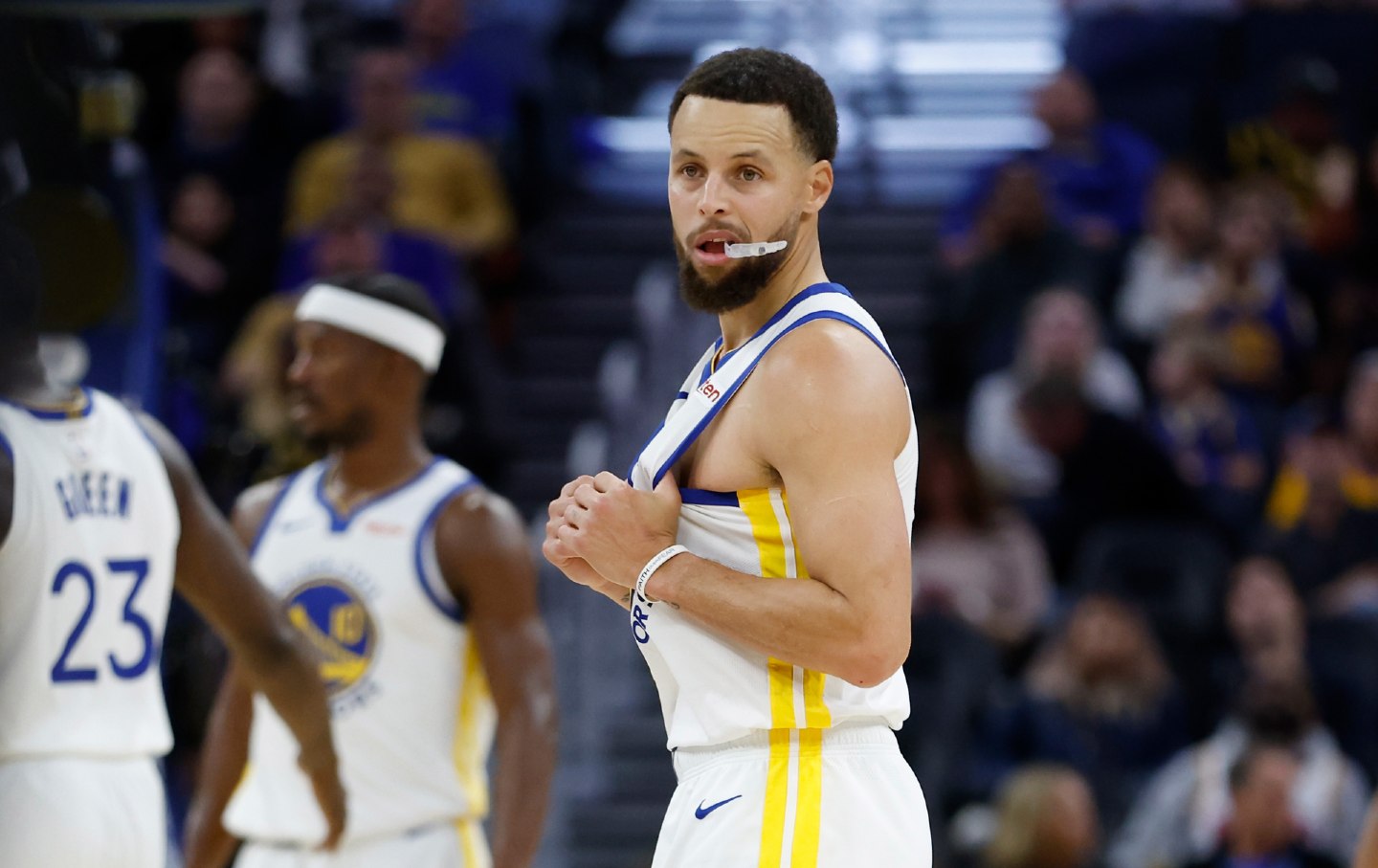
Stephen Curry of the Golden State Warriors tugs at his jersey in a game against the Atlanta Hawks on January 11, 2026, in San Francisco, California.
(Lachlan Cunningham / Getty Images)Steph Curry is the greatest shooter ever. His three-ball revolutionized the game, ushering in the “pace and space” and “five-out” era. After 16 seasons in the NBA, he’s more than a sure-fire Hall of Famer; he’s a mythic hero.
But Curry’s mythology rests not just on his basketball brilliance but also his goodness. He is the humble superstar, the smiling assassin. Throughout his long career, he’s remained largely controversy-free. He’s the corny dad, the dutiful husband. His relative lack of height—he’s listed at 6 foot-2—makes suburban kids believe they can do what he does while bricking shots in the driveway.
Curry’s activism has rarely strayed beyond consensus liberalism. When the United States fractures, he offers a milquetoast quote. During the Minneapolis protests, he called the turnout “beautiful,” saying it “speaks to how important people felt it was to have their voice heard.” He funds literacy and nutrition programs in Oakland through the Eat. Learn. Play. Foundation.
In 2023, the NBA named him the Kareem Abdul-Jabbar Social Justice Champion, an award established in 2021 to recognize players advancing racial and economic justice. The honor stamped him as morally fluent, a superstar operating on the right side of history.
But now after four championships, two MVPs, and a Finals MVP—and just three years after the NBA celebrated Curry’s acts of social justice—Curry is underwriting the architecture of the Israeli security state. Curry is helping to give cover to a system in which Silicon Valley capital fuels the private-sector companies that prop up Israeli oppression.
As a special adviser to Penny Jar Capital, Curry has participated in major venture rounds funding Israeli cybersecurity start-ups. Penny Jar has backed Upwind Security, which raised more than $300 million, and Zafran, which secured $30 million. Those firms sell cybersecurity tools and maintain deep ties to Israel’s security infrastructure. Upwind monitors cloud systems and alerts customers if someone tries to break in. Zafran makes software that scans a company’s computer networks and tells it which security weaknesses need to be fixed first. Both companies are led by veterans of Israel’s elite military intelligence units, including Unit 8200 and Mamram.
Unit 8200 started in the 1950s as a signals unit rigging antennas on hills and tapping lines, but it grew into Israel’s version of the National Security Agency, a vast intelligence factory built to intercept, decode, hack, and feed information up the chain. The unit effectively works as an incubator, training soldiers in warfare and then spitting them out as founders and executives in Israel’s cybersecurity economy. One of Zafran’s founders, CEO Sanaz Yashar, was a spy in Unit 8200 for 15 years, and his story inspired the Apple TV thriller Tehran.
There is no public, official statement from Zafran Security or Upwind framing their work as connected to the war on Gaza. Nor does either company advertise its products as tools of military aggression. But Upwind’s leadership and staff—many of whom served in Israel’s military intelligence units—have been called up as reservists during the war, a fact referenced in communications from company founders on LinkedIn. Upwind’s CEO, Amiram Shachar, shared a photo of himself with Curry following October 7, and the company has said it will be added to the US government’s list of certified cybersecurity providers, underscoring its integration into national security markets.
One key intermediary in Curry’s Israeli investments is Omri Casspi, the NBA’s first Israeli-born player and a former teammate of Curry’s on the Warriors. Casspi now runs Sheva, a venture capital firm focused on Israeli start-ups. Sheva co-led Upwind’s early funding round and helped connect Curry’s Penny Jar Capital to the deal. The former player has become a connector behind the scenes of the NBA, helping to bring NBA players to Israel. Casspi has described his project as a kind of “Zionism 2.0” in which he plugs IDF-trained technologists into the venture-backed infrastructure that undergirds Israel’s economic and strategic power.
In a 2017 interview, Casspi described how NBA players like Curry fit into this: “What I wanted to accomplish was to create a better awareness by bringing big celebrities with a lot of followers on social media, creating goodwill ambassadors for Israel. Unfortunately, Israel gets a bad rep sometimes in the media. These guys are from places like Baltimore and Alabama. And there are kids down there who follow them really closely, and they see that they’ve been to Israel, and that creates good energy.”
Many of Casspi’s trips to Israel have been funded by Dallas Mavericks owner and major Donald Trump donor Miriam Adelson and her now-deceased husband, Sheldon. Casspi has made it his mission to normalize Israel and its actions in the eyes of the West, and he has long been outspoken in his support of the Israel Defense Forces. In 2012, he told the Akron Beacon Journal, “It’s hard to have peace with people who really hate you. They don’t want you to live. They’d rather kill their kids and kill you, too. They’re crazy people.”
Since October 7, Casspi has doubled down on his support. He’s interviewed Ben Shapiro and collaborated with Sheryl Sandberg on her documentary Screams Before Silence, a film centered on unproven allegations of Hamas sexual violence that was promoted aggressively in Western media. Casspi criticizes boycott movements, organizes NBA trips that function as soft-power tours, and channels US venture capital into Israeli start-ups built by veterans of its intelligence apparatus.
Casspi’s narrative posturing and the intersection of Silicon Valley money and Israel’s security sector is common in the larger venture ecosystem. Sequoia Capital, one of Silicon Valley’s most powerful venture firms and a lead investor in Zafran, faced controversy after partner Shaun Maguire posted Islamophobic and aggressively pro-Israel statements, at times framing the war in civilizational terms and amplifying inflammatory narratives about Palestinians and Muslims. Following a US campus shooting, Maguire wrote in a now-deleted post, “It seems very likely that the Brown shooter was an ardent pro-Palestine activist of Palestinian heritage. Mustapha Kharbouch Brown is actively scrubbing his online presence.” None of which was true.
Francesa Albanese, the United Nations special rapporteur on the Occupied Palestinian Territories, has argued that this interlocking system of venture capital and Israeli tech-security is an “economy of genocide” and urged corporations to abstain from participating in it. Curry, however, is profiting from and lending his celebrity to this funding ecosystem.
Popular
“swipe left below to view more authors”Swipe →In affect, Curry is the NBA’s version of Barack Obama. Both project calm intelligence and technocratic restraint. Both maintain a frictionless decency that reassures the professional class. If Curry or Obama did it, how bad could it really be? (As a reminder, for his part in all this, Obama expanded US drone warfare and surveillance, opening more space for these companies.)
The Warriors’ proximity to Israeli tech and defense-linked networks isn’t new. In 2018, Draymond Green went on a trip to Israel organized in part by Friends of the IDF, a US-based nonprofit that raises funds for Israeli soldiers. The visit was framed as a cultural exchange, but critics like The Nation’s Dave Zirin viewed it as part of a broader effort to align US athletes with Israeli state institutions. Curry’s former teammate Kevin Durant is reported to have invested in the autonomous drone company Skydio, which supplied short-range reconnaissance drones to the Israeli military.
For decades, Silicon Valley capital has moved through Israel’s security sector. Unit 8200 functions as a pipeline, training intelligence officers who later launch venture-backed start-ups. Curry’s investments just add cultural legitimacy to that pipeline. The NBA’s most celebrated good guy—I mean he just released an animated movie about a hooping goat—becomes a connective tissue between American celebrity wealth and the intelligence ecosystem behind a genocide. Curry’s reputation shields capital, while that capital fortifies evil.
William Rhoden, the author of Forty Million Dollar Slaves: The Rise, Fall, and Redemption of the Black Athlete, describes how Black athletic genius is folded into structures of power that redirect it toward on- and off-court capital. Rhoden’s argument is that the modern sports industry turns Black athletic labor into an economic engine largely controlled by owners, leagues, and corporate partners. The athlete becomes both performer and brand: Their talent generates billions in revenue while their image is used to legitimize the institutions that profit from them. Curry’s move into Israeli security-tech investments reflects that pattern in a disturbing way. His public image carries cultural cachet. Rhoden’s thesis helps explain how a player celebrated for social justice can seamlessly transition into financing companies built by veterans of a genocidal intelligence apparatus without his brand taking any hits.
Few athletes in modern sports carry the cultural trust Curry does. He is the NBA’s smiling technocrat—universally admired, controversy-free. That image is now part of the Israeli tech security ecosystem’s soft power. When Curry invests, his smiling photo with a start-up founder obfuscates the fact that military intelligence veterans are building an oppressive security infrastructure.
Curry’s jumper is eternal. But legacies are built off the court, too. And myth, once hardened, is difficult to revise. It’s never too late for him to drop his investments in IDF-adjacent tech start-ups. It would be the boldest statement he’s ever made. If not, he is tarnishing a legacy that not even championships can offset.
Become a Sustaining Donor This September
Between the reemergence of right-wing red-baiting and Donald Trump’s use of the chilling National Security Presidential Memorandum–7 to criminalize left political organizing, we’re seeing McCarthyism reborn before our eyes.
This assault on democracy cannot be ignored or wished away. Resisting it requires bravery in the face of threats and repression, a steadfast commitment to the truth, and the unwavering belief that we can—and will—overcome this darkness.
We must have an independent media that sets the record straight, unearths corruption and abuses of power, and advances a politics of justice and dignity for all if we’re to win this fight.
That’s why I’m writing to you today. This September, The Nation needs to add 100 monthly donors to sustain our progressive journalism. Your contribution makes the next investigative report, the next truth-speaking column, and the next pathbreaking essay all possible.
I hope you’ll support our work with a recurring donation today. If you donate $10 or more a month, we’ll send you a brand new “Hands Off the Free Press!” sticker to recognise your commitment to our cause. Please, donate today.
Onward,
Katrina vanden Heuvel
Editor and Publisher, The Nation
More from The Nation

America Without the NFL America Without the NFL
Chuck Klosterman’s Football is a eulogy for the sport on the eve of its decline.
Justice for Macklemore Justice for Macklemore
The rapper has been dumped from Ed Sheeran’s tour for saying “free Palestine.” That’s a disgrace.
We Can’t Let the Kaepernick Era Be Erased From History We Can’t Let the Kaepernick Era Be Erased From History
Critics say the Black Lives Matter movement in sports went too far. In reality, it didn’t go far enough, and the backlash to it has been brutal.
Kaepernick and the Movement He Inspired Kaepernick and the Movement He Inspired
I once thought the protests of athletes after George Floyd’s murder would launch a new era of sports activism. Ten years after Kaepernick first kneeled, I revisit what I wrote.
Enes Kanter Freedom’s Bigoted Stunts Have Nothing to Do With Protecting Women Enes Kanter Freedom’s Bigoted Stunts Have Nothing to Do With Protecting Women
The trans women in sports panic is nothing but a stalking horse for permitting violence against trans people—and we should celebrate players like Natasha Cloud who say so.
The Bogus Lakers Sale Is Exactly Why We Need Publicly Owned Sports Teams The Bogus Lakers Sale Is Exactly Why We Need Publicly Owned Sports Teams
These private-equity vampires will just keep strip-mining the things that give us joy if we let them.

