
The US Attacks Iran in a War of Aggression
The US has waged many wars—but this is one of the most senseless we’ve ever seen.
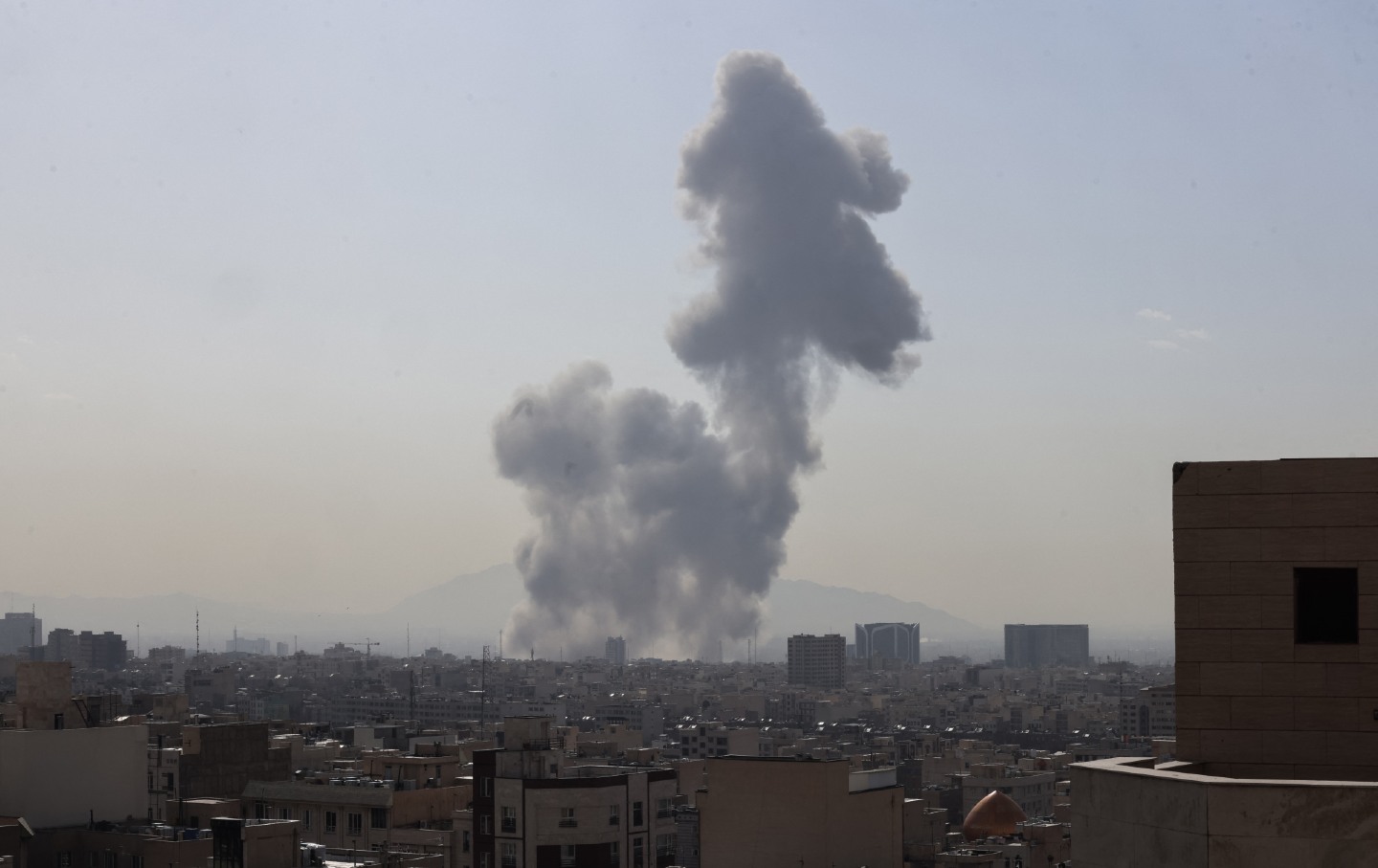
A plume of smoke rises following a reported explosion in Tehran on February 28, 2026.
(Atta Kenare / AFP via Getty Images)
The recent threats of a new war against Iran, and the giant military deployment sent to carry out such a war, have now come to fruition. With Trump’s call for regime change, and the massive bombardment, this will not be a short, “one and done” attack. The US and Israel are at war with Iran.
The Iranian military is retaliating against US military targets in the surrounding countries, where there are numerous military bases and 40,000 US troops already deployed, as well as Israel. Early reports indicate that the US and Israel have targeted regime leaders, including potentially an effort to assassinate the top religious leader in Iran. There is no indication yet whether those efforts have succeeded. What we do know is that 51 people, many of them children, have reportedly been killed in an early attack on a school in an Iranian port city.
This war is illegal under both US domestic law and international law. It violates the US Constitution, which gives only Congress, not the president, the power to take the nation to war. The UN Charter is clear that use of military force is legal only if authorized by the Security Council or if “an armed attack occurs against a Member.” In this case, neither of these things happened.
It is too late to prevent this war from starting. But as was the case in the run-up to the Iraq War in 2002 and ’03, it is not too late to see that it will have devastating outcomes. The similarities with the Iraq war have made this war more likely; the differences show why war with Iran could be even more dangerous.
There’s one particularly ironic comparison between then and now: In 2002–03, a huge global movement—what The New York Times called “the second super-power”—emerged to challenge the drive toward war. It brought together a majority of the UN Security Council, a number of individual governments, including important US allies, and, crucially, millions of people, who mobilized to protest around the world. This movement came to a thundering crescendo on February 15, 2003, when what was then the largest protest in human history took place across almost 800 cities around the world. Congressional debate was public and fierce, and when the Authorization for the Use of Military Force was voted on in October 2002, significant minorities in both the House and Senate opposed the war. It was perhaps the most powerful anti-war movement we have ever seen.
And yet, at the height of that movement in 2003, just before the US invaded Baghdad, 72 percent of people in the US still supported going to war.
These days, the hard work of organizing to prevent a new war has been intense. Pushing Congress to reclaim its constitutional role of determining whether the US goes to war, demanding that only the UN can authorize military force, insisting that international law be taken seriously—these campaigns have been happening. But they were not as visible. With the Trump administration eager to lash out around the world with military force, refusing to consult with Congress or the United Nations, and disdaining international law, the UN and Congress had been far less public about the debate than in the past. Trump believes the only constraint on his power is his “own morality.” That has made building a visible protest movement focused on pressuring Congress and demanding that the UN step up to prevent war much harder—and more urgent.
And yet even without a huge and undeniable anti-war movement, only 18 of people support war against Iran. This might be because so many remember the devastation wrought by the war in Iraq. But with an administration more interested in motivating the MAGA base than in taking to account what most people actually think, open, hard-won congressional opposition wouldn’t ever have been enough to obstruct presidential power running wild.
While the Iraq anti-war movement accomplished a number of important goals, including playing a major role in precluding Bush’s war against Iran in 2007, it remains sobering that it could not prevent the war in Iraq. And 23 years later the consequences—economic, military, environmental, and most especially human—of war against Iran could be significantly worse than even the catastrophic costs of the Iraq war.
One reason has to do with the shift in regional power dynamics. Despite the collapse of Israel’s legitimacy around the world following its genocide in Gaza, Israel is militarily more powerful than ever, with hegemonic influence across the Middle East. Following decades of ethnic cleansing, occupation, and apartheid, Israel has obliterated Gaza and caused massive destruction in the West Bank. Tel Aviv’s regional opponents have been profoundly weakened by two years of US-backed Israeli attacks against Lebanon, Syria, Yemen, Qatar, and Iran. Israel launched attacks against Gaza flotilla ships in international waters near Tunisia, Malta and Greece, without any consequence. Israel’s uninspected nuclear arsenal is never even mentioned as a major destabilizing factor across the Middle East. And with Washington still providing massive support to Israel, there is little to prevent a US-Israeli assault on Iran from quickly escalating to a major regional war. A more powerful Israel means a more dangerous region and a more dangerous world.
Another reason the consequences could be even worse involves the undermining of domestic and international law. Certainly Iranians will pay the highest price for the lack of restraint from international law, but this collapse of the rule of law makes it more dangerous for everyone else too. In 2002, Bush won congressional authorization for war against Iraq, and he had grudgingly acknowledged the need for Security Council authorization. For months, he tried—using lies, threats and pressure—to get a war resolution passed. The efforts failed, the Council majority stood defiant, and the Bush-Blair team finally launched the war illegally, without UN approval and without any “armed attack” by Iraq that might have justified a claim of self-defense. Now, in 2026, Trump has never acknowledged any need for congressional approval or UN authorization of war against Iran. No one—not the UN, not Congress, not the mainstream press, and few among foreign governments too often cowed by Trump’s threats—even mentions the UN Charter’s restrictions. And although Congress is debating a new War Powers Resolutions designed to prevent a rogue presidential decision to go to war, it remains uncertain whether it will win enough votes to become law. A US war against Iran will deepen the ongoing delegitimization of the rule of law—something that must be taken seriously if future wars are to be averted.
As we saw 23 years ago, the world watched a major military buildup precede the attacks. In recent weeks the US deployed an enormous armada of military weapons and personnel to the Middle East. The waters surrounding Iran filled with two aircraft carrier groups—one of them arriving from its last deployment near Venezuela. Dozens of warships, hundreds of warplanes, more than 10,000 Navy and Air Force troops, and about 40,000 additional troops are stationed at nearby US military bases.
And the same as 23 years ago, US officials and much of the US press are repeating exaggerations and lies about alleged weapons of mass destruction. Saddam Hussein’s government in Iraq did not have chemical or biological weapons and was not building a nuclear weapon, but many people believed they did and were. Speaking about Iran, Trump complained in his State of the Union speech that “we haven’t heard those secret words: We will never have a nuclear weapon.” But Iran’s top leaders have stated exactly that—publicly, not in secret—since at least 2003, when they explicitly rejected nuclear weapons, saying, “We don’t need atomic bombs, and based on our religious teaching we will not pursue them.” Two decades later the official US position is still that Tehran ended its early nuclear weapons program in 2003 and never restarted it. Lies and exaggerations have resulted in 87 percent of people in 2025 still believing that Iran is a threat to the United States.
Popular
“swipe left below to view more authors”Swipe →Twenty-three years ago UN intermediaries were still trying to negotiate between the US and the Iraqi government, but no one believed the US was serious about those talks. Recently, US-Iran negotiations were underway—sort of. It remained unclear whether the talks were serious, whether the US would actually lift sanctions on Iran under any circumstances, and whether either side was really looking for an off-ramp to avoid war. In June 2025, in fact, the US and Iran were negotiating a possible new nuclear deal, with the next round of talks scheduled for Oman on June 15. At least partly to prevent such negotiations from succeeding, Israel launched its illegal assault on Iran three days before those Oman talks were to begin. Given that the US knew of Israel’s plans and joined its attack on Iran even as those talks were supposed to be underway, it seems questionable whether Iran would be willing to rely on new US promises.
Bush’s initial Iraq deployment in 2003 involved about 160,000 US ground troops, who would fight on the streets of Iraqi cities to overthrow Saddam Hussein and the government in Baghdad. In contrast, Trump’s earlier military strikes around the world (in 2025 alone he ordered attacks against Somalia, Yemen, Iran, Syria, Iraq, Venezuela and Nigeria) have so far all been short-term bombing raids, with no more than a few boots briefly on the ground. The raids killed hundreds of civilians with virtually no US casualties. History provides no examples of regime change being carried out by air attacks alone. But Trump’s military buildup was clearly designed to fight a long air war, whether or not regime change in Iran were the military goal. Trump has sometimes said he intended a quick attack to push Iran towards more negotiations; other times he has warned of full-scale war. Sometimes, like in his February State of the Union speech, he has hinted at both. Building a movement to prevent a massive air war in 2026, being waged for unclear purposes, is a much more difficult task. And when that war takes on Iran, almost four times bigger in land and three times bigger in population than Iraq, with a far bigger and more motivated army than that of its predecessor two decades earlier, the consequences look dire indeed.
All of these similarities and differences together point to the urgency of building a big, powerful anti-war mobilization once again—right now. Not to prevent this war, but to stop it.
More from The Nation
Israel’s Extremist Election Israel’s Extremist Election
The run-up to the vote on Tuesday is exposing the façade of Israeli democracy—and the fealty of the country's so-called opposition when it comes to matters of Jewish supremacy.

“NAZA” and Israel’s History of Automated Warfare “NAZA” and Israel’s History of Automated Warfare
As violent technologies like spyware, predictive targeting algorithms, and 2,000-pound warheads become ordinary instruments of military rule, once-abhorred practices become routin...

Brazil’s Workers’ Party Is Not Stopping Brazil’s Workers’ Party Is Not Stopping
With just a few days remaining before the runoff election, supporters of Lula’s party are doing everything possible to rally support behind the president.


Brazil’s Decision Brazil’s Decision
The moral compass and basic humanity of political leaders really does matter.
Albanian Student Strikes Spur a Political Crisis Albanian Student Strikes Spur a Political Crisis
A new round of protests against the ruling party’s corruption has Prime Minister Edi Rama giving cops bonuses to crack down on dissent.

