
The Supreme Court Just Held an Anti-Trans Hatefest
The court’s hearing on state bans on trans athletes in women’s sports was not a serious legal exercise. It was bigotry masquerading as law.
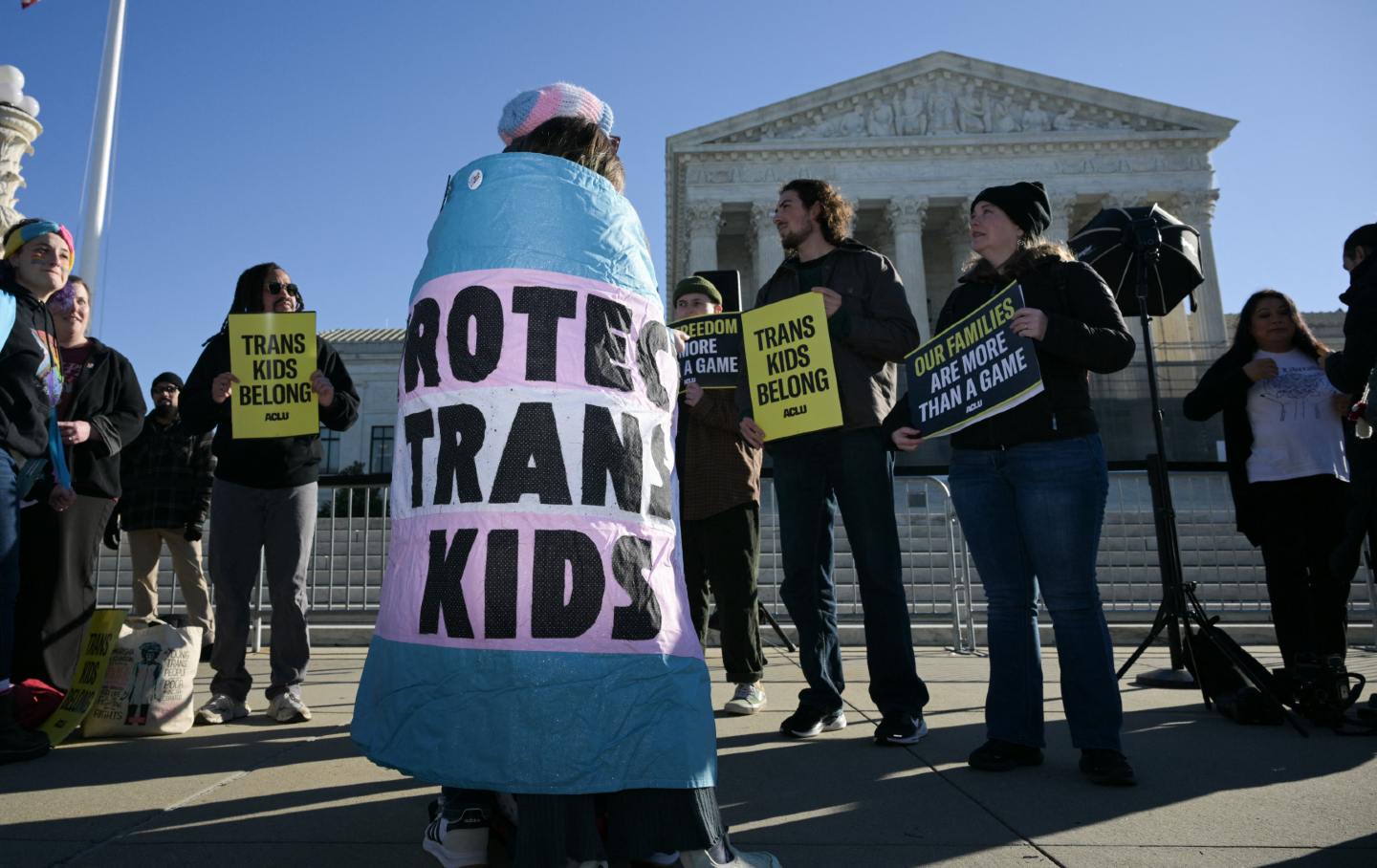
LGBTQ+ rights advocates rally outside the US Supreme Court as justices hear arguments in challenges to state bans on transgender athletes in women’s sports.
(Oliver Contreras / AFP via Getty Images)On Tuesday, the Supreme Court heard oral arguments in a pair of cases weighing the constitutionality of state bans on transgender women and girls in competitive sports. Given the Republican antipathy toward the trans community—and the way conservatives have ginned up a crusade against the less than 1 percent of trans women who want to compete in interscholastic athletics—the outcome of the cases is hardly in doubt. The Supreme Court will almost certainly vote, 6–3, to uphold the bans, with the anti-trans supermajority jury-rigging an opinion out of their various justifications for bigotry.
At issue in the hearing were two laws, passed by Idaho and West Virginia, barring trans women and girls from playing competitive sports at the high school and college level. The plaintiffs—one is a former college athlete at Boise State University (who has since withdrawn her complaint and vowed to never dare to attempt to play sports again), the other is a minor who wanted to play with her friends in West Virginia—argued that the bans violate their constitutional rights under the Equal Protection Clause of the 14th Amendment, and under the 1964 Civil Rights Act. Idaho, West Virginia, and the Trump administration made various counterarguments, including the claim that the laws don’t target “trans people,” only people who want to play on sports teams that do not conform to their gender at birth. It is the height of legal hypocrisy and bad faith to suggest that a law that affects only trans athletes somehow isn’t targeting trans athletes, but that is where we are with this pathetic excuse for a Supreme Court.
The bigots further argued that, even if the laws do target trans athletes (which, you know, they obviously do), the laws should be upheld because the states have a compelling interest in protecting women and girls. They argue that banning trans athletes is necessary to ensure the “safety” of athletic competition for women and girls.
As I listened to the arguments, I can’t say I was surprised to hear the Republican justices’ clear sympathy for these anti-trans positions. They have consistently shown us that they won’t let facts and science get in the way of their cultural perversions.
For the record (although it shouldn’t need to be said again): Trans women do not pose a “safety risk” to cis women participating in sports. Trans women do not dominate women’s sports, and there’s no evidence that trans participation in sports is crowding out cis women who also want to participate. This entire case is based on a manufactured cultural panic that bears no relation to the actual facts on the ground in any of these states. Republicans are allowing ICE to shoot women in the face and call them a “fucking bitch” while denying them medical attention, but they want us to believe that a trans woman hitting a tennis ball too hard at her opponent is the greater threat to women and girls.
Despite knowing all of this, I was still taken aback by the consistent use of anti-trans tropes and hypotheticals by the bigoted lawyers and justices. I guess I naïvely hoped that Supreme Court oral arguments would stay somewhat tethered to actual things that happen in the real world. But instead of lawyerly arguments about the nature of constitutional protections, we got a Fox News segment hosted by J.K. Rowling.
Nearly all of the Republicans who asked or answered questions competed to see who could sound the most ignorant about the issues they were talking about.
Idaho Solicitor General Allan Hurst used his opening statement to say that Idaho’s trans ban applies only to “a tiny subset of males who want an unfair advantage.” Deputy Solicitor General Hashim Mooppan claimed that men are taking “performance altering drugs” to compete in women’s sports. On the bench, five of the six Republican justices—John Roberts, Clarence Thomas, and Neil Gorsuch, alleged attempted rapist Brett Kavanaugh, and Amy Coney Barrett—all echoed these concerns about men pretending to be trans in order to dominate women’s sports. Samuel Alito, who doesn’t think trans people really exist, simply used all of his time to ask “what is the definition of sex?” like he was an eighth grader excited to talk about genitalia in public.
What this meant is that much of the three-and-a-half hours dedicated to debating a critical human rights issue focused on something that does not happen. Cis boys who are cut from the football team do not identify as girls and start taking hormone blockers in order to dominate field hockey. Cis men who are too slow to medal in track do not put themselves through years of therapy followed by gender reassignment surgery to win a freaking race against women. Denying transgender individuals the right to constitutional protections based on the specter of a conniving man playing women’s sports to get a leg up (only to get embarrassed by Caitlin Clark anyway) is like canceling a trip to Hawaii to avoid the risk of falling off the edge of the earth.
That didn’t stop the Republican justices. They were relentless. The worst offender was Kavanaugh, whose experience coaching girls’ high school basketball has apparently turned him into an authority on women’s rights. He called sports a “zero-sum game” and worried that any time a trans woman wins a competition or gets a spot on a team, there is some other (presumably cis) girl who has been “disadvantaged.” It was, in its way, an object lesson in the sexual politics that got this issue to the Supreme Court in the first place: Republicans want you to think they’re all about “protecting women and girls,” but really they’re being insufferably misogynist and patronizing. Nobody gives a damn when a 17-year-old defensive lineman who’s six-foot-four and 285 pounds concusses a five-foot-eight 115-pound freshman, but should a slightly bigger girl ice-hockey player cross-check a forward into next week, a national inquiry must be launched into that girls’ pants.
Kavanaugh’s (and the other Republicans’) concerns weren’t based on any real inquiry into how the Equal Protection Clause should apply to these cases—because their starting position was that equal protection shouldn’t apply to transgender athletes. Chief Justice John Roberts made this clear when he asked the two lawyers arguing against the bans whether they want the court to make an “exception” to the definition of “girls” or a “new definition” of girls. The lawyers dutifully explained that they are not asking for either but are simply asking for trans girls to receive their constitutional protections from discrimination.
The irony, of course, is that Roberts doesn’t really think that women and girls should be given their full measure of constitutional protections (see Dobbs v. Jackson Women’s Health); he just seems to think that trans women and girls should receive nothing.
While the top-line outcome of this case was probably decided a long time ago, there are other legal issues at play in these cases that go beyond whether states can discriminate against transgender women and girls. Those other issues were discussed during oral arguments, and they’re where the legal fights will be as the Republican supermajority crafts its bigoted opinion.
The first and most legally nerdy issue centers on the question of “as-applied” constitutional challenges. An “as-applied” challenge argues that a law is unconstitutional in a specific context, or for a specific set of people, even if it is constitutional toward others. These cases are as-applied challenges. But the states and the Trump administration argue, wrongly, that trans people shouldn’t be allowed to bring these challenges, because there are too few trans women athletes.
To be clear, it’s an established legal principle that a law doesn’t have to apply fairly to every conceivable person in a hypothetical universe, but Republicans essentially argued that trans people who want to play sports are too unique to be given the full measure of constitutional consideration. Justice Sotomayor repeatedly asked the Republicans lawyers to explain how many trans people have to exist before they can have constitutional protections, but they never directly answered her question.
Popular
“swipe left below to view more authors”Swipe →This is the biggest logical inconsistency with the Republican argument against trans women and girl athletes. They’re saying both that we need to erect entire state bans eradicating them or they’ll “take over” women’s sports and that there are so few trans women athletes that they can be functionally overlooked by the Constitution. It’s the now-classic Republican two-step, the one that argues, “I represent the super strong and powerful master race” but also “I am significantly harmed when I see a Black mermaid.” It’s ludicrous and nonsensical and reveals just how intellectually bankrupt their whole project is. But the very serious upshot is that if the court doesn’t let trans people make a challenge to the constitutionality of this law, then it’s hard to imagine any law trans people will be allowed to object to.
The second big legal issue that made it into oral arguments was California. While 27 states ban trans women and girls from participating in competitive sports, 23 states allow it. Some of the justices expressed concern that a ruling in favor of the state bans already in place could be used to impose trans bans on unwilling states. The Trump administration has already started coming after states like California for allowing trans athletes to compete. Mooppan, the deputy solicitor general, made no promises that the Trump administration won’t use this ruling to go after states like California, and both Roberts and Alito didn’t seem too concerned about that possibility. Kavanaugh, however, was concerned. As always, he prefers an antebellum approach to civil rights, one that allows states to decide for themselves which people get rights and which do not. So… I guess we have that sectarian Republican fight to look forward to.
The third and final issue involved, amazingly, chess. Essentially the anti-trans argument—that there are fundamental differences between boys and girls, and girls must be protected from unfairly having to compete with boys—can be used to justify the exclusion of cis women and girls from all sorts of things. Indeed, taken to their malign conclusion—that women are the dumber sex and thus they should not be put in situations where they have to compete with the men—such arguments have long been used to exclude them from everything from science classes to, yes, chess clubs. As I said, at the heart of the “protection of women and girls” argument is deep, insufferable misogyny and patriarchy.
Justice Elena Kagan zeroed in on this problem when she asked the solicitor general of West Virginia, Michael Williams, if his argument could be used to keep girls out of chess club; Williams said it was “a closer case.” I thought I detected some gasps in the courtroom, and I immediately went to make some popcorn to enjoy Kagan’s evisceration of his argument, but it never came. That’s because Gorsuch almost immediately jumped in to stop Williams from digging himself a bigger hole, saying something like, “I don’t want to talk about chess.” Five minutes later, Kavanaugh offered that “ruling for you on sports does not open the door for you” on chess. (Five minutes is a long time, but that’s the quickest I’ve ever seen Kavanaugh think.) Kagan never got back around to carving Williams’s tongue out with a spoon.
This episode showed just how dangerous this opinion will be when it comes out, probably in June. The anti-trans bigots know they’ve won this case, but they’ll be poring over the Republican supermajority opinion to see whom the court will let them discriminate against next. Every line will be analyzed for how it can be weaponized further against the trans community, or any of the other groups of people Republicans don’t like.
Many Democrats think that the transgender athletes issue is just about sports. They look at some of the poll numbers against trans inclusion, and think this is an issue they have to cede to the bigots. But this issue is not and never has been “just about sports” and the small number of trans athletes who should be allowed to compete. This is about unconstitutional discrimination, and history tells us that such discrimination, once allowed, only expands. Republicans will parlay their victory here into other arenas, against the entire LGBTQ community and other out groups.
What starts on the playing field never stays on the playing field. That was true for integration, and it will be true of discrimination.
More from The Nation

What’s It Like Inside a Data Center? What’s It Like Inside a Data Center?
Northern Virginia is laden with structures that house data for Fortune 500 companies. I went inside just one of those monstrosities that bothers its neighbors.

What Trump and Tucker Carlson Have in Common What Trump and Tucker Carlson Have in Common
Carlson has broken with Trump largely over the war in Iran. But on Ukraine and immigration, the two speak very much the same language.

The Jewish Case Against AI The Jewish Case Against AI
Haredi rabbis and the secular left agree: This technology is a threat to the entire social fabric.
The Fight for Educational Equality Is Also a Fight for a Just Supreme Court The Fight for Educational Equality Is Also a Fight for a Just Supreme Court
The court has severely weakened our ability to make an education system that fulfills the promise of Brown.

The Fall of “Scientific American” The Fall of “Scientific American”
When the beloved science publication got too political, its corporate owners stepped in. Now its future is uncertain.

The Bookstore Revolution in Taiwan’s Conservative Heartlands The Bookstore Revolution in Taiwan’s Conservative Heartlands
After Taiwan legalized same-sex marriage, gender-themed bookstores are working to build the social acceptance that the law alone couldn’t deliver.

