
For America’s Congolese Diaspora, Peace Deals Offer Little Comfort
The conflict in the Congo is one of the deadliest crises in the world, but many worry that Trump’s interest in the region emphasizes deals for US investors over lasting peace.
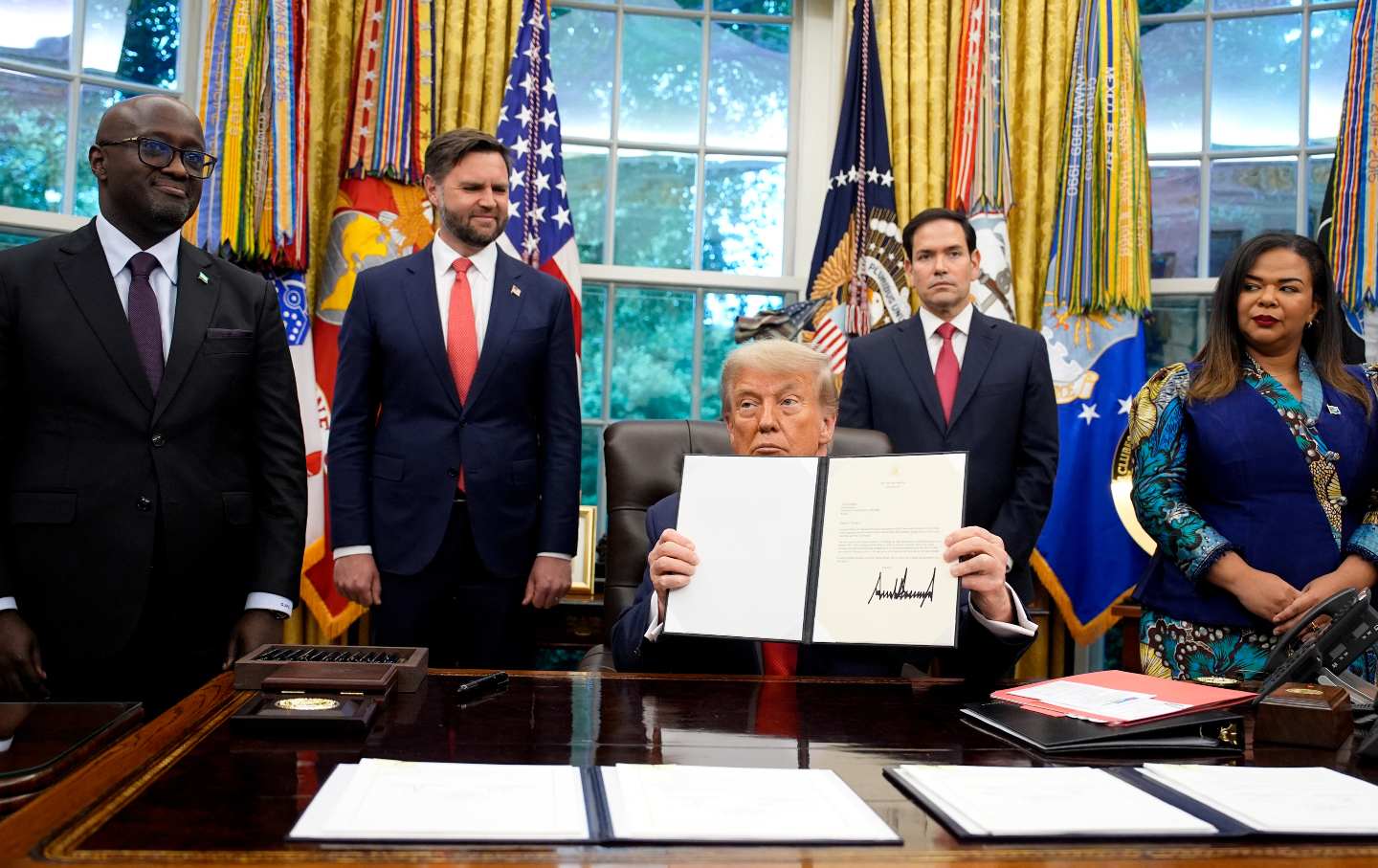
The Democratic Republic of Congo and Rwanda agreed to a US-backed peace deal meant to end years of deadly conflict and promote development in Congo’s volatile eastern region.
(Yuri Gripas / Getty)Nils Kinuani was sitting in his elementary school classroom in Bukavu, a city in the eastern region of the Democratic Republic of the Congo, when the rebel commander chiefs entered the room. “They picked a number of boys, but they never picked me,” Kinuani said, recounting the moment he saw his friends being kidnapped by rebel soldiers in 1997, following the outbreak of violence in the Congo. “Those boys that were picked and taken from the classroom, their families never saw them [again]… they were recruited into the army, and they never went back home.”
Kinuani, now residing in Maryland, leads a network of US-based Congolese activists at a nonprofit group called Action for Congo. Even after 15 years of living in the United States, he still thinks back to that frightening moment in the classroom as motivation for his continued activism.
“I always tell people that if I was picked that day, I’d never be in the US,” Kinuani told The Nation. “I don’t know how my life would be right now.”
The conflict is one of the deadliest humanitarian crises in the world. Since the First Congo War broke out in 1996, around 6 million people have been killed in a population of over 105 million, with millions more displaced. Reports of rape being used as a weapon of war are rampant. The conflict’s roots trace to the 1994 Rwandan genocide, during which Hutu militias killed over 800,000 ethnic Tutsi, in addition to moderate Hutus and Twa people, and ethnic tensions in the region date back to Belgian colonization, when the imperial power decreed varying levels of rights to the indigenous population.
In the genocide’s wake, a Tutsi-led government was established in Rwanda, and more than 2 million Hutu refugees spilled over the border, settling in the eastern Congolese provinces of North and South Kivu. Since then, rebel groups—some backed by foreign entities like Rwanda—have fought for power in the Congo’s eastern mineral-rich region.
The past year has been particularly brutal. The Rwandan-backed M23 militia seized the strategic eastern capital of Goma in January, followed by the city of Bukavu in February. International humanitarian organizations and journalists have accused the militia of carrying out vast war crimes, including public executions of civilians as young as 15 years old. Paul Kagame, the Rwandan president, denies providing support for M23, but the UN has released evidence to the contrary, accusing Rwanda of providing weaponry and strategic support for M23. In the provinces of North and South Kivu, M23’s assault has displaced over a million people and killed over 7,000.
In recent months, US President Donald Trump has shown a growing interest in the Congo due to the region’s abundance of rare earth minerals like cobalt and copper, key products sustaining the United States’ tech industry. According to the United States Bureau of International Labor Affairs, more than 70 percent of the world’s cobalt is sourced from the Congo. Other key minerals like tin, tantalum, and tungsten (often called “conflict minerals”) exist in large deposits in the Congo’s eastern region and are crucial in electronic manufacturing.
Trump’s interest in the nation is relatively new. Only four months before entering the White House for his second term, he told supporters at a campaign rally in Juneau, Wisconsin, that migrants invading the United States were “coming from the jails of the Congo.”
Now, he’s trying to establish an economic stronghold in the country. On June 27, representatives from Rwanda and the DRC signed a peace deal in Washington calling for the end of financial support to non-state armed militias, ensuring territorial integrity for the DRC, and giving investors in the United States access to the DRC’s mineral value chains.
“Donald Trump is coming to the table with a very different approach to things, and for him, it’s transactionalism,” says Jason Stearns, the founder of the Congo Research Group, a nonprofit focused on covering political developments in the region. “I think he sees an opportunity to be able to showcase his diplomacy. But—much more importantly—he sees an opportunity for US influence in the region, business and political opportunities.”
Many believe the deal turned a blind eye to Rwanda’s invasion of the Congo, rendering it “devoid of justice and accountability,” according to Bibi Ndala.
Ndala fled Kinshasa when she was 7, seeking refuge in Canada before coming to the US in 2017. She now lives in New York and works as the Outreach Coordinator for Friends of the Congo, a nonprofit organization whose mission is to advocate for a lasting peace in the region.
“When you think about your loved ones and your families and your friends that are [in] Eastern Congo, you feel like the state essentially failed them because they’re not going to get justice,” Ndala said. “ I want the American people know to know that this is something that implicates them directly.
Gaëtan-Dauphin Nzowo was born and raised in the capital of Kinshasa. His father was part of the opposition movement and an outspoken critic of governmental corruption. Nzowo, who came to Oregon as an international student to study civic engineering, said his family, now residing in Europe and the United States, received death threats as result of its outspoken political beliefs.
“It seems to me that we are saying to the world right now…that international law doesn’t count anymore, that it doesn’t matter who is violating international law, it doesn’t matter who is committing war crimes, that nation can be forgiven. [That] that nation can be protected, as long as [it’s] the ally of one of the most powerful nations,” Nzowo told The Nation.
Popular
“swipe left below to view more authors”Swipe →On July 19, M23 signed a ceasefire deal with the Congo in Qatar, an agreement many viewed as an extension of the one the US had brokered in Washington in June. But less than a month after both nations signed, reports began surfacing of M23’s continued expansion into Congolese territory.
The Qatar deal lacks a formal timeline—and its vagueness, according to Stearns, signaled to many that M23 would not follow through on a ceasefire or withdraw from the region. “Many people within the M23 think this deal will take years to implement and they will be left in control governing a large part of the Eastern Congo for years to come.”
That possibility is becoming increasingly likely after M23 announced its decision to walk away from the Doha peace deals on August 18, claiming the Congolese government had failed to follow through on previous ceasefire agreements. The Congolese government has rejected these claims.
After losing multiple family members, Kinuani hopes to raise awareness in the United States about the conflict among policy makers in Washington. “My family members that were killed,” said Kinuani, “and there’s no justice for them, for the family or for the survivors, the victims, and also accountability for perpetrators of violence.”
For America’s Congolese diaspora, securing peace in the region is far more imperative than promoting economic prosperity for US investors. “We welcome the US President Trump administration’s willingness to end that conflict,” said Kinuani. “But the only way you can end the conflict and bring sustainable peace is by addressing some of the root causes. A peace agreement is not the same as a business deal.”
More from The Nation
Writing About War as Bombs Fall Writing About War as Bombs Fall
While the Israeli government launched a well-orchestrated offensive of disinformation and hyperbole that would make the illegal permissible in the war on Gaza.
Turkey Is Brutally Oppressing Queer People. Here’s What You Need to Know. Turkey Is Brutally Oppressing Queer People. Here’s What You Need to Know.
The government’s sweeping crackdown on the LGBTQ community is an escalation of a decades-long pattern.
The Anatomy of a Literary Scandal The Anatomy of a Literary Scandal
The pillorying of Canadian-Haitian novelist Thélyson Orélien, accused of using AI to write his new novel, is the latest in a chaotic year for French publishing.
Has France’s Government Overplayed Its Hand? Has France’s Government Overplayed Its Hand?
The speed and scale of the police response mark a dangerous new normal.
This Is Not an Anniversary This Is Not an Anniversary
Does remembering the date of October 7 make it easier to name?
Are Europe and Russia Slow-Walking to World War III? Are Europe and Russia Slow-Walking to World War III?
Dangerous rhetoric has been escalating on both sides for some time now.

