The Queer Chess Club Making the First Moves Toward Revolution
The “queerest anti-imperialist chess club on earth” is using chess to build a community and provide an entry way into radical politics.

About a dozen chess players and observers gathered on the patio of Blue Star Parlor, a bar in the Flatbush neighborhood of Brooklyn for a meeting of Queers Gambit, which advertises itself as the “queerest anti-imperialist chess club on earth.” Free rapid Covid tests and colorful KN-95s were stacked on a table. Stickers and a zine could be purchased at sliding scale to fundraise for G.L.I.T.S.—Gays and Lesbians Living in a Transgender Society, an organization led by Black trans women that helps them find housing, healthcare, education, and asylum assistance.
Niki Cross, who cofounded Queers Gambit in 2023, sat on one side of a pastel-pink-and-white board that had the words “Intifada now” scrawled in the center, and explained to a newer enthusiast of the game how they should move their queen. Queers Gambit’s founders are using chess to form a community whose members know they’re not alone and can come together to fight for a more just world.
Cross, who moved to New York to practice environmental law, found their introduction to the local chess scene alienating. “Out of 30 players” at the first club they went to, “there was one visibly queer person—me—and there was one cis woman,” they told me earlier this year. “I thought that it would be probably a good idea to make a space for other queers to learn the game in a way that was much more inviting than most spaces provided.”
Cross’s experience isn’t unusual. The world of chess, like the world outside of it, is often a sexist, transphobic one. In 2023, more than 100 women chess players signed an open letter against sexism and sexual harassment in the game after two-time US women’s champion Jennifer Shahade accused prominent player Alejandro Ramírez of sexual assault. Eight more women told The Wall Street Journal that they had been victimized by Ramírez in a pattern of predatory behavior that stretched over a decade. Their reports to top chess bodies had been ignored. That same month, the International Chess Federation, which goes by its French acronym FIDE, banned trans women from women’s tournaments. While national chess leagues like the United States Chess Federation and Shahade herself rallied against the ban, former FIDE vice president Nigel Short justified it, saying, “Men are ‘hardwired’ to be better chess players than women.”
It was against this background—and a history of LGBTQ+ people widening the playing field for community sport, including by founding of trans-led leagues—that Cross and their two chess cocaptains, Sapphrodite Alexander and Azani Amarachi Creeks, started Queers Gambit. They were looking for ways to build connections between queer people and allies while materially supporting marginalized communities.
“There can be a tendency for folks to feel like the gathering itself is the revolutionary thing, and that being together—which is a beautiful thing—is the work,” said Creeks, a researcher for the Private Equity Stakeholder Project, which documents the adverse impacts of private equity. But she added, “It’s only the precursor to doing the larger work that we need to do together.”
A monthly party called Body Hack was the blueprint for Queers Gambit, because, Cross said, “They’re an excellent example of trans organizers of color looking out for community, not only in providing an amazing space for queer and trans people to have fun, but also in raising a lot of money for trans people of color, for recovery funds, for organizations like G.L.I.T.S., and also in providing various services like political education around Palestine and free STI testing.”
One of the venues that hosts Queers Gambit, the Brooklyn bar Purgatory, partnered with the club to donate over $1,000 or 10 percent of its members’ bar tab to Black Trans Liberation, a mutual aid collective founded by activist and costume designer Qween Jean. Queers Gambit provides free STI testing through Project STAY and CAMBA, raises funds for jail support and aid for Gazans, and joins protests as a group.
Alexander spearheaded Queers Gambit’s zine project Forking Trans Women—which, so far, has published an Issue #0 and #1. She called it that because, besides being a chess pun, it was “an homage” to Mira Bellwether’s groundbreaking sexual-health-education zine Fucking Trans Women.
This month Alexander opened submissions for a third issue of Forking Trans Women to help fund her gender-affirming care. The first issue, published last summer, “was mostly just me trying to teach someone how to play chess as fast as possible,” she said. It has so far raised $1,200 for G.L.I.T.S. The fall issue, which has raised over $700, was more eclectic, featuring submissions that ranged from a love letter between queer chess players to a guide to fisting to Cross’s essay denouncing attempts to pinkwash Zionism.
“It’s important for queers to speak up in particular because Israel claims to be a beacon of sexual liberation and queer freedom when in fact it’s systematically raping Palestinians and also simultaneously using hoax claims of mass rape to manufacture consent to its genocide,” said Cross. They see New York’s chapter of the HIV/AIDS activist group ACT UP as a model, which has disrupted pride events and fundraising galas for LGBTQ+ organizations with financial ties to weapons manufacturers and Zionist donors like the Human Rights Campaign.
Organizers of Queers Gambit said that it was also important to them to increase the accessibility of events by implementing masking policies and distributing free rapid tests and PPE from local mask blocs. “It’s increasingly difficult to easily get free tests,” Creeks said. “For us, having masks on, sharing pictures of us in masks, giving them out, is definitely a way to visibly push back against that kind of stuff, like [Governor Kathy] Hochul wanting a mask ban on the subway.”
Cross and Creeks and rest of the team behind Queers Gambit hope the club is one small entry way into the kind of mass mobilization needed to resist authoritarianism. “A space like Queers Gambit can be a place where you meet someone who might be involved in a political organization you want to learn more about,” said Creeks. “And so you meet someone, and they’re like, ‘Come to this meeting with me.’ Or maybe you go to a protest.”
Cross acknowledged that the world “is really bad” right now, “but it really makes a difference to be with others who know that and are able to talk about it with you, so people don’t have to feel so alienated.”
But she added, “It takes some work to build that community.”
Disobey authoritarians, support The Nation
Over the past year you’ve read Nation writers like Elie Mystal, Kaveh Akbar, John Nichols, Joan Walsh, Bryce Covert, Dave Zirin, Jeet Heer, Michael T. Klare, Katha Pollitt, Amy Littlefield, Gregg Gonsalves, and Sasha Abramsky take on the Trump family’s corruption, set the record straight about Robert F. Kennedy Jr.’s catastrophic Make America Healthy Again movement, survey the fallout and human cost of the DOGE wrecking ball, anticipate the Supreme Court’s dangerous antidemocratic rulings, and amplify successful tactics of resistance on the streets and in Congress.
We publish these stories because when members of our communities are being abducted, household debt is climbing, and AI data centers are causing water and electricity shortages, we have a duty as journalists to do all we can to inform the public.
In 2026, our aim is to do more than ever before—but we need your support to make that happen.
Through December 31, a generous donor will match all donations up to $75,000. That means that your contribution will be doubled, dollar for dollar. If we hit the full match, we’ll be starting 2026 with $150,000 to invest in the stories that impact real people’s lives—the kinds of stories that billionaire-owned, corporate-backed outlets aren’t covering.
With your support, our team will publish major stories that the president and his allies won’t want you to read. We’ll cover the emerging military-tech industrial complex and matters of war, peace, and surveillance, as well as the affordability crisis, hunger, housing, healthcare, the environment, attacks on reproductive rights, and much more. At the same time, we’ll imagine alternatives to Trumpian rule and uplift efforts to create a better world, here and now.
While your gift has twice the impact, I’m asking you to support The Nation with a donation today. You’ll empower the journalists, editors, and fact-checkers best equipped to hold this authoritarian administration to account.
I hope you won’t miss this moment—donate to The Nation today.
Onward,
Katrina vanden Heuvel
Editor and publisher, The Nation
More from The Nation
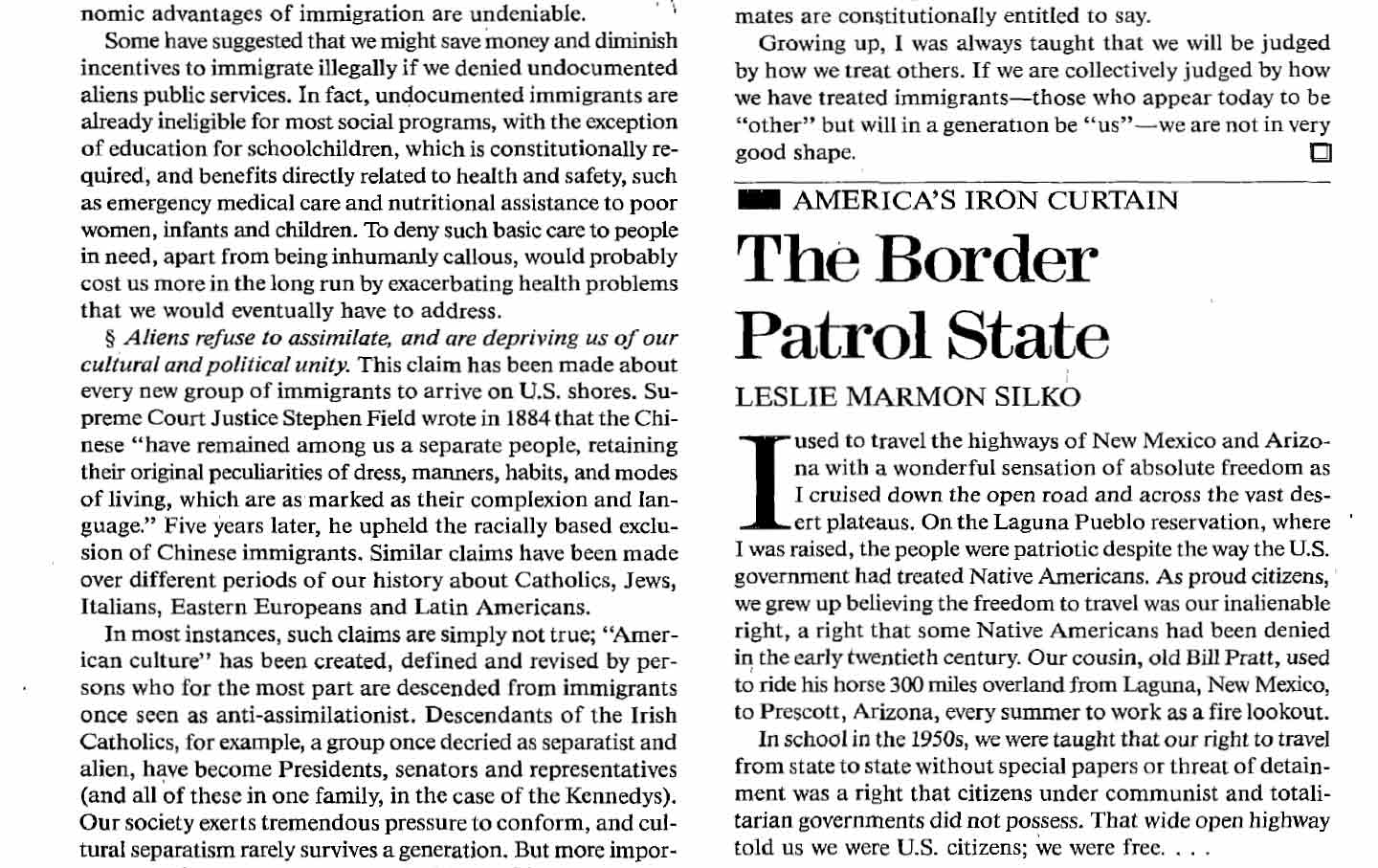
How the Border Patrol Moved Inland—and Created a Police State How the Border Patrol Moved Inland—and Created a Police State
In 1994, the writer Leslie Marmon Silko wrote a piece for The Nation warning of a frightening new immigration regime.

Why Epstein’s Links to the CIA Are So Important Why Epstein’s Links to the CIA Are So Important
We won’t know the full truth about his crimes until the extent of his ties to US intelligence are clear.

The Public Health Heroes of 2025 The Public Health Heroes of 2025
The Trump administration wants to destroy our health infrastructure. These warriors aren't letting that happen without a fight.

Rob Reiner, Bari Weiss, and the Shifting Politics of Hollywood Rob Reiner, Bari Weiss, and the Shifting Politics of Hollywood
Weiss’s ascent reveals the extent to which Hollywood, once a Democratic stronghold, has defected for a politics that puts the concerns and egos of wealthy people first.

The Longest Journey Is Over The Longest Journey Is Over
With the death of Norman Podhoretz at 95, the transition from New York’s intellectual golden age to the age of grievance and provocation is complete.

The Epstein Survivors Are Demanding Accountability Now The Epstein Survivors Are Demanding Accountability Now
The passage of the Epstein Files Transparency Act is a big step—but its champions are keeping the pressure on.

