The Last (Michael) Waltz
We should welcome the humiliation of Trump’s hawkish, neocon national security adviser.
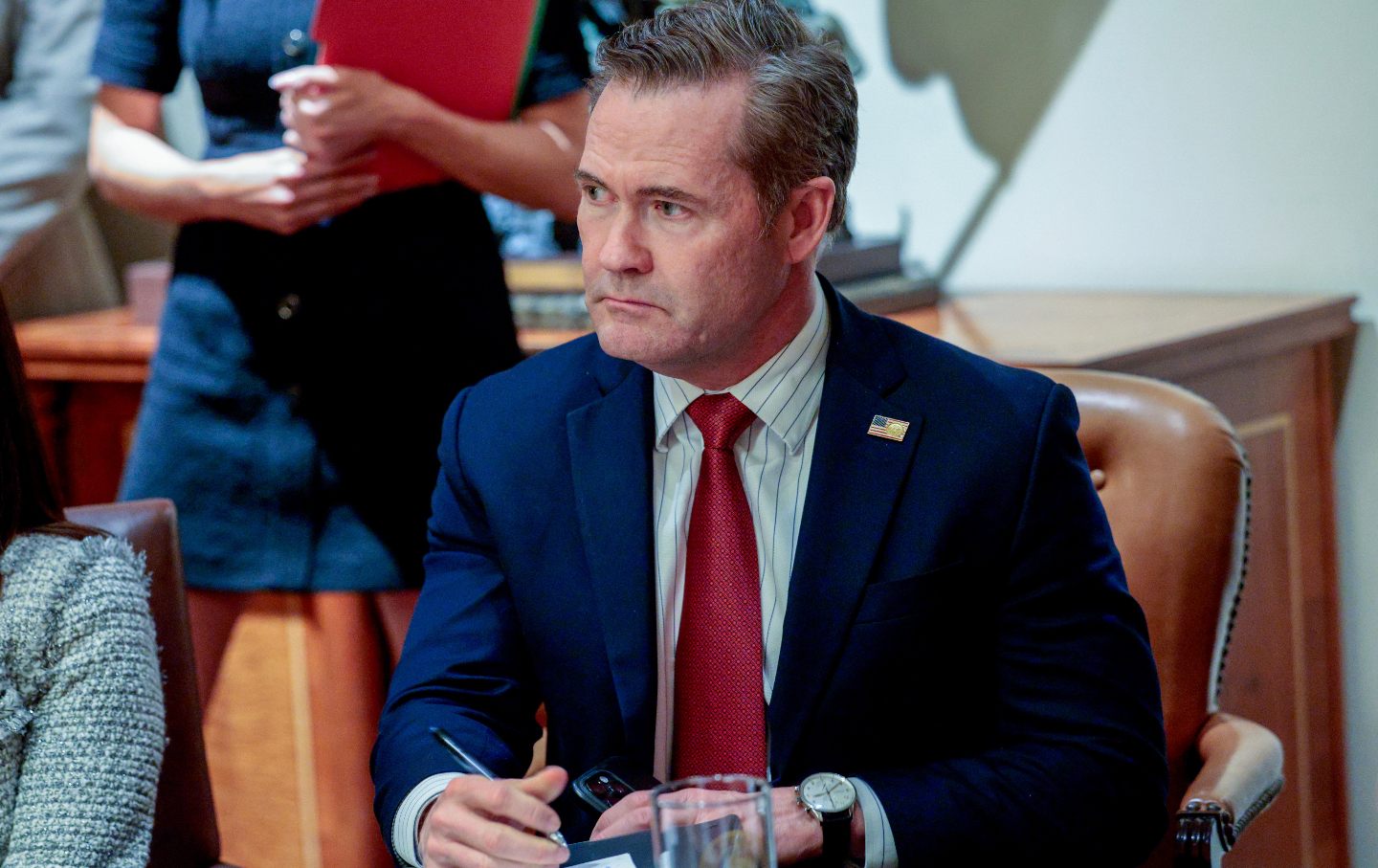
On Thursday, national security adviser Michael Waltz was ousted from his post in the most unceremonious way possible. Waltz had been long rumored to be on thin ice with President Donald Trump even before the adviser became the center of a security scandal that erupted on March 24, when Atlantic editor Jeffrey Goldberg revealed that he had been mistakenly added to a group chat on Signal where the nation’s top national security officials planned an attack on Yemen. In any normal White House, a blunder this bad would be a firing offense. But the so-called Signalgate scandal was only a trigger for a demotion that would have happened anyway, since, as Politico reports, Trump had long felt Waltz was too arrogant and pursuing his own agenda.
Trump’s desire to cut Waltz down to size can be seen in the way the president conducted the demotion. Stories about Waltz’s imminent departure circulated in the press all day on Thursday—and then Trump announced in a Truth Social post that Waltz was being shifted to the position of UN ambassador (a post that will require Senate approval). The demotion was so sudden that Tammy Bruce, the State Department spokeswoman, was visibly flustered when she learned about it from reporters during a live press conference—a further embarrassment for Waltz, since it highlighted how quickly and without preparation the move had been made. Waltz’s very hawkish deputy, Alex Wong, might also lose his post.
The position of national security adviser was given on a temporary basis to the already ridiculously overburdened Marco Rubio, who is currently the secretary of state, acting administrator of the US Agency for International Development, and acting archivist for the National Archives and Records Administration. Trump’s attitude toward filling posts in his White House seems to be that if no one else is at hand, the job goes to Rubio. Giving the post to Rubio is another way of saying, “Anyone is better for this job than Waltz.”
Vice President JD Vance tried to put a positive spin on Waltz’s mistreatment by saying, “You could make a good argument that it’s a promotion.” This is a blatantly absurd and dishonest claim. National security adviser is a top-level policymaking post, while ambassador to the UN is a more symbolic public relations job (which, presumably, is why anyone thought Elise Stefanik might be up to the task).
The chaos surrounding Waltz’s demotion is par for the course in Trump’s White House, where sudden firings and hirings are common. Waltz can at least take pride in the fact that he lasted a full 101 days, whereas Michael Flynn, the original national security adviser in Trump’s first term, made it to only 22 days before being ousted for lying about conversations he had with the Russian government.
More interesting than the usual Trumpian personnel roller coaster is the fact that Waltz’s demotion was due to a significant but subterranean ideological battle still raging inside the Trump White House. Waltz is the latest victim of the struggle between neoconservatives, restrainers, and prioritizers that has roiled the Trump administration. As I’ve noted before, Waltz was the foremost neoconservative—a believer in the long-standing national security goal of American preeminence, which means being prepared to fight Russia, China, and Iraq all at the same time if necessary. The prioritizers, headed by undersecretary of defense for policy Elbridge Colby, are China hawks who want to draw down in Europe and the Middle East in order to fight the main enemy in Asia. The restrainers are more skeptical of military interventions of any sort, believing that the United States should focus on domestic improvement. This position has less clear-cut articulation than that of the neoconservatives and the prioritizers, but can occasionally be heard from Vice President Vance.
Over the first three months of the Trump administration, we’ve seen a spate of firings as the three factions target one another for smear campaigns. This internal civil war in Trumpland likely means the president’s foreign policy will continue to be unstable, while the long-promised “deals” with foreign powers remain chimerical.
The New York Times acknowledged the ideological dimensions of the demotion, noting that, “most of Mr. Trump’s advisers had already viewed Waltz as too hawkish to work for a president who campaigned as a skeptic of American intervention abroad and was eager to reach a nuclear deal with Iran and normalize relations with Russia.”
Strikingly, the anti-Trump centrist press (notably The New Yorker and The Atlantic) treated Waltz’s brief tenure as a tragedy where a responsible and mature statesman had to become a craven courtier only to be humiliated by an erratic president. There is no denying that Trump is unstable, but Waltz doesn’t deserve these eulogies from centrists.
According to Susan B. Glasser of The New Yorker, before the 2024 election Waltz was “a generally well-regarded, generally hawkish” congressman. Further, Glasser notes that after Trump’s appointment of Waltz and nomination of Rubio, “official Washington breathed a bit easier—both were known commodities, stolid Republican elected officials who seemed to mean it when they talked about ‘peace through strength’ and the need for American leadership in a world on fire. They were both known for tough views on China and Iran, and both were early supporters of Ukraine after Russia’s full-scale invasion in 2022—though, in 2024, they had both voted against providing additional military aid to Ukraine as the prospect of a victory by the Ukraine-skeptical Trump drew closer.”
Writing in The Atlantic, David A. Graham painted a similarly flattering portrait:
Waltz was one of the more respected and expert hands on Trump’s team, and that would have doomed him sooner or later…. Waltz is a right-winger and a convert to Trumpism, but he is not a blind loyalist. He won four Bronze Stars while serving in U.S. Special Forces. He worked at the Pentagon during the George W. Bush administration, and was elected to four terms in Congress. As national security adviser, he tried to bring his expertise to the service of the president.
According to Graham, Trump is disdainful of expertise and so was inevitably going to clash with Waltz. This framing is a classic example of militarism disguising itself as neutral journalism. While it is true that Trump has little use for expertise, Waltz is only an embodiment of expertise if you accept the opinion that endless American military interventions all over the world are a policy all rational people should support.
Popular
“swipe left below to view more authors”Swipe →In an article for Responsible Statecraft, Branko Marcetic did a service by documenting just how extreme Waltz and his deputy Wong are:
Waltz has shifted since, but largely because he sees a U.S.-China confrontation as a bigger priority. Waltz views China as “the most threatening adversary America has ever faced,” believes that Washington is already locked in a “Cold War” with Beijing and must “curb” its power, step up military aid to Taiwan, and end the policy of “strategic ambiguity” over the island nation, which has been at the core of decades of successful U.S. policy balancing deterrence without tipping into disastrous war.
He has also disparaged diplomacy with the Chinese government, and thinks U.S. forces should have stayed in Afghanistan to hang on to Bagram Airfield for possible use as a “second front” in a future U.S.-China war….
Alex Wong, Trump’s pick for deputy national security adviser, agrees. Wong believes that Americans “have to be prepared for a level of tension, regional destabilization, and—yes—possible conflict [with China] that we have not seen since the end of World War II.” Wong noted he deliberately used that destructive, hot conflict as a reference point and not the Cold War.
It’s true that many of the MAGA critics of Waltz are themselves extremists, notably the loopy influencer Laura Loomer, who seems to have a strange, Rasputin-like sway over Trump. But proper distrust and disdain for Loomer shouldn’t fool us into thinking that Waltz and his fellow neoconservatives are emblems of rationality. Neoconservatives are warmongers who are respectable—and, as such, more dangerous than the MAGA warmongers who at least receive more sustained critical media scrutiny. For those on the left, when MAGA and the neocons battle, the best attitude is, to quote a famous meme, “let them fight.”
Disobey authoritarians, support The Nation
Over the past year you’ve read Nation writers like Elie Mystal, Kaveh Akbar, John Nichols, Joan Walsh, Bryce Covert, Dave Zirin, Jeet Heer, Michael T. Klare, Katha Pollitt, Amy Littlefield, Gregg Gonsalves, and Sasha Abramsky take on the Trump family’s corruption, set the record straight about Robert F. Kennedy Jr.’s catastrophic Make America Healthy Again movement, survey the fallout and human cost of the DOGE wrecking ball, anticipate the Supreme Court’s dangerous antidemocratic rulings, and amplify successful tactics of resistance on the streets and in Congress.
We publish these stories because when members of our communities are being abducted, household debt is climbing, and AI data centers are causing water and electricity shortages, we have a duty as journalists to do all we can to inform the public.
In 2026, our aim is to do more than ever before—but we need your support to make that happen.
Through December 31, a generous donor will match all donations up to $75,000. That means that your contribution will be doubled, dollar for dollar. If we hit the full match, we’ll be starting 2026 with $150,000 to invest in the stories that impact real people’s lives—the kinds of stories that billionaire-owned, corporate-backed outlets aren’t covering.
With your support, our team will publish major stories that the president and his allies won’t want you to read. We’ll cover the emerging military-tech industrial complex and matters of war, peace, and surveillance, as well as the affordability crisis, hunger, housing, healthcare, the environment, attacks on reproductive rights, and much more. At the same time, we’ll imagine alternatives to Trumpian rule and uplift efforts to create a better world, here and now.
While your gift has twice the impact, I’m asking you to support The Nation with a donation today. You’ll empower the journalists, editors, and fact-checkers best equipped to hold this authoritarian administration to account.
I hope you won’t miss this moment—donate to The Nation today.
Onward,
Katrina vanden Heuvel
Editor and publisher, The Nation
More from
Jeet Heer 

Why Epstein’s Links to the CIA Are So Important Why Epstein’s Links to the CIA Are So Important
We won’t know the full truth about his crimes until the extent of his ties to US intelligence are clear.
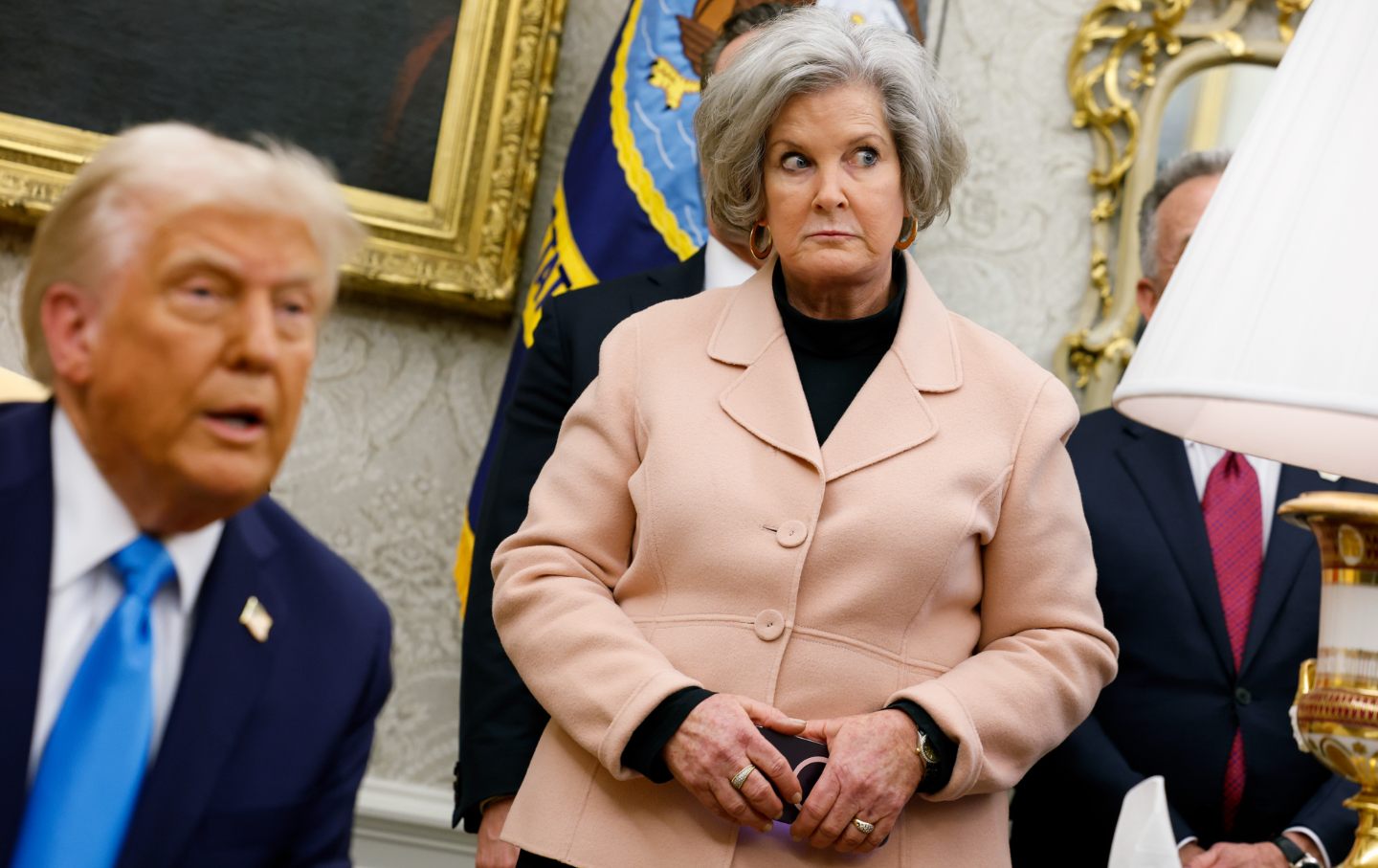
The Shocking Confessions of Susie Wiles The Shocking Confessions of Susie Wiles
Trump’s chief of staff admits he’s lying about Venezuela—and a lot of other things.

In America, Mass Shooting Survivors Can Never Know Peace In America, Mass Shooting Survivors Can Never Know Peace
A growing number of US residents have lived through more than one massacre.
Corporate Democrats Are Foolishly Surrendering the AI Fight Corporate Democrats Are Foolishly Surrendering the AI Fight
Voters want the party to get tough on the industry. But Democratic leaders are following the money instead.
Sleepy Donald Snoozes, America Loses Sleepy Donald Snoozes, America Loses
It’s bedtime for Bozo—and you're paying the price.
The Revolt of the Republican Women The Revolt of the Republican Women
Speaker Mike Johnson’s sexism is fueling an unexpected uprising within the GOP caucus.

