
The Labyrinth of European Rearmament
The European Union’s rush to increase military spending is as much about appeasing Washington as achieving actual “strategic autonomy.”
In what seems like a lifetime ago, US president Barack Obama prodded his European counterparts for being “complacent” on military spending, warning that fiscal austerity amid the 2010s Eurozone crisis would hamper the ability of European states to play a larger role in their defense.
It was a taste of things to come. Though the Joe Biden administration’s support for Ukraine lulled fears of an American withdrawal from Europe, those hopes were doused with Donald Trump’s thundering return to the White House. Since January, Trump has rapidly escalated his criticism of the United States’ traditional allies in the European Union all while opening negotiations with Moscow, over the heads of EU capitals and Kiev. By the time the Jeffrey Goldberg leaks dropped, showing top brass of the Trump administration privately mocking European dependency—“It’s PATHETIC,” wrote Pentagon chief Pete Hegeseth—there was little that EU elites should not have already known.
And the message, it seems, is landing. The European Union and key member states are laying the groundwork for a surge in the bloc’s military expenditures.
Two percent of GDP? 3.5 percent? 5 percent? 5.5 percent? Governments from Sweden and Germany to Lithuania and Poland are one-upping themselves in military spending targets, ahead of a NATO summit this June where the size of military budgets are expected to play an important part in the push to keep Washington invested in the continent. A point of consensus has emerged in the bloc’s normally fractious politics, one uniting Social Democrats and Green parties on the left to establishment conservatives and factions of the far right: It’s time to rearm. Many questions and disagreements over long-term strategy may persist, but they are being papered over by calls, like that of Danish Prime Minister Metter Frederiksen, to “spend, spend, spend on defense and deterrence.”
That shift was consecrated in a defense policy white paper released on March 19 by the European Commission, the EU executive arm headed since 2019 by Ursula von der Leyen. The document, “European Defense Readiness 2030,” is the framework for an overhaul of EU military industrial policy, one intended to prepare Europe to pick up the slack of a cutoff in US aid to Ukraine and achieve military self-sufficiency in a few years’ time. Building on the “ReArm Europe” plan announced earlier this winter, the plan calls for a “once in a generation surge in European defense investment,” urging joint procurement, greater interoperability between armed forces, and a deeper arsenal of military hardware. EU military contractors are to come away with the investment predictability needed for a durable return to wartime scale and production.
Accelerating following Russia’s full-scale invasion of Ukraine, European defense spending was on the rise since before Trump’s return to the White House. Since 2021, cumulative military spending across the 27 member states of the EU has increased by 31 percent, arriving at €336 billion in 2024—roughly 1.9 percent of the bloc’s GDP. In early March, European states greenlighted von der Leyen’s ReArm Europe package, which claims to free up an additional €800 billion for a multiyear budget drive, including through €150 billion of collective borrowing and loans from Brussels to member states.
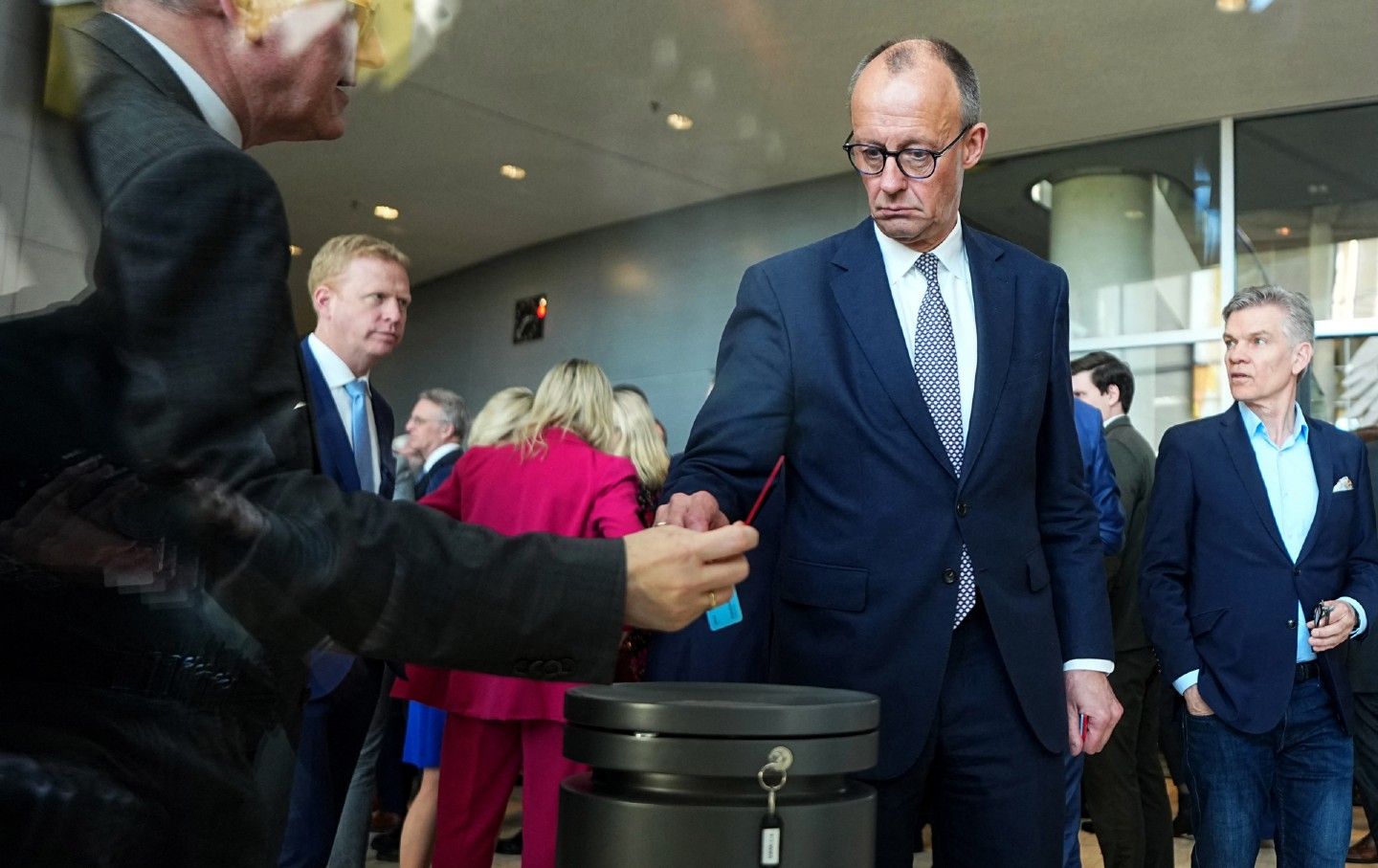
Perhaps the most dramatic turnaround has been made by Germany, where the arrival to power of conservative Chancellor-elect Friedrich Merz is pointing toward a revolution in defense-industrial policy. After leading a campaign largely geared toward upholding financial orthodoxy, Merz won the German parliament’s approval in March for a work-around for defense credits to the German constitution’s “fiscal break,” which strictly limits deficit spending. In total, Merz’s plan could see a €1 trillion spending bump over the coming years, roughly spit between new military expenditures and a €500 billion fund for investments in infrastructure.
Many have wanted to see in these announcements a belated victory for French President Emmanuel Macron, who has long been an advocate for European “strategic autonomy.” Faced with the increasing unreliability and overbearingness of Washington’s treatment of its allies, the argument is that Europe needs to be able to steer its own foreign and defense policy—and not shy away from the type of pump-priming investments made by the EU’s peer geopolitical powers. “My absolute priority will be to strengthen Europe as quickly as possible so that, step by step, we can really achieve independence from the US,” Merz said on election night in late February. From a conservative of the German establishment, a statement like that would have been nearly inconceivable only a few years ago.
Yet the surge of military budgets conceals a maze of competing interests and pressures in the way of greater European autonomy. Major disagreements still divide EU capitals, namely thorny questions like strategic vision and just what a remilitarized Europe is precisely for. The disparities in financial power needed to cushion new defense spending are also vast, in an economic bloc suffering from depressed economic growth rates and high levels of public indebtedness.
Rearmament risks exacerbating the EU’s own internal imbalances. Germany’s largesse marks a clear break from the decades of underinvestment that the country’s political and economic elites now pinpoint as a major cause—alongside the severing of Russian fuel imports—of its industrial woes. And if some analysts claim that a German splurge could act as a tide that lifts all boats, its fiscal moves are the flip side of the budgetary constraints faced by other EU states. Indeed, one concern is that a rapid increase in German borrowing could make it harder for its partners to seek their own financing.
In fact, much of the €800 billion figure put forward by von der Leyen is hypothetical. Beyond the €150 billion in direct loans from Brussels, the other roughly €650 billion is to come through a loosening of EU deficit-spending rules for military expenditures and more private investment in the defense industry.
Many in the bloc would likewise jump at the chance, any chance to hold on to ties with their excitable big brother across the Atlantic. This has been on plain display in the push by Macron and British Prime Minister Kier Starmer to constitute a “coalition of the willing” for a European “reassurance force” in Ukraine. While interest for the idea has grown, a broad coalition is probably dependent on winning guarantees from Washington and the support of the US military’s logistical and intelligence capabilities.
Then there are the forces actively pushing to deepen ties with Washington. The only EU leader to attend Trump’s inauguration in January, Italy’s far-right premier, Giorgia Meloni, wants to position herself as a bridge between Washington and the EU, calling the choice between greater EU cooperation and transatlantic ties “childish” in a recent interview.
The best sign of how the push-and-pull of rupture with Washington actually plays out will be to follow where defense credits flow. Under the terms of the ReArm EU plan, at least 65 percent of the €150 billion of member-state loans are to be spent on procurements for European-made products. This was widely deemed a “victory” for France, which boasts a large defense industry and has long argued for a “buy Europe” approach.
This means that a considerable degree of purchases, including from member states’ own independent borrowing, will still go to contractors from outside the European Union. US firms have a level of scale and technical expertise that makes them nearly unavoidable. And as everyone knows, Trump looks kindly on big-ticket purchases of US products and services. Critics are therefore not wrong in warning that growing European defense budgets might act as an indirect US tax. A “bribe” might describe it too.
Some things the US provides will be next to impossible to replace, notably the security “umbrella” provided by its nuclear arsenal. This winter has seen a series of talks and speculation, with some German interest, about greater Franco-British cooperation on nuclear policy and capabilities (the United Kingdom and France are the two nuclear powers on the continent).
A European “deterrent” may sound reasonable on paper. But many capitals still see no alternative to the United States. Poland is lobbying for the US to move nuclear warheads into the country, where a new US missile defense base was opened in late 2024. Positioning itself to be the eastern anchor of European rearmament, Warsaw plans to increase military spending to at least 5 percent of GDP, while it brokers a Trump-administration pledge to enforce NATO’s mutual defense clause.
Popular
“swipe left below to view more authors”Swipe →As a reaction to the Trump-shock, the acceptance, with some exceptions, among European publics for more military spending is certainly understandable. The trouble will come if that means making other sacrifices, as the deficit-spending loopholes for defense budgets won’t extend to other state priorities.
A recent Le Monde editorial predicted that public opinion would require a firm dose of “pedagogy” to prepare for the tough spending choices ahead. One Financial Times columnist likewise argued that “all other priorities are secondary” to Europe’s being able to muster more military power—and that what needed an axing are social and welfare programs. This “military Keynesian” moment is already eclipsing the security implications of the climate crisis, with the EU commission vying to water down environmental regulations approved just a few years ago.
Back in 2003, an open letter signed by leading intellectuals Jacques Derrida and Jürgen Habermas took aim at the European Union’s inability to provide an effective opposition to the United States’ invasion of Iraq. “The reduction of politics to a stupid and costly alternative of war or peace simply doesn’t pay,” they wrote. “At the international level and in the framework of the UN, Europe has to throw its weight on the scale to counterbalance the hegemonic unilateralism of the United States.” Over 20 years later, the rush to increase defense budget has Europe throwing its “weight on the scale,” you might say. But with very little in the way of an actual alternative vision for the continent in global affairs. For all the uproar at the Trump administration’s apparent willingness to abandon Kiev to Putin’s designs, the European defense of international law has been dealt a fatal blow by its seconding of Washington’s support for Israel’s war on Gaza. What remains is the lure of a Fortress Europe, with Ukraine as von der Leyen’s “steel porcupine” to the east, or for Meloni’s “360 degree” threats from everywhere else.
More from The Nation

Israel’s Extremist Election Israel’s Extremist Election
The run-up to the vote on Tuesday is exposing the façade of Israeli democracy—and the fealty of the country's so-called opposition when it comes to matters of Jewish supremacy.

“NAZA” and Israel’s History of Automated Warfare “NAZA” and Israel’s History of Automated Warfare
As violent technologies like spyware, predictive targeting algorithms, and 2,000-pound warheads become ordinary instruments of military rule, once-abhorred practices become routin...

Brazil’s Workers’ Party Is Not Stopping Brazil’s Workers’ Party Is Not Stopping
With just a few days remaining before the runoff election, supporters of Lula’s party are doing everything possible to rally support behind the president.
Brazil’s Decision Brazil’s Decision
The moral compass and basic humanity of political leaders really does matter.
Albanian Student Strikes Spur a Political Crisis Albanian Student Strikes Spur a Political Crisis
A new round of protests against the ruling party’s corruption has Prime Minister Edi Rama giving cops bonuses to crack down on dissent.

