
Texas Student Journalists Are Being Censored, but That Won’t Stop the Presses
On University of Texas campuses, students have found other ways of newsmaking that free their publications from editorial control by their schools and state.
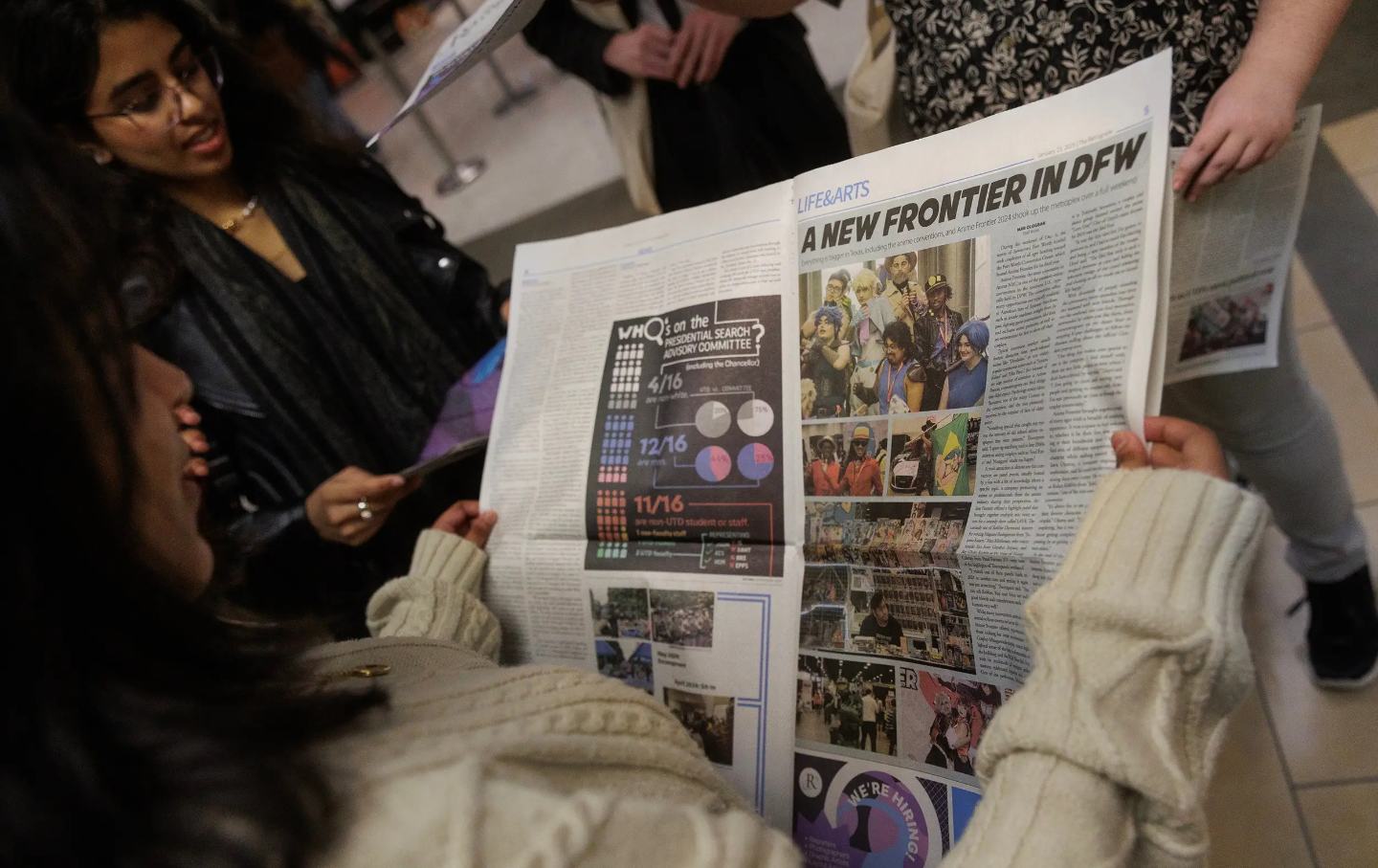
Sophomore Kavya Racheetim looks through the first edition of The Retrograde.
(Shelby Tauber / The Texas Tribune)
In May of last year, Gregorio Olivares began his tenure as editor in chief of The Mercury, the University of Texas, Dallas’s student newspaper. By September, just four months later, Olivares was fired. Not long after, the rest of the managing staff was laid off and the entire paper ceased operation. It’s no surprise that Olivares describes the state of student journalism in Texas as a “flaming cauldron of chaos.”
His expulsion didn’t come out of nowhere. “This has been an ongoing issue that we’ve had with our campus administration since I joined the newspaper,” said Olivares, who is a second-year student studying political science and philosophy. Olivares began working for the paper in the fall of their freshman year, around the same time that UTD administration removed the Spirit Rocks—three rocks on campus that previously served as a public forum—after they were painted with pro-Palestinian imagery.
In December 2023, Olivares and others on The Mercury staff argued in an op-ed that “the removal of the rocks [set] a dangerous precedent for free expression on campus.” The Mercury op-ed decried the removal as cracking down on pro-Palestinian speech in particular: “[UTD] has allowed hot-button topics on the Spirit Rocks and platformed controversial groups like Turning Point USA, and yet it seems to draw the line following a progressive outpouring of support for human rights in Palestine.”
On Olivares’s first day as editor in chief, students erected a Gaza solidarity encampment on campus. He and Mercury staff live-reported on the protest throughout the day. Their coverage culminated in a special print issue in May 2024 devoted entirely to the student encampment, including time-stamped accounts, news coverage of arrests of students and faculty, and critiques of the administration’s brutal response. Above the fold on the issue’s front page read “Welcome to UTD,” and below it, red ink splattered like blood beneath another headline, “Students Speak, Admin Silences.”
Jenni Huffenberger, UTD’s senior director of marketing and student media, labeled the May 20 issue as “wall-to-wall-activism” and “journalistic malpractice.” (Huffenberger, along with the university vice president Gene Fitch, were key figures steering student media leadership throughout the course of its actions against Olivares and Mercury staff.) Following The Mercury’s coverage in May, UTD demoted its adviser, Jonathan Stewart. “That adviser then told me that my head was next on the chopping block,” Olivares said. Huffenberger took over Stewart’s advising role.
Come September, following what Olivares described as a “hellish summer” where The Mercury managing staff’s monthly stipends were delayed by administration, the school appointed a new director of student media, Lydia Lum, who mandated prior review of The Mercury’s content (Lum later advocated for Mercury staff, only to be removed by student affairs by the end of the fall semester). “That was our red line,” Olivares said. “We’re not going to let our service be censored by the campus administration under any circumstances.”
Olivares was fired on account of his refusal for prior review and administrative oversight, along with his alleged violation of Student Media bylaws, including overrunning the budget and holding multiple student jobs.
Suffice it to say, Olivares isn’t too hopeful about the future of student journalism—and understandably so. Examples for student journalists to look up to within mainstream media are often few and far between. While some media barons mandate that their newsrooms produce oligarch-friendly coverage, others implement racist artificial intelligence tools, while the purported paper of record continues to dehumanize Palestinian people.
These issues, particularly with regard to editorial control of coverage, aren’t limited to student media—especially in Texas. The only difference, Olivares says, is that “when you’re dealing with the mega news conglomerates, they’re all owned by super wealthy billionaires, like the Murdoch dynasty,” but “when it comes to student newspapers, for the most part, the huge conglomerate that owns us—that decides what we do—is the university.”
The Mercury staff went on strike, led by former managing editor turned acting editor in chief Maria Shaikh, demanding three actions: that Olivares be reinstated, that the operating board amend its bylaws, and that the editor-in-chief position be democratically elected by Mercury members rather than board-appointed. By October, all remaining managing staff, including Shaikh, were fired by Student Affairs (the office argued that Mercury management had voluntarily quit, despite none of the managing staff’s resigning or stating an intent to resign).
Firing management alone was enough to completely shut down The Mercury, Shaikh said. The nearly half-century-old newspaper was essentially dissolved. The Mercury’s final paper remains a special issue released on September 16, which featured, among the strike’s demands and its signatories, a question to its readers: “Want to read the rest of The Mercury?” The answer, simple and inked in a bold red type, was printed just below the question: “Bring our Editor-in-Chief back.”
The staff wasn’t as disillusioned by journalism as they were emboldened, launching a new, fully independent paper called The Retrograde in the same month with Olivares and Shaikh at the helm. “We started off as a really scrappy, late-night sort of thing, but have since been improving so that we’re able to more consistently get through the flow of things now that we’re fully severed from the university,” Olivares said.
Following Mercury’s dissolution, UTD administration removed the majority of the newspaper stands around campus in January, but recently began work to revive the paper, opening up applications for the editor-in-chief and managing-editor roles. While The Mercury’s homepage previously indicated that the staff was on strike, it now gives no such notice and features a section for its “latest paper” that links to an issue that came out just before the strike edition.
Shaikh said that former staffs’ demands have yet to be met and the problems that catalyzed The Mercury’s hiatus have yet to be solved. In response, The Retrograde editorial board has urged students to not cross the picket line. “We would genuinely feel bad for whoever fills out The Mercury’s ranks as scabs,” said Shaikh, who is a biochemistry junior. She went on to say that the new staff would “have to operate the newspaper in this paradigm where if they step out of line, the administration feels totally comfortable removing or punishing them in some kind of way.”
Instead, Olivares and Shaikh want to further solidify The Retrograde as UTD’s paper of record, continuing to expand the breadth of the independent publication by bringing in more staff, regularizing print production, and building out a shared identity so as to keep editorial control in the hands of the students.
Without university funding, though, The Retrograde must pay for operating and publishing costs itself through advertisements, donations, grants, and sponsorships, including raising money on GoFundMe and Patreon. UTD also doesn’t have a journalism program, which makes “onboarding staff so much harder,” Olivares said. “We have to bring people who don’t know anything about journalism into the field of journalism.”
For Shaikh, “a lot of it has been learn as I go” without a formal program, whether that takes the shape of former editors passing knowledge down to her, researching how other publications are operating, or getting thrown into the thick of protest coverage on her first day as managing editor. But this has also proven to be a “blessing,” according to Shaikh, allowing room for students like her—who juggle a busy schedule of interdisciplinary commitments, from biochemistry research to an Asian studies minor—to participate in the paper.
And while onboarding students without prior journalism experience takes more time and resources, Olivares said that it’s ultimately a benefit to the paper’s coverage. “We have people with different interests and fields of expertise who know everything that’s happening on campus,” Olivares said. In turn, despite any logistical challenge, a paper detached from degree programs or the university fosters a kind of student journalism completely by and for the students and, according to Olivares, “open to everyone.”
This kind of student journalism is not only “integral to the university ecosystem,” Shaikh said, but also “plays a larger role in shaping public opinion and helping to hold power to account through documenting the less savory actions of people in power.” Simultaneously, these efforts are “under threat,” she said, “both at UTD specifically and at universities around the nation that are currently putting internal pressure on their student media teams to perform coverage in a certain way.”
At the University of Texas’s flagship campus in Austin, just under four hours south, other student newspapers face similar pressures. Recent UT system policies bar university institutions from taking “political” stances, including all publications under the umbrella of Texas Student Media, an “uncensored” enterprise of the university: The Daily Texan, KVRX, Texas Student Television, to name a few. But as is the case at UTD, issues in coverage predate recent university or state actions.
Popular
“swipe left below to view more authors”Swipe →For Leila Saidane, a radio-television-film and journalism senior and former photo editor at The Daily Texan, this included, in October 2023, having to convince the newspaper adviser and management that coverage of Palestine and protests for Palestine was necessary. Initially, Saidane was told that The Daily Texan was not to report on the topic.
“I was very vocal to the staff and said that management was kidding themselves if they thought this wasn’t going to impact us and spark responses on campus,” Saidane said. “Beyond that, there are students here who are Palestinian, who have family in Gaza and the West Bank. This isn’t some untouchable issue that we have nothing to do with—not even to touch on the way that UT is complicit through their investments.”
Eventually, the paper began coverage of campus and statewide protest actions led by Austin’s Palestine Solidarity Committee (PSC) throughout the end of 2023 and into 2024, including those that the administration violently broke up in April. “If I hadn’t pushed it, I don’t think it would have been covered until way too late,” Saidane said.
Along with her photographing pro-Palestine protests for The Daily Texan, as well as for outlets like Texas Tribune, Saidane gathered photos, video footage, interviews, and more from throughout the past two years into a documentary on PSC called Sumud—named after the Arabic word for “steadfastness” or “steadfast perseverance,” which is commonly used to describe the continued spirit of Palestinian resistance against Israeli occupation.
Saidane has continued her coverage of the PSC for her thesis documentary, further embedding herself into the community, capturing just how personal that which is deemed political. “No one is covering it from the angle that I’m covering it in terms of the connection I have with the PSC,” Saidane said. “I show up to every event and have created a relationship with them.”
A little over two hours further south of UT Austin, UT San Antonio’s student newspaper, The Paisano, hasn’t had to worry about university pressures; prior to The Retrograde, the publication at UTSA was the only fully financially and editorially independent student newspaper within the UT system. “When news was coming out about what was happening with The Mercury, it made all of us really grateful that we will never have to experience the same kind of pushback or suppression from our university administration,” said Jake Mireles, who is The Paisano’s editor in chief and a politics and law junior at UTSA.
Originally from Austin, Mireles had planned to finish out his undergrad years at UT’s flagship campus, but decided to stay in San Antonio. “A large part of the reason why I stayed was because of the people that I met through [The Paisano] and because of [The Paisano] itself,” he said. For Mireles, one of the biggest selling points about The Paisano was its fully independent model; the paper doesn’t allow “the wants and wishes of the university to shape” how it reports on stories, he said. According to Miereles, such a model—where journalists are “taking back the profession,” as he puts it—is the way forward. It is in this independent and community-based vision of journalism that Miereles finds hope for the future of the industry.
While students like Olivares are less hopeful about journalism’s future, perhaps there is also utility in pessimism: “You’re doing really well if your university seeks to destroy your newspaper.”
Become a Sustaining Donor This September
Between the reemergence of right-wing red-baiting and Donald Trump’s use of the chilling National Security Presidential Memorandum–7 to criminalize left political organizing, we’re seeing McCarthyism reborn before our eyes.
This assault on democracy cannot be ignored or wished away. Resisting it requires bravery in the face of threats and repression, a steadfast commitment to the truth, and the unwavering belief that we can—and will—overcome this darkness.
We must have an independent media that sets the record straight, unearths corruption and abuses of power, and advances a politics of justice and dignity for all if we’re to win this fight.
That’s why I’m writing to you today. This September, The Nation needs to add 100 monthly donors to sustain our progressive journalism. Your contribution makes the next investigative report, the next truth-speaking column, and the next pathbreaking essay all possible.
I hope you’ll support our work with a recurring donation today. If you donate $10 or more a month, we’ll send you a brand new “Hands Off the Free Press!” sticker to recognise your commitment to our cause. Please, donate today.
Onward,
Katrina vanden Heuvel
Editor and Publisher, The Nation
More from The Nation
What’s the Matter With Effective Altruism? What’s the Matter With Effective Altruism?
President Trump has decried the techbro creed for indulging in AI doomerism, but its excesses are far worse than that.
As Morale Sags, More Military Service Members Are Having a Crisis of Conscience As Morale Sags, More Military Service Members Are Having a Crisis of Conscience
According to multiple GI rights organizations, service members are inquiring in unprecedented numbers about seeking conscientious objector status.
What Remains of Riis? What Remains of Riis?
A new members’ club has revived Riis Park’s long-vacant bathhouse, reopening old questions about whom the People’s Beach is really for.
When Texas Sex Ed Falls Short, Gen Z Women Turn to Social Media When Texas Sex Ed Falls Short, Gen Z Women Turn to Social Media
A 2025 study found that 70 percent of adolescents sought reproductive health information through social media platforms.
Justice for Macklemore Justice for Macklemore
The rapper has been dumped from Ed Sheeran’s tour for saying “free Palestine.” That’s a disgrace.
We Are Living Under Roy Cohnian Logic We Are Living Under Roy Cohnian Logic
The political fixer created a career for himself as a self-promoting, ubiquitous hustler. Like Trump, he got away with it by having the right friends.

