
Trump’s Academic Purge Will Make America Stupid and Provincial Again
The administration’s targeting of international students is a return to a disgraced tradition of xenophobic anti-intellectualism.
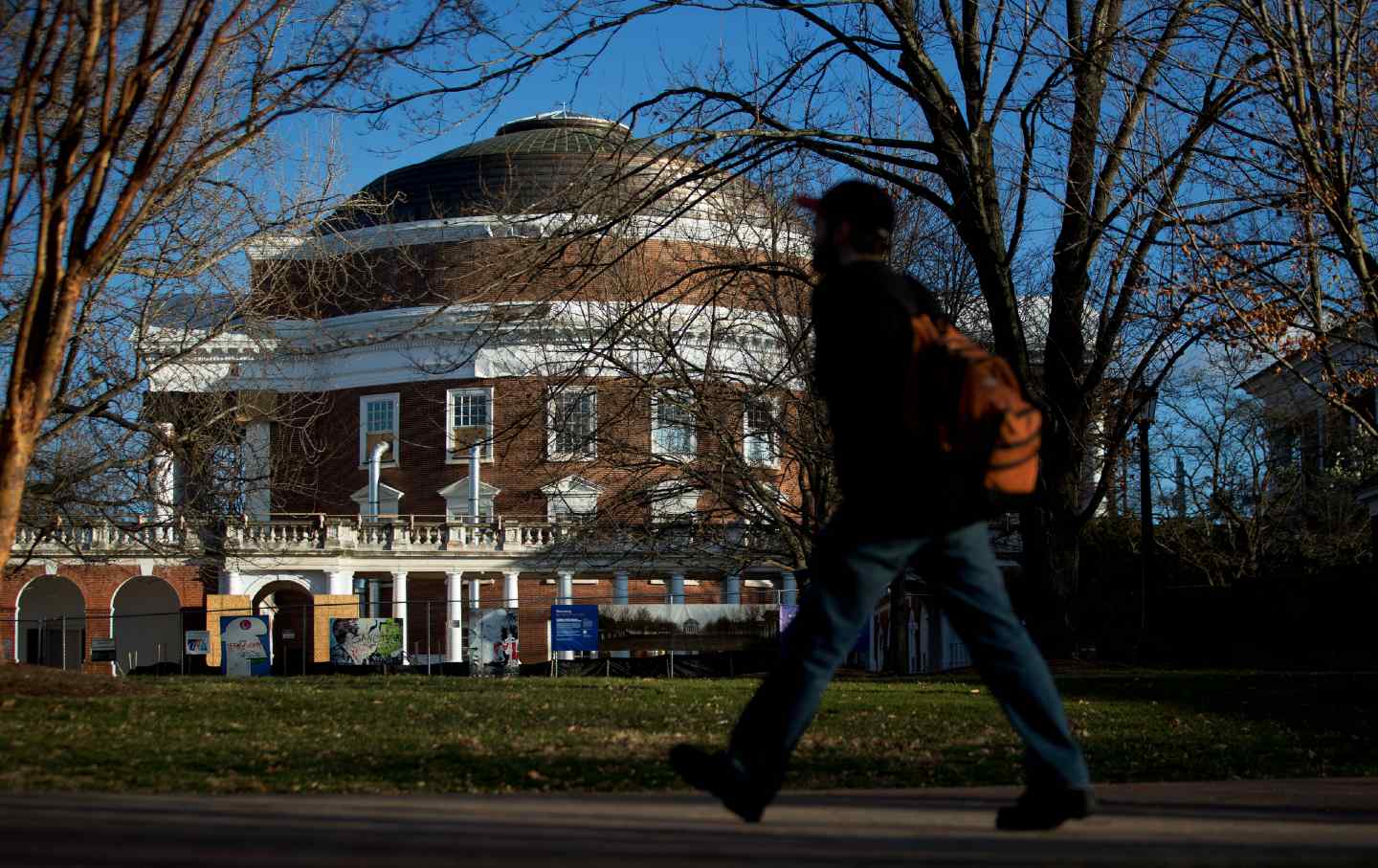
Thomas Jefferson’s personal reputation has been much tarnished in recent years as historians have uncovered ever more damning evidence of the secret shackled family he sired with the enslaved Sally Hemings, yet his historical significance looms the larger precisely because he, more than any other founding father, embodied the crucial discrepancy between lofty ideals and tawdry reality. Jefferson dreamed of a new nation that was not only independent but also enlightened. Toward that end, he created in 1825 the University of Virginia, with the goal of bringing the best minds of Europe over to nurture the fledgling youth of the new republic, who would be given free space in a “University of Adolescent Liberty” to pursue the life of the mind.
Recruiting the first cohort of University of Virginia professors, Jefferson hired five Europeans (four British, one German) and three Americans. But importing scholars was an easier task than creating a country hospitable to learning.
Jefferson’s problem was the students, not the teachers. The students at the University of Virginia tended to be, like Jefferson himself, plantation gentry with the hauteur intrinsic to the slave-owing class. They had little appetite for mental exertion, preferring to gamble and brawl rather than learn Latin or algebra. Suffused with a good-old-boy ethos, they prized manly belligerence and regarded the studious with contempt.
These strapping young men would have their slaves carry their books, which they themselves rarely deigned to open. They would regularly challenge each other and their professors to duels. They rioted with the chant, “Down with the European professors!” In September of 1825, after professors had been attacked with bricks and bottles, a campus gathering took place in the university’s rotunda. A tearful Jefferson, sitting on a long table with fellow former presidents James Madison and James Monroe, addressed faculty and students, trying to achieve calm with a mixture of disciplinary efforts and pleas for the students to govern each other.
Long after Jefferson’s death in 1826, the seeds of Enlightenment ideas had a hard time finding purchase in the rocky soil of American xenophobia and anti-intellectualism. In 1841, the brilliant mathematician James Joseph Sylvester, only 27 years old but already writing papers whose conceptual brilliance astonished the field, was hired by the University of Virginia. As historian Lewis S. Feuer noted, Sylvester was “the first observing Jew to be called to the United States to fill a full professorship in a secular subject.”
That in itself was a source of scandal. The Virginia gentry were already suspicious of foreign professors, distrusting them as secret abolitionists or otherwise hostile to the “peculiar institution” of slavery. Sylvester’s lack of Christian faith was even more of a problem, especially since he had been hired along with a Hungarian Catholic. A local publication argued that both Sylvester and “the Hungarian Papist” should not be hired because “the great body of the people of this Commonwealth are by professions Christians and not heathen, nor musselmen, nor Jews, nor Atheists, nor Infidels. They are also Protestants, and not Papists.”
Harassed by students, Sylvester was advised by fellow professors to carry a weapon. He chose a sword-cane. In early 1842, Sylvester scuffled with a student who fell the ground yelling, “I am killed! He has killed me!” A surgeon inspected the student and found a mild cut, little bigger than a mosquito-bite. But the incident was traumatic enough for Sylvester to flee Virginia. The following year, he was denied an appointment at Columbia College (subsequently Columbia University), likely because he was Jewish. Sylvester returned to England, eventually finding a post at the Royal Military Academy, Woolwich, and subsequently returning to America to teach at Johns Hopkins before finding his final position at Oxford.
Sylvester’s checkered career of academic triumphs in the face of petty bigotry is emblematic. Well into the 20th century, the Jeffersonian dream of importing intellectual excellence was repeatedly thwarted by rampant provincialism. The Institute for Advanced Study in New Jersey, created in 1930, was able to assemble a distinguished faculty of refugee scholars (headed by Albert Einstein) because neighboring Princeton University was notoriously antisemitic. It was only with the threat of losing the Second World War and the Cold War that America’s WASP elite was willing to loosen its habitual hidebound insularity.
As a consequence of world war, American universities became for the first time genuine international research hubs rather than finishing schools for the gentry. This transformation was not an easy one. One factor contributing to postwar McCarthyism was that aspiring aristocrats were uneasy with schools that now admitted foreigners of talent who sometimes voiced unfamiliar ideas. Emblematically, as an undergraduate in the late 1940s the would-be patrician William F. Buckley Jr., true heir to the louts who harassed Sylvester, was scandalized that atheists and Keynesians were allowed to teach at Yale. In his first book, God and Man at Yale (1951), Buckley argued that wealthy alumni needed to clean house and deploy their financial muscle to purge the schools of subversive educators.
This long conflict between Enlightenment scholarship and American provincialism is the backdrop for the current Trump administration’s war on international students, in which ICE has rounded up graduate students such as Mahmoud Khalil who have protested (or even simply criticized) American support for Israel’s onslaught in Gaza. This new crackdown has seen international students from around America scooped up by masked government agents and sent to a detention facility in Louisiana, where they are kept for days without contact with family or lawyers.
While the Trump White House is leading the charge, the state, as in earlier academic purges, is aided by powerful forces in civil society that want to settle their own political scores: The alumni networks that Buckley advocated for now find their modern incarnation in wealthy alumni of schools such as Columbia and Harvard, often in conjunction with right-wing Zionist organizations such as Betar and Canary Mission.
What is new about the current situation is that American universities are both more international than ever before—and more vulnerable to the economic clout of both the state and alumni. Far from being the “academical village” that Jefferson dreamed of as place for contemplation, the modern university is a large-scale corporation, often with large endowments, international investments, and research programs financed by government grants or done in conjunction with foreign states such as Israel.
Popular
“swipe left below to view more authors”Swipe →In a Substack post, Columbia University professor Adam Tooze spells out the three interlocking political crises that have made the university a site of controversy where the reactionary right can win easy victories:
#1 the unravelling of globalization and in particular the hope of the two state solution that explodes a critical fault line on our campus and throws the weight of power massively on to the side of the Israeli government’s efforts to uphold the project of the Jewish state by violent means;
#2 the MAGA assault exposes the compromise that liberal administrators thought they could create on campus, creating enclaves of left-wing thought and incipient mobilization, which are now being sacrificed pell mell to the new conservative mood;
#3 the multi-faceted crisis of “big science” as a source of consensual authority in the US.
To Tooze’s analysis one could add that the vulnerability of the universities is made worse by the unnecessary fecklessness of liberal elites. While reactionary political forces have long been anti-intellectual, it is also the case that America was able to become more cosmopolitan because both liberal and mainstream opinion were willing to stand up for immigration and scholarship as social goods.
In the current moment, the top leaders of the Democratic Party are ideological Zionists. This is notably true of former president Joe Biden, Senate minority leader Chuck Schumer, and House minority leader Hakeem Jeffries. They have all been conspicuously unwilling to apply elementary liberal principles to either the Israel/Palestine conflict or the domestic attacks on pro-Palestinian protesters. In fact, they’ve contributed to the hyperbolic and politically motivated claim that antisemitism is a significant factor in the pro-Palestinian protests. At best, as in Schumer’s recent interview with The New York Times, their defense of international students has been framed in legalistic procedural terms—as if an ideologically motivated immigration purge would be justified if all the forms were filled out correctly.
A full-throated defense of international students on liberal terms would run like this: Immigrant scholars have made America a much better country. This has been true from the time of James Joseph Sylvester to that of Albert Einstein to that of Mahmoud Khalil. The current Republican embrace of xenophobic anti-intellectualism is bad for America. It will make the country stupider and more provincial. The current tragedy of American politics is how few Democrats are willing to make that argument. Liberals have a powerful story to tell about immigration, but liberal leaders refuse to do so, either because they remain shell-shocked by the election or because their liberalism is compromised by their support for Israeli ethnonationalism.
More from
Jeet Heer 
Where Is the Outrage Over Trump’s Racist Targeting of Ilhan Omar? Where Is the Outrage Over Trump’s Racist Targeting of Ilhan Omar?
The establishment press and some Democrats are strangely mute over the president’s flagrant abuse of the legal system.
The Real AI Threat Is Already Here The Real AI Threat Is Already Here
Never mind some future apocalypse—AI is being used right now to cause enormous suffering.
Elon Musk’s James Talarico Smear Blew Up In His Face Elon Musk’s James Talarico Smear Blew Up In His Face
But that doesn’t mean the danger from Musk’s lies is over.
Does America First Really Mean Israel First? Does America First Really Mean Israel First?
Mike Huckabee’s aide shows how an extremist agenda dominates Trump’s Middle East policy.

The Death Penalty Has Become a Torture Machine The Death Penalty Has Become a Torture Machine
Christa Pike's botched lethal injection proves there is no humane form of execution.
Kimberly Guilfoyle Is a Master of Mafia Diplomacy Kimberly Guilfoyle Is a Master of Mafia Diplomacy
The US Ambassador to Greece is making suspicious deals for her buddies.

