
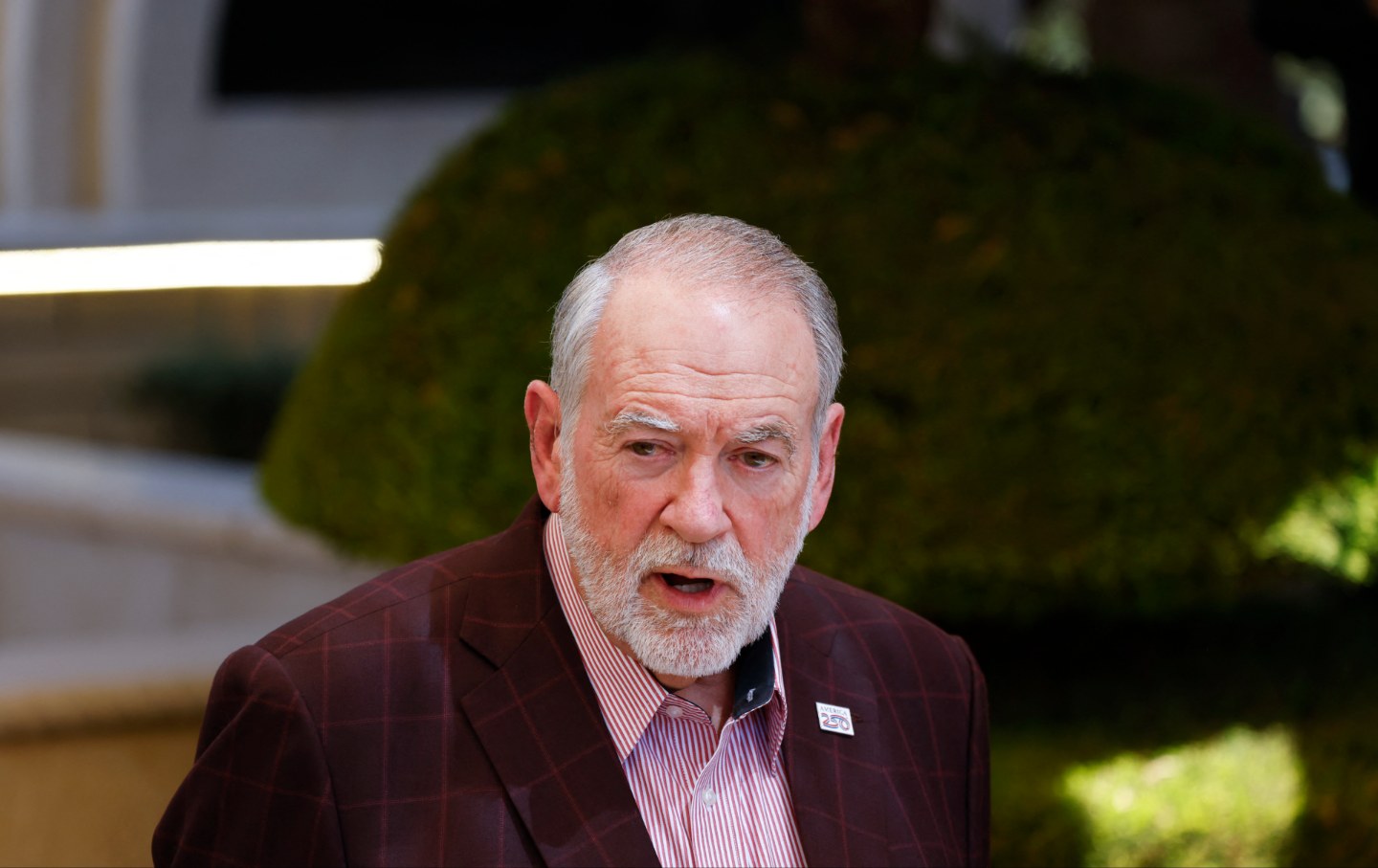
Mike Huckabee delivers a press statement during his visit to the town of Turmus Ayya, northeast of Ramallah in the West Bank, Palestine, on September 5, 2026.
(John Wessels / AFP via Getty Images)In February, Israeli settlers in the West Bank shot and killed a 19-year-old American named Nasrallah Abu Siyam. The youth had been trying to stop the settlers from stealing livestock.
Abu Siyam’s killing wasn’t an isolated incident. In the last four years, at least 1,500 Palestinians have been killed in the West Bank, sometimes by settlers but more commonly by the IDF (which acts as a de facto ally of the settler movement). Nine of those killed have been American citizens.
After Abu Siyam’s killing, 30 members of Congress, headed by Maryland Senator Chris Van Hollen, sent a letter to Secretary of State Marco Rubio decrying “the impunity afforded to extremist Israeli settlers in the West Bank under the protection of the Israel Defense Forces” and demanding accountability.
It’s unlikely that the Israeli government will have to answer for its lawlessness, at least as long as Donald Trump is in office. While Trump ran on an America First platform, in practice his politics have aligned remarkably well with the Greater Israel project of hard-line Zionists, who believe that Israel has a biblical mandate to annex the West Bank (and perhaps also large chunks of neighboring countries such as Egypt, Lebanon, Syria, Jordan, and Saudi Arabia). The Greater Israel agenda has made remarkable headway, even though Trump himself still pays lip service to the idea of a two-state solution and has said he won’t allow Israel to formally annex the West Bank.
Trump himself might shy away from explicitly endorsing a Greater Israel program, but important figures in his government clearly believe in it. On Thursday, The New York Times profiled a key policy shaper, David Milstein, an aide to US Ambassador to Israel Mike Huckabee. The newspaper reports that “when members of Congress pushed for accountability over the killings of Palestinian Americans by Israeli settlers and security forces, [Milstein] suppressed a detailed report that the embassy staff had written, effectively stonewalling lawmakers’ efforts to gain information, according to multiple officials briefed on the matter.”
Milstein’s actions here are part of a larger pattern. According to the Times, Milstein “has repeatedly suppressed or significantly revised embassy reporting on Israeli activities to present the Netanyahu government in a favorable light.”
Although the Times article featured fresh reporting, it also built on a report published last September by Connor Echols in Responsible Statecraft, which described Milstein as “something of a pro-Israel enforcer” who reached “across the State Department to steer U.S. policy and contest any information that casts Israel in a negative light.” Echols reported that Milstein tried to get the State Department to refer to the West Bank as “Judea and Samaria,” which is the biblically laden language of settlers pushing for annexation (and has been adopted by most major Israeli political leaders). Further, Milstein reportedly created a culture of fear at the State Department by enforcing ideological conformity around Israel. He seems to have gotten the State Department to fired Shahed Ghoreishi, the department’s lead press officer for Israel-Palestinian affairs.
Aside from his ideological extremism, Milstein has been tainted by the corruption that pervades the Trump administration. Last month, Politico reported that he had sent out a wedding invitation soliciting money from guests, including Israeli citizens, a practice that raised security concerns.
The State Department told the Times that “the entire team at State remains focused on advancing President Trump’s America First agenda.” This claim is dubious, unless one believes that America First actually means serving Greater Israel and disregarding the rights of Palestinian Americans.
Milstein is not a rogue agent. He represents a powerful pro-Israel faction within the modern GOP. This faction supports not just the right of Israel to exist but also its right to conquer and annex neighboring lands.
Milstein is the stepson of right-wing talk radio host Mark Levin, who often has the president’s ear, especially on Middle East policy. Milstein’s rise to prominence has been marked by the patronage of powerful political leaders defined by their Christian Zionism: Senator Ted Cruz, Governor Ron DeSantis, and Ambassador Mike Huckabee. When Huckabee tweeted out a defense of Milstein on X.com, it was retweeted by William Daroff, the CEO of the Conference of Presidents of Major American Jewish Organizations. Daroff’s intervention suggests Milstein has a high level of support from mainstream pro-Israel organizations.
Milstein’s alliance with Huckabee is particularly noteworthy. In February, Huckabee was interviewed by Tucker Carlson, who asked about the claims of Greater Israel advocates who believe that the biblically sanctioned borders of the Jewish state extend from “from the river of Egypt until the great river, the Euphrates,” which means “basically the entire Middle East.” Huckabee responded, “It would be fine if they [Israel] took it all.” Huckabee’s remarks were condemned in a joint statement made by virtually every state in the region other than Israel, including the United Arab Emirates, Egypt, Jordan, Indonesia, Pakistan, Turkey, Saudi Arabia, Qatar, Kuwait, Oman, Bahrain, Lebanon, and Syria. The statement described Huckabee’s remarks as “dangerous and inflammatory,” a “flagrant violation of the principles of international law and the Charter of the United Nations,” and “a grave threat to the security and stability of the region.”
Popular
“swipe left below to view more authors”Swipe →It’s unlikely that Trump himself is committed to the Greater Israel policy, at least in a real ideological sense. He primarily views the Middle East the way he views everything: as a vehicle for self-enrichment, via the wealthy Arab countries that might be allied with Israel in the war against Iran but don’t want to be annexed by it. Still, out of a mixture of political expediency, a desire to please donors, and laziness, Trump has given the pro-Israel faction wide powers in his administration.
Trump claims to be a tribune of America First but has in fact empowered Israel First fanatics such as Milstein and Huckabee. There is an obvious contradiction between his rhetoric and his actions, one that has been radically exacerbated by the Iran War (which Marco Rubio has described as being instigated by Israel). As The New York Times reported in December, a divide on Israel has created a “civil war” within MAGA. Trump’s embrace of the pro-Israel faction has empowered critics who insist that America First should mean a more restrained foreign policy in the Middle East. Some of Trump’s critics on the right, notably provocateurs such as Candace Owens and Carlson, are clearly motivated by antisemitism. But others, notably Representative Thomas Massie, are animated by a principled anti-war stance.
Trump’s version of America First is clearly cracking up. This ideological turmoil on the right is an opportunity for Democrats to take up the anti-war mantle and thus make an appeal to Republicans weary of war in the Middle East. Democrats don’t need to claim to be America First, a political position poisoned by nationalism. But they should make clear that their vision of national security is very different than the one promoted by Israel First zealots such as Milstein and Huckabee.
More from The Nation
Trump’s Die-Hards Are Taking Their Cultishness to New Lows Trump’s Die-Hards Are Taking Their Cultishness to New Lows
I’m finally starting to understand why Jim Jones’s lieutenants didn’t try to stop him.
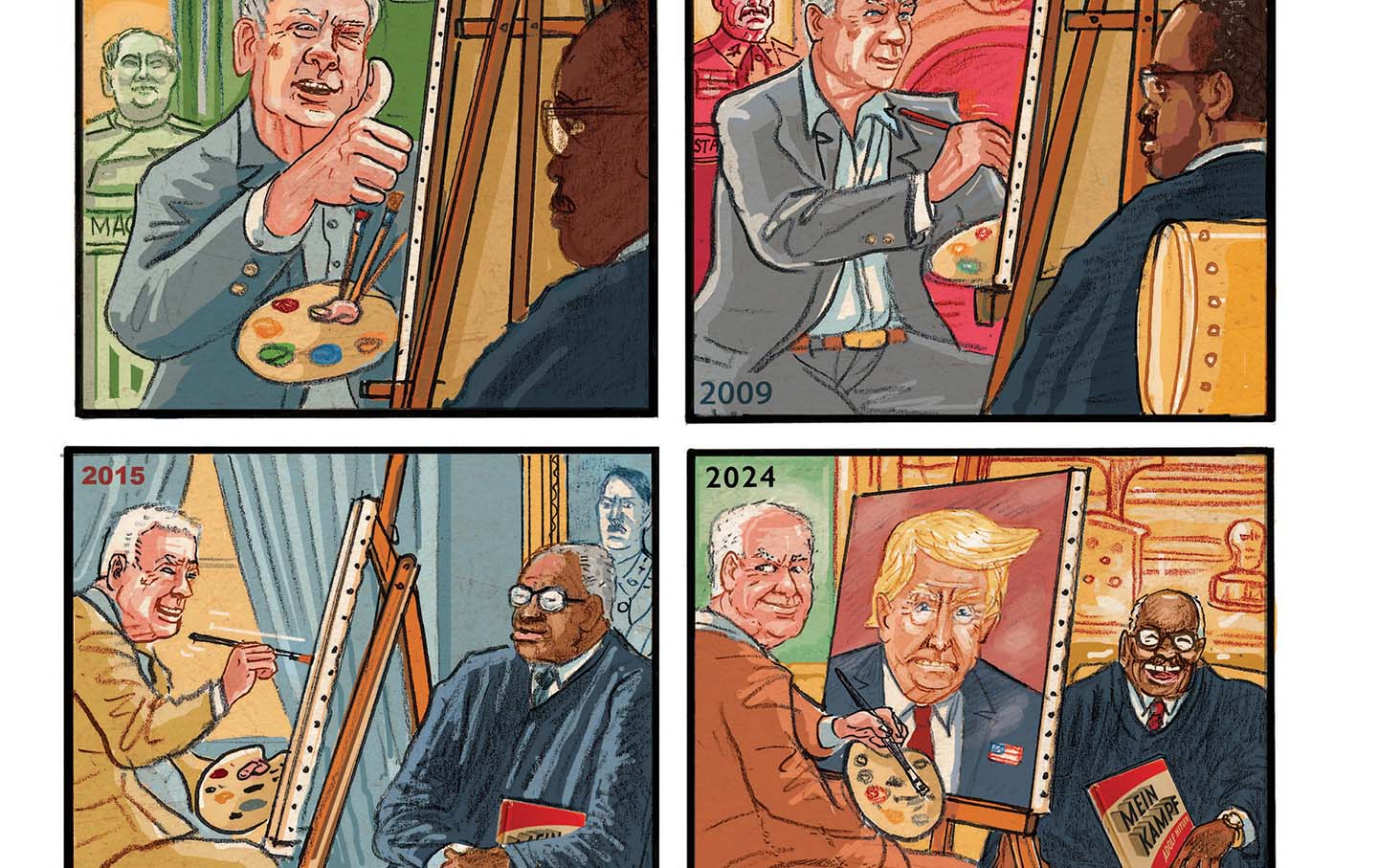
Harlan Crow’s Portrait of SCOTUS Under Trump Harlan Crow’s Portrait of SCOTUS Under Trump
Clarence Thomas, the picture of corruption.

How Elizabeth Warren’s Stop Wall Street Looting Act Would Rein In the Private-Equity Vampire How Elizabeth Warren’s Stop Wall Street Looting Act Would Rein In the Private-Equity Vampire
Let’s build an economy where patients, renters, and even youth hockey teams are given priority over investor profits.
Democrats Have a Bill Maher Problem Democrats Have a Bill Maher Problem
Establishment Democrats obsessing over Hasan Piker’s every move seem to have no issue talking to Maher, despite his decades of open bigotry.

Houthi Attacks on Saudi Arabian Oil Houthi Attacks on Saudi Arabian Oil
Houthi attacks on Saudi oil infrastructure heighten regional tensions and push up oil prices.

