
Mr. Trump: It’s Time to Listen to What Palestinians Want
The president keeps floating his colonial takeover plan. But people in Gaza just want to go home. How do we know? Because we asked them.
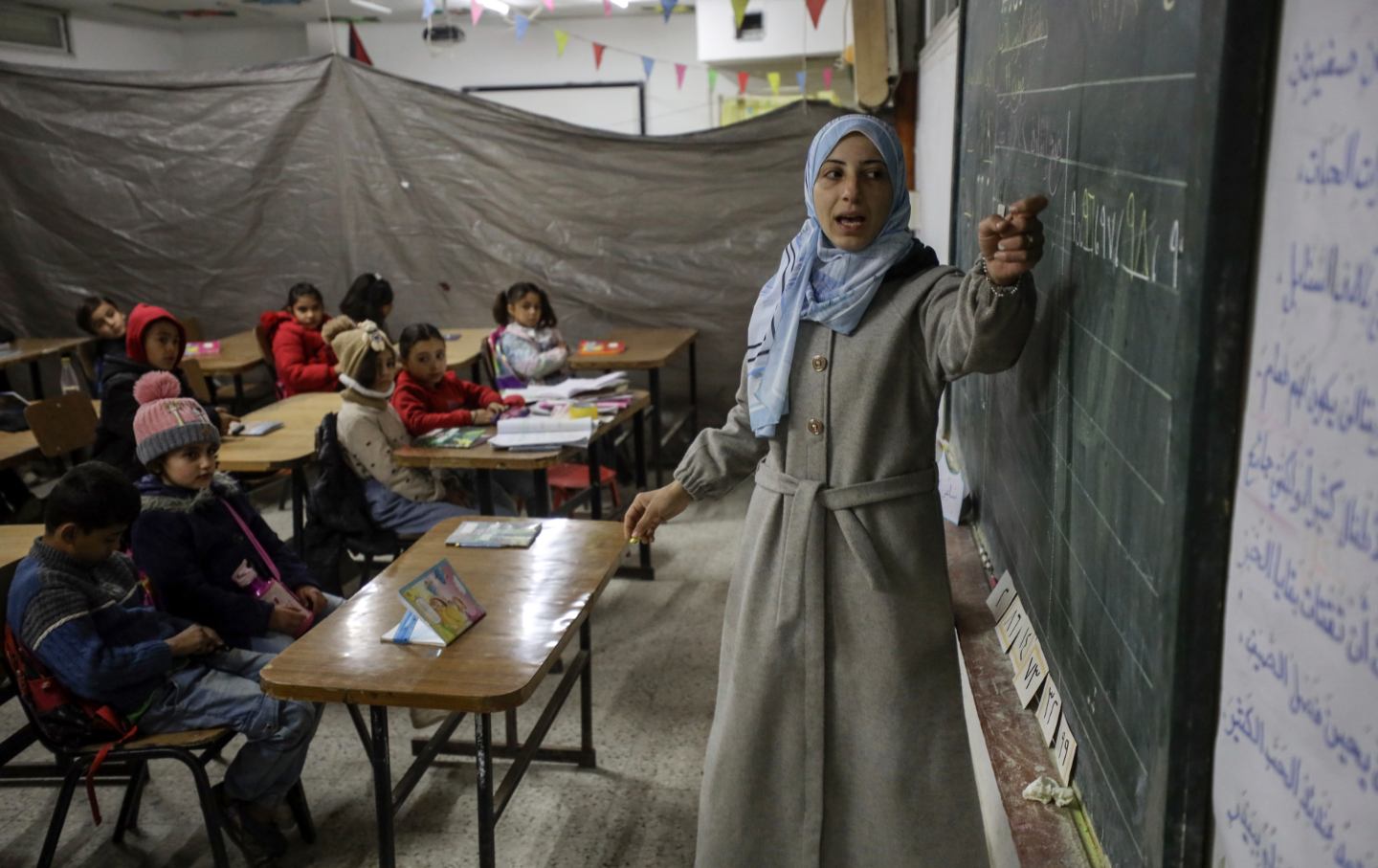
Palestinian children attend a lesson in a classroom at a damaged school in Gaza City, on February 26, 2025.
(Majdi Fathi / NurPhoto via AP)President Donald Trump set off a firestorm with his proposal to transform the postwar Gaza Strip into an American-controlled “Riviera,” cleared of its Palestinian population. Israel’s Prime Minister Benjamin Netanyahu praised the plan as “thinking outside the box.”
In fact, it is anything but.
Trump’s idea is reminiscent of the century-old colonial mindset shared by the British and the Political Zionist movement; both groups saw Palestine through the lens of their ambitions and viewed the indigenous Arabs of Palestine as mere pawns to be moved about without consideration for their needs or aspirations.
Proponents of Political Zionism routinely spoke of their desire to see Palestine cleared of its Arab inhabitants to make way for the Zionist project. They saw their enterprise as being a “rampart of Europe against Asia.… An outpost of civilization against barbarism.” The British agreed, seeking to divide up the Arab East, keeping control of Palestine through the establishment of a Jewish homeland that would help secure their foothold in the Eastern Mediterranean.
Supporting the belief that people should have the right to self-determination, the United States sent a commission of prominent Americans to survey Arab public opinion to discover what they did and did not want for their future. The commission concluded that the overwhelming majority of Arabs rejected: division or partition of their region, European mandates over them, and the establishment of a Zionist state in Palestine. What they hoped for was an independent, unitary Arab state.
The US commission report also warned of conflict if the planned partition moved forward. The British Lord Balfour rejected the very idea of a survey, saying,
In Palestine, we do not propose even to go through the form of consulting the wishes of the present inhabitants.… Zionism…[is] of far profounder import than the desires and prejudices of the 700,000 Arabs who now inhabit that ancient land.
In the end, Lord Balfour got his way, and the dire prediction of the US commission has been borne out. The Arab East was partitioned, and a British Mandate was imposed on Palestine, which the British used to foster Jewish immigration, leading to the establishment of Israel. Since then, Palestinians have been dispossessed, displaced, and subjected to unceasing violence. Because they have resisted, the last century has been one continuous conflict, culminating in the genocide in Gaza and crushing repression of the West Bank.
When the UN partitioned Palestine in 1948, the population of the area that was to form the Jewish State was nearly evenly divided between Arabs and Jews. In the war that followed, Jewish forces seized more land, from which they expelled over 700,000 Palestinians and then demolished over 400 of their villages to ensure that they could not return. Israel’s new leader, David Ben Gurion, celebrated this as a “double miracle…more land and less Arabs.”
For the last three-quarters of a century, the conflict, born of a failure to recognize Palestinian rights and their attachment to their homes and the land of Palestine, has continued to roil the region, taking its toll on Israelis and Palestinians alike.
In this context, it’s important to understand that 80 percent of Gaza’s residents are the descendants of the refugees from that 1948 war. To them, Mr. Trump’s proposal isn’t “out of the box.” It’s the same old disrespect for their rights, planting new seeds that will bear bitter fruit in the years to come.
Because what Palestinians want matters, especially after the nightmare they’ve endured, in the second half of last year, my polling firm, Zogby Research Services, conducted two separate polls of Palestinian opinion across the West Bank and Gaza. Our findings were quite revealing.
The scale of the devastation came through quite clearly, with 54 percent of Gazans reporting family members killed or missing, and 55 percent reporting that, since the war began, they had been forced to move at least five times seeking safety for their families.
Our polling leaves little doubt about the short-term desires of Palestinians in Gaza. After a grinding war of more than a year, they simply want to exhale, return to their homes, and begin the long, grueling process of reconstruction. On a basic humanitarian and moral level, that ought to count for something.
As they look to the future, what they want most of all is that the knee of the Israeli occupation be lifted off their backs so that they can finally have freedom and independence in a land of their own. When presented with a number of possibilities as to whom should govern Gaza at war’s end, the least favored options are an international or an Arab-Islamic coalition. Despite losing faith, in varying degrees, with both Hamas and the Palestinian Authority (the PA is seen more positively than Hamas among Palestinians in Gaza, while Hamas outscores the PA in the West Bank), the preferred options for postwar governance in Gaza are those that envision a unification of the Palestinian ranks (66 percent of respondents said this would be “very desirable.”) There is also 61 percent support in Gaza for holding a popular referendum to elect a new generation of leadership that can advance a new vision for Palestine. And instead of violence, their preferred options for resistance are nonviolent actions, including holding Israel accountable for its crimes in international bodies.
But most importantly, 92 percent of Palestinians in Gaza told us that they want to remain in Gaza and go back to where their homes had been. They are Palestinians and want to stay on the land of Palestine. The last thing they want—after 18 months of constant displacement and uncertainty—is to be shunted off into exile, presumably by force, and abandoned to a murky fate in a largely unknown country.
Popular
“swipe left below to view more authors”Swipe →This stands in marked contrast to the views advanced by the Americans and Israelis. Of course, these Palestinian views must be developed further, but heeding them is the better path to take precisely because it recognizes that instead of continuing to impose “solutions” on Palestinians, the place to begin is to ask them what they want, listen to what they say, and then work with them to make their aspirations a reality.
Palestinians should be permitted to decide their own futures. Part of the reason that we have arrived at such a bloody crossroads is because over the decades, the great powers have disposed of the Palestinians however they wished, without consideration for their views.
The message to President Trump should be clear: Palestinians will not accept being forced to leave the land of Palestine, and any attempt to conduct a mass displacement would likely descend into yet another horrific spiral of violence and death. If President Trump wants to be remembered for a really “out of the box” idea, he should listen to those whose lives hang on his decisions—the war-battered 2 million Palestinians of Gaza.
Become a Sustaining Donor This September
Between the reemergence of right-wing red-baiting and Donald Trump’s use of the chilling National Security Presidential Memorandum–7 to criminalize left political organizing, we’re seeing McCarthyism reborn before our eyes.
This assault on democracy cannot be ignored or wished away. Resisting it requires bravery in the face of threats and repression, a steadfast commitment to the truth, and the unwavering belief that we can—and will—overcome this darkness.
We must have an independent media that sets the record straight, unearths corruption and abuses of power, and advances a politics of justice and dignity for all if we’re to win this fight.
That’s why I’m writing to you today. This September, The Nation needs to add 100 monthly donors to sustain our progressive journalism. Your contribution makes the next investigative report, the next truth-speaking column, and the next pathbreaking essay all possible.
I hope you’ll support our work with a recurring donation today. If you donate $10 or more a month, we’ll send you a brand new “Hands Off the Free Press!” sticker to recognise your commitment to our cause. Please, donate today.
Onward,
Katrina vanden Heuvel
Editor and Publisher, The Nation
More from The Nation
Israel’s Election Can’t Fix What Netanyahu Broke Israel’s Election Can’t Fix What Netanyahu Broke
The fundamental problem is not the name of the prime minister, but rather the actions of the Israeli government and the urgent issues that need to be addressed.

The AfD’s Rise Isn’t Just About East Germany The AfD’s Rise Isn’t Just About East Germany
The Alternative für Deutschland has a stable national poll lead, including in the former West Germany. Its rise owes to much more than Eastern grievances.
Chinese Development Is the Betrayal Washington Cannot Forgive Chinese Development Is the Betrayal Washington Cannot Forgive
The prospects for Xi Jinping’s visit are dim because American leaders are blaming China for the failures of globalization.

Pinochet: The Verdict of History in the Letelier-Moffitt Case Pinochet: The Verdict of History in the Letelier-Moffitt Case
An act of international terrorism on the streets of Washington, DC, still reverberates 50 years later.
How to Arrest Benjamin Netanyahu How to Arrest Benjamin Netanyahu
Make no mistake: The United States can seize Netanyahu for crimes under US law and prosecute him in US courts when he is in New York City this week.

In the Age of AI, Nuclear Weapons Abolition Is a Renewed Imperative In the Age of AI, Nuclear Weapons Abolition Is a Renewed Imperative
As long as we have nuclear weapons, the job of ending humanity will continue to be as easy as the push of a button—or an AI agent hacking into a nuclear command-and-control system...

