
The Berlin International Film Festival in a Time of Crisis
During the Berlinale’s 75th anniversary, it felt like the world was coming apart—but at least we had the “borderless realm” of film.
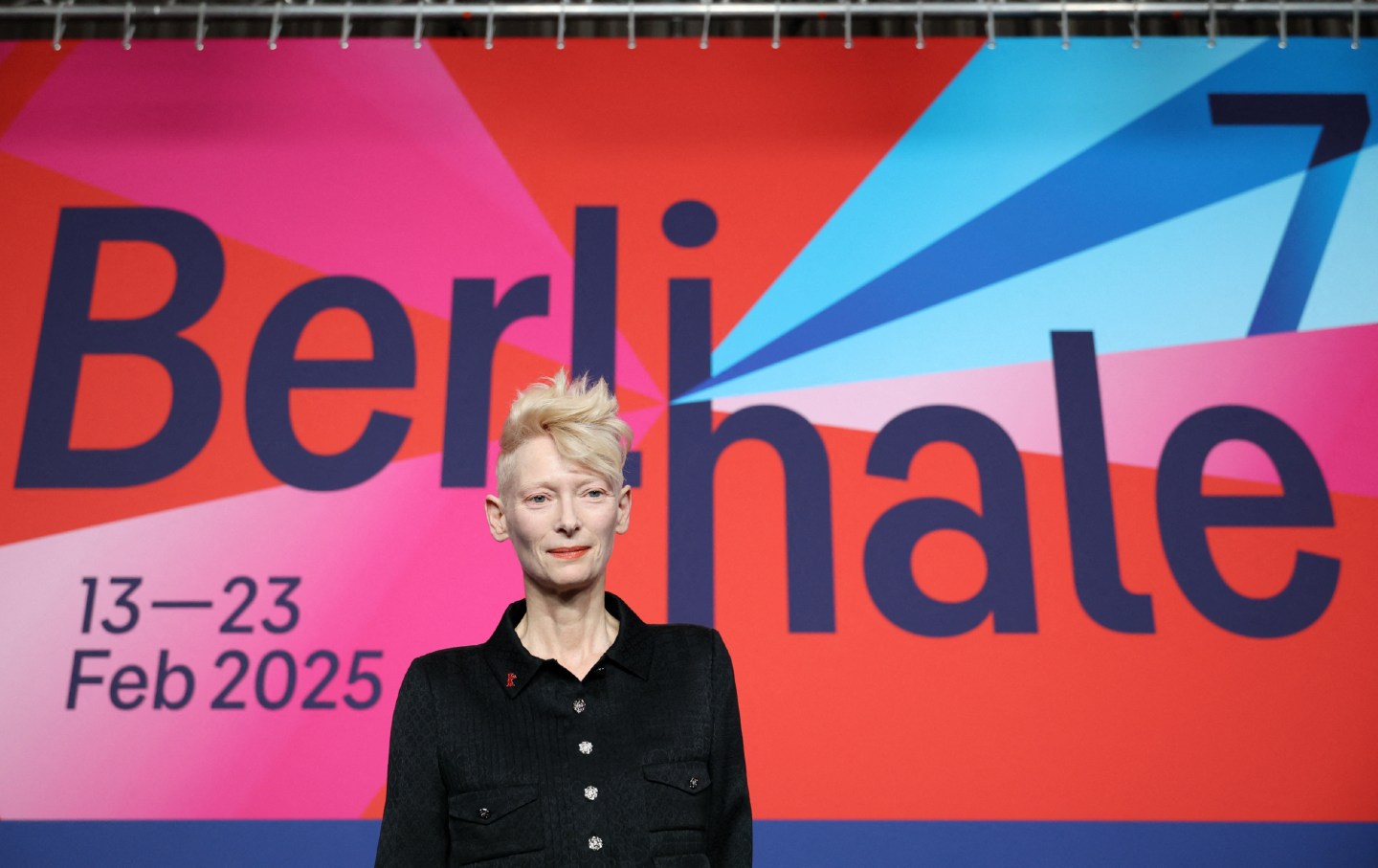
Tilda Swinton poses after attending a press conference for the Honorary Golden Bear award at the 75th Berlinale on February 14, 2025.
(Ronny Hartmann / AFP via Getty Images)
Berlin—“How do you feel about everything that’s going on in your country, and how do you think that this new presidency is going to affect the filmmaking landscape in your country?” a reporter asked Todd Haynes, jury president at the Berlin International Film Festival, at the first press conference as the 75th Berlinale began.
Snow fell over the sleek glass and steel buildings surrounding Potsdamerplatz, an area that was a no man’s land through the Cold War and became a central point in the city again after the wall came down. It was February 13, and outside the screening rooms and theaters, the world was shifting. There was a sense that, when the festival ended 10 days later, we might find ourselves dealing with a different reality than when the festival began.
In Germany, the far right was polling higher than it ever had postwar. Snap elections would be taking place on February 23, the last day of the festival. In the United States, the defunding and destruction of cultural and civic structures was taking place with alarming speed. US President Donald Trump had just had a phone call with Russia’s Vladimir Putin that signaled a shared plan to force Ukraine’s surrender and divide the spoils. News about all these things appeared on the phones we kept checking.
“We are in a state of particular crisis right now in the United States,” acknowledged Haynes. And “how we proceed toward coalescing different forms of resistance is still in the works.”
The Berlinale is a film festival born in the aftermath of conflict. It exists because in 1951, when Germany was still in ruins, a US State Department official decided it was canny to bring films from around the world to a Cold War outpost. Since then, some of the conflicts over what is shown and said there have reverberated widely.
“People often ask me, the press often ask me, if we’re a political festival, and we cannot—and we do not—shy away from this. It’s arguably in the DNA of the city itself and also in the festival itself,” Tricia Tuttle, the Berlinale’s director said.
In 1970, Michael Verhoeven’s feature o.k., which depicted US war crimes in Vietnam, was deemed anti-American by the judges and removed from competition. When other directors withdrew their films in solidarity, the rest of the festival was called off. In 2024, some of the directors, including Mati Diop and Ben Russell, expressed their solidarity with Palestine when they accepted their prizes. Two members of the Israeli Palestinian team that made No Other Land, given a best documentary prize, spoke about Israel’s invasion of Gaza. Basel Adra asked Germany to stop selling arms to Israel while Yuval Abraham explained that he and Adra did not have the same rights due to “a situation of apartheid.” Several politicians, including Berlin’s mayor, responded by accusing the festival of allowing antisemitism.
As Tuttle began her first year heading the festival (after those events), she had to reassure filmmakers they would not be prevented from expressing support for Palestine at the Berlinale, and she defended Adra and Abraham from accusations of antisemitism. “Listen Courageously—Cinematic Narratives in Times of Dissonance” was the theme for the festival’s series of workshops and talks. And the conversations did seem to be taking place constantly, everywhere.
In the toilet stalls in one of the venues, an audience member had put up small paper notes stating that Friedrich Merz, the presumptive next chancellor, must never make common cause with the far-right Alternative für Deutschland as he had in January: “Never again!” After the debut of the Romanian political satire, Kontinental ’25, which won the Silver Bear for best screenplay, the film’s director Radu Jude wrote “FUCK PUTIN + TRUMP” across the bottom of his official portrait.
“We can head for the great independent state of cinema and rest there in an unlimited realm, innately inclusive, immune to efforts of occupation, colonization, takeover, ownership, or the development of Riviera property,” Tilda Swinton said, in her acceptance speech for an Honorary Golden Bear. “A borderless realm and with no policy of exclusion, persecution, or deportation. No known address. No visa required. It’s so very, very good for us…to notice our myriad variations, and to unite in celebrating them, rather than resign ourselves to a submission to entitled domination and the astonishing savagery of spite.”
Her message was punctuated by frequent applause and brought members of the audience to tears. The next day, a reporter from Israel’s Haaretz congratulated her on the prize “and also for your very clear voice against the war in Gaza. So thank you for that.”
“All the wars,” said Swinton. “Everywhere,” she added. Then: “The wars concern all of us.”
What, the reporter asked, was Swinton’s position on BDS? This wasn’t a random question: The Palestinian Campaign for the Academic and Cultural Boycott of Israel (PACBI) had called for a boycott of Berlinale 2025, because, it said, the festival was “complicit in the German government’s partnership in Israel’s genocide in Gaza.” When participants of the Berlinale 2024 expressed their solidarity with Palestinians, it stated, “instead of doing the bare minimum of defending its participating filmmakers’ freedom of expression,” the festival’s leadership that year “shamefully sided with the German government, taking German censorship to the next level.”
Swinton responded to the reporter by saying, “I’m a great admirer of and have a great deal of respect for BDS.” But she explained that she decided to come to the festival and use her platform because doing so “was potentially more useful to all our causes than me not turning up.”
The Berlinale is the most accessible of the major film festivals, in the middle of a city, with tickets available to the public for most screenings. Though Hollywood stars appear on the red carpet, it’s the documentaries and independent films that draw many people to it—films you would struggle to access anywhere else.
Popular
“swipe left below to view more authors”Swipe →This year, there was Yalla Parkour, a documentary that conveys the brutality and limitations of life in Gaza before October 7 as well as the loss and sense of displacement experienced by exiles through a narrative that revolves around the risks and freedoms of parkour. There was Das Deutsche Volk, which investigates the racist murders of nine young people in Hanau from the perspective of their bereaved relatives. It was screened on the fifth anniversary of the murders. In The Moelln Letters, the survivors of a 1992 neo-Nazi arson attack lived with the aftermath of the attack for more than 30 years before discovering that hundreds of people in Germany had expressed their solidarity to them in letters that the local government had kept and stored in an archive. The Lie, a 1986 documentary on Roma and Sinti holocaust victims’ long struggle for recognition, premiered in a digitally restored version. Under the Flags, the Sun depicted the 35-year dictatorship of Alfredo Stroessner in Paraguay through riveting archival footage. It was impossible to watch it without thinking of the United States as well, of the imperial boomerang bringing home the kind of brutality once meted through colonial structures.
At the start of the festival, Tuttle had told the press that she wanted to offer “that sense of community that you build. And it’s not a bubble. Hopefully we’re not locking out the outside world. We’re inviting people to come into this space and share a cinema with us.… And if we stop talking to each other—that’s when things are really scary.”
Late on Sunday night, we walked back out on the dark streets after the last screenings. The weather was warmer than 10 days before and the German election results had arrived. They were not ideal, but also did not realize our worst fears—the far right did not receive more support than was expected. We anticipated more bad news from America. But at the Berlinale we’d been sustained.
More from The Nation
The Architectural Follies of Trump’s Washington, DC The Architectural Follies of Trump’s Washington, DC
The president plans to remake the capital in his own image, but is all he is doing destroying what’s already there?
The Genius of Charli XCX The Genius of Charli XCX
On her new album, Music, Fashion, Film, the musician embraces rock.
The Carnival of Venice Biennale The Carnival of Venice Biennale
That so much of the art of “In Minor Keys” is muted in effect is ironic, because so much of it is overproduced, aspirationally eye-catching, and so big.

