Why Hasn’t Trump Already Closed the Department of Education?
Maybe because its support for students is popular with Republicans as well as Democrats. And because cutting that funding would blow a big hole in the budgets of red states.
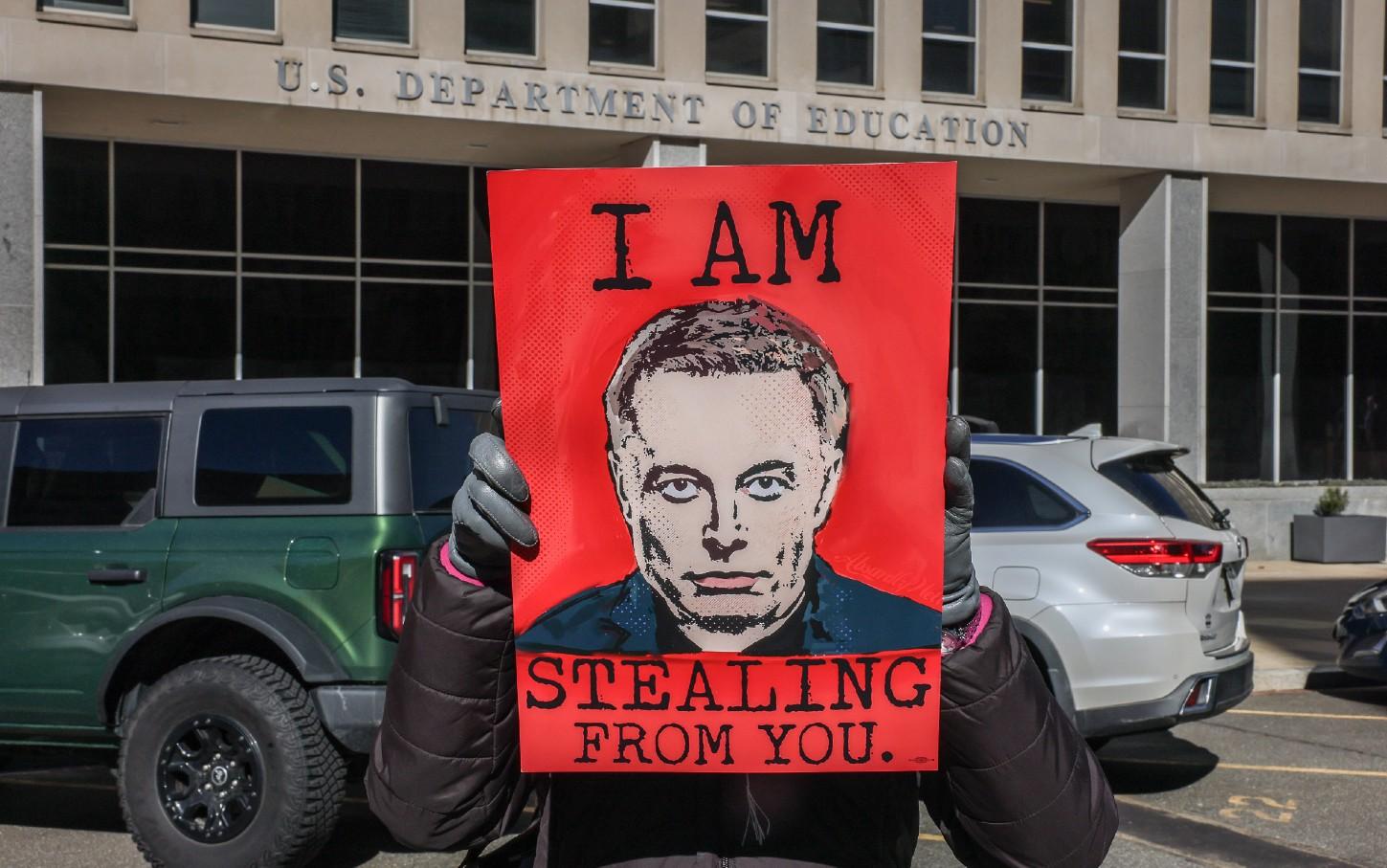
At her confirmation hearing last week, Linda McMahon, Donald Trump’s nominee for secretary of education, walked a thin line. On the one hand, she needed to assure Congress and the American people that she was fit for a cabinet-level position. On the other, she needed to satisfy her would-be boss, who has said quite candidly that he wants McMahon “to put herself out of a job.” We shouldn’t be surprised, then, that McMahon rejected the notion that she would “defund” education, suggesting instead that she would root out “waste, fraud, and abuse.”
That’s a falsehood. But it’s a lie McMahon has to tell because the truth isn’t as popular as the president would like.
Today, the Department of Education is the site of our strongest national commitments to equal opportunity for school-age children. This wasn’t always the case. For much of its early history, the US Office of Education, as it was then known, was chiefly tasked with collecting statistics. But as the nation gradually extended the reach of established rights and the range of its assurances to the young, it accumulated a substantial portfolio of education-related protections and provisions. Just in the two decades prior to the elevation of education to a cabinet-level agency, Congress passed the Elementary and Secondary Education Act of 1965, the Higher Education Act of 1965, the Education Amendments of 1972, and the 1975 Education for All Handicapped Children Act (subsequently replaced by the Individuals with Disabilities Education Act in 1990). These kinds of investments, along with school-based enforcement of laws like the 1964 Civil Rights Act, meant that the federal government was playing an increasingly active role in leveling the playing field for young people.
The Department of Education isn’t without its flaws. As Republican critics have claimed over the past several decades, the agency has been the site of federal overreach. Perhaps the most brazen enthusiast of such transgressions was Arne Duncan, Barack Obama’s secretary of education, who used his post to drive through a host of unpopular reforms during his tenure. Such efforts were ill-advised—not merely because they pushed beyond the historical limits of the federal role in a system long characterized by high levels of local control. They also created fodder for conspiracy-minded thinking about the nationalization of education. Though it may seem like ancient history now, the right-wing Tea Party faction used the Common Core State Standards to revitalize its movement after Obama was reelected. Backed by funds from both the Department of Education and the Gates Foundation, “Obamacore” was portrayed as a “nefarious federal plot to wrest control of education from local school systems and parents.”
Yet the Department of Education was hardly a partisan project of the Democratic Party. As is often mentioned, Jimmy Carter signed the 1980 legislation that peeled the Office of Education away from the Department of Health, Education, and Welfare. But the stand-alone Department of Education was established by a congressional act with more than 100 cosponsors in the House and Senate, 26 of whom were Republicans. As members of the 96th Congress described it, the new agency would solidify “the Federal commitment to ensuring access to equal educational opportunity for every individual.”
That commitment is what’s under assault right now. And it’s exactly why Trump sees the agency as a “big con job.” Look past the rhetoric and the surface-level activity of the Department of Education and focus, instead, on its budget. Roughly $15 billion each year goes to schools serving low-income students, mostly urban and rural communities. Another $15 billion or so goes to support students with disabilities. And more than $50 billion each year goes to Pell grants and subsidized loans to defray the cost of college. The con job in question is what we once called the welfare state, before that phrase was slandered into obscurity. It’s what allows tens of millions of kids to live and learn in dignity.
Donald Trump legally can’t close the Department of Education. But as recent events indicate, the limits of executive authority are going to be tested early and often in this administration. Even if Trump doesn’t force an unconstitutional cessation of agency operations, he will almost certainly kneecap it by firing staff and slashing its budget. Elon Musk’s so-called Department of Government Efficiency has already cut roughly $1 billion in education grants and contracts. And Trump has suggested that he’ll transform any remaining federal spending on education into block grants—funds that can be spent on virtually anything, including projects that would undermine the strength and stability of public schools. His January 29 executive order, “Expanding Educational Freedom and Opportunities for Families,” directs states to use Department of Education block grant funding for private school vouchers and other forms of school choice.
The law, alone, isn’t going to restrain Donald Trump. Nor are the facts. But Trump fancies himself a populist, and the myriad contradictions in his views can often be explained by his tendency to seek approval from his supporters. Inasmuch as that is the case, saving the Department of Education, if it can be done at all, will require convincing ordinary Republicans that they have something to lose. And they most certainly do. Look, for instance, at Florida’s Sarasota County, where nearly 60 percent of ballots were cast for Trump last November. In that same election, 84 percent of voters opted to raise their own property taxes to support local schools. And according to the grassroots group Support Our Schools, Sarasota stands to lose big if the Department of Education gets the axe: $12.3 million for special education, $11.4 million for schools serving low-income students, and more than $4 million in other federal funds.
Even in the midst of a raging culture war, Americans are still pragmatic people who maintain practical interests in their communities and the institutions that anchor them. So when the Trump administration lets loose a wrecking ball on the schools, it will likely produce more confusion than applause among his supporters. At that point, however, it may also be too late. The trick, then, is to sound an alarm now that can be heard across the partisan divide.
Become a Sustaining Donor This September
Between the reemergence of right-wing red-baiting and Donald Trump’s use of the chilling National Security Presidential Memorandum–7 to criminalize left political organizing, we’re seeing McCarthyism reborn before our eyes.
This assault on democracy cannot be ignored or wished away. Resisting it requires bravery in the face of threats and repression, a steadfast commitment to the truth, and the unwavering belief that we can—and will—overcome this darkness.
We must have an independent media that sets the record straight, unearths corruption and abuses of power, and advances a politics of justice and dignity for all if we’re to win this fight.
That’s why I’m writing to you today. This September, The Nation needs to add 100 monthly donors to sustain our progressive journalism. Your contribution makes the next investigative report, the next truth-speaking column, and the next pathbreaking essay all possible.
I hope you’ll support our work with a recurring donation today. If you donate $10 or more a month, we’ll send you a brand new “Hands Off the Free Press!” sticker to recognise your commitment to our cause. Please, donate today.
Onward,
Katrina vanden Heuvel
Editor and Publisher, The Nation