
Trump’s Phony Trade Wars Are Evidence of American Imperial Decline
President’s bullying of allies yields symbolic results—but betrays substantive weakness.
Donald Trump loves talking tough on trade. He’s full of swagger as he threatens to wield the power of tariffs against friend and foe alike to reclaim the American primacy that he feels other politicians are too weak to assert. In 2018, Trump tweeted, “When a country (USA) is losing many billions of dollars on trade with virtually every country it does business with, trade wars are good, and easy to win. Example, when we are down $100 billion with a certain country and they get cute, don’t trade anymore—we win big. It’s easy!” Toward the end of last year, a senior Trump official told a Financial Times reporter, “Our strategy on tariffs will be to shoot first and ask questions later.”
You don’t need to be a psychologist to know that this type of hyper-macho swagger is often compensatory, masking deep insecurities about weakness. There’s no reason to think words will match deeds, especially with a figure like Trump whose characteristic mode of aggressive hyperbole is invariably dishonest. Trump’s lies are integral to his politics and public persona, rooted in his background not just as a real estate huckster but also as an entertainer. Aside from his career as a reality-show star, Trump learned the art of public showmanship through many years as a fixture on the World Wrestling Entertainment circuit, where he was friends with the disgraced impresario Vince McMahon (whose wife, Linda McMahon, is Trump’s nominee to be Department of Education secretary).
Trump is to real politics as professional wrestling is to genuine sports: a parody that has popular appeal because it offers the pleasures of over-the-top narratives. Professional wrestlers often engage, like the heroes of Homeric epics, in prolonged, rhetoric-filled feuds. They insult each other, give each other nicknames, fight battles, and then, as the plot twist might require, suddenly shift from bitter enemies to best buddies. Professional wrestling has given us the useful word “kayfabe,” which Merriam-Webster defines as the “tacit agreement between professional wrestlers and their fans to pretend that overtly staged wrestling events, stories, characters, etc., are genuine.”
So far in his second term, Trump’s trade wars have been pure kayfabe. They’ve been noisy, attention-getting, and full of surprise narrative turns, but they are only slightly more connected to reality than the feud between Hulk Hogan and Andre the Giant.
The major mark of Trump’s second-term trade wars to date has been that he has mostly gone after countries considered close allies (Canada, Mexico, Denmark, Panama, Colombia), with a milder focus on America’s supposed geopolitical rival China (notably slapped with 10 percent tariffs as against the 25 percent threatened against Canada and Mexico). Moreover, the overall thrust of Trump’s trade war has been in the Western Hemisphere, with grandiose proclamations of a new “manifest destiny” (proposals to annex Canada as the 51st state and take over imperial control of Greenland from Denmark). Finally, in each of these hemispheric trade wars, Trump was quick to claim victory after a purely symbolic triumph where his supposed antagonist merely made face-saving concessions designed to give Trump good headlines.
In other words, Trump is just fighting fake matches on a wrestling stage that allows him to beat his chest as well as enact the essential surprise turn where he shifts from friend to foe to friend again. This may be great kayfabe—but it has little to do with economic or geopolitical reality.
It’s worth spelling out in detail just how counterfeit the trade wars have been. Let’s take the countries one by one.
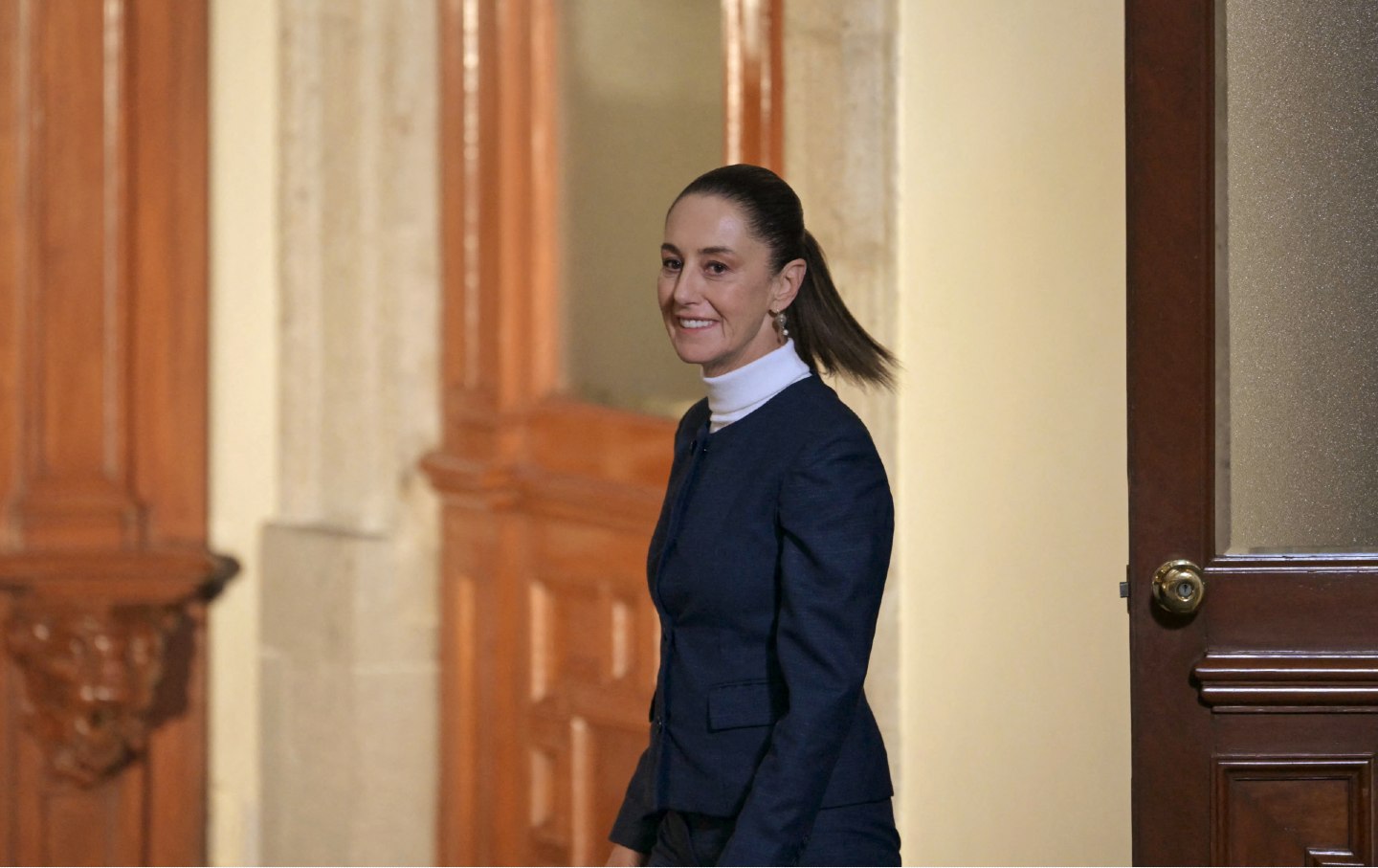
Mexico: Trump put a pause on threatened tariffs after an agreement with Mexican President Claudia Sheinbaum, who said she would send 10,000 troops to help secure the USA/Mexico border if the United States would work to stop the flow of weapons into Mexico. As Washington Post columnist Catherine Rampell notes, “Anyone reporting Mexico conceded anything to Trump to get him to delay tariffs has not done their homework. Trump boasts he got Sheinbaum to commit to stationing 10K troops at our border. Apparently he didn’t realize Mexico already has 15K troops deployed there.” Trump in truth got nothing, while Sheinbaum got a major concession.
Canada: Again, Trump put a pause on tariffs after an agreement with Justin Trudeau that promised $1.3 billion in border spending as well as “new commitments” such as the creation of a border czar. But again, Trudeau was agreeing to something that he had already previously announced (the border spending plan was first floated in December). As the right-wing magazine National Review observes, “The ‘new commitments’ are either pointless or not new.” With both Mexico and Canada, National Review complains, Trump is a “cheap date.” Another prominent Trump-friendly right-wing organ, the editorial page of The Wall Street Journal, came to the same conclusion, noting that it was Trump who blinked in his tariff war, and only won “minor concessions.”
The sheer unreality of the whole trade war can be seen in the fact that Trump and Vice President Vance have both made fentanyl smuggling from Canada a major talking point. According to Vance, “Canada has seen a massive increase in fentanyl trafficking across its border.” In point of fact, as Aaron Reichlin-Melnick of the American Immigration Council notes, “Total fentanyl seizures at the U.S.-Canada border since October 2021: 69 lbs. A grand total of TWO pounds of fentanyl were seized in the entirety of fiscal year 2023. Total. The idea that Canada is a major hub for fentanyl trafficking into the US is a fantasy.” At the Mexican border, most of the fentanyl being smuggled in comes from US citizens bringing it back home. In other words, this is a problem of demand, not supply. The make-believe threat of Canadian and Mexican fentanyl smuggling is nothing but uncut kayfabe.
Panama. Trump-friendly outlets such as The Washington Free Beacon touted what they saw as a major victory for the administration: Panama saying it won’t renew the Belt and Road Agreement with China. This happened after Trump threatened to take over the Panama Canal. But as French foreign policy analyst Arnaud Bertrand noted, this framing misunderstands the nature of the Belt and Road Initiative, which isn’t an formal alliance but merely deals to work on projects. Panama was merely declaring what was already policy since 2019, when Panamanian President Laurentino Cortizo suspended major Belt and Road Initiative projects. Bertrand observes:
The only major ongoing project is a $1.3 billion bridge over the canal being built by Chinese companies (and which Panama won’t cancel since it’s already well underway). As things stand, there are no new BRI projects planned in Panama. So this announcement that it is forgoing the BRI is probably a mutually-agreed talking point between Washington and Panama to make it look like U.S. pressure achieved something when in effect it basically changes nothing.
Colombia. Trump’s spat with Colombia’s President Gustavo Petro over the treatment of deportees has been falsely presented by Trump and a credulous American press as a victory for the American leader. But as a careful analysis in Current Affairs shows, this is yet another case where Trump accepted a face-saving compromise that amounts to a return to an older status quo. As Current Affairs notes:
Trump wanted the deportees taken on U.S. military planes, shackled. Colombia refused to receive deportees in this manner. Trump did not successfully force Colombia to accept his conditions. Instead, the U.S. government acceded to Petro’s demand that he be allowed to determine how the migrants came home.
Popular
“swipe left below to view more authors”Swipe →The pattern is clear. Trump has inverted Theodore Roosevelt’s adage to speak softly but carry a big stick. Tariffs indeed allow Trump to speak loudly—but they are a very small stick (in large part because they scare Wall Street, which creates an incentive for Trump to quickly wrap up trade wars). Time after time, Trump is using tariff threats to extract meager or nonexistent concessions, which allow him to proclaim himself a winner.
This kayfabe act is a way of exciting the MAGA fanbase, and it has also won plaudits from the increasingly servile mainstream media. But in real terms, Trump’s tariff wars are not, as he proclaims, proof that America is recovering from global decline. Rather, they are a symptom of an empire that is increasingly on the skids, withdrawing into the pleasures of fantasy to escape the reality of diminishing power.
Despite being exercises in spectacle, Trump’s trade wars will have real world consequences: They sow distrust in allies. Even in a country as integrated with the United States as Canada, anti-Americanism is on the rise, with the need to decouple from the United States economically and diplomatically increasingly taken up not just by the left but by centrist elites. Within the United States, the major effect of the trade wars is as a distraction. Trump’s boorish threats to annex the Panama Canal, Canada, and Greenland make for good headlines to hide real dangers, such as Elon Musk’s attack on the integrity of government payment systems. One of the crucial tasks of the Trump era is being able to distinguish the kayfabe from the coups.
On Tuesday at a press conference with Israeli Prime Minister Benjamin Netanyahu, Trump expressed the desire to take over Gaza after it had been cleared of Palestinians (who he promised could have a wonderful life if they agreed to their own ethnic cleansing). Trump fantasized that under those conditions Gaza could become, “the Riviera of the Middle East”
Like his plans to annex Canada and Greenland, the proposed conquest of Gaza is Trump in wish-fulfillment mode. Still a real estate developer at heart, he’d love to have new territory to play with. It’s not a serious reflection of policy, but a window into a doddering mind detached from reality. Unfortunately, that decayed mind belongs to the President of the United States.
More from
Jeet Heer 
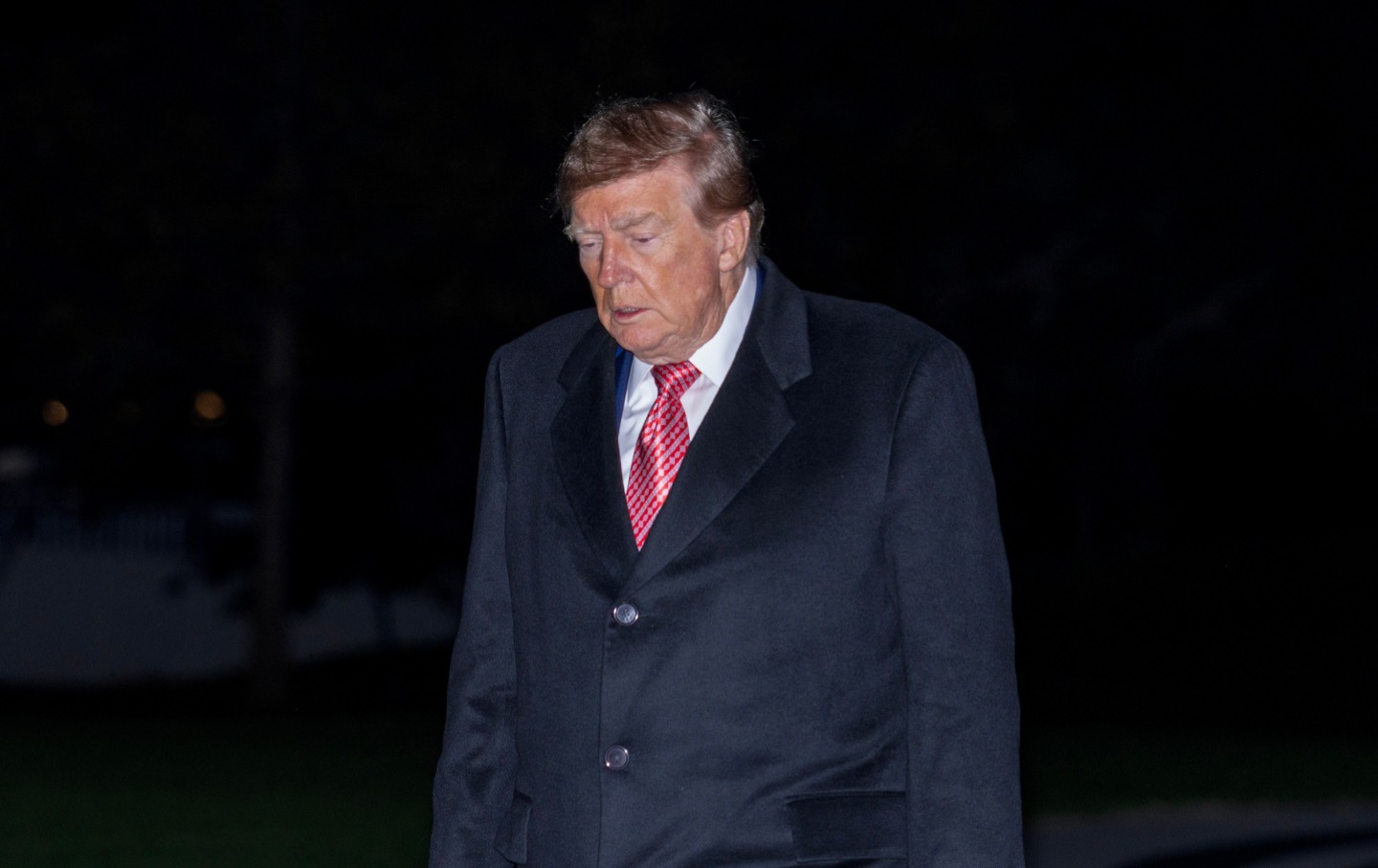
Even Republicans Are Waking Up to Trump’s Corruption Even Republicans Are Waking Up to Trump’s Corruption
And, somewhat shockingly, so are Democratic elites.
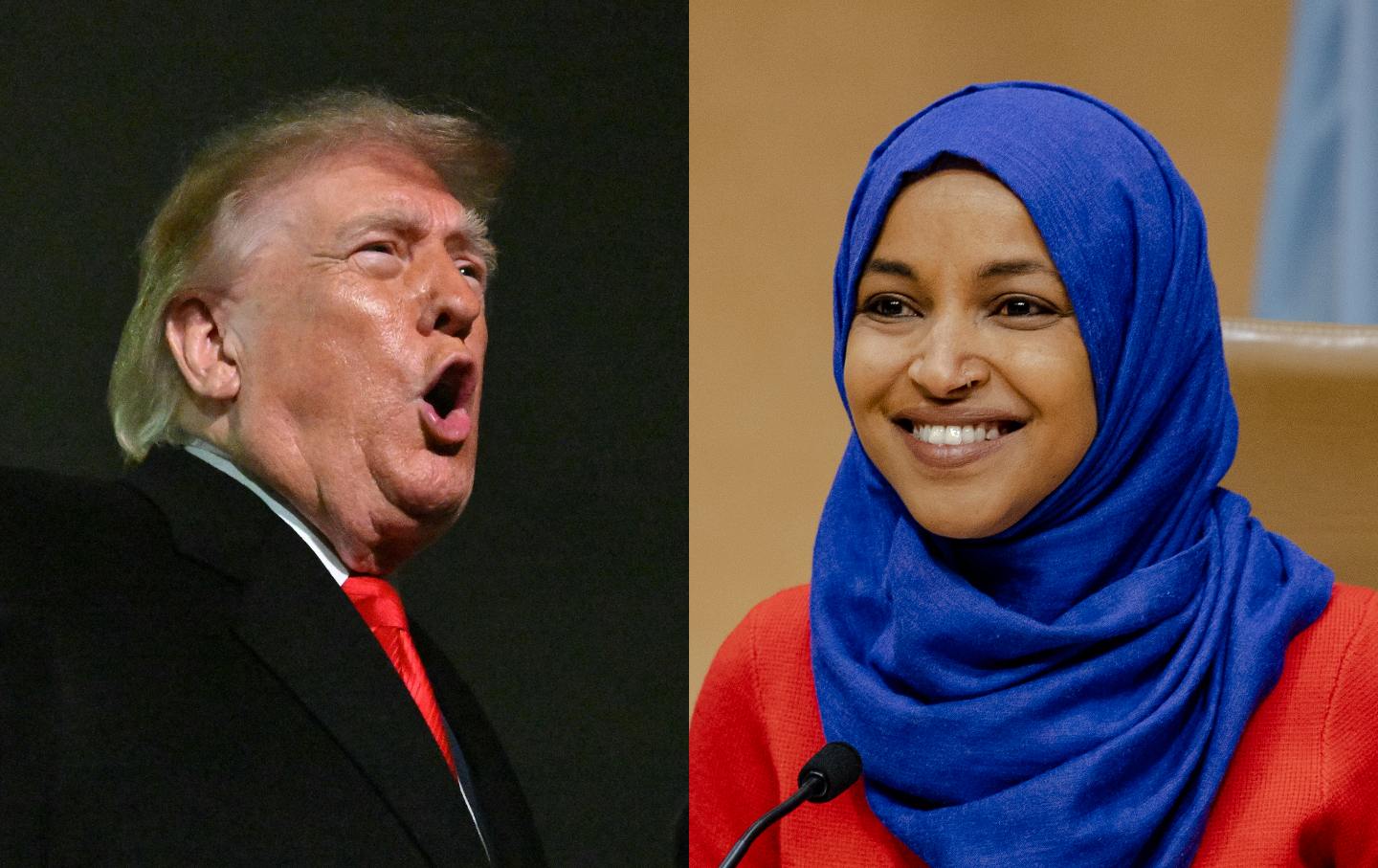
Where Is the Outrage Over Trump’s Racist Targeting of Ilhan Omar? Where Is the Outrage Over Trump’s Racist Targeting of Ilhan Omar?
The establishment press and some Democrats are strangely mute over the president’s flagrant abuse of the legal system.

The Real AI Threat Is Already Here The Real AI Threat Is Already Here
Never mind some future apocalypse—AI is being used right now to cause enormous suffering.
Elon Musk’s James Talarico Smear Blew Up In His Face Elon Musk’s James Talarico Smear Blew Up In His Face
But that doesn’t mean the danger from Musk’s lies is over.
Does America First Really Mean Israel First? Does America First Really Mean Israel First?
Mike Huckabee’s aide shows how an extremist agenda dominates Trump’s Middle East policy.

The Death Penalty Has Become a Torture Machine The Death Penalty Has Become a Torture Machine
Christa Pike's botched lethal injection proves there is no humane form of execution.

