The Nation’s Early Experiments in Jazz
The Nation’s Early Experiments in Jazz
When the magazine began covering jazz in the 1920s, it often struggled to catch the beat.
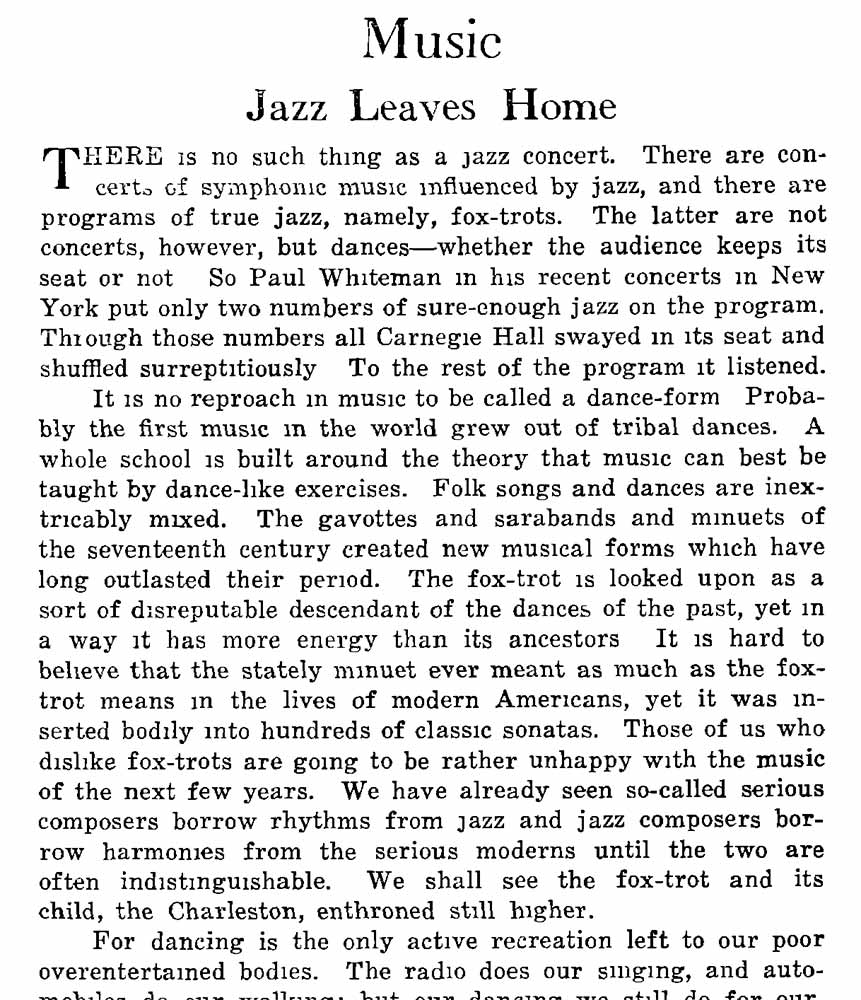
Ethan Iverson writes in this issue about a newly surfaced recording of pianist McCoy Tyner and saxophonist Joe Henderson playing at the downtown club Slugs’ in 1966. Reading his piece, I wondered how The Nation covered the advent of jazz a century ago.
Edited by the gentlemanly class traitor Oswald Garrison Villard, the magazine was turning ever more politically radical, yet it remained culturally somewhat conservative. Its early coverage of jazz reflected both tendencies, signaling an openness to the emerging form even as it offered a rather patronizing take on the music’s significance.
“There are times,” the critic Henrietta Straus reluctantly granted in early 1922, “when jazz may be regarded as a virtue.”
Straus was talking about a new concert by the classically trained white interpreter John Alden Carpenter, whom she praised for having turned the “noisy commentaries” of jazz into “philosophic reflections.” Within two years, she had adopted a more generous appraisal of the form—she described the white bandleader Paul Whiteman’s now-famous “An Experiment in Modern Music” concert, in which he premiered George Gershwin’s Rhapsody in Blue, as nothing less than “revolutionary.” Even so, for her, as for other Nation contributors, jazz—or, at least, the jazz they deemed worth discussion—was a white phenomenon, stripped of its African American roots. It would take another decade for the magazine to give equal attention to Black musicians.
Some Nation writers went out of their way to avoid discussing race in their critiques of the new music, even as loaded language seeped through nonetheless. “Industrialized folk-music” is how William J. Shultz described jazz in the October 25, 1922, issue of The Nation. “It is at once the old and the new.”
Traditional European folk music, Schultz explained, had reflected the bucolic concerns of “the great, silent, subject, agricultural population. Their music was a music of out-of-doors…a music of physical merrymaking, a music that looked away from weary body-labor, yet ever reflected its shadow through the wildest abandon.” Jazz, in contrast, was an expression of the modern age. It addressed the desires and concerns of the Massemensch (mass-man), “a creature of paved and lighted streets and grimed air.”
Shultz saw jazz as the culmination of a long cultural decline that began with the French Revolution and the dwindling of landed aristocracies that had long supplied funds for the creation of “intellectualized music.” The dilettantish nouveaux riches who took over as supporters of the arts “sought only for the less exacting sensuous appeal in music.” The result: “From Schubert through Schumann, Wagner, the Russian school, Richard Strauss, to Stravinski and Schoenberg, romantic music has been letting down the high standards of the classic era…trying to cover its retreat by criticizing the older music as dry and formal.” Modern composers had become mere “experimentor[s] in cacophony.”
Still, at least jazz wasn’t pretentious. “It does not play the hypocrite or deceive itself by talking glibly in the cant of art,” Shultz wrote. “Our contempt for jazz is snobbery…. The cognoscenti, like the poor, are always with us; theirs be the kingdoms of romantic and classic music. The jazzists will never dispute them their possessions.”
Become a Sustaining Donor This September
Between the reemergence of right-wing red-baiting and Donald Trump’s use of the chilling National Security Presidential Memorandum–7 to criminalize left political organizing, we’re seeing McCarthyism reborn before our eyes.
This assault on democracy cannot be ignored or wished away. Resisting it requires bravery in the face of threats and repression, a steadfast commitment to the truth, and the unwavering belief that we can—and will—overcome this darkness.
We must have an independent media that sets the record straight, unearths corruption and abuses of power, and advances a politics of justice and dignity for all if we’re to win this fight.
That’s why I’m writing to you today. This September, The Nation needs to add 100 monthly donors to sustain our progressive journalism. Your contribution makes the next investigative report, the next truth-speaking column, and the next pathbreaking essay all possible.
I hope you’ll support our work with a recurring donation today. If you donate $10 or more a month, we’ll send you a brand new “Hands Off the Free Press!” sticker to recognise your commitment to our cause. Please, donate today.
Onward,
Katrina vanden Heuvel
Editor and Publisher, The Nation