
How the War in Ukraine Has Been a Major Contributor to Global Inflation
And it has been a strategic boon to the far right at home and abroad.
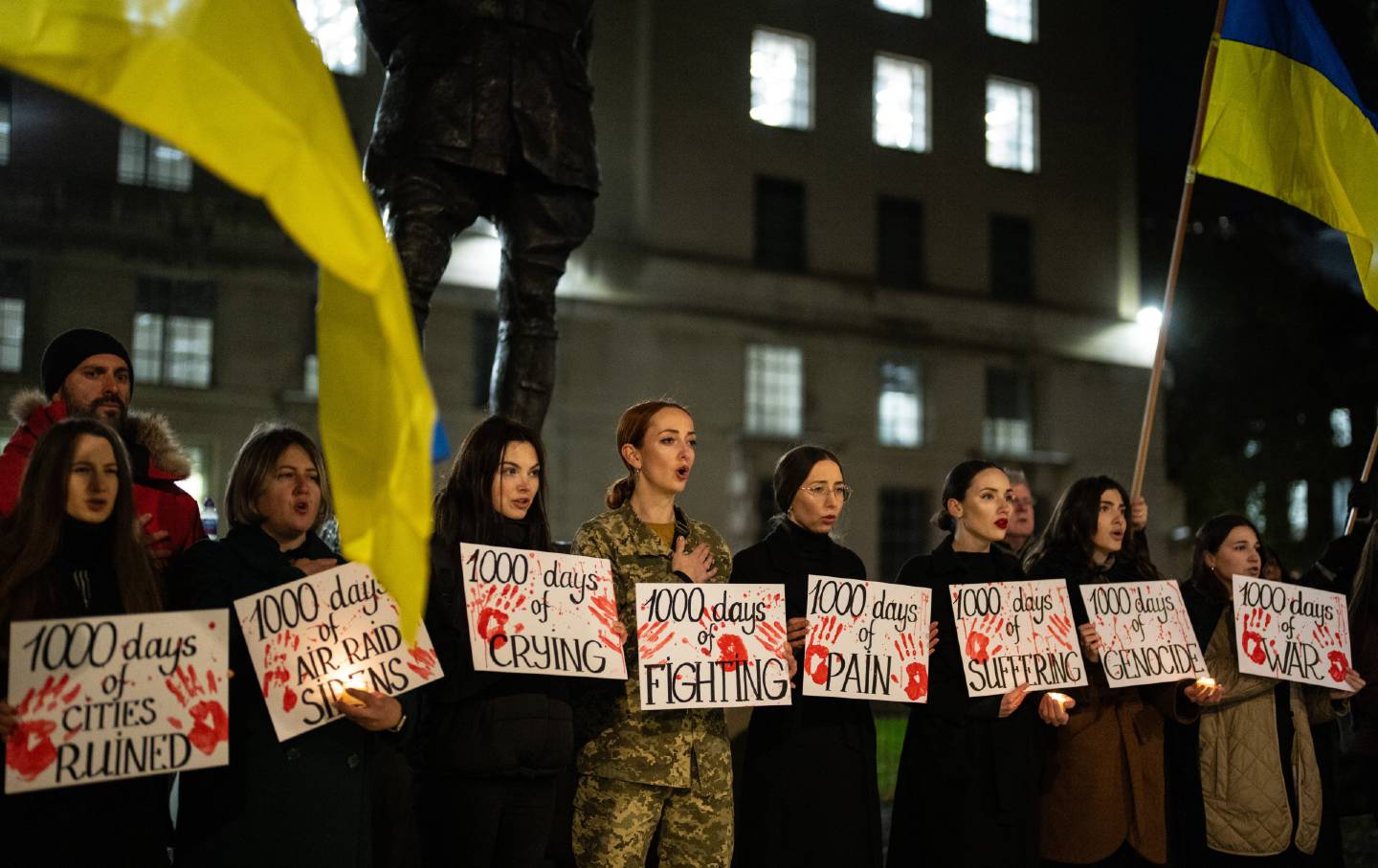
There is a growing realization that voters’ dissatisfaction with inflation resulted in Donald Trump’s election victory last month. But almost no attention has been placed on one of the major contributors to this inflation: the war in Ukraine, and the decision to repeatedly reject negotiating its end.
Of course, Ukrainians have suffered most from the prolonging of the war. Just as the largely Pentagon-funded RAND Institute had warned, the costs of a long war have been far worse for the country than the potential loss of territory in a peace deal: a staggering number of casualties, an amputee population on the scale of Europe in World War I, half of its energy infrastructure in ruins, and a shattered economy, massive debt and reconstruction costs three times that of the Marshall Plan that will make it prey for future neoliberal shock therapy. The war effort is being fueled by stringent conscription that sees poor Ukrainian men kidnapped off the street, while the Financial Times reports that the Ukrainian far right is now better armed and trained, and poses a real threat to the Ukrainian state.
But the conflict has had a vast impact beyond Ukraine, too, most dramatically in the skyrocketing costs that resulted from the war’s additional supply chain disruptions and the economic sanctions placed on Russia as punishment. As both Ukraine and Russia are major commodities producers—particularly wheat, oil and gas, fertilizers, and key raw materials like the neon used to make semiconductors—the war’s impact rippled out far and wide, including in the United States.
“The Russian war in Ukraine contributed significantly to the painful acceleration in global inflation in 2022,” says Mark Zandi, chief economist at Moody’s Analytics. “Inflation expectations also jumped as the shock caused by the Russian war conflated with that caused by the ongoing global pandemic.”
Four months into the war, in June 2022, yearly US inflation peaked at 9.1 percent. Gas prices surged 42 percent to a record $5.02 that month, leaving US households spending an average of $900 more on fuel that year than 2021, and having knock-on effects on the price of virtually every other product. Fertilizer prices shot up between 27 and 53 percent over the conflict’s first five months, putting a strain on US farmers. Over the year to December 2022, food prices spiked 10.4 percent.
“Lots of things came together to push prices higher for both consumers and producers,” says Patrick Westhoff, director of the Food and Agricultural Policy Research Institute at the University of Missouri.
Much of this eventually receded, and food prices even went back down to below pre-invasion (though not pre-pandemic) levels. Yet, as we have seen with the public’s response to the past year’s headline news about a cooling inflation rate, the fact that the worst inflation happened in 2022 didn’t erase a lingering sting in people’s pocketbooks.
“While inflation has moderated, prices for many good and services remain elevated, and will not return to their pre–Russian war levels,” says Zandi.
The war also continued to impact US consumers in the form of higher interest rates. In March 2022, the Fed approved the first of 11 interest rate hikes it would make over the next two years, directly citing the uncertainties and impacts of the war.
“The implications [of the Ukraine invasion] for the U.S. economy are highly uncertain, but in the near term the invasion and related events are likely to create additional upward pressure on inflation and weigh on economic activity,” the Federal Open Market Committee said in a statement at the time.
Households were further squeezed as a result. As credit card debt hit record high after record high, so did credit card interest rates. By the end of 2023, mortgage interest rates were more than double what they were two years earlier, and monthly mortgage payments on median-priced homes went over $2,000 in most metro areas, leading housing costs to catch up to the price of food as a top economic concern. Mortgage costs hit a 30-year high by April this year, resulting in first-home buying falling and the US homeownership rate stalling. All of it fed voters’ discontent with the economy.
Yet numerous sources, including members of the Ukrainian negotiating team and world leaders involved as mediators, have said that the war could have potentially been ended with an agreement as early as April 2022. But they also disclosed that some of Ukraine’s partners—specifically the governments of the United Kingdom, United States, and former Eastern Bloc states—preferred the war go on, in the words of one New York Times opinion writer, “because the war was a chance to debilitate [Russia] without directly engaging it.”
Popular
“swipe left below to view more authors”Swipe →Since then, there have been numerous missed opportunities to negotiate a ceasefire, often shouted down in the midst of a war-frenzied political culture in Washington. When progressives in Congress put forward a letter calling for diplomacy to end the war, they quickly withdrew it under a hail of accusations and slander from liberal pundits. When former Joint Chiefs of Staff chairman Mark Milley urged Ukraine to “seize the moment” in November 2022, he was overruled by hawkish White House advisers. President Biden, meanwhile, told US voters that they would simply have to pay higher gas prices “as long as it takes.”
As a result, Democrats on November 5 experienced a belated version of what’s already happened throughout Europe. There, the economic blowback of the war and sanctions fueled an anti-incumbent sentiment that often benefited the far right, which either ran on promises to alleviate the cost-of-living crisis, or redirected people’s anger at the conditions into anti-immigrant sentiment.
Italy was the first to go, as skyrocketing energy costs caused by the war sent inflation surging. The resulting governmental impasse over how to respond collapsed the ruling coalition in July 2022, and the literally neofascist Brothers of Italy party capitalized on the discontent, taking the prime ministership.
A month later, the far-right Sweden Democrats, a party founded by neo-Nazis, came in second place in Swedish elections dominated by skyrocketing energy costs, undermining the ruling Social Democrats and pushing voters into the arms of the virulently anti-immigrant party. A year later, far-right Islamophobe Geert Wilders’ Freedom Party ran its sixth general election campaign, doubling its seats to become the biggest in parliament.
Fast-forward six months, and the cost of living and the state of the economy were the top motivating concerns for voters in European Parliamentary elections that saw a massive swing to the right and far right. That swing was led by France, where voters handed centrist French President Emmanuel Macron a stinging defeat and the far-right National Rally a popular vote win, their best ever result. In the snap election that followed, the National Rally were only halted from taking power in France by a left-wing coalition that ran on an ambitious platform aimed at voters’ pocketbooks.
Those European elections also handed a major win to the far-right Alternative for Germany (AfD), arguably the hardest hit by the war’s economic blowback and where voters likewise viewed the cost of living as their top concern. When state elections were held three months later, support for the ruling Social Democratic Party (SPD) collapsed, opening the door for the AfD: It won its first major election and nearly toppled the SPD in Brandenburg, where it had ruled for more than 30 years.
All of this will sound familiar to American voters: As the cost of living goes up, so does disillusionment with the ruling party and the status quo, which far-right populists capitalize on by scapegoating immigrants, raging against the establishment, and promising to fix the problems with a strong hand.
“The higher prices are a key factor driving voter decisions to vote out incumbent government in the US and in many other places across the globe,” says Zandi.
Looked at this way, delaying peace talks has not just been a tragedy for Ukraine, which has suffered greater death and destruction as a result. It has also been a politically strategic boon to the global far right.
Become a Sustaining Donor This September
Between the reemergence of right-wing red-baiting and Donald Trump’s use of the chilling National Security Presidential Memorandum–7 to criminalize left political organizing, we’re seeing McCarthyism reborn before our eyes.
This assault on democracy cannot be ignored or wished away. Resisting it requires bravery in the face of threats and repression, a steadfast commitment to the truth, and the unwavering belief that we can—and will—overcome this darkness.
We must have an independent media that sets the record straight, unearths corruption and abuses of power, and advances a politics of justice and dignity for all if we’re to win this fight.
That’s why I’m writing to you today. This September, The Nation needs to add 100 monthly donors to sustain our progressive journalism. Your contribution makes the next investigative report, the next truth-speaking column, and the next pathbreaking essay all possible.
I hope you’ll support our work with a recurring donation today. If you donate $10 or more a month, we’ll send you a brand new “Hands Off the Free Press!” sticker to recognise your commitment to our cause. Please, donate today.
Onward,
Katrina vanden Heuvel
Editor and Publisher, The Nation
More from The Nation
The AfD’s Rise Isn’t Just About East Germany The AfD’s Rise Isn’t Just About East Germany
The Alternative für Deutschland has a stable national poll lead, including in the former West Germany. Its rise owes to much more than Eastern grievances.
Chinese Development Is the Betrayal Washington Cannot Forgive Chinese Development Is the Betrayal Washington Cannot Forgive
The prospects for Xi Jinping’s visit are dim because American leaders are blaming China for the failures of globalization.

Pinochet: The Verdict of History in the Letelier-Moffitt Case Pinochet: The Verdict of History in the Letelier-Moffitt Case
An act of international terrorism on the streets of Washington, DC, still reverberates 50 years later.
How to Arrest Benjamin Netanyahu How to Arrest Benjamin Netanyahu
Make no mistake: The United States can seize Netanyahu for crimes under US law and prosecute him in US courts when he is in New York City this week.
In the Age of AI, Nuclear Weapons Abolition Is a Renewed Imperative In the Age of AI, Nuclear Weapons Abolition Is a Renewed Imperative
As long as we have nuclear weapons, the job of ending humanity will continue to be as easy as the push of a button—or an AI agent hacking into a nuclear command-and-control system...

These Students Are Shaping UN Human Rights Policy These Students Are Shaping UN Human Rights Policy
Princeton undergraduates are helping the organization develop standards for post-mortem digital privacy and death in custody.

