The Prison Rodeo at the Heart of Legal Enslavement
Angola prison workers make between 2 and 40 cents an hour. They also have a controversial outlet for recreation and to vend their wares at market rate: a rodeo.
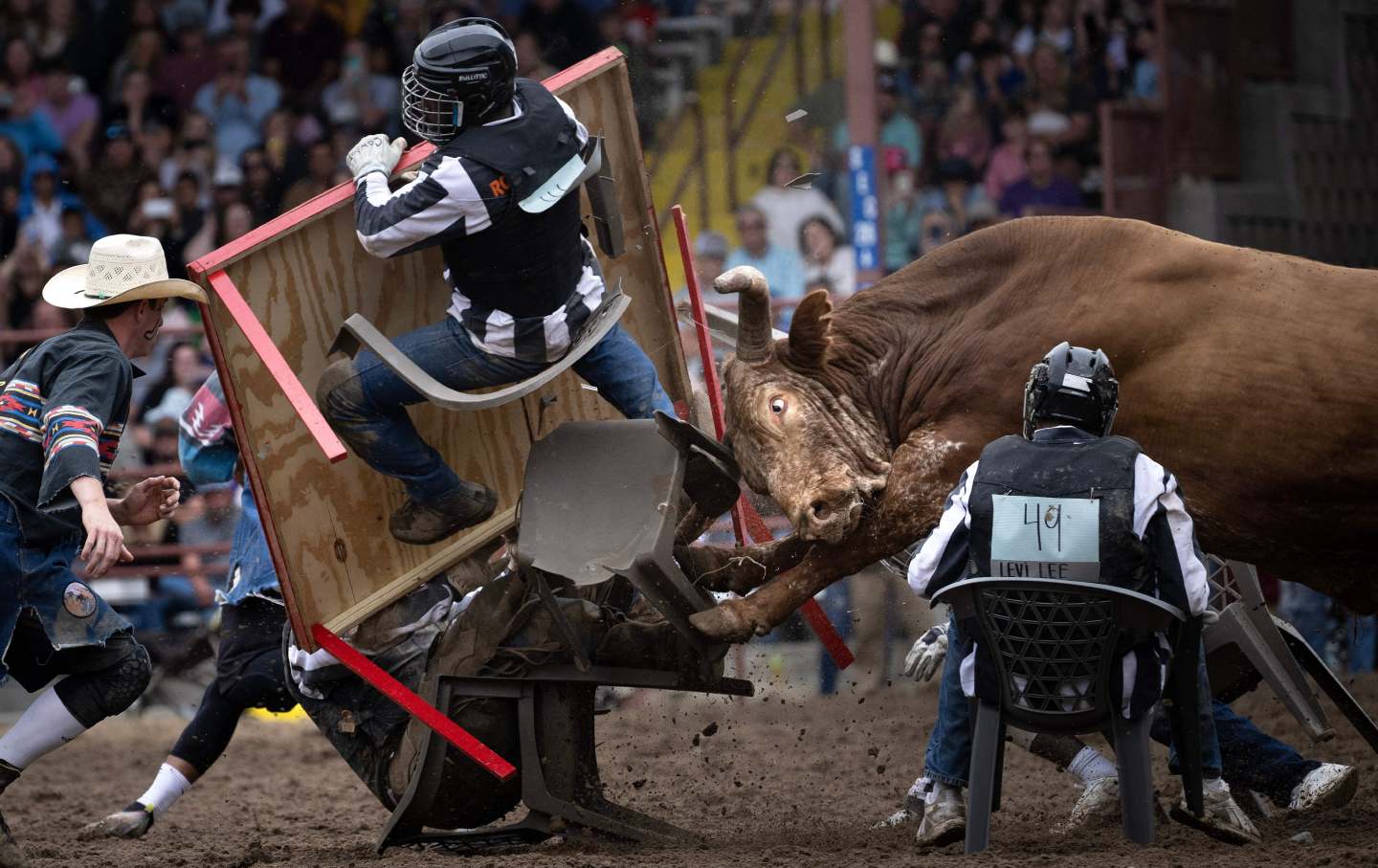
Incarcerated individuals participate in “Convict Poker” where they attempt to be the last contestant with their hands on the table as a bull charges them during the Angola Prison Rodeo held at the Louisiana State Penitentiary April 23, 2023, in Louisiana.
(Brendan Smialowski / AFP via Getty Images)
St. Francisville, Louisiana—Even in October, it was hot enough to sweat through the thin layers of clothing I wore to visit the opening weekend of the 58th annual Angola Prison Rodeo held on the grounds of the Louisiana State Penitentiary. As I queued with other ticketholders in a line that led through the arena’s gates, I watched visitors buy passes for a bus tour of the surroundings, which they paid for with cash stashed inside the translucent purses mandated by prison authorities. The clear bags are intended to prevent people from smuggling in weapons, cameras, cell phones, and other contraband. Recording devices are restricted, too, so I couldn’t log people’s direct quotes.
Amid the fuss, I met a man who told me he was released from Angola this spring after having been wrongfully incarcerated for decades. He was returning for the first time to visit friends.
If Louisiana is the center of the prison-industrial complex, incarcerating the highest proportion of its population (1,067 per 100,000 residents), Angola is its capital city. It is the largest maximum-security prison in the country and a primary site of legal slavery in the United States.
The 13th Amendment of the Constitution outlawed slavery in 1865, but it made an exception for the punishment of a crime. Nowhere are the consequences of this more evident than at Angola, where incarcerated men still work 18,000 acres of farmland on the site of the Angola Plantation, named for the southern African country from which its enslaved laborers were once imported.
Prison laborers harvest crops like cotton, wheat, corn, soybeans, and milo to be sold for profit by Prison Enterprises, a division of the Louisiana Department of Public Safety and Corrections that manages the state prisons’ agricultural, industrial, and service output. It is the largest employer in this remote pocket of Louisiana, about 30 miles northwest of Baton Rouge: West Feliciana Parish boasts a population of only about 15,000, according to 2023 census estimates, and the Louisiana Department of Public Safety and Corrections lists Angola’s prison population at 3,855 persons.
As the longest-running rodeo of its kind, the Angola Prison Rodeo is a unique recreational outlet for the people imprisoned at Angola as well as a necessary means of economic gain. During the regular work program, the prison population of Louisiana earns a wage that ranges between 2 and 40 cents an hour, according to figures published by Prison Enterprises in 2023. (That same year, the company reported $31 million in sales; prison wages were less than 4 percent of that.) But when vending crafts and other handmade wares at the rodeo, Angola residents set their own prices and earn upward of 100 to 1,000 times their normal hourly rate.
The prison’s semiannual rodeo program also serves as an antidote to the social isolation of the US prison system: It facilitates a rare opportunity for incarcerated people to interact with the public through the cattle and livestock show, a crafts market, carnival rides, and fundraising booths that vend food and refreshments. Through the rodeo, loved ones are granted proximity to incarcerated partners, friends, and relatives without the same oversight and supervision of a traditional prison visit.
I watched families reunite at the crafts fair and friends joyfully embrace. A pair of lovers sat next to each other while the male partner tried to vend his wares; when he was not attending to a customer, he and his girlfriend quietly brushed their fingers over one another’s hands.
Most of the artisan booths were situated under a metal awning, though determined vendors overflowed into the direct sunlight. Walking the rows of booths, I saw many variations of a honey-toned set of wooden chairs and tables—one featured the phrase “Most Wanted” with an image of Donald Trump behind bars emblazoned upon it; another featured Gucci and Louis Vuitton logos carved into finished wood and repainted. Dora the Explorer, Minnie Mouse, Princess Tiana, and miscellaneous other cartoon characters appeared on engraved woodworks and keychains. I saw wooden puzzles, planters, toy boxes that read “Play Time,” imitation snakeskin purses, and carved wooden roses dipped in red paint—all made and sold by the incarcerated men of Angola, constituting a unique folk-art aesthetic that exists no place else.
Popular
“swipe left below to view more authors”Swipe →The prison’s most infamous souvenir is a T-shirt that reads “Angola: A Gated Community.” The shirts are amusing in the abstract but horrific in reality; they reify participants in the Angola Prison Rodeo as the butt of a decades-long joke and remind us of the prison’s gates and our enclosure within barbed-wire fences. This division is temporarily suspended as free and incarcerated persons meet on the rodeo grounds. The T-shirt’s irony depends on subjugation. On my visit, it appeared to be sold out or was otherwise unavailable.
Different organizations sold different products to fund their respective activities. The Angolite, Angola’s award-winning prisoner-led publication offered subscriptions and renewal services next to a booth for Angola’s military veterans. At the food court, I saw signs advertising the offerings of other groups; an Alcoholics Anonymous affiliate sold coffee, and other organizations hawked American classics like hot dogs and hamburgers as well as traditional Louisiana cuisine like po-boy sandwiches and gumbo made from the residents’ family recipes.
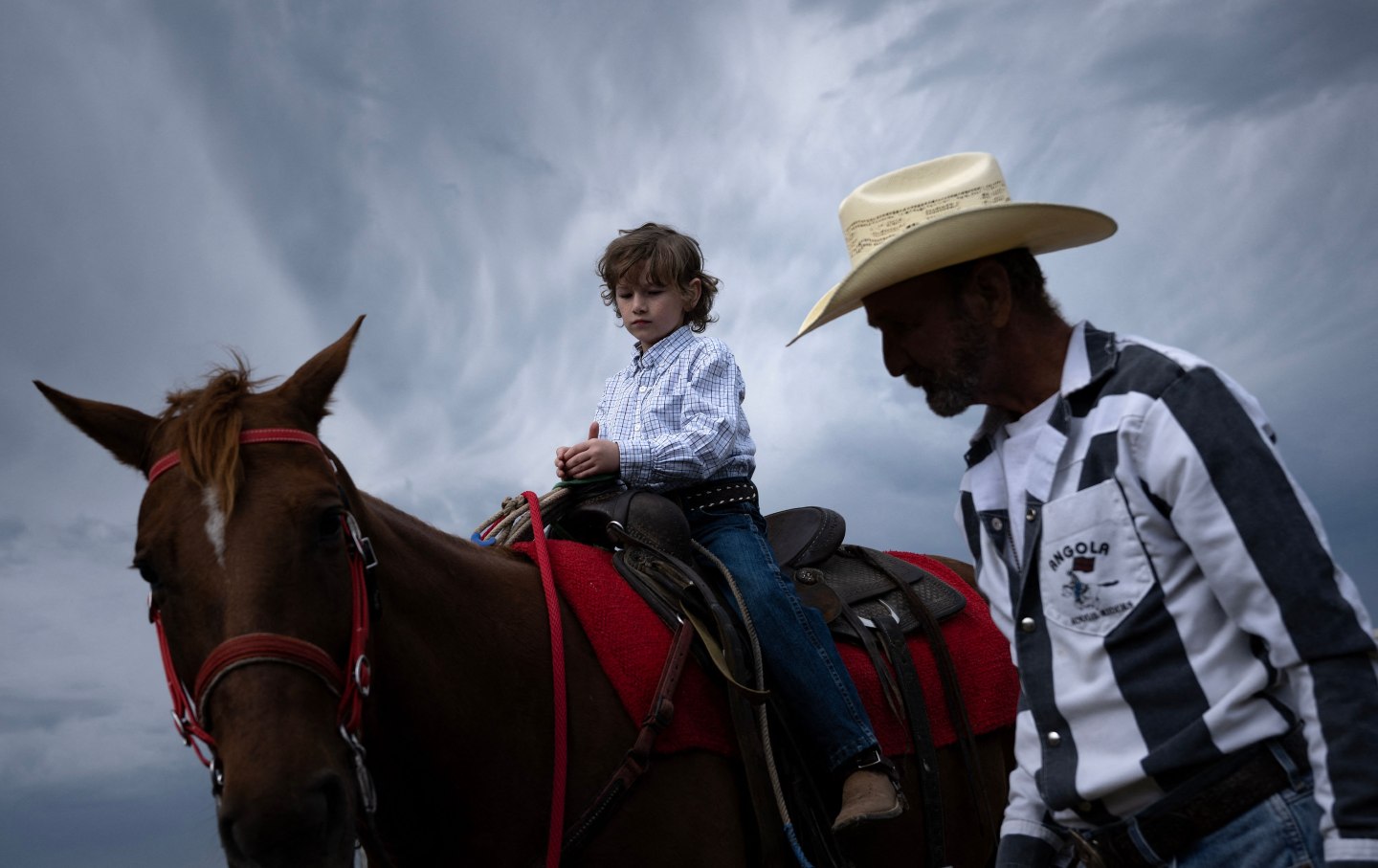
The decor of the corral was Americana, almost theatrically so. Twenty-five red, silver, and blue banners flapped in the wind, suspended from the rodeo pen’s rafters. Before the start of the competitions, Mack Ginn, a veteran rodeo personality and the announcer for the Angola program, introduced what he called “the most beautiful song ever penned”: “The Star-Spangled Banner.” This patriotic display seemed especially appropriate at an event that blends two hallmarks of America’s identity: the ranching and cattle industry and the prison-industrial complex.
The pageant is also not without its drag: Incarcerated competitors wear black-and-white-striped button-ups, and Angola’s other residents sport blue short-sleeve button-ups layered over white cotton T-shirts. Staff members of The Angolite wore white button-ups with the newspaper’s logo screen printed onto them; they are also permitted cameras to photograph the event. Rodeo cowboys wear vests, helmets, and masks while they compete.
After Ginn announced the start of the rodeo program, seven bulls entered the ring, and various feats of bravery followed.
A medical emergency occurred early on when a participant was gored by a bull during the Ring of Fire, in which a bull is released into the pen to spook a handful of men enclosed in a rope ring who must remain in place to win. Ginn prayed over the man who clutched his abdomen as he lay on the ground: “Lord, we know you are the ultimate physician…” He invoked the power of “Jesus Christ, the Savior” and implied that if the injured party were not a strong enough man to recover from the injuries he suffered, God would not have allowed him to have encountered the bull.
I struggled with the tidiness of this logic; by extension, the circumstances that led the man to prison must also have been preordained. The man was taken away on a gurney, and before he was raised into the back of the ambulance, he pumped his fist in the air—not unlike Donald Trump following his first assassination attempt.
Many other events followed, in which participants risked serious injury or their life: During Riding the Sled, a man holding a jar of water is pulled behind a horse on a small sled that provides a slim separation between him and the ground. His goal is to spill as little water as possible. In Wild Cow Milking, prisoners must express milk from an agitated cow, but in this week’s event, nobody got near the cow due to her speed and persistence in evading capture.
The final event of the day is called Guts and Glory, during which incarcerated competitors must retrieve a poker chip affixed between a bull’s horns, which are spraypainted bright red. The winner is awarded a $1,500 prize, but the amount increases every subsequent week if someone doesn’t grab the chip before time runs out the week before. I tallied 43 participants, but more filtered in right before the competition started; it was impossible to distinguish one person from another except for the handwritten numbers printed on the back of their shirts, along with their names, illegible to the audience, printed underneath. Only a couple of minutes into the event, one man grabbed the chip, but another was close behind him—men piled on top of one another to fight over its ownership. A clear winner was not announced to the crowd.
John Corley, the associate editor of The Angolite, told me that the event has become mundane for him. He no longer bothers to leave the publication’s booth to watch the competition. Instead, he prefers to talk to the strangers who visit the fair. In previous years, he has met Jeffrey Goldberg, the editor of The Atlantic, and the Christian singer Lauren Daigle. This year, he met Alison Pelegrin, the 2023–25 Louisiana Poet Laureate.
I could not, however, meet whom I really wanted to at the rodeo: the competitors. I was not able to ask the questions that nagged at me: Why do you do it? Is it only for a chance at prize money?
I left and headed back to my home in Lake Charles. But many people there would stay on those grounds for years to come—the rodeo becoming a chorus repeated the following week, the following spring, the following fall, the following year, ad nauseam.