Texas Is Fighting to Access Out-of-State Abortion Medical Records
State officials are suing the federal government over a Biden administration policy meant to protect patients and providers.
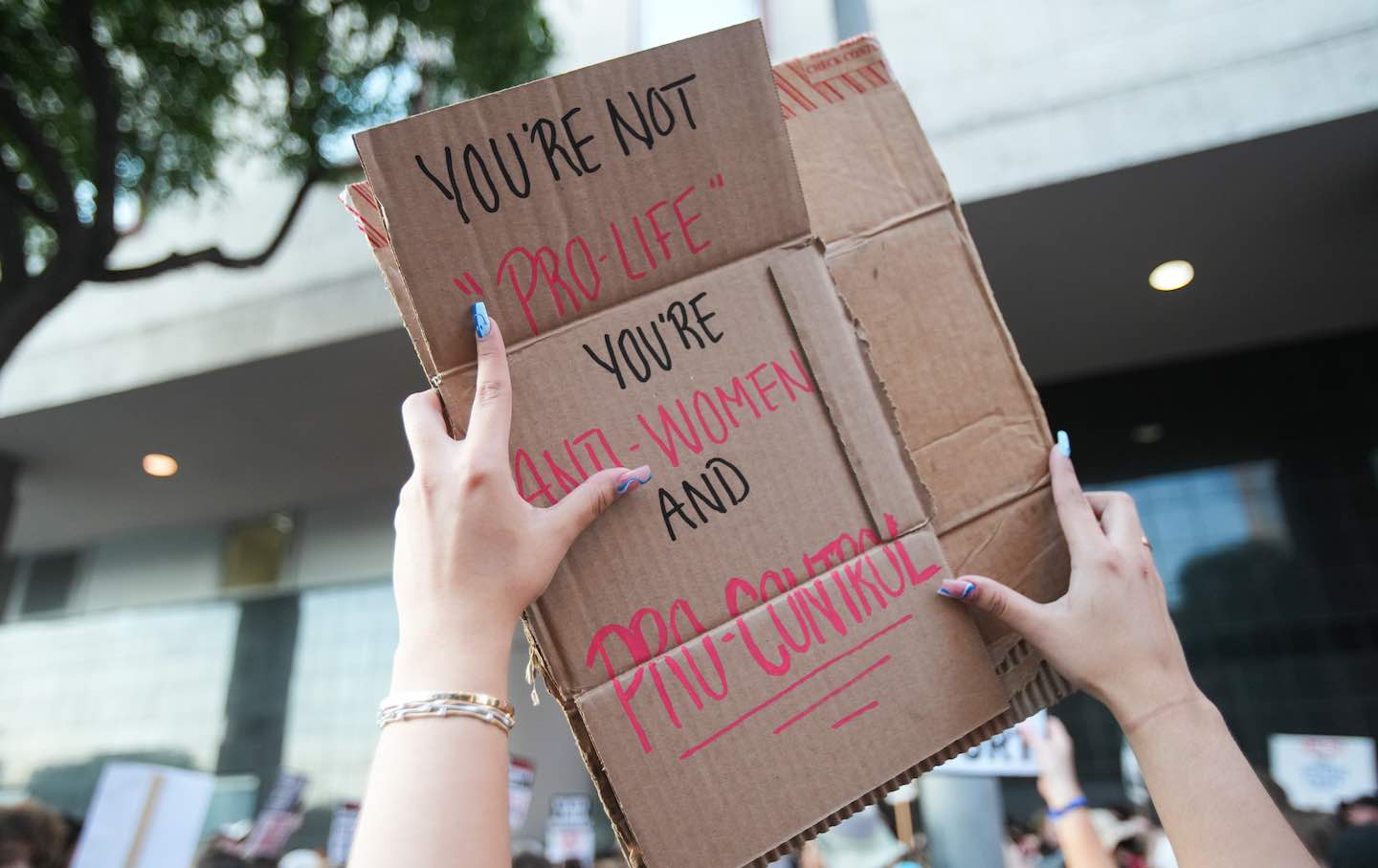
Abortion-rights demonstrators protest outside the Bob Casey Federal Courthouse on June, 24, 2022, in Houston, after the Supreme Court overturned Roe v. Wade.
(Brett Coomer / Houston Chronicle via Getty Images)
Pushed out of Texas after the state’s abortion ban went into effect, provider Dr. Lauren Thaxton still sees at least one patient from Texas daily. At her new ob-gyn practice in Colorado, Thaxton treats a stream of people who are forced to trek out of state for abortion care. After the fall of Roe, nearly one in five patients in the United States must now cross state lines to obtain care. Already burdened with the stress of travel and a medical procedure, her Texas patients often express “deep fear” that a family member, a partner, or the state will discover that they received an abortion upon their return. Even operating under an interstate shield law doesn’t fully allay concerns for Thaxton or her Texas patients.
“They are scared of criminalization from their home state, even though they’ve just undergone something completely legal,” Thaxton tells The Nation. “They are even scared of telling their own ob-gyns or primary doctors back in Texas out of fear it will somehow be used against them. It’s heartbreaking.”
In the wake of the Supreme Court’s Dobbs decision, Melanie Fontes Rainer has heard similar stories from many providers like Thaxton. As head of the Office for Civil Rights at the US Department of Health and Human Services, Fontes Rainer traveled all over the country to meet with healthcare providers in both banned and legal states. They share anxiety over the threat of their patients’ medical information being disclosed without permission, and used to potentially punish them down the line. Providers in legal states tell her they are already seeing requests for patient records from out-of-state officials.
“Providers and patients want their lawful medical records protected from fishing expeditions,” says Fontes Rainer. “They don’t want this sensitive information weaponized against them.”
In response to these pervasive fears, the Biden administration’s Department of Health and Human Services issued a new measure earlier this year that strengthens the Health Insurance Portability Act (HIPAA). The long-standing medical privacy law historically included an exception that allowed healthcare providers to turn over medical records to law enforcement. The new rule closes that loophole for patients who seek abortion care in legal states, prohibiting healthcare providers, insurers, and states from giving reproductive care information to criminal or civil investigations. Women who seek fertility treatments, contraception, or miscarriage care will also be protected. States have been given until December to comply.
“I believe this is one of the more consequential actions this administration has taken in response to the loss of Roe v. Wade,” Fontes Rainer tells The Nation. “The trust between a doctor and a patient is critically important. The last thing a patient should have to worry about is whether their medical records will be kept private.”
That rule change would provide much-needed protection for pregnant patients in any of the 21 abortion-hostile states like Texas, which carries one of the most restrictive abortion bans in the country. The state has lived under a draconian near-total ban since 2021—which was bolstered by a criminal ban in 2022—forcing some 35,000 residents to seek care out of state. And its leaders have aggressively sought to bar abortion procedures even in life-threatening circumstances. In Texas, providers could face life in prison for violating the law.
However, Texas right-wing officials have recently mounted a legal challenge to the federal policy in order to access the private medical records of patients who seek abortion care across state lines. Attorney General Ken Paxton is leading the charge nationally among 18 other attorneys general who signed a formal letter to the health department in opposition to the changes last June. Paxton argues that the new rule—as well as the original HIPAA privacy rules from 2000—limit the state’s authority to conduct investigations.
“The Biden Administration’s motive is clear: to subvert lawful state investigations on issues that the courts have said the states may investigate,” said Paxton in a statement. “The federal government is attempting to undermine Texas’s law enforcement capabilities, and I will not allow this to happen.”
The lawsuit reflects Texas’s ongoing “disregard” for federal reproductive rights protections in the post-Roe world, says Greer Donley, a law professor at the University of Pittsburgh who focuses on abortion rights. The state similarly challenged the Biden administration’s push in 2022 to ensure hospitals perform emergency abortion care under the federal Emergency Medical Treatment and Labor Act (EMTALA), amid several reports of patients nearly dying after being denied timely procedures. In early October, the US Supreme Court declined to hear the case, leaving a block on emergency abortions in place for Texans as a similar lawsuit out of Idaho proceeds in the Ninth Circuit.
“I’m often shocked by the actions of Texas officials when it comes to abortion rights, and this is no exception,” Donley tells The Nation. “They are saying the state should have the authority to define federal privacy rules, not the federal government. This really highlights how extreme they are. They are telling us ‘we want to be the most aggressive state on limiting abortion care, even outside our borders.”
Texas has already signaled its interest in restricting out-of-state care: Paxton is currently suing Austin, a progressive city that perennially finds itself in the crosshairs of the right-wing state government, for helping its residents seek care outside Texas. The city’s Reproductive Justice Fund—the first of its kind investment in the south when it was created in 2019 —allocates $400,000 for logistical abortion travel support, like airfare, gas, and hotel stays. And anti-abortion activists with friendly ties to state officials have successfully placed an abortion travel ban on the ballot for citizens of Amarillo, a Panhandle town that serves as a throughway to abortion-legal states like New Mexico.
The so-called “abortion trafficking” ordinance would empower citizens to file a civil lawsuit against people who “aid or abet” abortion and reap $10,000 in damages, similar to the state’s bounty-hunter-style Senate Bill 8. The measure could apply to anyone who offers funding to someone who passes through a city to receive out-of-state abortion care, who drives an abortion patient to their appointment on a city’s roads, or even provides directions to a clinic.
The ordinances not only help serve as a blueprint for future statewide laws as the Texas Legislature meets this January, but if passed in Amarillo, could carry sweeping national implications. The measure could give new life to a lawsuit seeking to ban abortion drug mifepristone, and grant the Republican-dominated Supreme Court an opportunity to consider the travel ban an extension of the archaic Comstock Act.
Moreover, Texas’s latest legal challenge is a glaring sign of the state’s march toward surveilling—and potentially prosecuting—abortion-seeking residents. While officials have continually reinforced the notion that they are not interested in punishing pregnant patients, only the providers who violate the law, advocates believe this is merely a temporary guise. Donley stresses that the lawsuit is certainly an attempt by Texas to “preserve their right” to do so under a future Republican administration.
Elizabeth Myers has been at the front lines of defending threats to abortion privacy in Texas. The Dallas attorney represents abortion funds who were faced with intrusive legal demands to hand over a wide swath of sensitive information, including the names of every person who helped their clients access abortion, in a suit led by Jonathan Mitchell, former solicitor general of Texas and architect of the state’s near-total ban. She considers the state’s lawsuit a “direct escalation” of these ongoing attacks and the first step in eventual criminalization.
“They’ve always said they won’t target pregnant patients, but in reality that’s always been their long-term plan, and their end game,” says Myers. “There is no reason for Texas to want to invalidate these federal rules unless they intend to eventually track—and one day prosecute—Texas women of reproductive age.”
Prosecutors and anti-abortion states likely feel emboldened post-Dobbs, say advocacy groups. Nationally, more than 200 people were prosecuted for conduct associated with pregnancy, abortion, pregnancy loss, or birth in the year after Roe was overturned, the highest number of such cases in a single year ever recorded, according to a September report from Pregnancy Justice. High-profile cases of women charged with serious crimes after pregnancy loss, including murder—that were later dismissed—have occurred in at least South Carolina, Ohio, and Texas.
Popular
“swipe left below to view more authors”Swipe →“We know of many instances where law enforcement show up to hospitals after pregnancy loss and insert themselves in extremely private health scenarios,” says Lauren Paulk, senior research counsel at reproductive justice legal nonprofit If/When/How. “Healthcare providers should never be pressured into sharing private medical records with police and suits like the one in Texas just increase the threat of criminalization.”
The Texas lawsuit cites “at least one instance” in which an entity has used the HIPAA rule as a reason it can’t comply with a state subpoena. It’s unclear how many abortion-related medical records Texas is currently seeking. It would not be the state’s first attempt at demanding private medical documents. After it banned transition-related care for minors last year, Paxton sought youth gender-affirming care records from health centers out of state, including Washington and Georgia.
The legal challenge now sits before US District Judge James Wesley Hendrix of Lubbock, who often rules against Biden administration policies. And a federal appeal to a ruling in the state’s favor would be heard by the ultraconservative US Court of Appeals for the Fifth Circuit, which also has a long history of siding with Texas anti-abortion policies.
Texas would also certainly get a boost in its fight against the rule if Republican presidential candidate Donald Trump and vice-presidential candidate JD Vance—who are both open to allowing states to monitor patient pregnancies—take the helm. Their Project 2025 playbook also supports severely rolling back abortion privacy protections and collecting a registry of abortion and miscarriages, among other extremist positions.
Providers like Thaxton brace for the possibility of an even “more terrifying dystopia,” for themselves and the patients they are entrusted to care for.
“It’s very scary to think about this cruel invasion of privacy, especially when we try so hard to keep our relationship with patients sacred and confidential,” she says. “It’s difficult to think that our records could be used to criminalize our patients somehow. It’s morally distressing. Our patients are already living with a lot of fear, I can’t imagine what it would be like for them if this is upheld.”