
A Cornell Graduate Student Faces Deportation After a Pro-Palestine Action
Momodou Taal, who is attending the university with a F-1 visa, was suspended after a September 18 protest under a new policy seeking to quash Gaza solidarity actions.
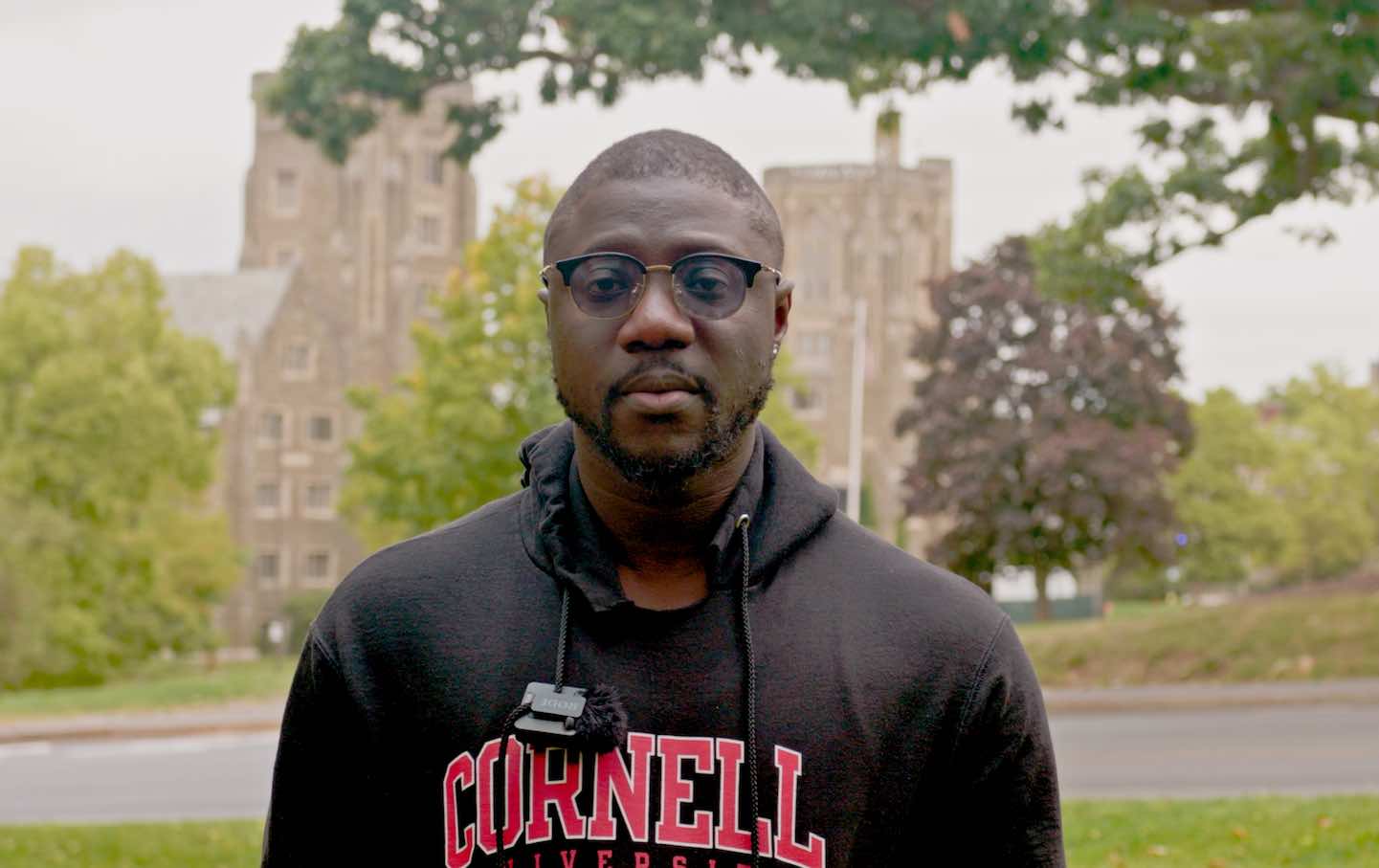
Campus administrators appear to have a new tool in their toolbox for suppressing pro-Palestinian speech. Cornell University, in Ithaca, New York, has taken disciplinary action against an international student that will likely force him to leave the country, and could have a chilling effect on other international students participating in political protests.
Momodou Taal is a PhD candidate in Africana studies and a graduate student worker, attending Cornell under the F-1 visa program. In the last academic year, Taal joined student-led actions demanding that Cornell divest from industries complicit in Israel’s attacks on civilians in Gaza.
Cornell student activists were not alone in launching public demonstrations against their college. Encampments took hold across the country. In response, some universities called in police to clear, often forcefully, pro-Palestinian student protesters.
But Cornell took a different approach. During a year when it ostensibly prioritized free expression, the university created a new policy to crack down on these types of protests.
First issued on January 24, 2024, the Interim Expressive Activities Policy limits when amplified sound can be used, delineates which objects are prohibited at collective campus actions, like candles and sticks, and subjects some protesters to increased disciplinary action.
By the end of the spring semester, six Cornell students, including Taal, faced suspensions for their pro-Palestinian activities.
“The interim expressive speech policy was very much a reaction to actions by students who were calling for divestment,” said Nick Wilson, another one of the students who faced suspension last year. “One of the policies that I think makes that clear is the ban on candles that was included in it, which was a direct reaction to candlelight vigils that were being held to mourn civilian loss of live in Gaza as the genocide began to kick off.”
The reasoning behind which students received suspensions is still unclear, but some of the students agreed not to engage in actions connected to the encampment on the Cornell arts quad. Wilson did not take a deal last semester, but agreed to a deal this semester, and could be suspended if he engages in expressive activities. In the last academic year, Taal had not agreed to refrain from protests this year.
On September 18, a group of students from multiple Cornell student groups under the umbrella organization Coalition for Mutual Liberation disrupted a career fair that was taking place at The Statler Hotel, which is located on campus grounds. The students disrupted this event because Boeing and L3Harris had tables at the fair—companies which, according to the students, are connected to the flow of military supplies being used by Israel to commit atrocities against civilians.
The university says that protesters forcibly entered the job fair by pushing campus police officers. Taal, who is a British national, was present at this action. When asked if the university had accused him of pushing police officers, Taal responded, “Yes, which is not true. I can say categorically that I shoved no police officer, nor did I not listen to a lawful directive, like they’re claiming.”
Asked about why he felt he was targeted, he said, “They’ve identified who they think are leaders [of the pro-Palestine movement on campus], and therefore [they] are trying to make an example out of me.”
Now, Taal may need to leave the country because of his presence at the protest.
The F-1 visa program allows foreign nationals to reside in the United States if they are enrolled in an academic educational program, a language-training program, or a vocational program. Those with F-1 visas can also work on campus and in limited off-campus training positions. According to the Department of Homeland Security, suspension from an academic program is a valid reason for the termination of a record, which changes the immigration status of someone holding a F-1 visa.
Cornell University did not respond to questions about its policies and procedures regarding the suspension of a student with an F-1 visa.
As of publication, the university still refers to disciplinary action against Taal as a “temporary suspension.” But by suspending Taal, the university set in motion immigration procedures without having to provide the level of evidence that due process would require, if the charges against Taal were criminal, which they are not.
“I’m trying to fight this—to at least have an investigation, and due process,” said Taal. “I’m not asking for anything special, I’m asking for Cornell to follow their own procedure,” by conducting an official investigation in which he would be able to respond to any claims. The Cornell Graduate Student Union, which is attempting to help Taal, said, “No investigation was conducted before the discipline of temporary suspension was issued to Momodou.”
The union issued a press release on Tuesday, explaining that it is demanding to bargain with Cornell over the effects of the suspension. It said:
Last spring, Cornell University signed a Memorandum Of Agreement (MOA) with CGSU-UE [Cornell Graduate Students United-UE] that gives the union the right to bargain over the effects of discipline of graduate workers on their working conditions, effective immediately. Pursuant to the MOA, CGSU-UE issued a demand to bargain with Cornell Administration over the effects of the discipline administered to Taal.
CGSU-UE condemns Taal’s suspension, which represents a disturbing pattern of discriminatory discipline against marginalized graduate workers. The union is still fighting for just cause protections in discipline and discharge, due process for academic evaluations, strong academic freedom, and nondiscrimination protections inclusive of political affiliation and action, religious practice, and caste.
The press release also quoted Jawuanna McAllister, of CGSU-UE’s bargaining committee, who was unequivocal about the university’s singling out Taal, who appears to be the only student, among the more than 100 protesters at the September 18 action, to face suspension. “The university’s targeting of Taal, a Black, Muslim, international grad worker, is a calculated and shameful attempt to intimidate workers who are protesting the atrocities in Gaza and stifle free expression on campus,” said McAllister.
Popular
“swipe left below to view more authors”Swipe →The university did not respond to questions from The Nation about the reasons for Taal’s suspension. Instead, Cornell Media Relations sent two prior statements (here and here) and e-mailed a response from Joel M. Malina, Cornell’s vice president for university relations. Malina said:
International students attending college in the U.S. on F-1 visas are obligated to comply with federal requirements to maintain their visa status. These federal requirements include remaining enrolled as a full-time registered student. Universities are required by federal regulation to terminate the F-1 status for any student who is not permitted to be enrolled due to a disciplinary action.
Any international student administratively withdrawn by Cornell pursuant to the Student Code of Conduct is urged to immediately review immigration guidelines and consult with experts. Universities can disallow enrollment and bar a student from campus, but do not have deportation powers.
For his part, Taal sees a disconnect in the university’s professed values. “Last year was the freedom of expression year, and that was done, technically, to allow right-wing speakers to come on campus and speak freely,” said Taal, referring to how the theme year facilitated Ann Coulter’s giving an anti-immigration talk at Cornell under heavy security. The year prior, Coulter had to end her talk early, due to protesters, which many on campus believe is what led to the expression theme year.
“Freedom of expression is only free when it’s not about Palestine, on this campus,” Taal said.
More from The Nation
My Family’s Dark, Hidden History With Institutionalization My Family’s Dark, Hidden History With Institutionalization
My great-great-grandfather was the namesake of an infamous institution for the disabled. From long-neglected records of the property, the lives of forgotten people were uncovered....
Smoke and Mirrors: The Right's Latest Attacks Against Trans People Smoke and Mirrors: The Right's Latest Attacks Against Trans People
The MAGA movement is redoubling its attacks on trans healthcare in an attempt to win votes this November.

Is Blockbuster Video the Answer to Our Digital Privacy Woes? Is Blockbuster Video the Answer to Our Digital Privacy Woes?
The Supreme Court is weighing whether a 1988 video-store law can be used to protect our digital privacy.
How Congress Is Cashing In on the AI Boom How Congress Is Cashing In on the AI Boom
Roughly one in five members of Congress has household investments in the industry.
Obviously, the Knicks Should Not Visit the White House. Why Is This Even a Discussion? Obviously, the Knicks Should Not Visit the White House. Why Is This Even a Discussion?
The Knicks shouldn’t let their legacy include genuflecting to Donald Trump, one of the most hated figures in the very city printed on their jersey. New Yorkers deserve better.
The Real AI Threat Is Already Here The Real AI Threat Is Already Here
Never mind some future apocalypse—AI is being used right now to cause enormous suffering.

