
Dispatch: From the Hostage Swap to the Kursk Incursion
Where does it lead?
In early 1943, shortly before the last time war had reached Russia’s southern city of Kursk, Hitler offered Stalin a deal: to exchange Stalin’s firstborn son, captured two years earlier, for Friedrich Paulus, storied commander of the defeated German army at Stalingrad. The Soviet despot refused. Nobody trades a marshal for a lieutenant, came his apocryphal reply (His son Yakov Dzhugashvili ended up shot to death at Sachsenhausen concentration camp.)
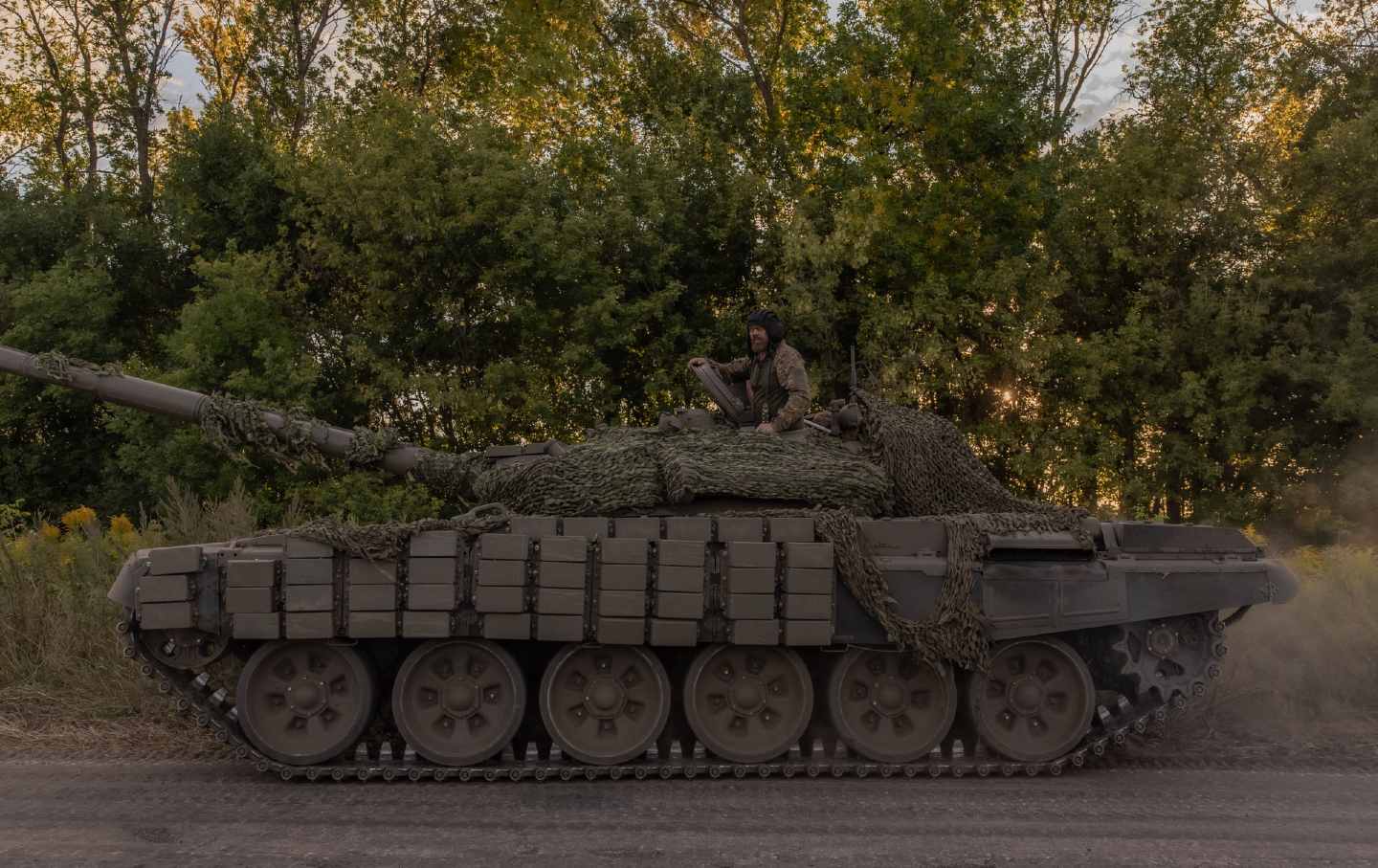
Some eight decades later, fighting once again rages in Kursk. On August 6, over a thousand Ukrainian troops mounted an audacious cross-border raid dozens of miles into Russian territory.
And on the eve of the Ukrainian advance, Russia’s current strongman traded as many as 16 “marshals”—including the American reporter Evan Gershkovich, businessman Paul Wheelan, three top Russian opposition leaders, and Oleg Orlov, a human rights activist whose organization, Memorial, won the 2022 Nobel Peace Prize—for just eight “lieutenants,” a motley group of spies, hitmen and crooks freed by the West.
President Vladimir Putin personally greeted the freed captives as they deplaned to a red carpet and guard of honor in Moscow. They included a pair of unmasked spies (of dubious prior effectiveness as sleeper agents in Slovenia and now forever operationally dead), an assassin caught carrying out his hit in broad daylight, and a petty cybercriminal. Despite this, former president Dmitry Medvedev, now deputy chair of Russia’s Security Council, declared the exchange to have been “in our favor.”
Donald Trump also weighed in. “I’d like to congratulate Vladimir Putin for having made yet another great deal,” he told a crowd at a rally in Atlanta.
Both Putin and Trump had self-interested reasons to portray the exchange as a triumph for Moscow. Trump in particular had publicly pledged to free Gershkovich as part of his election campaign. Trailing in the polls to Vice President Kamala Harris for the first time, he is heavily invested in minimizing President Joe Biden’s achievement. As for the Russian president, getting back FSB operatives sends a strong message that Russia’s security services leave no man behind.
Politics aside, several tangible benefits of the swap for the Kremlin were quick to emerge. Shortly after their release, left-wing politician Ilya Yashin, democracy activist Andrey Pivovarov, and liberal thinker Vladimir Kara-Murza—who had been among Russia’s most high-profile political prisoners—held a press conference in Bonn, Germany. With millions tuning in all over the world, here was an opportunity to establish themselves aggressively as a government in waiting.
Yet far from capitalizing on the surge of international sympathy, the newly released dissidents left themselves open to charges of repeating Kremlin talking points and clumsily turned the spotlight on the Russian liberal movement’s fraught relationship with Ukraine—none of whose tens of thousands of citizens incarcerated in Russia benefited from the exchange.
Pivovarov, the former head of Mikhail Khodorkovsky’s Open Russia organization, opened the press conference with the surreal call for the removal of sanctions, and asked the international community to help the people of Russia. Providing “simple things” like educational visas would give Russians “the opportunity to see that there are not only enemies here, as the TV shows,” he said.
When it was his turn to speak, Kara-Murza did condemn the “cruel, criminal, aggressive war that Putin’s regime has unleashed against Ukraine,” but only as part of a plea for the West “not to confuse the Putin regime and Russia.” He also called the current sanctions regime “unfair” for penalizing ordinary Russians.
Yashin, alone among the trio with proven chops as a retail politician in Russia, used his speech to decry his involvement in the swap and to draw attention to the plight of the country’s remaining political prisoners, who number in the thousands. “I view this event as an expulsion from Russia, an illegal expulsion from Russia against my will,” said Yashin. “I publicly asked not to include me in any exchange lists. I refused to leave Russia under the threat of arrest, understanding myself as a Russian politician and patriot, whose place is in Russia. Even if in prison, but in Russia.”
At the end of the press conference, a woman in the audience reportedly cried out, “Not a single question about Ukraine or about prisoners of war!”
That turned out to have been a prescient criticism. A fierce backlash quickly emerged online, largely from activists who claim to be pro-Ukrainian but who, now that polls show nearly half of Ukrainians favoring talks with Russia, could more accurately be described as pro-war. On social media, accounts identifying with NAFO—a meme-inspired movement of pro-NATO hawks that depicts all proponents of a diplomatic solution to the war as Russian assets—set about slandering Yashin, Kara-Murza, and Pivovarov as Putinist warmongers, cynically ignoring the vocal opposition to the war that helped seal their incarceration in the first place.
It is of course perfectly valid to draw distinctions between the Russian public and the regime. In fact, the notion that there are so-called “good Russians”—liberal, educated, pro-Western, anti-war—that need to be fostered and supported as bulwarks against Putinism was recently a wholly uncontroversial idea. Nor is there anything necessarily pro-Putin about the call for a negotiated settlement in the war, an increasingly mainstream position within Ukraine itself.
Vladislav Zubok, author of Collapse—a magisterial history of the final years of the Soviet Union—defended the trio against the Internet pile-on. “Stunning how many are upset with the release of ‘good Russians’ from the Gulag,” he wrote on X. “For them this is bad as it complicates their black [and] white worldview of Russia as a kind of 1952 evil empire.”
Yet other experts disagreed. Erica Marat, a professor of political science at the National Defense University, called Pivovarov, Kara-Murza, and Yashin “tone-deaf.” “The points Yashin made align closely with the Kremlin,” which too supports the lifting of sanctions and a negotiated settlement, she told me. But Marat reserved her biggest criticism for what she sees as the Russian opposition’s restrictive and self-referential worldview.
“They really narrowly represent activists and journalists from Moscow and Western Russia in general,” said Marat. “The conversations that are taking place among Russia’s indigenous nations—the Buryats, the Tuvans, the Sakha—are completely different from those held by Yashin, Pivovarov, and Kara-Murza. Some of them are talking about a different type of federation, where Indigenous nations have stronger rights on their native lands. Others are openly advocating independence from Russia. Those kinds of conversations are never reflected in the elite Muscovite circles.” This despite the fact that Russia’s Indigenous communities have borne a disproportionate brunt of the war.
“Many Buryats, Bashkirs, Kalmyks, and Tuvans see the successive mobilisation of their men as a continuation of Russia’s imperial onslaught, through violence on their lands, the erasure of their cultures and languages and the exploitation of their resources,” Marat said. She views the exclusion of such voices by the liberal opposition as a refusal to confront the same imperial hangover that also undergirds the war in Ukraine. “If they want to topple Putin, they need to support Ukraine openly,” she said.
Popular
“swipe left below to view more authors”Swipe →No doubt stung by the negative reaction, Yashin gave several follow-up interviews in which he strongly condemned the Ukraine war. But the damage had been done. “It’s an own goal,” said Jeremy Morris, professor of Russian and Balkan studies at Denmark’s Aarhus University. “As soon as I saw what they were saying I thought it would backfire. And I do think it backfired. If I was Ukrainian, I would have been pissed off.”
For Morris, the fumbling of the press conference exposed the political naîveté of the opposition, which he blames in part on the insular and privileged nature of torchbearers such as Kara-Murza, the Cambridge-educated son of a famous Soviet-era journalist. “It comes from a position of privilege throughout one’s whole life where one’s views and sense of importance have never been seriously challenged,” said Morris.
Aside from the shadow of Ukraine, the legacy of the Soviet Union also weighed like a nightmare on the proceedings. In the press conference, Kara-Murza invoked major Soviet dissidents such as Alexander Solzhenitsin, Natan Sharansky, and Vladimir Bukovsky, going as far as to emulate the latter’s famous pose, holding his passport aloft for the cameras, on his arrival to the West in 1976.
Yet the exiled Soviet dissidents, known as refuseniks after they were initially denied exit from the USSR on the spurious grounds of possessing state secrets, may not be the best role models for the Russian opposition to emulate. For a start, they arguably played little role in the end of the Cold War and the democratization of Russia. Their highbrow broadcasts over the BBC and Voice of America were consumed by a narrow sliver of the population, mostly confined to members of the intelligentsia who already shared many of their viewpoints and appear to have had little influence on the pugilistic Boris Yeltsin and his team of anti-Soviet reformers.
More ominously, the specific trio singled out by Kara-Murza carry some particularly unpleasant baggage. Solzhenitsin embraced Russian nationalism, denied the Ukrainian famine, and supported Putin. Sharansky, reinventing himself as an Israeli politician, vocally supported the expansion of illegal settlements in Gaza and the West Bank. Solzhenitsyn and Sharansky were hardly outliers: Many refuseniks betrayed their early promise as beacons of human rights and democracy—witness Dmitry Simes, the former firebrand cold warrior who came to host an influential program on Russian state television.
As for Bukovsky, a fierce campaigner against Soviet punitive psychiatry and clearly a hero to Kara-Murza, he became involved in various right-liberal causes in post-Soviet Russia without making any significant impact. Increasingly marginalized and politically extreme, by 2001 Bukovsky decried the European Union as the reincarnation of the Soviet Union and condemned its redistribution of wealth and quest to forge a supranational identity as “the beginning of the Gulag.”
Instead of Bukovsky, who died in disgrace in 2019 while standing trial on 11 counts of making and possessing indecent images of children, Kara-Murza would have been better off invoking a living Soviet and Russian dissident, one who remains in a Russian prison colony. That man is Boris Kagarlitsky, a Marxist theorist whose decades of independent left-wing writing and activism made him an enemy first of Brezhnev and now of Putin. Best known in the West as the author of The Thinking Reed, an authoritative survey of unofficial political culture in the USSR, in 2023 Kagarlitsky was charged with supporting terrorism because of his anti-war position and is currently serving a five-year sentence in a penal colony.
Kagarlitsky is one of around 700 political prisoners who remain trapped in Russian jails, according to OVD-Info, a Russian human rights organisation. During the press conference, Yashin mentioned several of them by name. Among them were Alexey Gorinov, a former member of the Krasnoselsky District Council of Deputies; Igor Baryshnikov, who was jailed for an anti-war speech; the journalist Maria Ponomarenko; anti-war activist Mikhail Kriger; and Daniel Kholodny, a TV technician who had worked for the late opposition leader Alexey Navalny. “They should all have been sitting at this table,” Yashin said. “These are the people whose release I and my comrades asked for, we begged for, we called for. These are the people who must be freed from prison.”
One ally of Navalny was freed in the prisoner swap. Ksenia Fadeeva, who spoke to The Nation in 2020, was a former independent city council member in the Siberian town of Tomsk, where she had also headed the regional branch of Navalny’s organisation. In a Telegram post after her release, Fadeeva stated that she was “simply bundled into a bus by the FSB” and spirited out of Russia against her will.
What lies ahead for Fadeeva, Kara-Murza, Pivovarov, and Yashin, newly freed but confined to the purgatory of exile? Their ability to influence events in their home country from abroad has become severely limited, but perhaps not more so than it was from inside a Russian jail.
“In Russia anyone who tries to get involved in politics gets repressed, but it’s also unclear how to influence people from abroad,” said Oleg Zhuravlev, of the Public Sociology Laboratory in Russia and the Scuola Normale Superiore in Pisa, Italy. For him, there is however one possible silver lining to the removal of the leaders of the liberal opposition from the country, and that is the revitalisation of political debate. “Before, when it was Navalny against Putin, ideology took a backseat,” Zhuravlev told me. “Now, ideological questions have started to come to the fore.”
Zhuravlev cites a recent campus protest at the Russian State Humanitarian University against the establishment of a research canter by the conservative philosopher Alexander Dugin, who is believed to have influenced Putin’s views on Ukraine. The center, named after Ivan Illin, an anti-Communist Russian nationalist who had allied with the Nazis, was picketed by students with the support of the normally docile Russian communist party.
For Zhuravlev, it was an encouraging sign that, “despite the dictatorship in Russia, the conflict between the left and ultraconservatives has become more visible.” Zhuravlev also noted the emergence of grassroots protest groups such as Wives of the Mobilized, which demands the return of men forcibly mobilized to the front.
As for the fate of the formal opposition in exile, Zhuravlev believes that the only way for them to survive and remain credible is to “gain the sympathy of the Russian people.” That would entail adopting “patriotic policies that will not always align with those of the State Department,” including less demonstrative support for Ukraine. But as the press conference debacle has shown, that is easier said than done—reflecting perhaps the greatest problem with an opposition that so self-consciously identifies with Soviet dissidents.
“The dissident movement as a whole remains a cultural movement, although its members sometimes think they are engaged in politics,” wrote Kagarlitsky more than 40 years ago. “But they do not confront the system with any program for change or any new conception of society, or even any new ideology. The dissidents really have created an alternative, but only a moral alternative.” And as Morris, the Aarhus University professor, remarked of their contemporary heirs, “their moral authority does not translate to political authority.” At least for now.
Become a Sustaining Donor This September
Between the reemergence of right-wing red-baiting and Donald Trump’s use of the chilling National Security Presidential Memorandum–7 to criminalize left political organizing, we’re seeing McCarthyism reborn before our eyes.
This assault on democracy cannot be ignored or wished away. Resisting it requires bravery in the face of threats and repression, a steadfast commitment to the truth, and the unwavering belief that we can—and will—overcome this darkness.
We must have an independent media that sets the record straight, unearths corruption and abuses of power, and advances a politics of justice and dignity for all if we’re to win this fight.
That’s why I’m writing to you today. This September, The Nation needs to add 100 monthly donors to sustain our progressive journalism. Your contribution makes the next investigative report, the next truth-speaking column, and the next pathbreaking essay all possible.
I hope you’ll support our work with a recurring donation today. If you donate $10 or more a month, we’ll send you a brand new “Hands Off the Free Press!” sticker to recognise your commitment to our cause. Please, donate today.
Onward,
Katrina vanden Heuvel
Editor and Publisher, The Nation
More from The Nation
Japan’s Far Right Is Courting Young Voters Japan’s Far Right Is Courting Young Voters
Sanseitō has attracted young voters through a robust social-media strategy, Charlie Kirk–like public speaking events, and anti-establishment messaging.
This AI Panic Is Nothing New This AI Panic Is Nothing New
In the 1940s, The Nation asked questions about the atomic bomb we’re asking of artificial intelligence today.
The Decades-Old Roots of Trump’s War on Iran The Decades-Old Roots of Trump’s War on Iran
An interview with historian Behrooz Ghamari-Tabrizi about the generations of US presidents who have tried to destroy the Iranian regime.
Emmanuel Macron’s Turbulent Exit Emmanuel Macron’s Turbulent Exit
Between a budget crisis and a cost-of-living squeeze, Macron is leaving a country feeling more insecure than ever—and ready to take to the streets.
Israel’s Election Can’t Fix What Netanyahu Broke Israel’s Election Can’t Fix What Netanyahu Broke
The fundamental problem is not the name of the prime minister, but rather the actions of the Israeli government and the urgent issues that need to be addressed.
The AfD’s Rise Isn’t Just About East Germany The AfD’s Rise Isn’t Just About East Germany
The Alternative für Deutschland has a stable national poll lead, including in the former West Germany. Its rise owes to much more than Eastern grievances.

