The Week That Was: A Cavalcade of Catastrophes Across Air Travel and Workplace Technology
America’s infrastructure crisis can no longer be ignored.
After nearly a decade, it seems that the Trump administration’s fabled “Infrastructure Week” finally materialized.
Except, instead of renewed investment in the tools and structures that make work and life possible, the nation was treated to a cavalcade of catastrophes—across air travel, banking, and workplace technology.
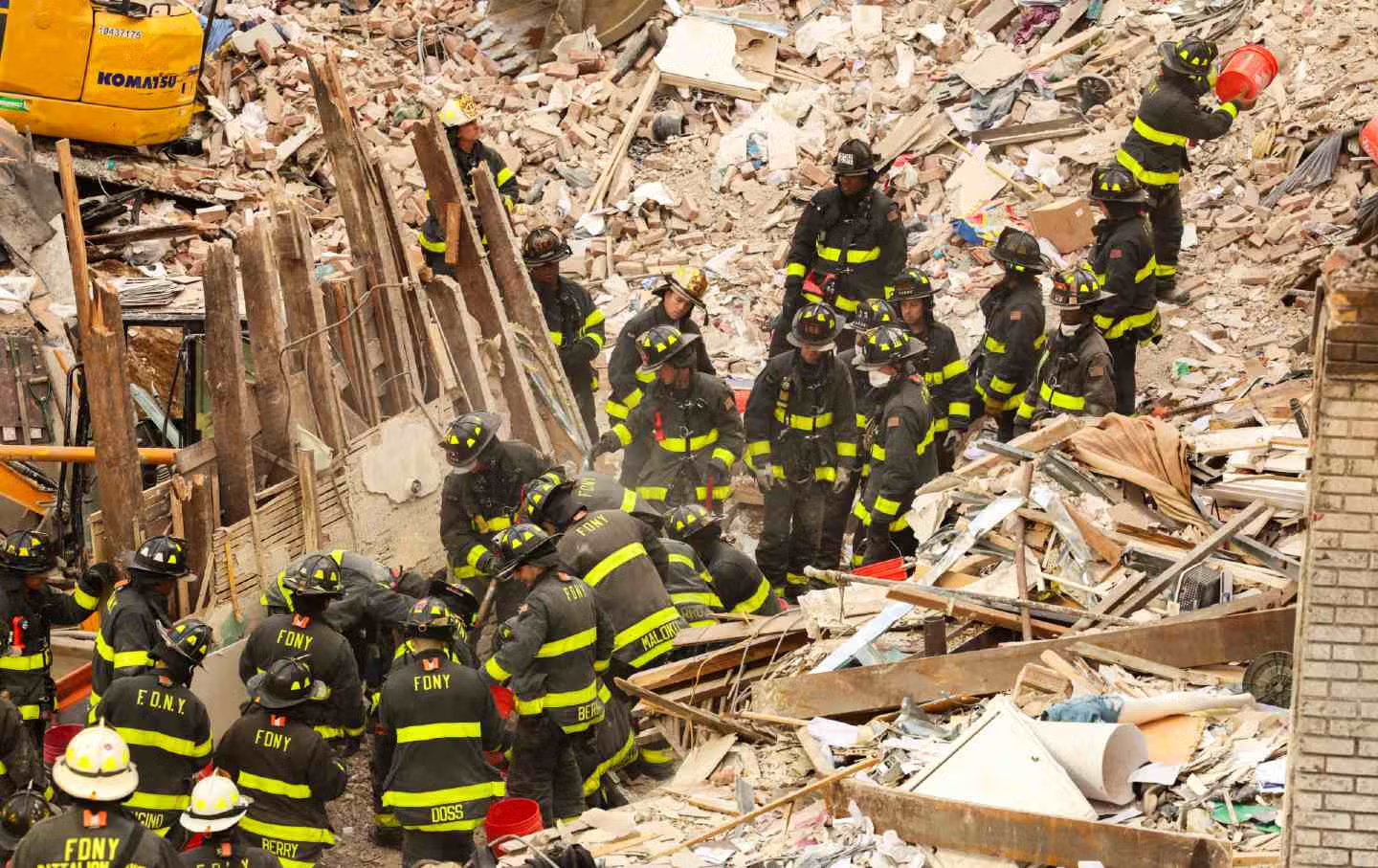
As Americans deboarded planes and scoured e-mail inboxes in vain, as account holders faced error messages while attempting to access their own money, as rescue workers searched for survivors of New York’s fatal apartment building collapse—it all added up to a sinking feeling. (And not just because, not long beforehand in Massachusetts, a 125-year-old pipe caved and created a literal sinkhole.)
In a time when Americans are already struggling to meet basic needs, the physical and digital systems we are meant to take for granted are crumbling. And while the timing of these crises may be coincidental, Dumb Infrastructure Week surfaced an alarming truth. Daily life in America hinges upon a patchwork of inadequate public and private infrastructure being maintained largely by a shrinking number of oligarchs and their hand-picked goons.
Over a third of America’s bridges need major repairs. It will require $625 billion of investments in pipe replacements, treatment plant maintenance, and other upgrades to sustain our clean water supply. And on the digital side, over 10 million Americans still lack high-speed Internet—even as the lightning-fast AI buildout strains power grids to further line a handful of well-padded pockets.
And all of these crises were well underway before the Trump administration canceled billions of dollars’ worth of EPA funding and cut staff at the Department of Transportation, before DOGE shrank regional FEMA offices and slashed the federal IT workforce. Public health infrastructure has been similarly undermined, to the tune of 5,412 measles cases and counting in 2026.
It is a self-fulfilling prophecy that Republican administrations have demonstrated again and again: claim government does not work, actively sabotage it while in power, then point to the resulting failures as evidence that government does not work. It is no wonder that the National Review’s proposed solution post-ground-stop is to privatize air traffic control.
So the federal government—led by an executive who has chosen to live out the remainder of his term in an endless episode of This Old House—is unlikely to meaningfully address any infrastructure needs outside of the ballroom sector.
But this vacuum of leadership offers an opening for progressives—to underscore the damage done by Trump’s disinvestment in civil service, and to propose bold, alternative solutions to the creeping privatization that has cheapened just about every facet of American living. Already, a number of leading voices in Congress are doing just that.
In an effort to avert blame for the nationwide ground stop, the Trump administration has claimed that full modernization of the FAA’s telecommunications infrastructure would require as much as $50 billion in additional funding from Congress.
In response, Democrats have rightly pointed out that Republicans have cut FAA funding under Democratic presidents, eliminated a number of roles from an already understaffed FAA through DOGE, and have yet to spend much of the $12.5 billion that was allocated to the agency’s modernization through the One Big Beautiful Bill Act.
Even Republicans in Congress have called for more fiscal transparency from The Real World: Boston alumnus Sean Duffy’s Department of Transportation. As Senator Thom Tillis said: “If you want $30 billion or $50 billion, you better damn sure have a long list of initiatives and planning that went into it versus ‘give me a number and I’ll figure out how to spend it.’”
Popular
“swipe left below to view more authors”Swipe →As it turns out, progressives have a long list of initiatives and planning of their own.
In Congress this year, Representatives Alexandria Ocasio-Cortez (NY) and Greg Casar (TX) and Senator Ed Markey (MA) reintroduced their Connect the Grid Act, which would join Texas’s electric grid with national systems, making power more reliable. And in another AOC partnership—this time with Illinois Representative Delia Ramirez and Bernie Sanders—the Green New Deal for Public Housing Act, which seeks to modernize and maintain the nation’s stock of public housing, has also been reintroduced.
And it happens that funding for the Infrastructure Investment and Jobs Act of 2021—which helped the US earn its highest grade yet on the American Society of Civil Engineers’ 2025 infrastructure report card—expired on September 30, with some provisions temporarily extended until December 11. There may now be political will for the IIJA’s proposed successor—called the BUILD America 250 Act, because of course it is—to be improved before passage.
As newly empowered Democrats rev up their investigation apparatus, they can also shine a spotlight on the ways that Trump’s gutting of the federal government has contributed to the string of recent breakdowns, and the consequences yet to come if those cuts are not reversed.
In a nation that’s feeling every one of its 250 years, the next Democrat in the White House will have to recommit to strengthening our foundations—safe housing, bridges, and roads, reliable telecommunications, affordable and dependable green power. And they’ll also have to recommit to the dedicated civil service members, long maligned by Republicans and destabilized by DOGE, who make those fundamental services possible.
After all, as Everett Kelley, president of the American Federation of Government Employees, has said, “Federal employees treat our veterans and support our military, safeguard our food and air, process retirement and disability payments for tens of millions of Americans every month and so much more.” Without them, the nation would truly be grounded.
More from The Nation

We’re Ready to Love Hot Democrats Again We’re Ready to Love Hot Democrats Again
Politician-related thirst levels are reaching heights not seen in decades. Why is America’s longing for lusty legislators spiking so much?
Indigenous Roots, American History Indigenous Roots, American History
November is Native American Heritage Month, a reminder to honor Indigenous histories, cultures, and contributions, not just this month but throughout the year.

Henry Kissinger’s Reputational Management Henry Kissinger’s Reputational Management
Barbara J. Keys’s new book, “Super K,” reveals Kissinger’s ceaseless efforts to burnish his bloody legacy.
The Right Has Stopped Pretending to Care About Meritocracy and Is Openly Embracing Racism The Right Has Stopped Pretending to Care About Meritocracy and Is Openly Embracing Racism
Apparently grit and diligence are only virtues when they’re being portrayed as something Black people lack. Once Indian Americans demonstrate them, they’re suspect.

Trump’s Goons Are Melting Down Trump’s Goons Are Melting Down
In this week’s Elie v. U.S., our justice correspondent digs into the freakout over the coming congressional investigations. Plus: the freakout over court reform.