On Surviving a Massacre in One of Gaza’s “Safe Zones”
The Nuseirat refugee camp was supposed to be a place of relative safety for Gaza’s besieged residents. Then the skies filled with Apache helicopters.
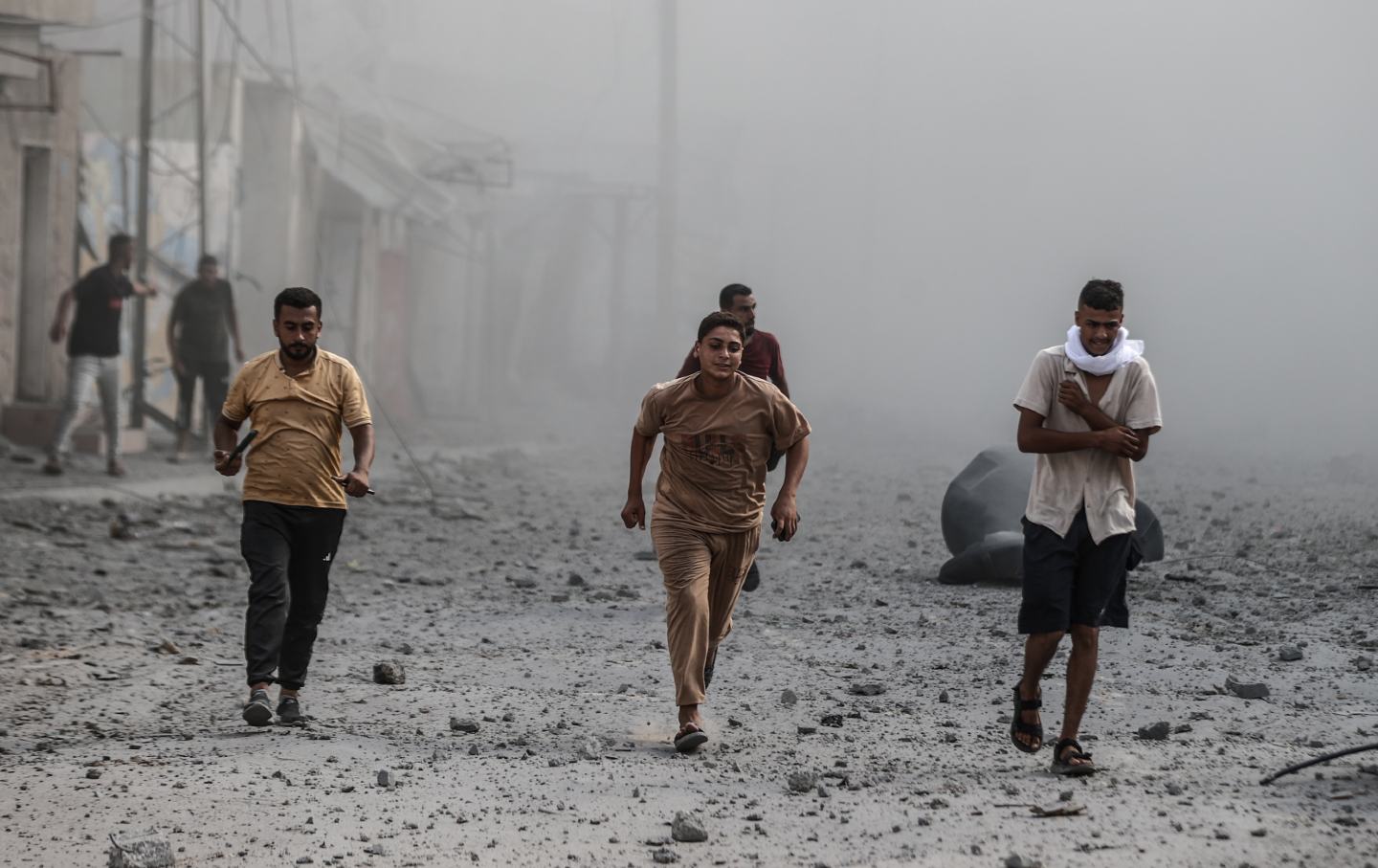
Palestinians try to get away from the area as smoke and dust rise following the Israeli army attack a building in the Nuseirat Refugee Camp in Deir al-Balah, Gaza, on July 21, 2024.
(Ali Jadallah / Anadolu via Getty Images)
My family and I are in the central Gaza Strip, attempting to survive the horrors of Israel’s savage onslaught with 35 others in a small shelter in an empty plot of land. Having been forced to flee for our lives from Gaza City to Rafah in mid-March, and from Rafah to central Gaza in May, we have experienced terrifying days under intense Israeli bombardment but nothing like what we witnessed in the Nuseirat refugee camp in June.
We have taken refuge in the so-called “safe” zone in central Gaza, an ever-shrinking area, where “safety” exists only in death, and where we have nothing left and nowhere to go but the sky. But the sky was full of US-made Apache helicopters on June 9 in Nuseirat.
At first, we didn’t fully understand what was happening, until local radio broadcasts began relaying the news of a massive Israeli military operation. We didn’t even try to hide because there was literally nowhere to seek shelter from the bombs; it is not an exaggeration to say that there is no safe place in Gaza.
So we waited, and we prayed.
Every 10 minutes, Israeli soldiers fired their machine guns at homes and on nearby streets, accompanied by nonstop artillery shelling, naval fire, and bombings from F-16 aircraft. It was a terrifying scene and one of the deadliest days since Israel’s genocidal campaign in Gaza began more than eight months ago. To add insult to injury, tanks advanced from Al-Rashid Street, bulldozing what remained of already annihilated streets that were once the heart of Central Gaza’s shopping district.
After four agonizing hours, the assault ended. Among those killed was my colleague, a young pharmacist, Dr. Mohammad Abu Ghaza. Mohammad had just gotten engaged before the war with plans to marry. The dead lay all over upturned roads; there was no place to treat the wounded. Hospitals tried in vain to send distress calls. The shelling destroyed the homes where friends and families lived and the markets where we purchased our daily supplies.
The Israeli military massacred more than 274 innocent Palestinians that day to get back four Israelis who could have been freed peacefully through negotiations. Instead of pointing this out, the US government and many in the media celebrated the operation as a monumental achievement. How farcical that Israel used the (now dismantled) US-made pier, meant for humanitarian purposes, in the attack. Was the media narrative as such because Palestinian lives matter less? Don’t the laws of war apply to us, too?
We wonder if we will be the next targets of American missiles or Israeli snipers, or if anyone will even care. Will our bloodied body parts simply be collateral for the rescue of Israelis whose stories and names and faces will be shown around the world?
Perhaps those are the easier questions. The more difficult ones to answer: Where will we go if we are forced to flee yet again? How will we ever go back to our normal lives after all normality, and everything that sustains life, have been deliberately destroyed?
More than three months have passed since we were forcibly removed from our beloved city, Gaza, under the direct threat of 14 Israeli soldiers and their weapons. They stormed the home that we were staying in since November after our own home had been hit by an Israeli shell, and forced us to walk down the deadly coastal road south to Rafah for 10 hours in the middle of the night, my disabled in-laws in tow. We left with nothing but backpacks and a wheelchair that was rendered useless by the torn-apart roads. Later, we learned that the soldiers burned down the building.
We have not yet fully recovered from the feeling of life after death; our wounds have not yet healed after being displaced again from Rafah to the central area of Gaza. We still carry the heartache of being separated from loved ones—some who have been lucky enough to flee abroad, many more who are no longer living.
We are now caught between the jaws of a vise, being bombed in and forcibly transferred from the north, while being pushed to the south, where war and destruction continue unabated.
And yet, we continue to insist on life. We love life and hold on to it because we deserve it. Therefore, despite everything we’ve been through, despite displacement and sickness and exhaustion and dispossession, we continued with our lives. I began educating my children under the most difficult circumstances; they studied under fire and fear, and they achieved their accomplishments and succeeded with excellence. This life is theirs, and they deserve to live it.
I do not know what awaits us. In the time that has passed since the bloodbath at Nuseirat, Israel has continued to commit massacre after massacre with total impunity—at schools where families were sheltering, in tented “safe zones” providing only an illusion of safety, and in soccer fields where children were playing.
Popular
“swipe left below to view more authors”Swipe →We are exhausted from having to justify our humanity, from making pleas for basic security, by searching for food and water, by living an unending nightmare. There is no life, no education, no work. There is just waiting. We wait for the world to act; we wait for a permanent ceasefire; we wait for an end to the siege; we wait for freedom and dignity from Israeli occupation; and we wait for the escape from death.